fan Hyundai Getz 2005 Owner's Manual
[x] Cancel search | Manufacturer: HYUNDAI, Model Year: 2005, Model line: Getz, Model: Hyundai Getz 2005Pages: 437, PDF Size: 11.19 MB
Page 33 of 437
1- 22 FEATURES OF YOUR HYUNDAI
!
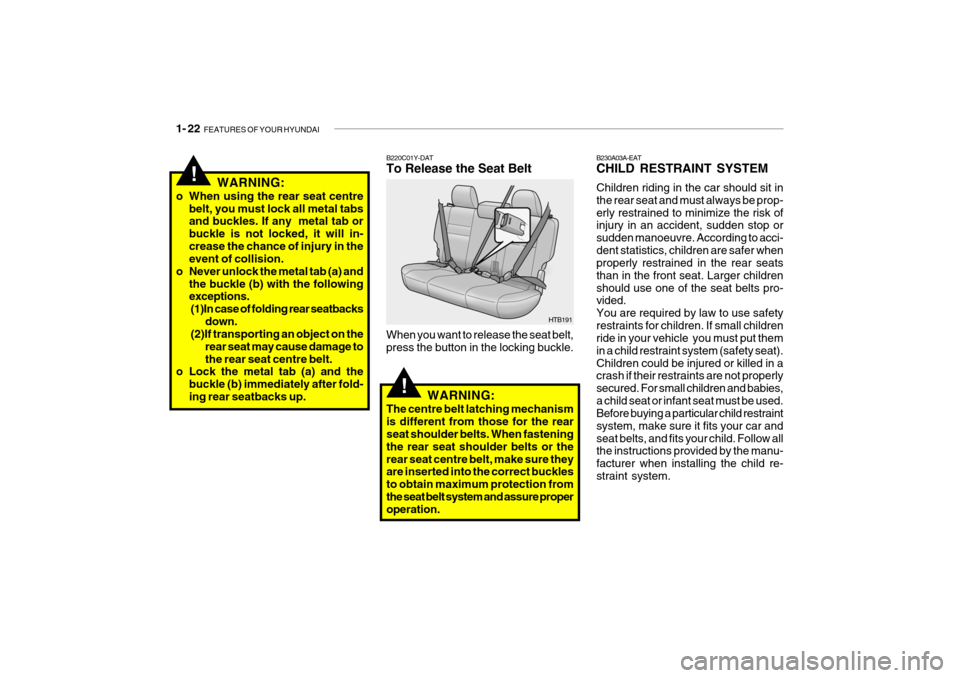
B220C01Y-DAT To Release the Seat Belt
When you want to release the seat belt, press the button in the locking buckle. HTB191
WARNING:
The centre belt latching mechanismis different from those for the rear seat shoulder belts. When fastening the rear seat shoulder belts or therear seat centre belt, make sure they are inserted into the correct buckles to obtain maximum protection fromthe seat belt system and assure proper operation. B230A03A-EAT CHILD RESTRAINT SYSTEM Children riding in the car should sit in the rear seat and must always be prop-erly restrained to minimize the risk of injury in an accident, sudden stop or sudden manoeuvre. According to acci-dent statistics, children are safer when properly restrained in the rear seats than in the front seat. Larger childrenshould use one of the seat belts pro- vided. You are required by law to use safetyrestraints for children. If small children ride in your vehicle you must put them in a child restraint system (safety seat).Children could be injured or killed in a crash if their restraints are not properly secured. For small children and babies,a child seat or infant seat must be used. Before buying a particular child restraint system, make sure it fits your car andseat belts, and fits your child. Follow all the instructions provided by the manu- facturer when installing the child re-straint system.
!WARNING:
o When using the rear seat centre belt, you must lock all metal tabs and buckles. If any metal tab or buckle is not locked, it will in-crease the chance of injury in the event of collision.
o Never unlock the metal tab (a) and
the buckle (b) with the followingexceptions.(1)In case of folding rear seatbacks down.
(2)If transporting an object on the
rear seat may cause damage to the rear seat centre belt.
o Lock the metal tab (a) and the
buckle (b) immediately after fold-ing rear seatbacks up.
Page 34 of 437

FEATURES OF YOUR HYUNDAI 1- 23
Never allow children to ride in the front passenger seat.
o Always make sure that the shoul-
der belt portion of the outboardlap/shoulder belt is positioned midway over the shoulder, never across the neck or behind theback. Moving the child closer to the centre of the vehicle may help provide a good shoulder belt fit.The lap belt portion of the lap/ shoulder belt or the centre seat lap belt must always be positioned aslow as possible on the child's hips and as snug as possible.
o If the seat belt will not properly fit the child, Hyundai recommendsthe use of an approved booster seat in the rear seat in order toraise the child's seating height so that the seat belt will properly fit the child.
o Never allow a child to stand up or kneel on the seat. o Never use an infant carrier or child
safety seat that "hooks" over a seatback; it may not provide ad- equate security in an accident.
o Never allow a child to be held in a person's arms while they are in amoving vehicle, as this could re-sult in serious injury to the child in the event of an accident or a sudden stop. Holding a child in amoving vehicle does not provide the child with any means of pro- tection during an accident, even ifthe person holding the child is wearing a seat belt.
o If the child restraint seat is not
anchored properly, the risk of achild being seriously injured or killed in a collision greatly in-creases.
WARNING:
o A child restraint system must be placed in the rear seat. Never in- stall a child or infant seat on the front passenger's seat.Should an accident occur and cause the passenger side airbag to deploy, it could severely injureor kill an infant or child seated in an infant or child seat. Thus, only use a child restraint in the rearseat of your vehicle.
o Since a safety belt or child re-
straint system can become veryhot if it is left in a closed vehicle, be sure to check the seat cover and buckles before placing a childthere.
o When the child restraint system is
not in use, store it in the trunk orfasten it with a safety belt so that it will not be thrown forward in the case of a sudden stop or an acci-dent.
o Children who are too large to be in
a child restraint should sit in therear seat and be restrained with the available lap/shoulder belts.!
Page 35 of 437

1- 24 FEATURES OF YOUR HYUNDAI
!WARNING:
Do not install any child restraint sys- tem in the front passenger seat. Should an accident occur and cause the passenger side airbag to deploy,it could severely injure or kill an infant or child seated in an infant or child seat. Therefore, only use a childrestraint system in the rear seat of your vehicle.
If you need to tighten the belt, pull morewebbing toward the retractor. When you unbuckle the seat belt and allow it toretract, the retractor will automatically revert back to its normal seated pas- senger emergency locking usage con-dition. NOTE:
o Before installing the child restraint
system, read the instructions sup- plied by the child restraint system manufacturer.
o If the seat belt does not operate as described, have the systemchecked immediately by yourHyundai authorised repairer.
B230B01TB
B230B02A-GAT Using a Child Restraint System with "Tether Anchorage" Sys-tem For small children and babies, the use of a child seat or infant seat is stronglyrecommended. This child seat or infant seat should be of appropriate size for the child and should be installed inaccordance with the manufacturer's in- structions. It is further recommended that the seat be placed in the vehicle'srear seat since this can make an impor- tant contribution to safety. Your vehicle is provided with three child restrainthook holders for installing the child seat or infant seat. Spacer (10mm), Child Restraint Hook Holder
Holder Bolt (5/16"-30 mm) Washer, Conical Spring Holder, Child Restraint Hook
Retainer Washer
To install a child restraint system in the outboard rear seats, extend the shoul- der/lap belt from its retractor. Install thechild restraint system, buckle the seat belt and allow the seat belt to take up any slack. Make sure that the lap por-tion of the belt is tight around the child restraint system and the shoulder por- tion of the belt is positioned so that itcannot interfere with the child's head or neck. After installation of the child re- straint system, try to move it in alldirections to be sure the child restraint system is securely installed.B230G01A-GAT Installation on Outboard Rear Seats
B230G01L
Page 46 of 437
FEATURES OF YOUR HYUNDAI 1- 35
!
B240C01HP WARNING:
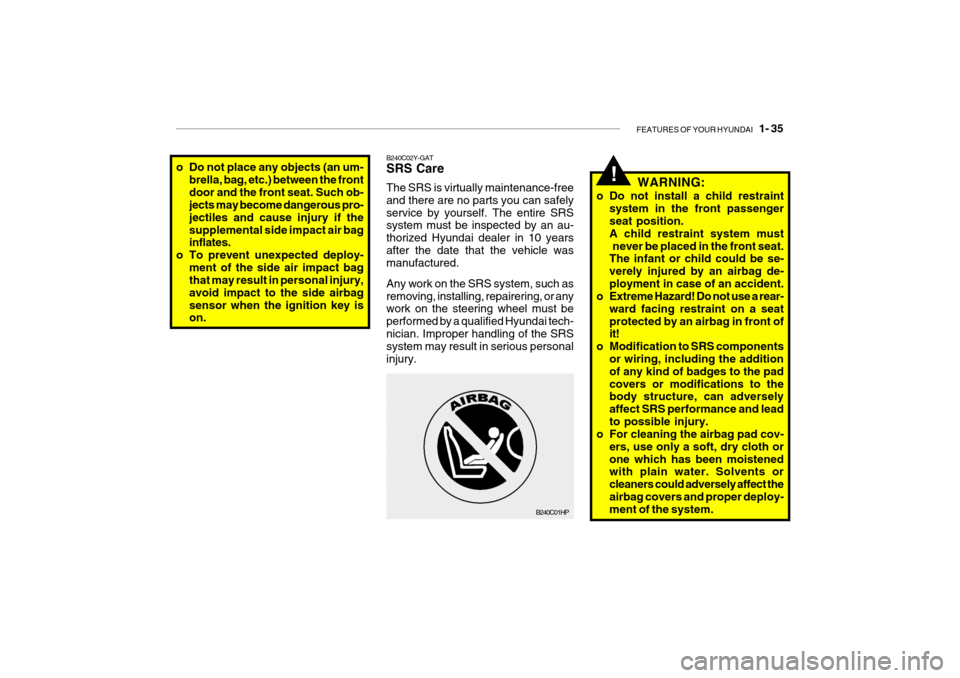
o Do not install a child restraint system in the front passenger seat position. A child restraint system must
never be placed in the front seat. The infant or child could be se- verely injured by an airbag de-ployment in case of an accident.
o Extreme Hazard! Do not use a rear-
ward facing restraint on a seatprotected by an airbag in front of it!
o Modification to SRS components or wiring, including the addition of any kind of badges to the padcovers or modifications to the body structure, can adversely affect SRS performance and leadto possible injury.
o For cleaning the airbag pad cov-
ers, use only a soft, dry cloth orone which has been moistened with plain water. Solvents or cleaners could adversely affect theairbag covers and proper deploy- ment of the system.
B240C02Y-GAT SRS Care The SRS is virtually maintenance-free and there are no parts you can safelyservice by yourself. The entire SRS system must be inspected by an au- thorized Hyundai dealer in 10 yearsafter the date that the vehicle was manufactured. Any work on the SRS system, such as removing, installing, repairering, or any work on the steering wheel must be performed by a qualified Hyundai tech-nician. Improper handling of the SRS system may result in serious personal injury.
o Do not place any objects (an um-
brella, bag, etc.) between the frontdoor and the front seat. Such ob- jects may become dangerous pro- jectiles and cause injury if thesupplemental side impact air bag inflates.
o To prevent unexpected deploy- ment of the side air impact bagthat may result in personal injury, avoid impact to the side airbagsensor when the ignition key is on.
Page 82 of 437
FEATURES OF YOUR HYUNDAI 1- 71
B710A01TB-EAT
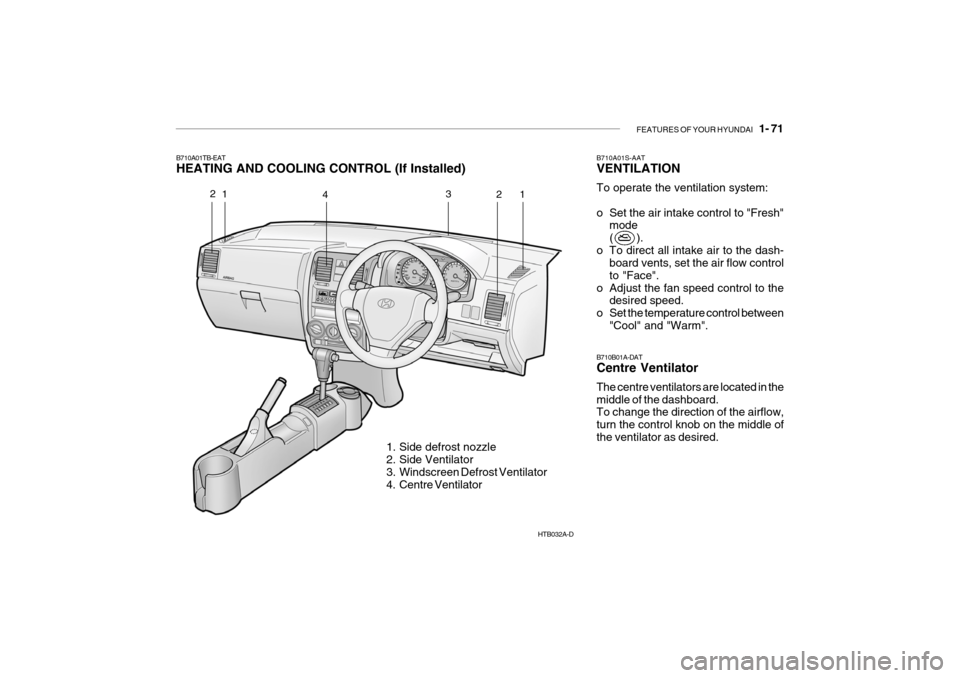
HEATING AND COOLING CONTROL (If Installed)
1. Side defrost nozzle
2. Side Ventilator
3. Windscreen Defrost Ventilator
4. Centre VentilatorB710A01S-AAT VENTILATION To operate the ventilation system:
o Set the air intake control to "Fresh"
mode
( ).
o To direct all intake air to the dash- board vents, set the air flow controlto "Face".
o Adjust the fan speed control to the desired speed.
o Set the temperature control between "Cool" and "Warm".
HTB032A-D
1
2
3
4 1
2
B710B01A-DAT Centre Ventilator The centre ventilators are located in the middle of the dashboard. To change the direction of the airflow, turn the control knob on the middle ofthe ventilator as desired.
Page 83 of 437
1- 72 FEATURES OF YOUR HYUNDAI
HTB033A-D
1
23
4 HTB034
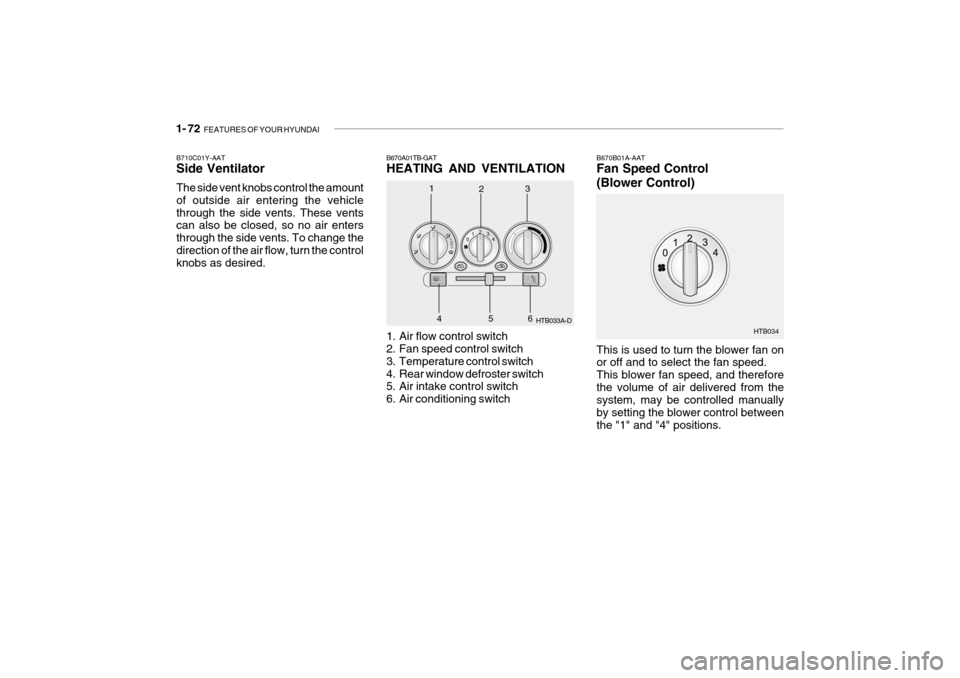
B670A01TB-GAT HEATING AND VENTILATION
1. Air flow control switch
2. Fan speed control switch
3. Temperature control switch
4. Rear window defroster switch
5. Air intake control switch
6. Air conditioning switch B670B01A-AAT Fan Speed Control (Blower Control) This is used to turn the blower fan on or off and to select the fan speed. This blower fan speed, and thereforethe volume of air delivered from the system, may be controlled manually by setting the blower control betweenthe "1" and "4" positions.
B710C01Y-AAT Side Ventilator The side vent knobs control the amount of outside air entering the vehiclethrough the side vents. These vents can also be closed, so no air enters through the side vents. To change thedirection of the air flow, turn the control knobs as desired.
56
Page 87 of 437
1- 76 FEATURES OF YOUR HYUNDAI
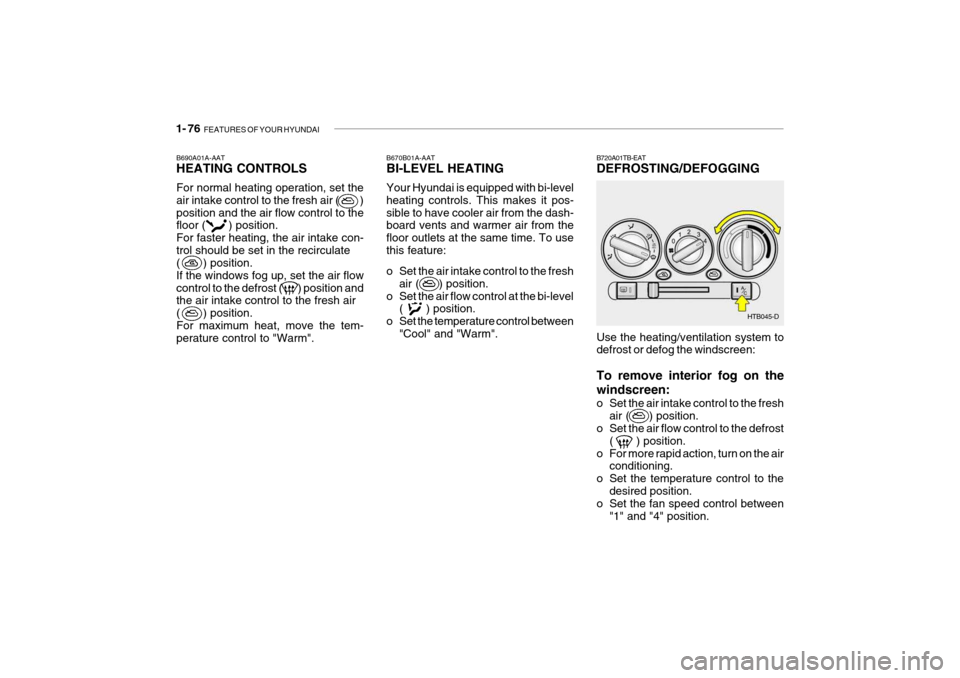
B670B01A-AAT BI-LEVEL HEATING Your Hyundai is equipped with bi-level heating controls. This makes it pos-sible to have cooler air from the dash- board vents and warmer air from the floor outlets at the same time. To usethis feature:
o Set the air intake control to the fresh
air ( ) position.
o Set the air flow control at the bi-level ( ) position.
o Set the temperature control between "Cool" and "Warm".
B690A01A-AAT HEATING CONTROLS For normal heating operation, set the air intake control to the fresh air ( )position and the air flow control to the floor ( ) position. For faster heating, the air intake con-trol should be set in the recirculate ( ) position. If the windows fog up, set the air flowcontrol to the defrost ( ) position and the air intake control to the fresh air ( ) position.For maximum heat, move the tem- perature control to "Warm". B720A01TB-EAT DEFROSTING/DEFOGGING
HTB045-D
Use the heating/ventilation system to defrost or defog the windscreen: To remove interior fog on the windscreen:
o Set the air intake control to the fresh air ( ) position.
o Set the air flow control to the defrost
( ) position.
o For more rapid action, turn on the air conditioning.
o Set the temperature control to the
desired position.
o Set the fan speed control between
"1" and "4" position.
Page 88 of 437
FEATURES OF YOUR HYUNDAI 1- 77
B740A01A-AAT AIR CONDITIONING SWITCH (Not all models)
B730A01FC-EAT Operation Tips
o To keep dust or unpleasant fumes
from entering the car through the ventilation system, temporarily set the air intake control at "Recircula- tion". Be sure to return the control to"Fresh" when the irritation has passed to keep fresh air in the ve- hicle. This will help keep the driveralert and comfortable.
o Air for the heating/cooling system is
drawn in through the grilles justahead of the windscreen. Care should be taken that these are not blocked by leaves, snow, ice or other ob-structions.
o To prevent interior fog on the
windscreen, set the air intake controlto the fresh air ( ) position and fan speed to the desired position.
To remove the frost or exterior fog on the windscreen:
o Set the air intake control to the fresh
( ) position.
o Set the air flow control to the defrost ( ) position
o Set the temperature control to warm.
o Set the fan speed control to position
"3" or "4".
NOTE: When the A/C is operated continu- ously on the floor-defrost level ( ) or defrost level ( ), it may cause fog to form on the exteriorwindscreen. If this occurs, set the air flow control to the face level posi- tion ( ) and fan speed control tothe low position. The air conditioning is turned on by pushing the A/C button on the heating/ air conditioning control panel.
HTB037-D
Page 89 of 437
1- 78 FEATURES OF YOUR HYUNDAI
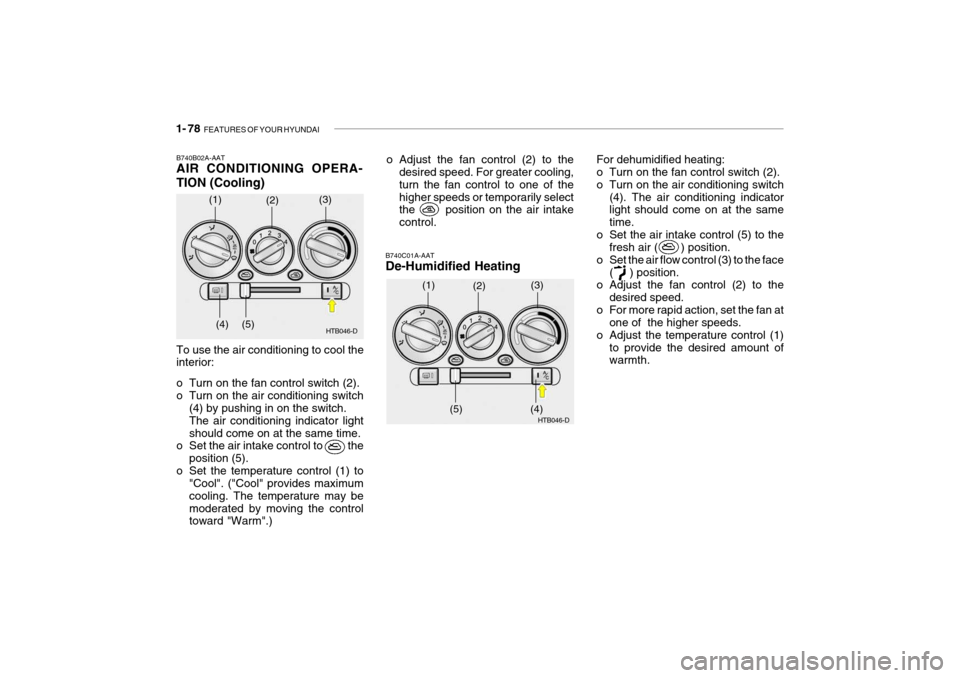
B740B02A-AAT AIR CONDITIONING OPERA- TION (Cooling)
B740C01A-AAT De-Humidified Heating
To use the air conditioning to cool the interior:
o Turn on the fan control switch (2).
o Turn on the air conditioning switch(4) by pushing in on the switch.The air conditioning indicator lightshould come on at the same time.
o Set the air intake control to the
position (5).
o Set the temperature control (1) to "Cool". ("Cool" provides maximumcooling. The temperature may bemoderated by moving the control toward "Warm".) HTB046-D
o Adjust the fan control (2) to the
desired speed. For greater cooling, turn the fan control to one of thehigher speeds or temporarily select
the position on the air intake control. For dehumidified heating:
o Turn on the fan control switch (2).
o Turn on the air conditioning switch
(4). The air conditioning indicator light should come on at the same time.
o Set the air intake control (5) to the fresh air ( ) position.
o Set the air flow control (3) to the face ( ) position.
o Adjust the fan control (2) to the
desired speed.
o For more rapid action, set the fan at one of the higher speeds.
o Adjust the temperature control (1)
to provide the desired amount of warmth.
(1)
(2)
(3)
(4) (5)
HTB046-D
(1)
(2)
(3)
(4)
(5)
Page 120 of 437
3- 4 WHAT TO DO IN AN EMERGENCY
!
!
D030A01TB-EAT IF THE ENGINE OVERHEATS If the temperature gauge indicates overheating:
1. Pull off the road and stop as soon as
it is safe to do so.
2. Place the gear selector lever in "P" (automatic), or neutral (manual transaxle) and set the parking brake.If the air conditioning is on, turn it off.
3. If coolant is running out under the car
or steam is coming out from underthe bonnet stop the engine. Do not open the bonnet until the coolant has stopped running or the steaming hasstopped. If there is no visible loss of coolant and no steam, leave the engine running and check to be surethe engine cooling fan is operating. If the fan is not running, turn the engine off.
4. Check to see if the water pump drive belt is missing. If it is not missing,check to see that it is tight. If thedrive belt seems to be satisfactory, check for coolant leaking from the radiator, hoses or under the car. (Ifthe air conditioning had been in use, it is normal for cold water to be draining from it). WARNING:
Whilst the engine is running, keep hands and clothing away from mov- ing parts such as the fan and drivebelts to prevent injury.
7. Switch ON the main beam
headlamps before carefully remov-ing the jumper cables in the reverseorder of attachment. Once the jumper cables have been removed, switch "OFF" the main beamheadlamps.
CAUTION:
If the jump cable is incorrectly in-stalled, damage to the vehicle elec- trical system may occur, in particu- lar the electronic components suchas the Fuel Injection system com- puter and the Automatic transaxle computer. The battery must neverbe disconnected whilst the engine is running.
!
WARNING (Diesel only):
Never work on injection system with engine running or within 30 sec- onds after shutting off engine. Highpressure pump, rail, injectors and high pressure pipes are subject to high pressure even after the enginestopped. The fuel jet produced by fuel leaks may cause serious in- jury, if it touch the body. Peopleusing pacemakers should not move than 30cm closer to the ECU or wiring harness within the engineroom while engine is running, since the high currents in the Common Rail system produce considerablemagnetic fields.