spare wheel Hyundai Getz 2005 Owner's Manual
[x] Cancel search | Manufacturer: HYUNDAI, Model Year: 2005, Model line: Getz, Model: Hyundai Getz 2005Pages: 437, PDF Size: 11.19 MB
Page 122 of 437

3- 6 WHAT TO DO IN AN EMERGENCY
SD060A1-E IN THE EVENT OF A PUNCTURE If a puncture occurs whilst driving the vehicle:
1. Bring the car to rest as soon as it is
safe to do so and with the minimum amount of braking required which will assist in maintaining the maxi- mum amount of control. The vehicleshould be parked wherever pos- sible upon firm level ground to facili- tate wheel changing.
2. If the vehicle is creating a hazard and the road conditions do not per-mit the wheel to be changed safely,assistance should be sought.
3. Passengers must not be allowed to
remain inside the vehicle duringwheel changing. If a puncture oc- curs whilst the vehicle is on a motorway, the passengers shouldtake refuge on the motorway em- bankment to avoid the possibility of injury occurring should the vehiclebe struck by other motorway traffic.
4. Wheel changing should be per-
formed according to the followinginstructions.
SD050A2-E SPARE WHEEL (Not all models) The spare wheel is stored under the luggage compartment floor and is ac-cessed from within the luggage com- partment by lifting the carpet and the floor panel.To remove the spare wheel, unscrew the retainer, rotating this in an anti clockwise direction and lift out thewheel. To replace the wheel, screw the retainer by hand until tight having located the wheel in the luggage com-partment floor well. The inflation pres- sure of the spare wheel should be checked at least monthly and when-ever the wheel is fitted to the vehicle.
Inflation Pressure
Tyre Size
Spare Tyre Pressure
Full Size 210 kPa (30 psi)
CAUTION:
o Do not use snow chains with your temporary spare tyre.
o Do not use more than one tempo- rary spare tyre at a time.
!
5. The temporary spare tyre should
not be used on any other wheels, nor should standard tyre, snow tyre,wheel covers or trim rings be used with the temporary spare wheel. If such use is attempted, damage tothese items or other car compo- nents may occur.
6. The temporary spare tyre pressure should be checked once a monthwhile the tyre is stored.
Page 124 of 437

3- 8 WHAT TO DO IN AN EMERGENCY
HTB149
SD070E1-E 3. Loosen Wheel Nuts The wheel nuts should be loosened slightly before raising the car. To loosen the nuts, turn the wheel brace counter- clockwise. Ensure that the wheel bracesocket is seated properly on the nut and that it cannot slip. Do not remove the nuts at this stage.Flat tyre
HTB156
SD070D1-E 2. Block the Wheel Block the wheel that is diagonally op- posite from the flat tyre to prevent the vehicle from rolling when the car israised on the jack.
Take out the jack case and tool bag, then remove the spare tyre from the luggage room. NOTE: The jack case is located on the spare tyre in the vehicle.
Hang the luggage room mat to the mat hanger and remove the luggage under tray (If installed)
D060B01TB-EAT 1. Obtain Spare Tyre and Tool
HTB224
HTB296
Mat hanger
Page 125 of 437

WHAT TO DO IN AN EMERGENCY 3- 9
!
SD070H1-E 6. Changing Wheels
HTB157
SD070F1-F 4. Put the Jack in Place The base of the jack should be placed on firm, level ground. The jack should be positioned as shown in the drawing.
SD070G1-E 5. Raising the Car After inserting a wrench bar into the wheel nut wrench, install the wrench bar into the jack as shown in the draw- ing. To raise the vehicle, turn the wheelnut wrench clockwise. As the jack be- gins to raise the vehicle, double check that it is properly positioned and willnot slip. If the jack is on soft ground or sand, it may be necessary to place a stout piece of timber under the base ofthe jack to prevent it from sinking. Raise the car high enough so that the fully inflated spare wheel can be in-stalled. HFC4022
Wrench bar
Wheel nut wrench
WARNING:
Do not get under the car when it is supported by the jack! The jack is solely designed for wheel chang-ing and is not intended to support the vehicle for other purposes. The use of purpose designed supportsis necessary whilst the vehicle is raised and the operator is required to get underneath.
HTB228
Page 126 of 437

3- 10 WHAT TO DO IN AN EMERGENCY
!
HTB150
SD070J2-E 8. Lower Vehicle and Tighten
Nuts
Lower the car to the ground turning the wheel nut wrench counterclockwise. When the vehicle is firmly on the ground, remove the jack and tightenthe wheel nuts securely. At the first available opportunity, the wheel nut torque should be checked with a suit-able torque wrench. Wheel nut tightening torque Steel wheel & aluminium alloy wheel: 90-110 Nm, 100 kg.cm (65-80 lb.ft)
SD070I1-E 7. Re-install Wheel NutsFit the wheel nuts onto the studs and tighten with the wheel brace.
HTB227
Using the wheel brace, remove the nuts and slide the wheel off the hub and wheel studs. Lie the wheel flat toprevent it from rolling. Ensure that the faces of the wheel and hub are clean. Position the spare wheel over the studsand slide it up to the hub.
HTB229
WARNING:
It is important that the faces of the wheel and hub are clean prior toinstalling the wheel. The prescence of dirt or other matter in the wheel or hub faces could result in thewheel nuts becoming loose whilst the vehicle is being driven.
Page 127 of 437

WHAT TO DO IN AN EMERGENCY 3- 11
HTB151
SD070K1-E AFTER CHANGING WHEELS The pressure of the spare tyre should be checked at the first available oppor- tunity. If any doubt exists as to the tyre pressure, the vehicle should be drivenslowly to the nearest service station and the tyre pressure checked and adjusted as required.If the valve cap is lost from any of the valves, a replacement should be ob- tained and fitted at the first availableopportunity. The valve cap prevents the ingress of dirt which may cause the valve to stick and therefore leak and ispart of the valve sealing function. Ensure that the spare wheel, jack and wheel nut wrench as well tools are correctly located in the boot of thevehicle to prevent damage and noise.
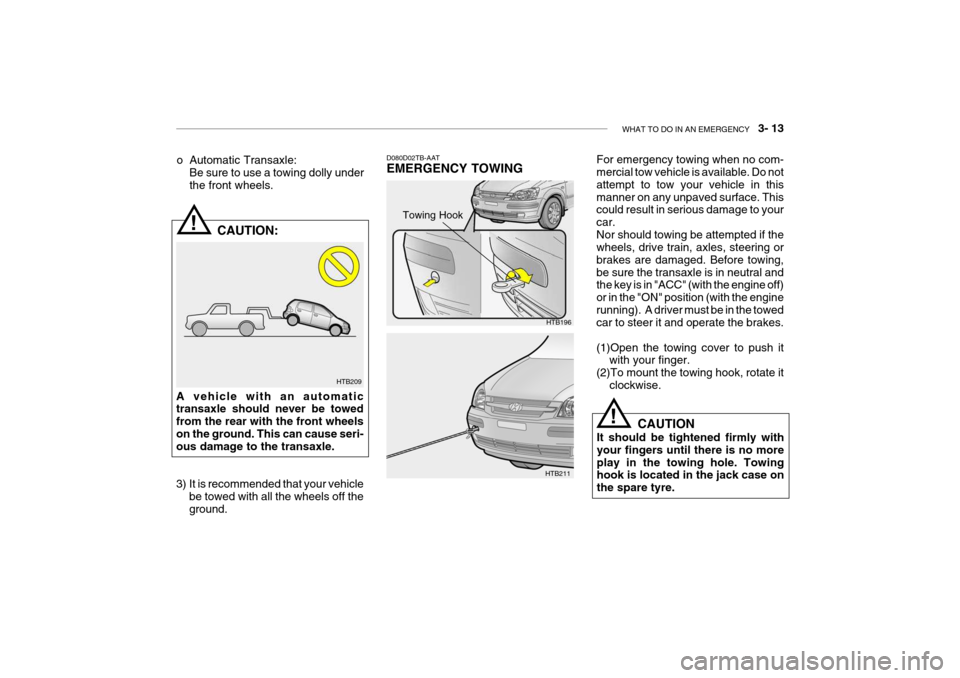
D080A01O-GAT IF YOUR VEHICLE MUST BE TOWED If your vehicle has to be towed, it should be done by your Hyundai dealer or a commercial tow truck service. This will help assure that your vehicleis not damaged in towing. Also, profes- sionals are generally aware of local laws governing towing. In any case,rather than risk damage to your car, it is suggested that you show this infor- mation to the tow truck operator. Besure that a safety chain system is used and that all local laws are observed. It is recommended that your vehiclebe towed with a wheel lift and dollies or flatbed equipment with all the wheels off the ground.
!
CAUTION:
o Your vehicle can be damaged if towed incorrectly!
o Be sure the transaxle is in neu-
tral.
o When the engine will not start, be sure the steering is unlocked by placing the key in the "ACC" po-sition.
Page 129 of 437
WHAT TO DO IN AN EMERGENCY 3- 13
HTB209
!
o Automatic Transaxle:
Be sure to use a towing dolly under the front wheels.
CAUTION:
A vehicle with an automatic transaxle should never be towed from the rear with the front wheelson the ground. This can cause seri- ous damage to the transaxle.
3) It is recommended that your vehicle be towed with all the wheels off the ground.
D080D02TB-AAT EMERGENCY TOWING For emergency towing when no com- mercial tow vehicle is available. Do not attempt to tow your vehicle in thismanner on any unpaved surface. This could result in serious damage to your car.Nor should towing be attempted if the wheels, drive train, axles, steering or brakes are damaged. Before towing,be sure the transaxle is in neutral and the key is in "ACC" (with the engine off) or in the "ON" position (with the enginerunning). A driver must be in the towed car to steer it and operate the brakes. (1)Open the towing cover to push it
with your finger.
(2)To mount the towing hook, rotate it clockwise.
HTB196
HTB211 CAUTION
It should be tightened firmly with your fingers until there is no moreplay in the towing hole. Towing hook is located in the jack case on the spare tyre.
!
Towing Hook
Page 140 of 437

VEHICLE MAINTENANCE REQUIREMENTS 5- 5
F030C02TB-EAT R : Replace I : Inspect and, after inspection, clean, adjust, repairer or replace if necessary
GENERAL MAINTENANCE COOLING SYSTEMCOOLANTCOOLANT SPECIFIC GRAVITYMANUAL TRANSAXLE OILAUTOMATIC TRANSAXLE FLUIDBRAKE PIPES, HOSES, AND CONNECTIONSBRAKE FLUIDCLUTCH FLUIDREAR BRAKE LININGS AND CYLINDERSBRAKE PADSSUSPENSION AND STEERING SYSTEMFRONT SUSPENSION BALL JOINTSPOLLEN FILTER (FOR EVAPORATOR AND BLOWER UNIT)REAR WHEEL BEARINGSTYRE CONDITION AND PRESSURE (incl. Spare)LUBRICATE LOCKS AND HINGESCHECK ALL ELECTRICAL SYSTEMSROAD TESTCHECK ALL SYSTEMS WITH HI-SCAN
60 72
5060
4048
I I I
R
I
RR II I I
R III I II
I I I IIIII I II
R II I III
I I I II
RR I I II
R II I III
30 36
2024
I I I IIIII I II
R II I III
I I I II
RR I I II
R II I III
10 12
I I I IIIII I II
R II I III
MILES X 1000MONTHS
NO. DESCRIPTION
1 23456789
10111213141516171819
See NOTE (1)
Note :(1) FOR THE FIRST TIME, REPLACE THE COOLANT 60,000 MILES OR 60 MONTHS. AFTER THAT, REPLACE IT EVERY 30,000 MILES OR 24 MONTHS.
Page 185 of 437

8. CONSUMER INFORMATION
Vehicle Identification Number (VIN) ............................................... 8-2
Engine number ................................................................................. 8-2
Tyre pressures ................................................................................. 8-3
Snow tyres ....................................................................................... 8-4
Tyre chains ...................................................................................... 8-4
Tyre rotation ..................................................................................... 8-4
Tyre balancing .................................................................................. 8-5
Tyre Replacement ............................................................................ 8-5
Wheel Replacement ......................................................................... 8-5
Spare tyre and tools ......................................................................... 8-6
8
Page 188 of 437
8- 4 CONSUMER INFORMATION
!
I050A01TB-EAT TYRE CHAINS Tyre chains, if necessary, should be installed on the front wheels. Be surethat the chains are the proper size and that they are installed in accordance with the manufacturer's instructions.To minimize tyre and chain wear, do not continue to use tyre chains when they are no longer needed.
SI030A2-E SNOW TYRES If it is desired to fit snow tyres to the vehicle, it must be ascertained that theoriginal size and load carrying capacity are met by the replacement tyres. When using snow tyres, the vehicle shouldnot be driven at speeds in excess of 60 MPH.
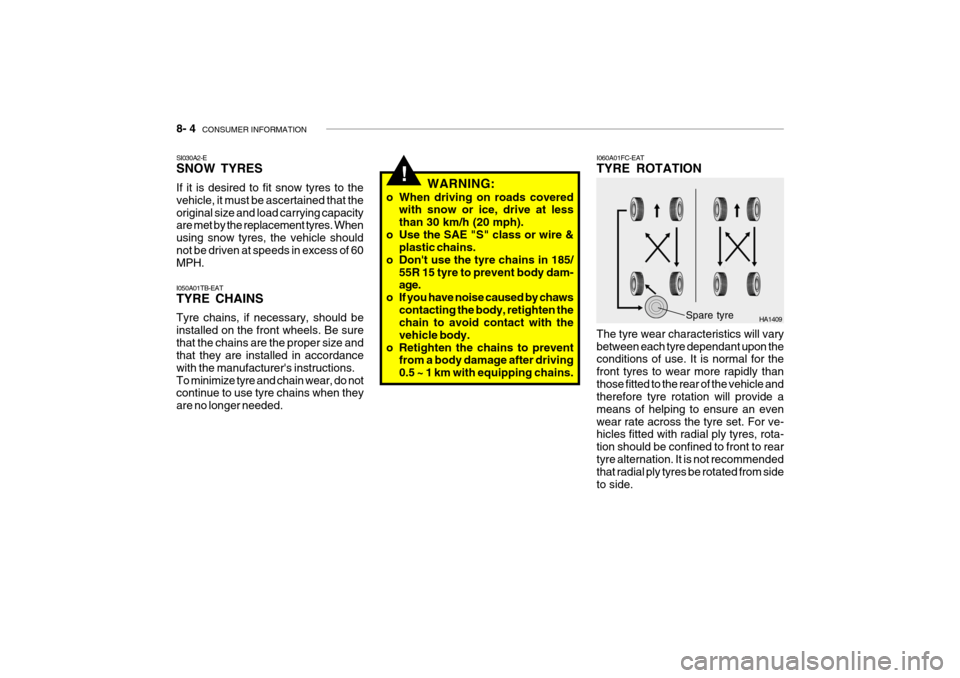
I060A01FC-EAT TYRE ROTATION The tyre wear characteristics will vary between each tyre dependant upon the conditions of use. It is normal for the front tyres to wear more rapidly thanthose fitted to the rear of the vehicle and therefore tyre rotation will provide a means of helping to ensure an evenwear rate across the tyre set. For ve- hicles fitted with radial ply tyres, rota- tion should be confined to front to reartyre alternation. It is not recommended that radial ply tyres be rotated from side to side.
WARNING:
o When driving on roads covered with snow or ice, drive at lessthan 30 km/h (20 mph).
o Use the SAE "S" class or wire & plastic chains.
o Don't use the tyre chains in 185/ 55R 15 tyre to prevent body dam- age.
o If you have noise caused by chaws contacting the body, retighten thechain to avoid contact with the vehicle body.
o Retighten the chains to prevent from a body damage after driving0.5 ~ 1 km with equipping chains.
HA1409Spare tyre
Page 189 of 437
CONSUMER INFORMATION 8- 5
!
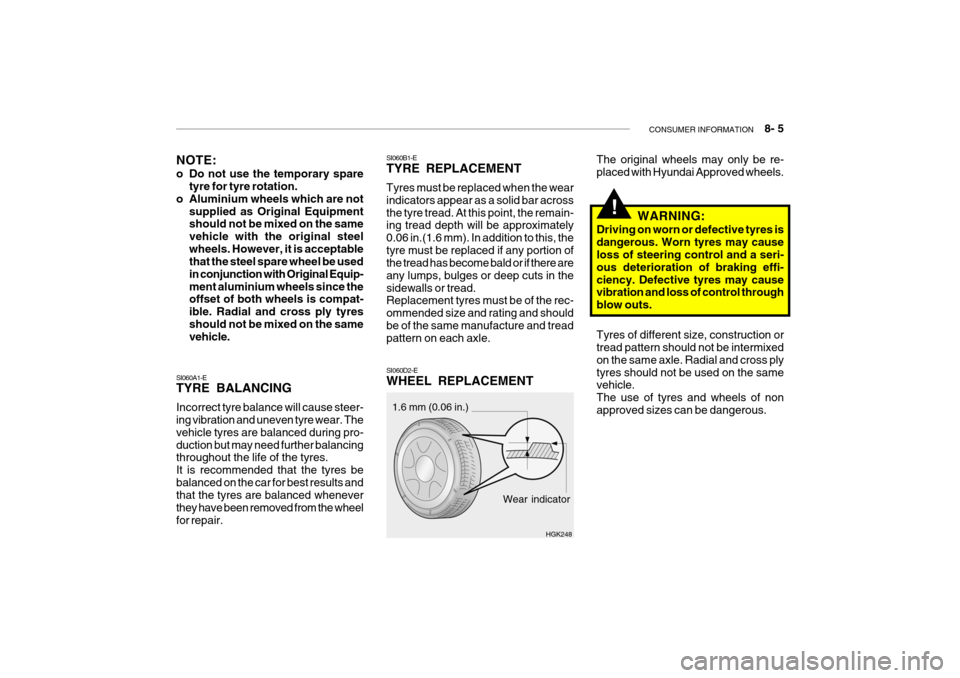
SI060B1-E TYRE REPLACEMENT Tyres must be replaced when the wear indicators appear as a solid bar acrossthe tyre tread. At this point, the remain- ing tread depth will be approximately 0.06 in.(1.6 mm). In addition to this, thetyre must be replaced if any portion of the tread has become bald or if there are any lumps, bulges or deep cuts in thesidewalls or tread. Replacement tyres must be of the rec- ommended size and rating and shouldbe of the same manufacture and tread pattern on each axle. SI060D2-E WHEEL REPLACEMENT
Wear indicator
1.6 mm (0.06 in.)
HGK248
NOTE:
o Do not use the temporary spare
tyre for tyre rotation.
o Aluminium wheels which are not
supplied as Original Equipment should not be mixed on the same vehicle with the original steelwheels. However, it is acceptable that the steel spare wheel be used in conjunction with Original Equip-ment aluminium wheels since the offset of both wheels is compat- ible. Radial and cross ply tyresshould not be mixed on the same vehicle.
SI060A1-E TYRE BALANCING Incorrect tyre balance will cause steer- ing vibration and uneven tyre wear. The vehicle tyres are balanced during pro-duction but may need further balancing throughout the life of the tyres. It is recommended that the tyres bebalanced on the car for best results and that the tyres are balanced whenever they have been removed from the wheelfor repair. The original wheels may only be re- placed with Hyundai Approved wheels.
WARNING:
Driving on worn or defective tyres is dangerous. Worn tyres may cause loss of steering control and a seri- ous deterioration of braking effi-ciency. Defective tyres may cause vibration and loss of control through blow outs. Tyres of different size, construction or tread pattern should not be intermixed on the same axle. Radial and cross plytyres should not be used on the same vehicle. The use of tyres and wheels of nonapproved sizes can be dangerous.