clutch Hyundai Getz 2008 Owner's Guide
[x] Cancel search | Manufacturer: HYUNDAI, Model Year: 2008, Model line: Getz, Model: Hyundai Getz 2008Pages: 383, PDF Size: 9.23 MB
Page 298 of 383
2- 20 DRIVING YOUR HYUNDAI
C190E02L
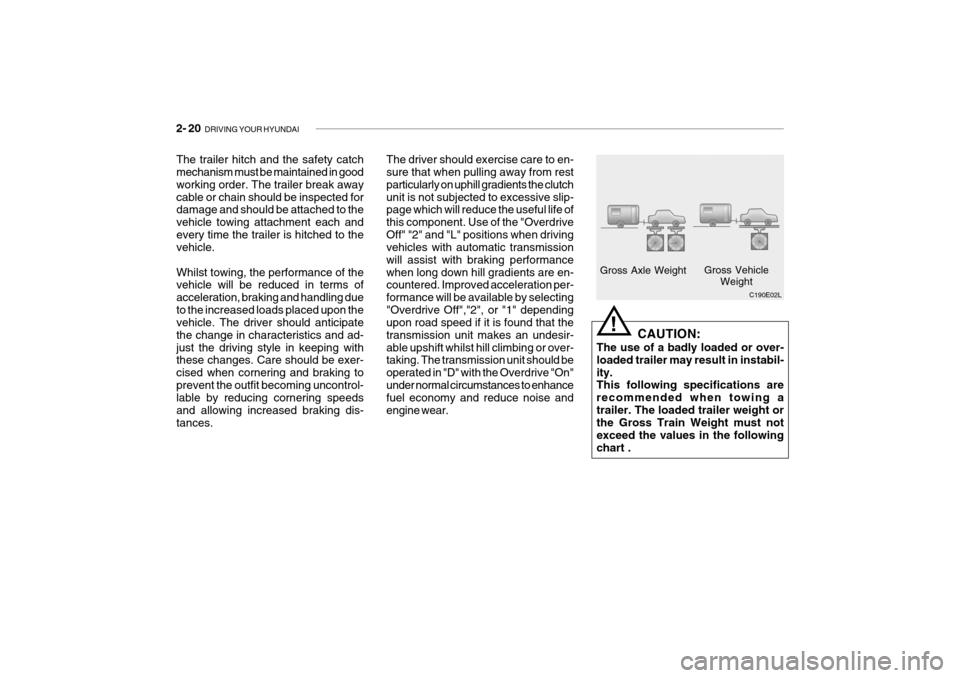
Gross Axle Weight
Gross Vehicle
Weight
The trailer hitch and the safety catch mechanism must be maintained in good working order. The trailer break awaycable or chain should be inspected for damage and should be attached to the vehicle towing attachment each andevery time the trailer is hitched to the vehicle. Whilst towing, the performance of the vehicle will be reduced in terms of acceleration, braking and handling dueto the increased loads placed upon the vehicle. The driver should anticipate the change in characteristics and ad-just the driving style in keeping with these changes. Care should be exer- cised when cornering and braking toprevent the outfit becoming uncontrol- lable by reducing cornering speeds and allowing increased braking dis-tances. The driver should exercise care to en- sure that when pulling away from rest particularly on uphill gradients the clutchunit is not subjected to excessive slip- page which will reduce the useful life of this component. Use of the "OverdriveOff" "2" and "L" positions when driving vehicles with automatic transmission will assist with braking performancewhen long down hill gradients are en- countered. Improved acceleration per- formance will be available by selecting"Overdrive Off","2", or "1" depending upon road speed if it is found that the transmission unit makes an undesir-able upshift whilst hill climbing or over- taking. The transmission unit should be operated in "D" with the Overdrive "On"under normal circumstances to enhance fuel economy and reduce noise and engine wear.
CAUTION:
The use of a badly loaded or over-loaded trailer may result in instabil-ity. This following specifications are recommended when towing atrailer. The loaded trailer weight or the Gross Train Weight must not exceed the values in the followingchart .
!
Page 302 of 383
3- 2 WHAT TO DO IN AN EMERGENCY
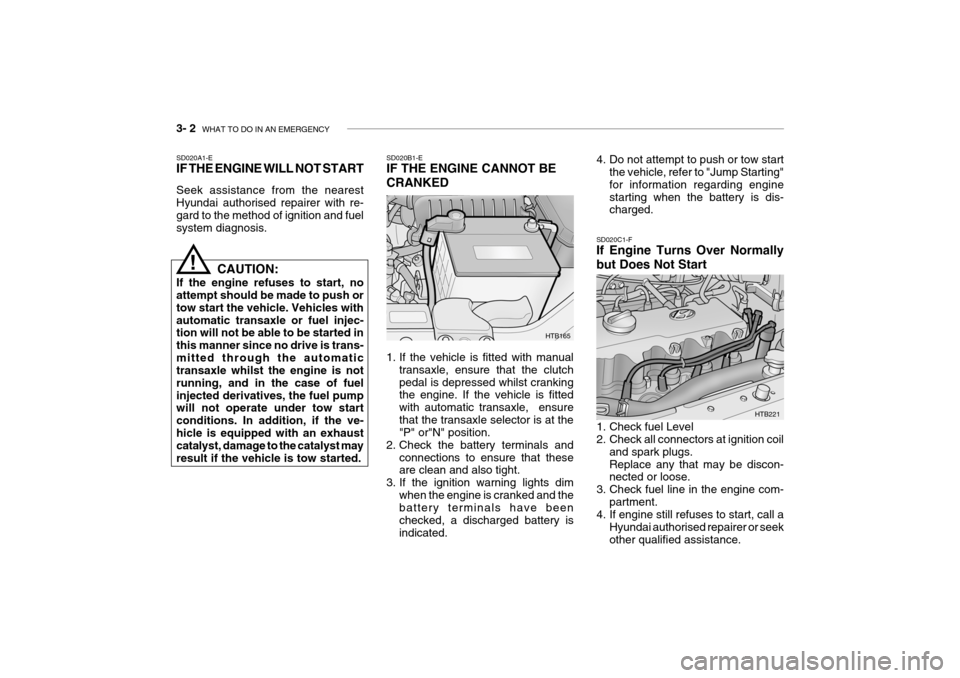
HTB165
SD020B1-E IF THE ENGINE CANNOT BE CRANKED
1. If the vehicle is fitted with manual
transaxle, ensure that the clutch pedal is depressed whilst cranking the engine. If the vehicle is fitted with automatic transaxle, ensurethat the transaxle selector is at the "P" or"N" position.
2. Check the battery terminals and
connections to ensure that theseare clean and also tight.
3. If the ignition warning lights dim
when the engine is cranked and thebattery terminals have been checked, a discharged battery isindicated. SD020C1-F If Engine Turns Over Normally but Does Not Start
SD020A1-E IF THE ENGINE WILL NOT START Seek assistance from the nearest Hyundai authorised repairer with re- gard to the method of ignition and fuelsystem diagnosis.
!
HTB221
CAUTION:
If the engine refuses to start, no attempt should be made to push or tow start the vehicle. Vehicles withautomatic transaxle or fuel injec- tion will not be able to be started in this manner since no drive is trans-mitted through the automatic transaxle whilst the engine is not running, and in the case of fuelinjected derivatives, the fuel pump will not operate under tow start conditions. In addition, if the ve-hicle is equipped with an exhaust catalyst, damage to the catalyst may result if the vehicle is tow started. 4. Do not attempt to push or tow start
the vehicle, refer to "Jump Starting"for information regarding enginestarting when the battery is dis- charged.
1. Check fuel Level
2. Check all connectors at ignition coil and spark plugs. Replace any that may be discon- nected or loose.
3. Check fuel line in the engine com- partment.
4. If engine still refuses to start, call a
Hyundai authorised repairer or seek other qualified assistance.
Page 303 of 383
WHAT TO DO IN AN EMERGENCY 3- 3
!
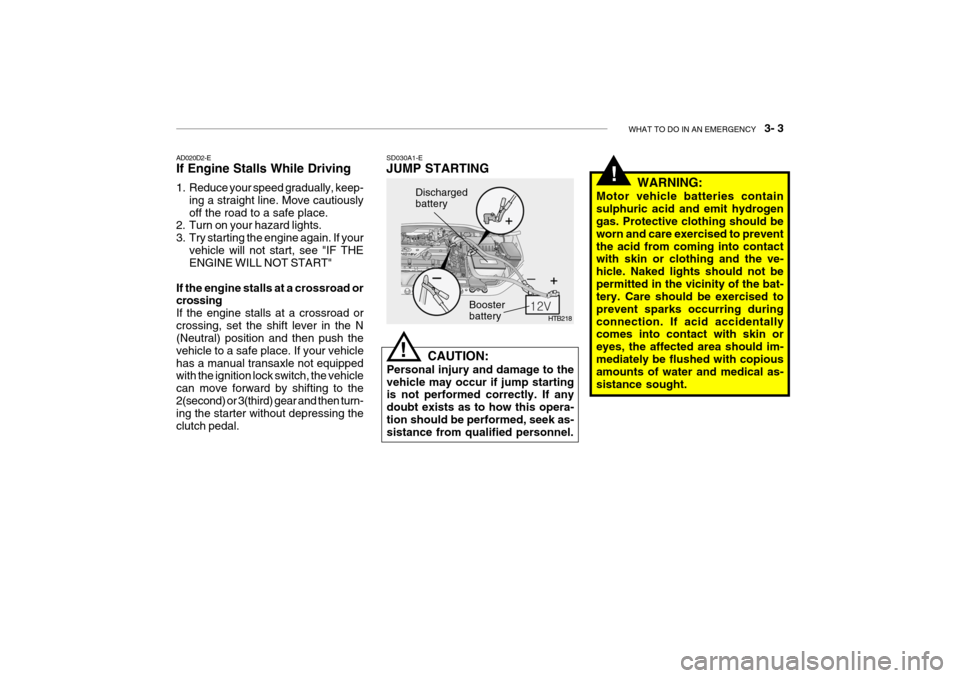
HTB218
Discharged battery
Booster battery
CAUTION:
Personal injury and damage to the vehicle may occur if jump starting is not performed correctly. If any doubt exists as to how this opera-tion should be performed, seek as- sistance from qualified personnel.
SD030A1-E JUMP STARTING
AD020D2-EIf Engine Stalls While Driving
1. Reduce your speed gradually, keep-
ing a straight line. Move cautiously off the road to a safe place.
2. Turn on your hazard lights.
3. Try starting the engine again. If your
vehicle will not start, see "IF THE ENGINE WILL NOT START"
If the engine stalls at a crossroad orcrossing If the engine stalls at a crossroad orcrossing, set the shift lever in the N (Neutral) position and then push the
vehicle to a safe place. If your vehiclehas a manual transaxle not equipped with the ignition lock switch, the vehicle can move forward by shifting to the2(second) or 3(third) gear and then turn- ing the starter without depressing the clutch pedal.! WARNING:
Motor vehicle batteries contain sulphuric acid and emit hydrogen gas. Protective clothing should be worn and care exercised to preventthe acid from coming into contact with skin or clothing and the ve- hicle. Naked lights should not bepermitted in the vicinity of the bat- tery. Care should be exercised to prevent sparks occurring duringconnection. If acid accidentally comes into contact with skin or eyes, the affected area should im-mediately be flushed with copious amounts of water and medical as- sistance sought.
Page 324 of 383
VEHICLE MAINTENANCE REQUIREMENTS 5- 5
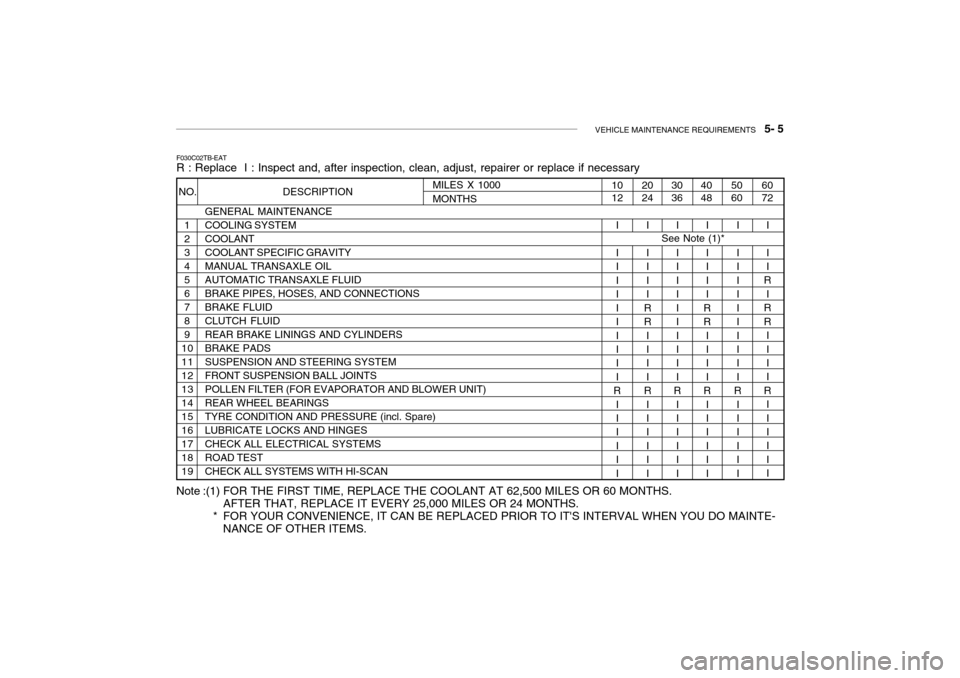
F030C02TB-EAT R : Replace I : Inspect and, after inspection, clean, adjust, repairer or replace if necessary
GENERAL MAINTENANCE COOLING SYSTEMCOOLANTCOOLANT SPECIFIC GRAVITYMANUAL TRANSAXLE OILAUTOMATIC TRANSAXLE FLUIDBRAKE PIPES, HOSES, AND CONNECTIONSBRAKE FLUIDCLUTCH FLUIDREAR BRAKE LININGS AND CYLINDERSBRAKE PADSSUSPENSION AND STEERING SYSTEMFRONT SUSPENSION BALL JOINTSPOLLEN FILTER (FOR EVAPORATOR AND BLOWER UNIT)REAR WHEEL BEARINGSTYRE CONDITION AND PRESSURE (incl. Spare)LUBRICATE LOCKS AND HINGESCHECK ALL ELECTRICAL SYSTEMSROAD TESTCHECK ALL SYSTEMS WITH HI-SCAN
60 72
5060
4048
I I I
R
I
RR II I I
R III I II
I I I IIIII I II
R II I III
I I I II
RR I I II
R II I III
30 36
2024
I I I IIIII I II
R II I III
I I I II
RR I I II
R II I III
10 12
I I I IIIII I II
R II I III
MILES X 1000MONTHS
NO. DESCRIPTION
1 23456789
10111213141516171819
See Note (1)*
Note :(1) FOR THE FIRST TIME, REPLACE THE COOLANT AT 62,500 MILES OR 60 MONTHS. AFTER THAT, REPLACE IT EVERY 25,000 MILES OR 24 MONTHS.
* FOR YOUR CONVENIENCE, IT CAN BE REPLACED PRIOR TO IT'S INTERVAL WHEN YOU DO MAINTE-
NANCE OF OTHER ITEMS.
Page 331 of 383
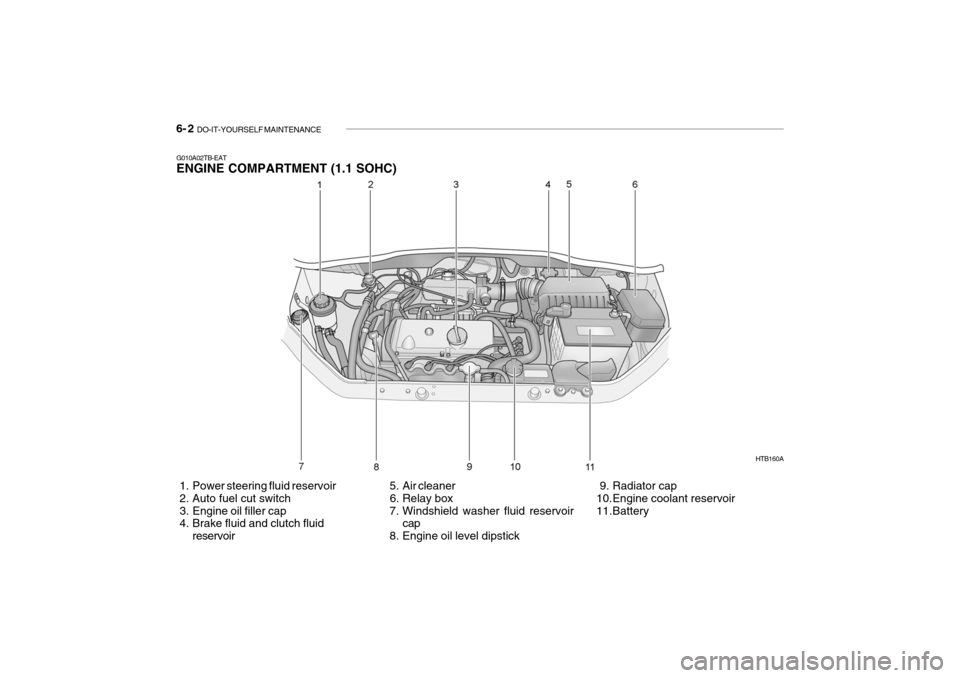
6- 2 DO-IT-YOURSELF MAINTENANCE
HTB160A
1. Power steering fluid reservoir
2. Auto fuel cut switch
3. Engine oil filler cap
4. Brake fluid and clutch fluid reservoir 5. Air cleaner
6. Relay box
7. Windshield washer fluid reservoir
cap
8. Engine oil level dipstick 9. Radiator cap
10.Engine coolant reservoir
11.Battery
G010A02TB-EAT ENGINE COMPARTMENT (1.1 SOHC)
Page 332 of 383
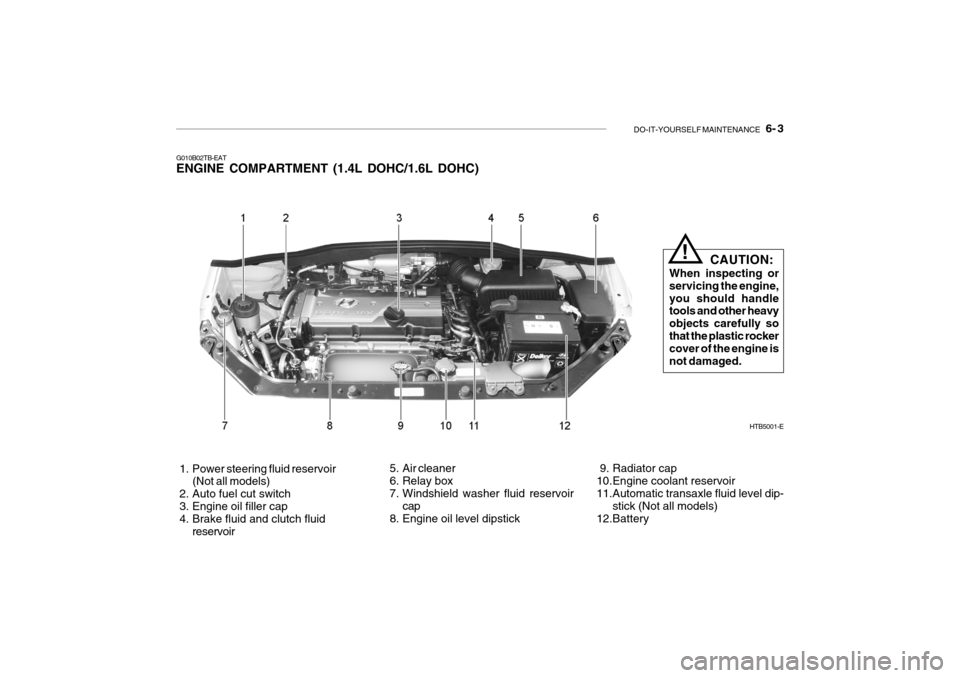
DO-IT-YOURSELF MAINTENANCE 6- 3
G010B02TB-EAT ENGINE COMPARTMENT (1.4L DOHC/1.6L DOHC)
HTB5001-E
1. Power steering fluid reservoir (Not all models)
2. Auto fuel cut switch
3. Engine oil filler cap
4. Brake fluid and clutch fluid reservoir 5. Air cleaner
6. Relay box
7. Windshield washer fluid reservoir
cap
8. Engine oil level dipstick 9. Radiator cap
10.Engine coolant reservoir
11.Automatic transaxle fluid level dip-
stick (Not all models)
12.Battery CAUTION:
When inspecting or servicing the engine,you should handle tools and other heavy objects carefully sothat the plastic rocker cover of the engine is not damaged.
!
Page 333 of 383
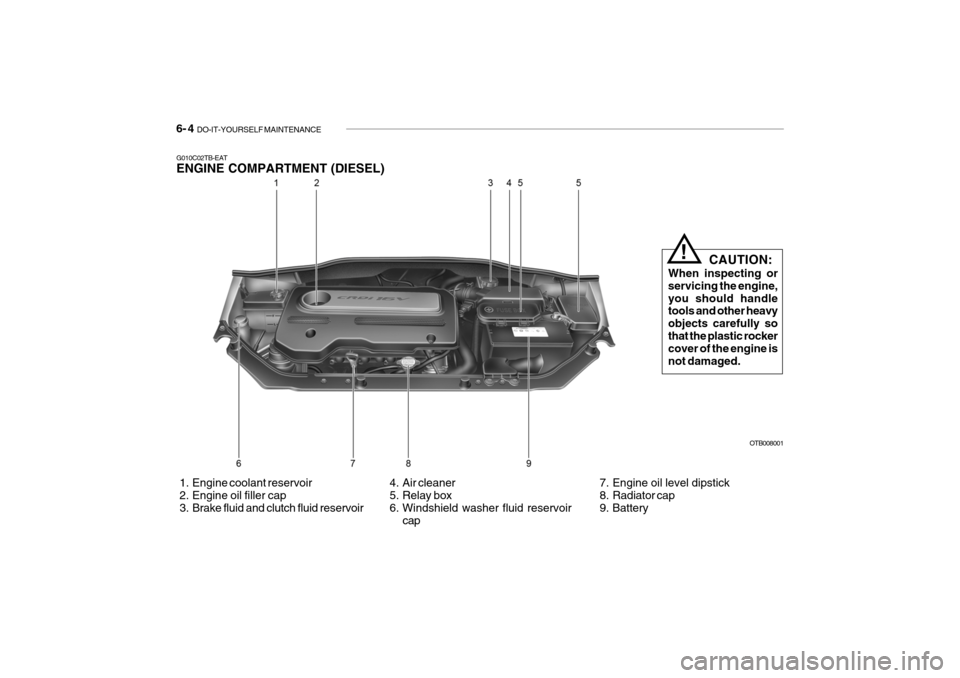
6- 4 DO-IT-YOURSELF MAINTENANCE
G010C02TB-EAT ENGINE COMPARTMENT (DIESEL)
OTB008001
1. Engine coolant reservoir
2. Engine oil filler cap
3. Brake fluid and clutch fluid reservoir 4. Air cleaner
5. Relay box
6. Windshield washer fluid reservoir
cap 7. Engine oil level dipstick
8. Radiator cap
9. BatteryCAUTION:
When inspecting or servicing the engine,you should handle tools and other heavy objects carefully sothat the plastic rocker cover of the engine is not damaged.
!