wheel Hyundai Getz 2008 Owner's Guide
[x] Cancel search | Manufacturer: HYUNDAI, Model Year: 2008, Model line: Getz, Model: Hyundai Getz 2008Pages: 383, PDF Size: 9.23 MB
Page 215 of 383
6- 20 DO-IT-YOURSELF MAINTENANCE
HTB293
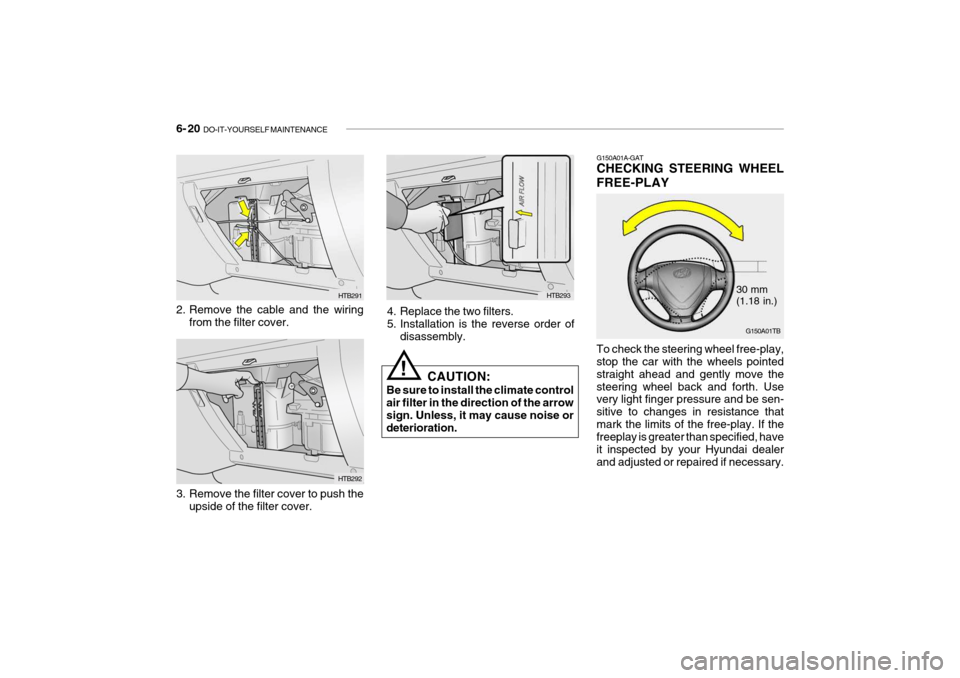
4. Replace the two filters.
5. Installation is the reverse order of disassembly.
CAUTION:
Be sure to install the climate control air filter in the direction of the arrow sign. Unless, it may cause noise ordeterioration. G150A01A-GAT CHECKING STEERING WHEEL FREE-PLAY To check the steering wheel free-play, stop the car with the wheels pointed straight ahead and gently move thesteering wheel back and forth. Use very light finger pressure and be sen- sitive to changes in resistance thatmark the limits of the free-play. If the freeplay is greater than specified, have it inspected by your Hyundai dealerand adjusted or repaired if necessary.
G150A01TB
30 mm (1.18 in.)
!
HTB291
2. Remove the cable and the wiring from the filter cover.
HTB292
3. Remove the filter cover to push the upside of the filter cover.
Page 242 of 383
8- 4 CONSUMER INFORMATION
I050A01TB-GAT TIRE CHAINS Tire chains, if necessary should be installed on the front wheels. Be sure that the chains are the proper size andthat they are installed in accordance with the manufacturer's instructions. To minimize tire and chain wear, donot continue to use tire chains when they are no longer needed.
I040A01S-GAT SNOW TIRES If you equip your car with snow tires, they should be the same size and havethe same load capacity as the original tires. Snow tires should be installed on all four wheels; otherwise, poor han-dling may result. Snow tires should carry 28 kPa (4 psi) more air pressure than the pressurerecommended for the standard tires on the tire label on, or up to the maxi- mum pressure shown on the tiresidewall whichever is less. Do not drive faster than 120 km/h (75 mph) when your car is equipped withsnow tires.
!WARNING:
o When driving on roads covered with snow or ice, drive at less than 30 km/h (20 mph).
o Use the SAE "S" class or wire &
plastic chains.
o Don't use the tire chains in 185/ 55R 15 tire to prevent body dam-age.
o If you have noise caused by chaws contacting the body, re-tighten the chain to avoid contactwith the vehicle body.
o Retighten the chains to prevent
from a body damage after driving0.5 ~ 1 km with equipping chains.
CAUTION:
Always observe the following:
o Check pressures when the tires are cold. That is, after the car has been parked for at least three hours and hasn't been drivenmore than 1.6 km or one mile since starting up.
o Check the pressure of your spare
tire each time you check the pres-sure of other tires.
!
Page 243 of 383
CONSUMER INFORMATION 8- 5
I070A01A-AAT TIRE BALANCING A tire that is out of balance may affect handling and tire wear. The tires onyour Hyundai were balanced before the car was delivered but may need balancing again during the years youown the car. Whenever a tire is dismounted for repair, it should be rebalanced beforebeing reinstalled on the car. I080A01A-AAT TIRE TRACTION Tire traction can be reduced if you drive on worn tires, tires that are im-properly inflated or on slippery road surfaces. Tires should be replaced when tread wear indicators appear. Toreduce the possibility of losing control, slow down whenever there is rain, snow or ice on the road.
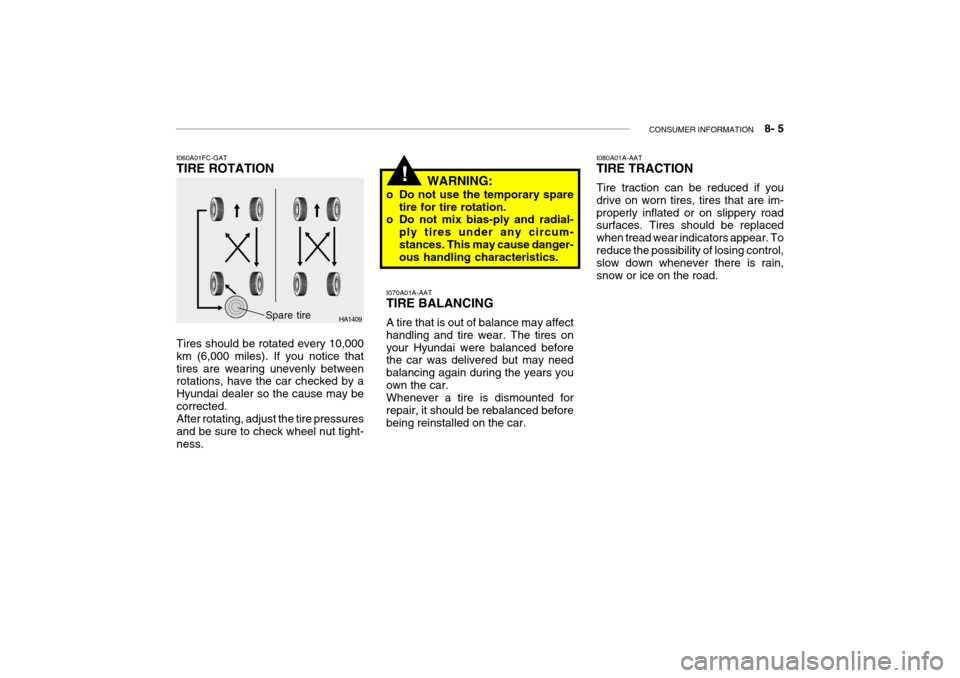
I060A01FC-GAT TIRE ROTATION
Tires should be rotated every 10,000 km (6,000 miles). If you notice thattires are wearing unevenly between rotations, have the car checked by a Hyundai dealer so the cause may becorrected. After rotating, adjust the tire pressures and be sure to check wheel nut tight-ness.
HA1409Spare tire WARNING:
o Do not use the temporary spare tire for tire rotation.
o Do not mix bias-ply and radial-
ply tires under any circum- stances. This may cause danger- ous handling characteristics.
!
Page 244 of 383
8- 6 CONSUMER INFORMATION
I100A01TB-GAT SPARE TIRE AND TOOLS
Your Hyundai is delivered with the fol- lowing: Spare tire and wheel Wheel nut wrench, Wrench bar, Screw driver,Jack, Towing hook HTB224
WARNING:
o Driving on worn-out tires is dan- gerous! Worn-out tires can cause
loss of braking effectiveness, steering control and traction. When replacing tires, never mixradial and bias-ply tires on the same car. If you replace radial tires with bias-ply tires, they mustbe installed in sets of four.
o Using tires and wheels of other
than the recommended sizes maycause unusual handling charac- teristics that may cause death, serious injury or property dam-age.
o Tires degrade over time, even when
they are not being used. Regard-less of the remaining tread, it is recommended that tires generally be replaced after six (6) years ofnormal service. Heat caused by hot climates or frequent high load- ing conditions can accelerate theaging process. Failure to follow this warning can result in sudden tire failure, which could lead to aloss of control and an accident involving serious injury or death.
!
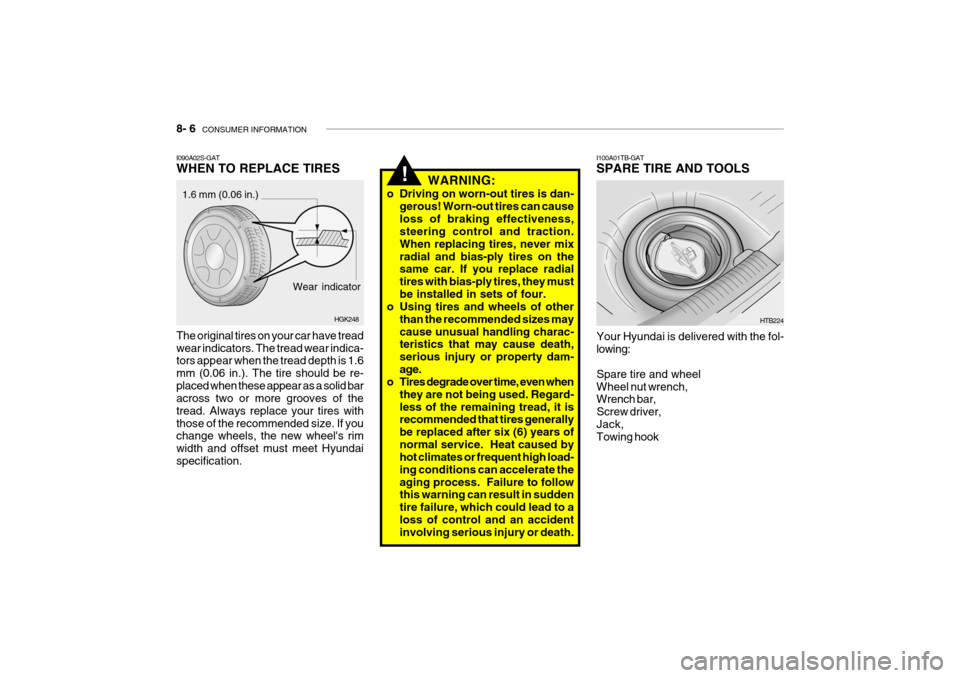
The original tires on your car have tread wear indicators. The tread wear indica- tors appear when the tread depth is 1.6 mm (0.06 in.). The tire should be re-placed when these appear as a solid bar across two or more grooves of the tread. Always replace your tires withthose of the recommended size. If you change wheels, the new wheel's rim width and offset must meet Hyundaispecification.
I090A02S-GAT WHEN TO REPLACE TIRES
Wear indicator
1.6 mm (0.06 in.)
HGK248
Page 246 of 383

9- 2 VEHICLE SPECIFICATIONS
Type Wheel free playRack stroke Oil pump type 3,825 (150.6)
1,665(65.6) 1,495(58.9) 1,490(58.7)2,455(96.7) 1,450(57.1) 1,440(56.7)
Overall lengthOverall width Overall height (unladen)Wheel base Wheel tread J030A02TB-GAT TIREDual hydraulic with brake booster Ventilated disc DrumCable
J010A02TB-GAT MEASUREMENT
J060A01TB-GATFUEL SYSTEMRack and pinion 0 ~ 30 mm (0 ~ 1.18 in.) 140 mm (5.5 in.)132 mm (5.20 in.) Vane type
165/65R14, 175/65R14, 185/55R15
Option
Front Rear
mm (in.)
J020A01TB-GAT POWER STEERING
Fuel tank Capacity Capacity (Iceland only) Liter
4540 Imp.gal
9.98.8 J050A01FC-GAT BRAKE
Type Front brake type Rear brake type Parking brake
J035A01TB-GAT SPARE TIRE
T105/70D14(Temporary) Full size
Standard Option
GENEC
Manual Power
Page 253 of 383

INDEX 10- 5
Outside rear view mirror heater .................................. 1-75
P Parking Brake ............................................................. 1-76
Power outlet ................................................................ 1-67
Power Steering Fluid Level ......................................... 6-27
Power Windows .......................................................... 1-13
RRear ashtray ............................................................... 1-68
Rear Seat ................................................................... 1-17
Folding rear seatback and seat cushion ..................1-18
Rear Seat Entry .......................................................... 1-17
Rear seat warning ....................................................... 1-21
Rear Window Defroster Switch ................................... 1-65
SSeat Adjustable ................................................................ 1-13
Front ........................................................................ 1-13
Seatback Holder ......................................................... 1-79
Seat Pocket ................................................................ 1-79
Seat Warmer .............................................................. 1-20
Seat Belts
3-Point system ........................................................ 1-24
2-Point system ........................................................ 1-25
Adjustabl e height ..................................................... 1-23
Adjusting your seat belt ........................................... 1-25
Care of seat belts .................................................... 1-22
Precautions .............................................................. 1-21Smooth corneri
ng ........................................................ 2-16
Spectacle C ase .......................................................... 1-72
Speedometer .............................................................. 1-55
Starting ........................................................................ 2-5
Steering Wheel Freeplay ............................................. 6-20
Steering Wheel Tilt Lever ........................................... 1-83
Stereo Radio Operation (K220, K240, M280, H446) ..... 1-97, 1-102, 1-107, 1-118
Stereo Sound System ................................................ 1-95
Sun Visor .................................................................... 1-83
Sunroof ....................................................................... 1-69
Opening the sunroof ................................................ 1-69
Reseting the sunroof system ................................... 1-71
Tilting the sunroof .................................................... 1-70
T Tachometer ................................................................. 1-57
Tail gate ..................................................................... 1-78
Theft-Alarm system ..................................................... 1-9
Tires
Balancing .................................................................. 8-5
Chains ...................................................................... 8-4
If you have a flat tire ................................................ 3-6
Information ................................................................ 8-3
Pressure ................................................................... 8-3
Replacement ............................................................. 8-7
Rotation .................................................................... 8-5
Snow tires ................................................................ 8-4
Spare tire .................................................................. 3-5
Traction ..................................................................... 8-5
Page 282 of 383
2- 4 DRIVING YOUR HYUNDAI
!
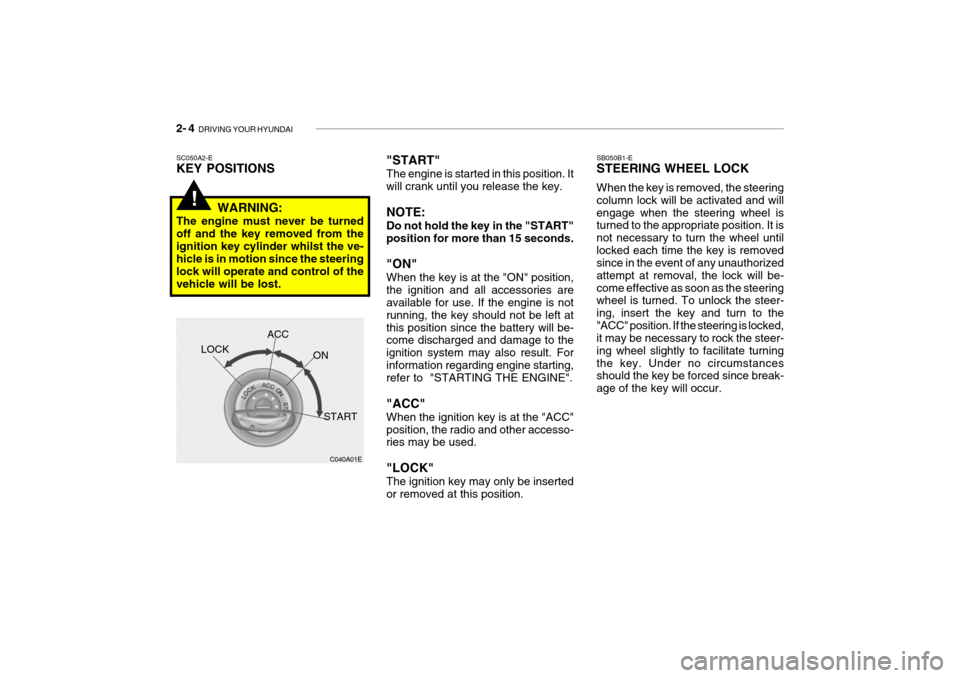
"START" The engine is started in this position. It will crank until you release the key. NOTE: Do not hold the key in the "START" position for more than 15 seconds. "ON" When the key is at the "ON" position, the ignition and all accessories are available for use. If the engine is not running, the key should not be left atthis position since the battery will be- come discharged and damage to the ignition system may also result. Forinformation regarding engine starting, refer to "STARTING THE ENGINE". "ACC" When the ignition key is at the "ACC" position, the radio and other accesso- ries may be used. "LOCK" The ignition key may only be inserted or removed at this position.SC050A2-E KEY POSITIONS
C040A01E
LOCK
ACC
ON
START
WARNING:
The engine must never be turned off and the key removed from theignition key cylinder whilst the ve- hicle is in motion since the steering lock will operate and control of thevehicle will be lost. SB050B1-E STEERING WHEEL LOCK When the key is removed, the steering column lock will be activated and willengage when the steering wheel is turned to the appropriate position. It is not necessary to turn the wheel untillocked each time the key is removed since in the event of any unauthorized attempt at removal, the lock will be-come effective as soon as the steering wheel is turned. To unlock the steer- ing, insert the key and turn to the"ACC" position. If the steering is locked, it may be necessary to rock the steer- ing wheel slightly to facilitate turningthe key. Under no circumstances should the key be forced since break- age of the key will occur.
Page 288 of 383

2- 10 DRIVING YOUR HYUNDAI
YC090A1-E SELECTOR POSITIONS o P (Park): With the selector in this position, no drive is transmitted from the engine and the transaxle output and thereforethe front wheels locked. The engine may be started with the selector in this position.
!
CAUTION:
The selector must NEVER be shifted to the "P" position whilst the ve-hicle is in motion, otherwise seri- ous transaxle damage will result. DC110C1-E o R (Reverse): With the selector in this position, re- verse gear will be engaged. The en-gine may not be started with the selec- tor in this position.
CAUTION:
The selector must NEVER be shifted to the "R" position whilst the ve- hicle is in motion.
! DC110D1-E o N (Neutral): With the selector in this position, no gear is selected and no drive is trans-mitted from the engine. The engine may be started with the selector in this position.
!
CAUTION:
Do not coast with the selector at the "N" position. DC110E2-E o D (Drive): Bring the car to a complete stop before shifting the selector lever to "D" posi-tion. With the selector in this position, first gear will be engaged from rest and thetransmission will automatically upshift to second, third and fourth depending upon the vehicle speed, throttle posi-tion and the position of the overdrive switch. The engine may not be started with the selector in this position. DC110F1-E o 2 (Second Gear): With the selector in this position, first gear will be engaged from rest. Thetransmission will upshift to second gear depending upon the vehicle speed and throttle position. No upshift to third orfourth will occur. The engine may not be started with the selector in this position. DC110G2-E o L (Low Gear): With the selector in this position, first gear will be engaged from rest. No upshift will occur regardless of vehiclespeed and throttle opening. The en- gine may not be started with the selec- tor in this position.
!
CAUTION:
Do not move the selector to the "L" position when the vehicle speed is in excess of 50 m.p.h.
Page 290 of 383
2- 12 DRIVING YOUR HYUNDAI
o When climbing steep gradients us-
ing large throttle openings, the transaxle may re-peatedly changebetween two adjacent ratios. This is a normal characteristic and may be prevented by cancelling the over-drive facility if the shifting occurs between third and fourth ratios, se- lecting position "2" if the shiftingoccurs between third and second ratios or selecting position "1" if the shifting occurs between first andsecond ratios.
o Never move the selector to or from
the "P" or "N" position with the ac-celerator depressed.
o Ensure that the overdrive switch is
at the "ON" position for maximumeconomy.
o If rapid acceleration is required, fully
depress the accelerator pedal. Inthis condition, the kickdown mecha- nism will be operated and the transaxle will automatically down-shift according to the vehicle speed. o The automatic transaxle may be used
to great effect if the vehicle becomesstuck in snow or mud by allowing thevehicle to be rocked to and fro. The engine speed should be held at ap- proximately 1,000rpm by means ofthe accelerator pedal and the selec- tor lever moved between the "D" and "R" positions to induce a rockingmotion.
o Do not depress the accelerator pedal
with the brakes applied and the se-lector at the "R", "D", "2" or "L" position.
o Turn the overdrive switch on for
good fuel economy and smooth driv-ing. But if engine braking is needed in the "D" range or if repeated up-shifting and downshifting between the 3rd and 4th gear is needed when climbing a gentle slope, it is recom-mended that the overdrive switch be turned off. Turn the overdrive switch back on immediately after-ward.
!WARNING:
o Avoid high cornering speeds.
o Do not make quick steering wheel movements, such as sharp lane changes or fast, sharp turns.
o Always wear your seat belts. In a collision crash, an unbeltedperson is significantly more likely to die than a person wearing aseatbelt.
o The risk of rollover is greatly in-
creased if you lose control of yourvehicle at highway speeds.
o Loss of control often occurs if two
or more wheels drop off the road-way and the driver oversteers to reenter the roadway.
o In the event your vehicle leaves the roadway, do not steer sharply.Instead, slow down before pulling back into the travel lanes.
o Never exceed posted speed limits.
o Excessive depressing of the
accelerater pedal under the tire slip condition such as moving out of the mud or fresh snow etc, may cause severe damage to thetransaxle. At this time, take other way such as towing.
Page 292 of 383
2- 14 DRIVING YOUR HYUNDAI
!WARNING:
ABS will not prevent accidents due to improper or dangerous driving maneuvers. Even though vehicle control is improved during emer-gency braking, always maintain a safe distance between you and ob- jects ahead. Vehicle speeds shouldalways be reduced during extreme road conditions. The braking distance for carsequipped with an anti-lock braking system may be longer than for those without it in the following road con- ditions.
o Driving on rough, gravel or snow- covered roads.
o Driving with tyre chains installed.
o Driving on roads where the road surface is pitted or has differentsurface height.
These roads should be driven atreduced speeds. The safety featuresof an ABS equipped vehicle should not be tested by high speed driving or cornering. This could endangerthe safety of yourself or others.
SC140B2-E ANTI-LOCK BRAKE SYSTEM (Not all models) The Anti-Lock Brake System (ABS) is designed to prevent wheel lock-up during sudden braking or on hazard-ous road surfaces. The ABS control module monitors the wheel speed and controls the pressure applied to eachbrake. Thus, in emergency situations or on slick roads, ABS will increase vehicle control during braking. NOTE:
o A click sound may be heard in the
engine compartment when the ve- hicle begins to move after the en- gine is started. These conditions are normal and indicate that theanti-lock brake system (Electronic Stability Program) is functioning properly.
o During ABS operation, a slight pulsation may be felt in the brakepedal when the brakes are ap-plied. Also, a noise may be heard in the engine compartment whilst braking. These conditions arenormal and indicate that the anti- lock brake system is functioning properly.
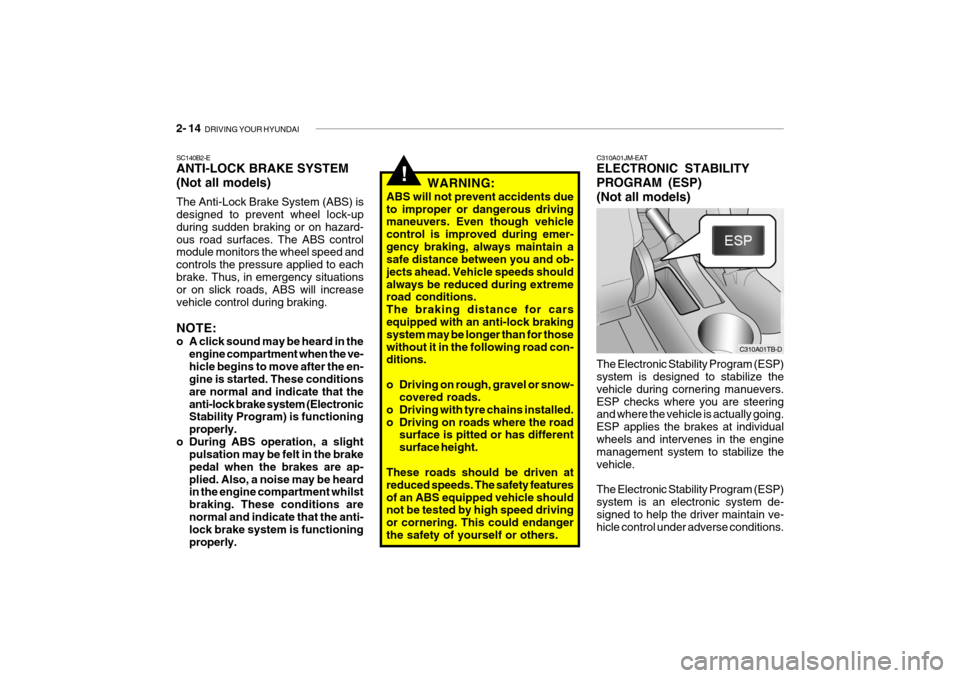
C310A01JM-EAT ELECTRONIC STABILITY PROGRAM (ESP)(Not all models) The Electronic Stability Program (ESP) system is designed to stabilize the vehicle during cornering manuevers.ESP checks where you are steering and where the vehicle is actually going. ESP applies the brakes at individualwheels and intervenes in the engine management system to stabilize the vehicle. The Electronic Stability Program (ESP) system is an electronic system de-signed to help the driver maintain ve- hicle control under adverse conditions. C310A01TB-D