head Hyundai Getz 2008 Service Manual
[x] Cancel search | Manufacturer: HYUNDAI, Model Year: 2008, Model line: Getz, Model: Hyundai Getz 2008Pages: 383, PDF Size: 9.23 MB
Page 250 of 383

10- 2 INDEX
A Active Headrests ........................................................ 1-15
Adjustable headrests .................................................. 1-15
Adjusting arm rest angle .............................................. 1-16
Air Bag ....................................................................... 1-36
Passenger's front airbag O N/OFF switch ................1-40
Side impact airbag ................................................... 1-41
Air Cleaner Filter ......................................................... 6-11
Air Conditioning Care ......................................................................... 6-18
Operation ................................................................. 1-93
Switch ...................................................................... 1-92
Antenna .................................................................... 1-128
Ashtray ....................................................................... 1-67
Audio remote control switch .......................................1-84
Auto Fuel cut Switch .................................................. 1-82
B Battery .............................................................. 2-17, 6-28
Before starting the engine ........................................... 2-3Brake Anti-lock system ...................................................... 2-13
Checking the brakes ................................................ 6-17
Fluid ......................................................................... 6-17
Pedal clearance ....................................................... 6-21
Pedal free play .......................................................... 6-21
Practices ................................................................. 2-12
Breaking-In your New Hyundai .................................... 1-4
Bulbs Replacem ent ..................................................... 6-30
Bulbs wa ttage ............................................................. 6-35C
Care of Cassette Tapes ...........................................
1-126
Care of Disc ............................................................. 1-126
Cargo area cover ........................................................ 1-80
Cassette Tape Player Operation (K220, K240, M280) ........................1-100, 1-105, 1-110
Catalytic Converter ...................................................... 7-3
Central Door Lock ........................................................ 1-9
Child-Protector Rear Door Lock ................................... 1-8
Child Restraint System ............................................... 1-28
Cigarette Lighter ......................................................... 1-66
Climate Control Air Filter .................................. 1-94, 6-19
Clock .......................................................................... 1-66
Clutch
Pedal freep lay .......................................................... 6-21
Combination Light
Headlight flasher ...................................................... 1-60
Headlight swi tch ...................................................... 1-59
High-beam switch .................................................... 1-60
Lane change si gnal .................................................. 1-59
Turn signal operation ............................................... 1-59
Compact Disc Player Operation
(M280, H446) .............................................. 1-113, 1-121
Console tray ............................................................... 1-68
Cooling Fans .............................................................. 6-26
Corrosion protection
Cleaning the interior .................................................. 4-5
Protecting your Hyundai from corrosion ................... 4-2
Washing and waxing ................................................. 4-3
Page 251 of 383

INDEX 10- 3
D Day/Night inside rearview mirror ................................. 1-76
Defrosting / Defogging ................................................ 1-91
Digital clock ................................................................ 1-66
Door Door locks ................................................................ 1-7 Locking, unlocking front doors with a key ................ 1-7
Locking from the inside ............................................ 1-8
Locking from the outside .......................................... 1-8
Drink Holder ................................................................ 1-68
Drive Belts .................................................................. 6-22
Driving
Economical driving .................................................. 2-15
Smooth corneri ng ..................................................... 2-16
Winter driving ........................................................... 2-16
E Electronic stability program (ESP) ..............................2-14
Emission Contro l System ............................................ 7-2
Engine
Before starting the engine ........................................ 2-3Compartment ............................................................ 6-2
Coolant .................................................................... 6-10
Coolant temperature gauge ......................................1-54
If the engine overheats ............................................. 3-4
Number ..................................................................... 8-2
Oil ............................................................................. 6-7Starting ..................................................................... 2-3
Engine Exhaust Can Be Dangerous ............................ 2-2 FFog Light
Front ........................................................................ 1-65
Rear ......................................................................... 1-66
Folding the outside rearview mirror .............................1-75
Front Seats
Adjustable front seats .............................................. 1-13
Adjustable headrests ............................................... 1-14
Adjusting seat forward and rearward ........................1-13
Adjusting seatback angle .. ......................................1-13
Lumbar support control ............................................ 1-15
Seat cushion height adjustment .............................. 1-16
Seat warmer ............................................................ 1-20
Fuel
Capacity ................................................................... 9-2
Gauge ...................................................................... 1-55
recommendations ...................................................... 1-2
Fuel Filler Lid
Remote release ....................................................... 1-78
Fuses ......................................................................... 6-23
Fuse Panel description ............................................... 6-36
GGeneral Checks ........................................................... 6-5
Glove Box .................................................................. 1-73
Page 252 of 383

10- 4 INDEX
H Hazard Warning System ............................................. 1-64
Headlight Aiming Adjustm ent ...................................... 6-31
Headlight Leveling Device S ystem .............................1-68
Headlight flasher ......................................................... 1-60
Headlight switch ......................................................... 1-59
Heating and cooling control ........................................ 1-86
Heating and Ventilation ............................................... 1-87
Air flow control ......................................................... 1-88
Air intake control ..................................................... 1-88
Bi-level heating ........................................................ 1-91
Fan speed control .................................................... 1-87
Temperature control ................................................. 1-90
High-Mounted Rear Stop Light.................................... 1-76
Hood Release ............................................................. 1-77
How to use luggage room ........................................... 1-80
Horn ............................................................................ 1-84
IIgnition Switch ............................................................. 2-3
Immobilizer System ..................................................... 1-5
Instrument Cluster and Indicator light ......................... 1-46
IInterior Light Interior light .............................................................. 1-72
Map light .................................................................. 1-71
Intermittent Wiper ....................................................... 1-63
JJump Starting .............................................................. 3-3 K
Key .............................................................................. 1-4
If you lose your keys .............................................. 3-14
Positions ................................................................... 2-4
Keyless entry system ................................................. 1-11
LLane change si gnal ..................................................... 1-59
Lubrication Chart .......................................................... 9-4
Luggage Net ............................................................... 1-81
Luggage Board ............................................................ 1-81
Luggage Under Tray ................................................... 1-80
Lumbar Support Control .............................................. 1-16
MMaintenance Intervals Explanation of scheduled maintenance items................................................................................. 5-8
Maintenance under severe usage conditions ............ 5-7
Scheduled maintenance ............................................ 5-4
Service requirements ................................................ 5-2
Mirrors
Day-night inside rearview ......... ................................1-75
Outside rearview mirror heater .................................1-75
O
Odometer .................................................................... 1-56
Outside rear view mirror ............................................. 1-73
Electric type ............................................................ 1-74
Manual type ............................................................. 1-73
Page 265 of 383

YOUR VEHICLE AT A GLANCE
F9
1. Glove Box
2. Passenger's Airbag
3. Hazard Warning Light
4. Digital Clock
5. Windshield Wiper/Washer Switch
6. Horn and Driver's Airbag
7. Instrument Cluster
8. Multi-Function Light Switch
9. Headlight Leveling Switch (Not all models)
10. Rear Drink Holder
CAUTION:
When installing a container of liquid air freshener inside a vehicle, do not place it near the instrumentcluster nor on the instrument panel pad surface. If there is any leakage from the air freshener onto these areas (instrument cluster, instrument panel pad or air ventilator), it may damage these parts. If the liquid from the air freshener does leak onto these areas, wash them with water immediately. 11. Parking Brake Lever
12. Shift Lever (Not all models)
13. Front Drink Holder
14. Ashtray
15. Cigar Lighter
16. Heating/Air Conditioning Control Panel
(Not all models)
17. Audio Remote Control Switch (Not all models)
18. Fuse Box
19. Hood Release Lever
!
Page 273 of 383
FEATURES OF YOUR HYUNDAI 1- 91
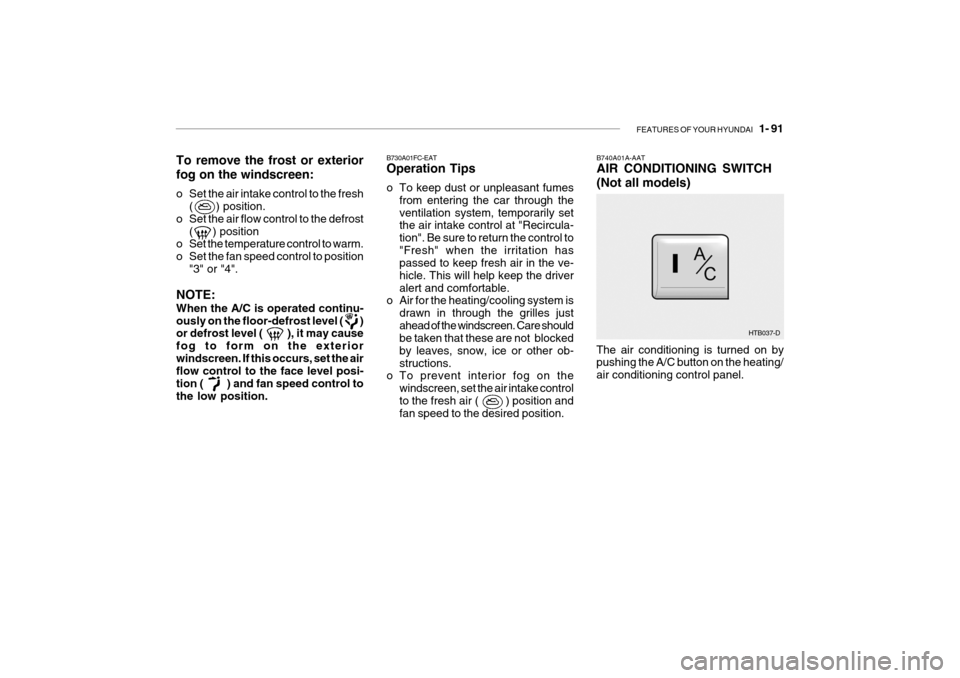
B740A01A-AAT AIR CONDITIONING SWITCH (Not all models)
B730A01FC-EAT Operation Tips
o To keep dust or unpleasant fumes
from entering the car through the ventilation system, temporarily set the air intake control at "Recircula- tion". Be sure to return the control to"Fresh" when the irritation has passed to keep fresh air in the ve- hicle. This will help keep the driveralert and comfortable.
o Air for the heating/cooling system is
drawn in through the grilles justahead of the windscreen. Care should be taken that these are not blocked by leaves, snow, ice or other ob-structions.
o To prevent interior fog on the
windscreen, set the air intake controlto the fresh air ( ) position and fan speed to the desired position.
To remove the frost or exterior fog on the windscreen:
o Set the air intake control to the fresh
( ) position.
o Set the air flow control to the defrost ( ) position
o Set the temperature control to warm.
o Set the fan speed control to position
"3" or "4".
NOTE: When the A/C is operated continu- ously on the floor-defrost level ( ) or defrost level ( ), it may cause fog to form on the exteriorwindscreen. If this occurs, set the air flow control to the face level posi- tion ( ) and fan speed control tothe low position. The air conditioning is turned on by pushing the A/C button on the heating/ air conditioning control panel.
HTB037-D
Page 281 of 383
DRIVING YOUR HYUNDAI 2- 3
!
C020A03O-EAT BEFORE STARTING THE EN- GINE Before you start the engine, you should always:
1. Look around the vehicle to be sure
there are no flat tyres, puddles of oil or water or other indications of pos-sible trouble.
2. After entering the car, check to be
sure the parking brake is engaged.
3. Check that all windows, and lights are clean.
4. Check that the interior and exterior mirrors are clean and in position.
5. Check your seat, seatback and
headrestraint to be sure they are intheir proper positions.
6. Close all the doors.
7. Fasten your seat belt and be sure
that all other occupants have fas- tened theirs.
8. Turn off all lights and accessories that are not needed.
9. When you turn the ignition switch to
"ON" check that all appropriate warn- ing lights are operating and that you have sufficient fuel.
10.Check the operation of warning lights and all bulbs when key is in the "ON"position. WARNING: (DIESEL ENGINE)
To ensure that sufficient vacuum exists within the brake system dur-ing cold weather start-up conditions, it is necessary to run the engine at idle for several seconds after start-ing the engine. SC040A1-F COMBINATION IGNITION SWITCH AND STEERING LOCKTo Start the Engine
o If your Hyundai is equipped with a
manual transaxle, place the shift lever in neutral and depress theclutch pedal fully.
o If your Hyundai has an automatic
transaxle, place the shift lever in "P"(park).
o To start the engine, insert the igni-
tion key and turn it to the "START"position. Release it as soon as the engine starts. Do not hold the key in the "START" position for more than15 seconds.
NOTE: For safety, the engine will not start if the shift lever is not in "P" or "N"Position (automatic transaxle).
!WARNING:
Always wear appropriate shoes when operating your vehicle. Unsuitable shoes (high heels, ski boots, etc.) may interfere with yourability to use the brake and accelera- tor pedal, and the clutch (if installed).
!WARNING:
When you intend to park or stop the vehicle with the engine on, be care- ful not to depress the acceleratorpedal for a long period of time. It may overheat the engine or exhaust sys- tem and cause fire.
Page 285 of 383
DRIVING YOUR HYUNDAI 2- 7
!
!
C055B01B-GAT STARTING AND STOPPING THE ENGINE FOR TURBO CHARGERINTERCOOLER (DIESEL EN-GINE)
(1) Do not race the engine or sudden
accelerate the engine immediately after start it. If the engine is cold, allow the engine to idle for severalseconds before it is driven to en- sure sufficient lubrication of the turbo charger unit.
(2) After high speed or extended driv- ing, requiring a heavy engine load,the engine should be allowed to idleabout 1 minute before turning it off. This idle time will allow the turbo charger to cool prior to shutting theengine off.
WARNING:
Do not turn the engine off immedi- ately after it has been subjected to a heavy load. Doing so may causesevere damage to the engine or turbo charger unit.
WARNING:
Be sure that the clutch is fully de- pressed when starting a manualtransaxle vehicle. Otherwise there is the potential to cause damage to the vehicle or injury to someoneinside or outside the vehicle as a result of the forward or backward movement of the vehicle that willoccur if the clutch is not depressed when the vehicle is started. SC060B1-E FUEL ECONOMY The following suggestions are made to assist in achieving the greatest degreeof fuel economy.
o Maintaining a constant check on
fuel consumption will enable the most economical use pattern and driving style to be adopted.
o Avoid using the vehicle for very short journeys if possible, particu-larly when a cold start is involved.
o Ensure that tyre pressures are main- tained at the correct level.
o Use only the recommended grade of fuel.
o Avoid carrying unnecessary weight,
and if a roof rack is in use, removeit as soon as possible after use.
o Anticipate the road and conditions
ahead to enable adjustments in speedto be made smoothly. Avoid heavy acceleration and sharp braking.
o Avoid cruising at unnecessary high speeds.
o Always ensure that the periodic main-
tenance services are performed by a Hyundai authorised repairer at the time and/or mileage intervals specified.
o Use the air conditioning only when necessary.
5. Turn the ignition key to the "Start"
position and release it when the engine starts.
Page 291 of 383
DRIVING YOUR HYUNDAI 2- 13
HTB217-D
SC130A1-E OVERDRIVE SWITCH
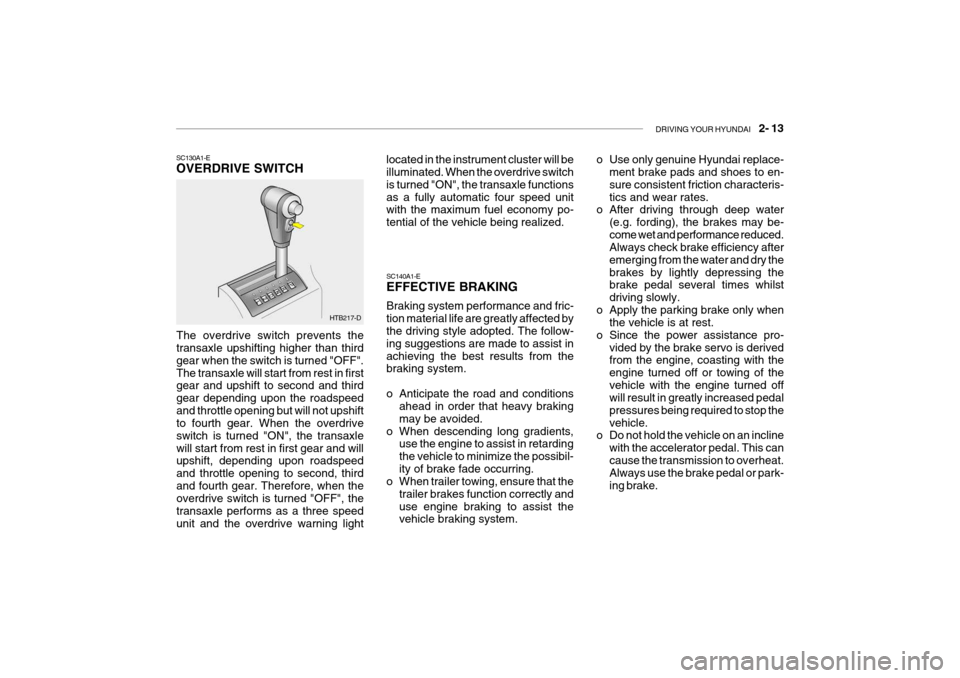
The overdrive switch prevents the transaxle upshifting higher than third gear when the switch is turned "OFF".The transaxle will start from rest in first gear and upshift to second and third gear depending upon the roadspeedand throttle opening but will not upshift to fourth gear. When the overdrive switch is turned "ON", the transaxlewill start from rest in first gear and will upshift, depending upon roadspeed and throttle opening to second, thirdand fourth gear. Therefore, when the overdrive switch is turned "OFF", the transaxle performs as a three speedunit and the overdrive warning light located in the instrument cluster will be illuminated. When the overdrive switch is turned "ON", the transaxle functionsas a fully automatic four speed unit with the maximum fuel economy po- tential of the vehicle being realized. SC140A1-E EFFECTIVE BRAKING Braking system performance and fric- tion material life are greatly affected by the driving style adopted. The follow- ing suggestions are made to assist inachieving the best results from the braking system.
o Anticipate the road and conditions
ahead in order that heavy braking may be avoided.
o When descending long gradients, use the engine to assist in retardingthe vehicle to minimize the possibil-ity of brake fade occurring.
o When trailer towing, ensure that the
trailer brakes function correctly anduse engine braking to assist the vehicle braking system. o Use only genuine Hyundai replace-
ment brake pads and shoes to en- sure consistent friction characteris-tics and wear rates.
o After driving through deep water
(e.g. fording), the brakes may be-come wet and performance reduced. Always check brake efficiency after emerging from the water and dry thebrakes by lightly depressing the brake pedal several times whilst driving slowly.
o Apply the parking brake only when the vehicle is at rest.
o Since the power assistance pro- vided by the brake servo is derived from the engine, coasting with the engine turned off or towing of thevehicle with the engine turned off will result in greatly increased pedal pressures being required to stop thevehicle.
o Do not hold the vehicle on an incline
with the accelerator pedal. This cancause the transmission to overheat. Always use the brake pedal or park- ing brake.
Page 292 of 383
2- 14 DRIVING YOUR HYUNDAI
!WARNING:
ABS will not prevent accidents due to improper or dangerous driving maneuvers. Even though vehicle control is improved during emer-gency braking, always maintain a safe distance between you and ob- jects ahead. Vehicle speeds shouldalways be reduced during extreme road conditions. The braking distance for carsequipped with an anti-lock braking system may be longer than for those without it in the following road con- ditions.
o Driving on rough, gravel or snow- covered roads.
o Driving with tyre chains installed.
o Driving on roads where the road surface is pitted or has differentsurface height.
These roads should be driven atreduced speeds. The safety featuresof an ABS equipped vehicle should not be tested by high speed driving or cornering. This could endangerthe safety of yourself or others.
SC140B2-E ANTI-LOCK BRAKE SYSTEM (Not all models) The Anti-Lock Brake System (ABS) is designed to prevent wheel lock-up during sudden braking or on hazard-ous road surfaces. The ABS control module monitors the wheel speed and controls the pressure applied to eachbrake. Thus, in emergency situations or on slick roads, ABS will increase vehicle control during braking. NOTE:
o A click sound may be heard in the
engine compartment when the ve- hicle begins to move after the en- gine is started. These conditions are normal and indicate that theanti-lock brake system (Electronic Stability Program) is functioning properly.
o During ABS operation, a slight pulsation may be felt in the brakepedal when the brakes are ap-plied. Also, a noise may be heard in the engine compartment whilst braking. These conditions arenormal and indicate that the anti- lock brake system is functioning properly.
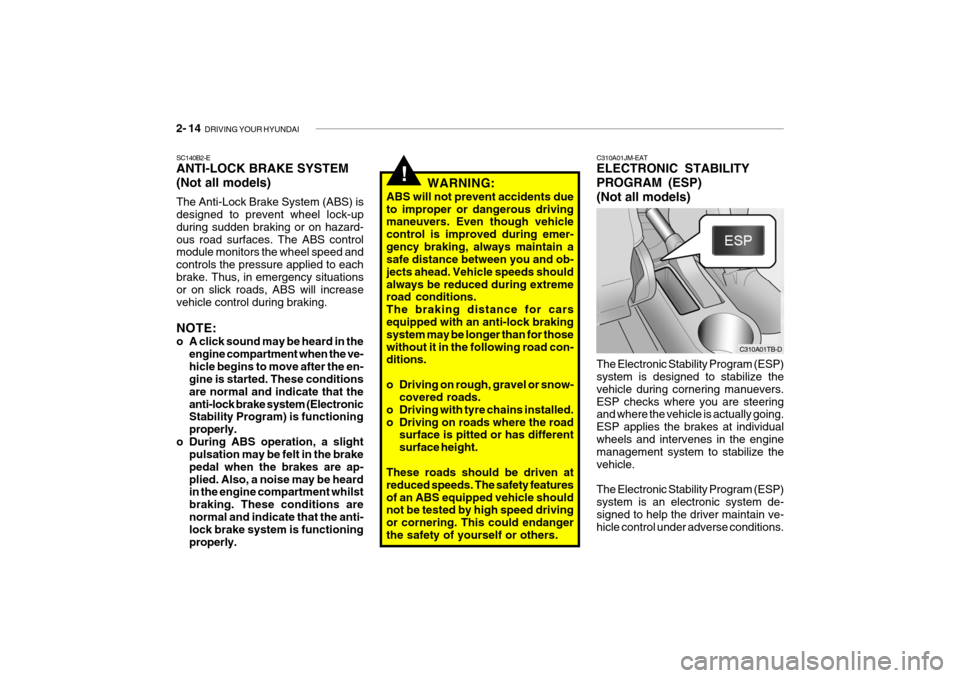
C310A01JM-EAT ELECTRONIC STABILITY PROGRAM (ESP)(Not all models) The Electronic Stability Program (ESP) system is designed to stabilize the vehicle during cornering manuevers.ESP checks where you are steering and where the vehicle is actually going. ESP applies the brakes at individualwheels and intervenes in the engine management system to stabilize the vehicle. The Electronic Stability Program (ESP) system is an electronic system de-signed to help the driver maintain ve- hicle control under adverse conditions. C310A01TB-D
Page 296 of 383

2- 18 DRIVING YOUR HYUNDAI
SC170E1-E Windscreen Washers and Wip- ers The windscreen washer bottle should be filled with a solution of water and a proprietary winter screen wash addi-tive. The windscreen wipers should not be used if the blades are frozen to the windscreen or if they are coveredwith snow, before this is removed. NOTE: Never allow undiluted screen washer fluid additive to spill upon the paintwork or use engine cool- ant anti-freeze since damage to thepaintwork may result.
o When driving in extreme conditions,
the windscreen wiper blades may fail to clear the screen properly due to the formation of ice upon theblade edge. It will therefore be nec- essary to periodically remove such ice to restore their efficiency.
o If the power operated door mirrors become frozen, attempts to adjustthese may damage the mechanism.
ZC170D1-E Door Locks Should the door lock mechanism be- come frozen, a proprietary lock de-icer should be used. Alternatively, warm- ing the door key may thaw the doorlock. However, the key should be handled carefully to avoid burning the fingers.Never attempt to thaw a frozen door lock using hot water, since the water will eventually freeze and compoundthe problem. NOTE: The proper temperature for using the immobilizer key is from -40°F to 176°F (-40°C to 80°C). If you heat the immobilizer key over 176°F (80°C)to open the frozen lock, it may cause damage to the transponder in its head.
o The formation of snow or ice built up
inside the wheel arches may inter-fere with the road wheels or steeringmechanism. In such instances, un- usual noises or an increase in steer- ing effort may result. Therefore,ensure that the wheel arches are checked periodically and any accu- mulated snow or ice removed.
o It is advisable to carry emergency equipment including, torch, shovel,tow rope, blankets etc., if a journeyis to be undertaken into areas of severe road conditions.