air con Hyundai Getz 2008 Owner's Manual
[x] Cancel search | Manufacturer: HYUNDAI, Model Year: 2008, Model line: Getz, Model: Hyundai Getz 2008Pages: 383, PDF Size: 9.23 MB
Page 9 of 383

YOUR VEHICLE AT A GLANCE
F9
1. Headlight Leveling Switch (If installed)
2. Front Fog Light Switch (If installed)
3. Multi-Function Light Switch
4. Instrument Cluster
5. Horn and Driver's Airbag (If installed)
6. Windshield Wiper/Washer Switch
7. Digital Clock
8. Hazard Warning Light
9. Audio System (If installed)
10. Passenger's Airbag (If installed)
11. Glove Box
CAUTION:
When installing a container of liquid air freshener inside a vehicle, do not place it near the instrument cluster nor on the instrument panel pad surface. If there is any leakage from the air freshener onto these areas (instrument cluster, instrument panel pad or air ventilator), it may damage these parts.If the liquid from the air freshener doesleak onto these areas, wash them with water immediately. 12. Hood Release Lever
13. Fuse Box
14. Audio Remote Control Switch (If installed)
15. Heating/Air Conditioning Control Panel
(If installed)
16. Cigarette Lighter
17. Ashtray
18. Front Drink Holder
19. Shift Lever (If installed)
20. Parking Brake Lever
21. Rear Drink Holder
!
Page 11 of 383

YOUR VEHICLE AT A GLANCE
F11
1. Glove Box
2. Passenger's Airbag (If installed)
3. Audio System (If installed)
4. Hazard Warning Light
5. Digital Clock
6. Windshield Wiper/Washer Switch
7. Horn and Driver's Airbag (If installed)
8. Instrument Cluster
9. Multi-Function Light Switch
10. Headlight Leveling Switch (If installed)
11. Rear Drink Holder
CAUTION:
When installing a container of liquid air freshener inside a vehicle, do not place it near the instrument cluster nor on the instrument panel pad surface. If there is any leakage from the air freshener onto these areas (instrument cluster, instrument panel pad or air ventilator), it may damage these parts. If the liquid from the air freshener does leak onto these areas, wash them with water immediately. 12. Parking Brake Lever
13. Shift Lever (If installed)
14. Front Drink Holder
15. Ashtray
16. Power Outlet (If installed)
17. Heating/Air Conditioning Control Panel
(If installed)
18. Audio Remote Control Switch (If installed)
19. Fuse Box
20. Hood Release Lever
!
Page 13 of 383

1. FEATURES OF YOUR HYUNDAI
Fuel Recommendations ................................................................... 1-2
Breaking in Your New Hyundai ........................................................ 1-4
key (Immobilizer system) ................................................................. 1-5
Door locks (Theft-alarm system) ..................................................... 1-9Power windows.............................................................................. 1-13
Seat ................................................................................................ 1-13
Seat Belt ......................................................................................... 1-21
Child restraint system .................................................................... 1-28
Supplemental restraint (AIRBAG) system .....................................1-36
Instrument cluster and indicator lights ............................................1-44
Warning Light and Indicator ............................................................ 1-48
Trip computer ................................................................................. 1-57
Multi-Function Light Switch............................................................ 1-59
Windshield wiper/Washer Switch ...................................................1-61
Sunroof ........................................................................................... 1-69
Mirror ......... ..................................................................................... 1-73
Hood R elease ................................................................................ 1-77
How to use luggage Room ............................................................. 1-80
Heating and cooling control ............................................................ 1-86
Stereo sound system ..................................................................... 1-95
Audio system ................................................................................. 1-97
Antenna ........................................................................................ 1-128
1
Page 15 of 383

FEATURES OF YOUR HYUNDAI 1- 3
B010B01A-AAT What About Gasohol? Gasohol (a mixture of 90% unleaded gasoline and 10% ethanol or grainalcohol) may be used in your Hyundai. However, if your engine develops driveability problems, the use of 100%unleaded gasoline is recommended. Fuels with unspecified quantities of alcohol, or alcohols other than ethanol,should not be used.
Biodiesel Commercially supplied biodiesel blends of no more than 5% biodiesel, com- monly known as "B5 biodiesel" may be used in your vehicle if it meets EN14214 or equivalent specifications. (EN stands for "European Norm"). The use of biofuels made from rapeseed methylester (RME), fatty acid methyl ester (FAME), vegetable oil methyl ester (VME) etc. or mixing diesel withbiodiesel will cause increased wear or damage to the engine and fuel system. Repair or replacement of worn or dam-aged components due to the use of non approved fuels will not be covered by the manufactures warranty.
CAUTION:
o Never use any fuel, whether diesel or B5 biodiesel that fails to meetthe latest petroleum industry speci- fication.
o Never use any fuel additives or treatments that are not recom-mended or approved by the ve- hicle manufacturer.
! B010D01S-AAT Do not Use Methanol Fuels containing methanol (wood al- cohol) should not be used in your Hyundai. This type of fuel can reducevehicle performance and damage com- ponents of the fuel system.
CAUTION:
Your Hyundai's New Vehicle Lim- ited Warranty may not cover dam- age to the fuel system and perfor- mance problems that are caused bythe use of methanol or fuels con- taining methanol.
! B010E01A-AAT Gasolines for Cleaner Air To help contribute to cleaner air, Hyundai recommends that you usegasolines treated with detergent addi- tives, which help prevent deposit for- mation in the engine. These gasolineswill help the engine run cleaner and the Emission Control System performance. B010F01A-AAT Operation in Foreign Countries If you are going to drive your Hyundai in another country, be sure to:
o Observe all regulations regarding
registration and insurance.
o Determine that acceptable fuel is available.
Page 23 of 383

FEATURES OF YOUR HYUNDAI 1- 11
CAUTION:
Only the transmitter can disarm the armed stage. If the transmitter does not disarm the system, it is neces-sary to take the following steps;
1. Unlock the door with the key, which will cause, the alarm to be activated.
2. Insert the key in the ignition key cylinder and turn the ignition keyto "ON" position.
3. Wait for 30 seconds. After completing the steps above, the system will be disarmed.! B070F02TB-GAT Keyless Entry System (If Installed)Locking doors
1. Close all doors.
2. Push the button on the transmitter.
3. At the same time all doors lock, the
turn signal lights will blink once to indicate that the system is armed.
Unlocking doors
1. Push the button on the transmitter.
2. At the same time all doors unlock, the turn signal light will blink twice to indicate that the system is disarmed.
NOTE: The transmitter will not work if any of following occur:
- The ignition key is in ignition switch.
- You exceed the operating distance limit (10 m).
- The battery in the transmitter is
weak.
- Other vehicles or objects may be
blocking the signal.
- The weather is extremely cold. - The transmitter is close to a radio
transmitter such as a radio station or an airport which can interferewith normal operation of the trans- mitter.
When the transmitter does not work correctly, open and close the door with the ignition key. If you have a problem with the transmitter, con-tact an authorized Hyundai Dealer. NOTE: Keep the transmitter away from wa- ter or any liquid. If the keyless entry system is inoperative due to expo- sure to water or liquids, it will not becovered by your manufacturer ve- hicle warranty.
Page 26 of 383

1- 14 FEATURES OF YOUR HYUNDAI
WARNING:
To minimize risk of severe injury in the event of a collision or a suddenstop, both the driver and passen- ger seatbacks should always be in an upright position while the ve-hicle is in motion. The protection provided by the seat belts and airbags may be reduced significant-ly when the seatbacks are reclined. There is greater risk that the driver and passenger will slide under theseat belt which may result in seri- ous injury if a crash occurs when the seatbacks are reclined. The seatbelt cannot provide full protection to an occupant if the seat back is reclined.!WARNING:
To ensure the seat is locked se- curely, attempt to move the seat for- ward or rearward without using thelock release lever.!
To recline the seatback, lean forward to take your weight off it, then pull up onthe recliner control lever at the outside edge of the seat. Now lean back until the desired seatback angle is achieved.To lock the seatback into position, release the recliner control lever.
HTB026
B080C01A-AAT Adjusting Seatback Angle
HTB024
B080B02A-GAT FRONT SEATS Adjusting Seat Forward andRearward To move the seat toward the front or rear, pull the lock release lever up- ward. This will release the seat on its track so you can move it forward orrearward to the desired position. When you find the position you want, release the lever and slide the seat forward orrearward on its track until it locks into the desired position and cannot be moved further.
Page 41 of 383

FEATURES OF YOUR HYUNDAI 1- 29
o Never allow a child to stand up or
kneel on the seat.
o Never use an infant carrier or child safety seat that "hooks" over a seatback; it may not provide ad- equate security in an accident.
o Never allow a child to be held in a person's arms while they are in a moving vehicle, as this could re-sult in serious injury to the child in the event of an accident or a sudden stop. Holding a child in amoving vehicle does not provide the child with any means of pro- tection during an accident, even if the person holding the child is wearing a seat belt.
o If the child restaint seat is not anchored properly, the risk of achild being seriously injured or killed in a collision greatly in- creases.
B230G01TB
To install a child restraint system in the outboard rear seats, extend the shoul- der/lap belt from its retractor. Installthe child restraint system, buckle the seat belt and allow the seat belt to take up any slack. Make sure that the lapportion of the belt is tight around the child restraint system and the shoulder portion of the belt is positioned so thatit cannot interfere with the child's head or neck. After installation of the child restraint system, try to move it in alldirections to be sure the child restraint system is securely installed. B230G01A-GAT Child Restraint System Installa- tion on Outboard Rear Seats
WARNING:
Do not install any child restraint sys- tem in the front passenger seat. Should an accident occur and causethe passenger side airbag to deploy, it could severely injure or kill an infant or child seated in an infant orchild seat. Therefore, only use a child restraint system in the rear seat of your vehicle.
If you need to tighten the belt, pull more webbing toward the retractor. When you unbuckle the seat belt and allow it toretract, the retractor will automatically revert back to its normal seated pas- senger emergency locking usage con-dition. NOTE:
o Before installing the child re-
straint system, read the instruc- tions supplied by the child re- straint system manufacturer.
o If the seat belt does not operate as described, have the systemchecked immediately by yourauthorized Hyundai dealer.!
Page 45 of 383
FEATURES OF YOUR HYUNDAI 1- 33
WARNING:
o Do not install a child restraint seat at the center of the rear seat using the vehicle's outboard rear seat ISOFIX anchors. The ISOFIX an-chors are only provided for the left and right outboard rear seating positions. Do not misuse theISOFIX anchors by attempting to attach a child restraint seat in the middle of the rear seat to the ISOFIXanchors. In a crash, the child re- straint seat ISOFIX attachments may not be strong enough to se-cure the child restraint seat prop- erly in the center of the rear seat and may break, causing seriousinjury or death.!
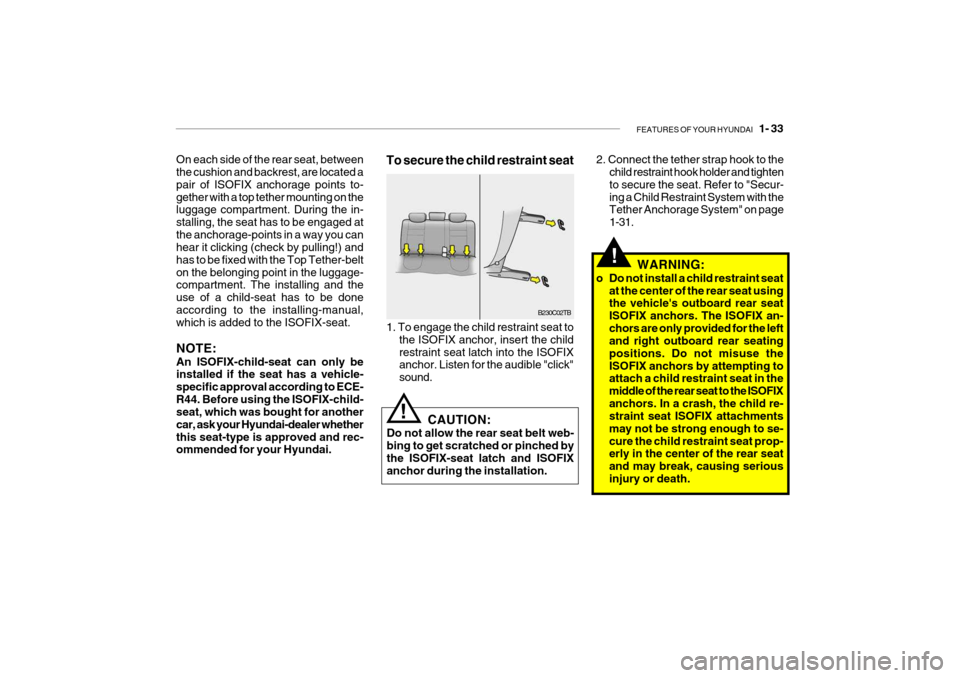
On each side of the rear seat, between the cushion and backrest, are located a pair of ISOFIX anchorage points to-gether with a top tether mounting on the luggage compartment. During the in- stalling, the seat has to be engaged atthe anchorage-points in a way you can hear it clicking (check by pulling!) and has to be fixed with the Top Tether-belton the belonging point in the luggage- compartment. The installing and the use of a child-seat has to be doneaccording to the installing-manual, which is added to the ISOFIX-seat. NOTE: An ISOFIX-child-seat can only be installed if the seat has a vehicle- specific approval according to ECE-R44. Before using the ISOFIX-child- seat, which was bought for another car, ask your Hyundai-dealer whetherthis seat-type is approved and rec- ommended for your Hyundai. B230C02TB
1. To engage the child restraint seat to the ISOFIX anchor, insert the child restraint seat latch into the ISOFIX anchor. Listen for the audible "click" sound.
To secure the child restraint seat2. Connect the tether strap hook to the
child restraint hook holder and tighten to secure the seat. Refer to "Secur-ing a Child Restraint System with the Tether Anchorage System" on page 1-31.
! CAUTION:
Do not allow the rear seat belt web- bing to get scratched or pinched bythe ISOFIX-seat latch and ISOFIX anchor during the installation.
Page 46 of 383
1- 34 FEATURES OF YOUR HYUNDAI
o When using the vehicle’s “ISOFIX”
system to install a child restraint system in the rear seat, all unused vehicle rear seat belt metal latchplates or tabs must be latched securely in their seat belt buckles and the seat belt webbing must beretracted behind the child restraint to prevent the child from reaching and taking hold of unretracted seat
belts. Unlatched metal latch plates or tabs may allow the child to reach the unretracted seat beltswhich may result in strangulation and a serious injury or death to the child in the child restraint.
o Do not mount more than one child restraint to a child restraint loweranchorage point. The improperincreased load may cause the an- chorage points or tether anchor to break, causing serious injury ordeath.
o Attach the ISOFIX or ISOFIX-com-
patible child restraint seat only tothe appropriate locations shown in the illustration.
o Always follow the installation and use instructions provided by themanufacturer of the child restraint. The pre-tensioner seat belt operates inthe same way as an Emergency Lock- ing Retractor (ELR) type of seat belt.
HXG229
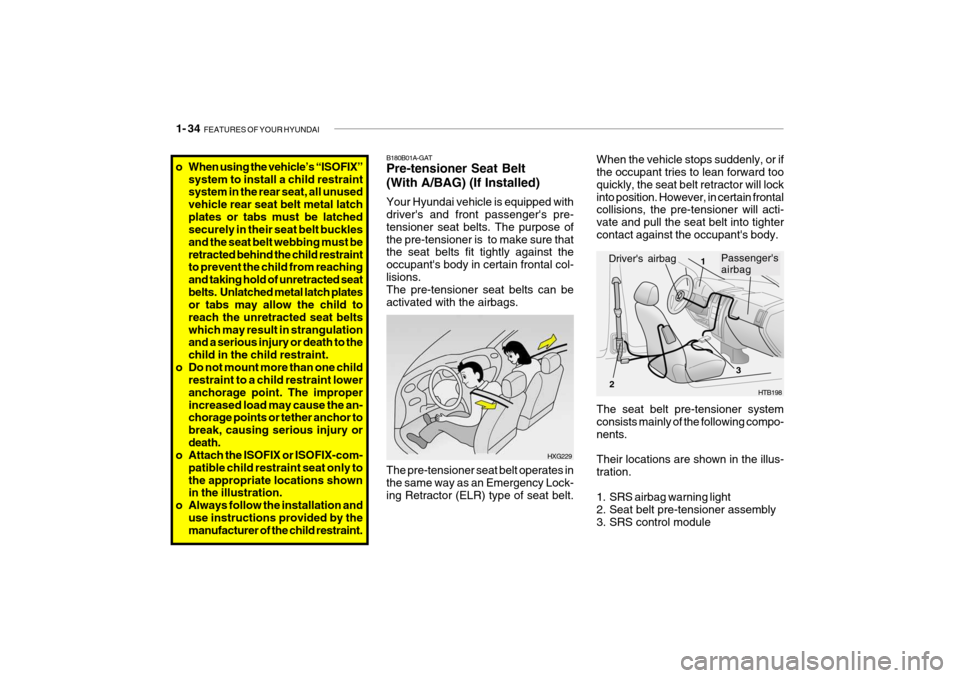
B180B01A-GAT Pre-tensioner Seat Belt (With A/BAG) (If Installed) Your Hyundai vehicle is equipped with driver's and front passenger's pre- tensioner seat belts. The purpose ofthe pre-tensioner is to make sure that the seat belts fit tightly against the occupant's body in certain frontal col-lisions. The pre-tensioner seat belts can be activated with the airbags.
When the vehicle stops suddenly, or if the occupant tries to lean forward too quickly, the seat belt retractor will lockinto position. However, in certain frontal collisions, the pre-tensioner will acti- vate and pull the seat belt into tightercontact against the occupant's body.
The seat belt pre-tensioner system consists mainly of the following compo- nents. Their locations are shown in the illus- tration.
1. SRS airbag warning light
2. Seat belt pre-tensioner assembly
3. SRS control module
HTB198
Driver's airbag1
2 3Passenger's airbag
Page 47 of 383
FEATURES OF YOUR HYUNDAI 1- 35
illuminates while the vehicle is being driven, please have an au- thorized Hyundai dealer inspectthe pre-tensioner seat belt or SRS airbag system as soon as pos- sible.
WARNING:
o Pre-tensioners are designed to operate only one time. After acti- vation, pre-tensioner seat belts must be replaced. All seat belts, of any type, should always bereplaced after they have been worn during a collision.
o The pre-tensioner seat belt as- sembly mechanisms become hotduring activation. Do not touch the pre-tensioner seat belt as-semblies for several minutes af- ter they have been activated.
o Do not attempt to inspect or re-
place the pre-tensioner seat beltsyourself. This must be done by an authorized Hyundai dealer.
o Do not strike the pre-tensioner seat belt assemblies.!
WARNING:
To obtain maximum benefit from a pre-tensioner seat belt:
1. The seat belt must be worn cor- rectly.
2. The seat belt must be adjusted to
the correct position.!
NOTE:
o Both the driver's and frontpassenger's pre-tensioner seat belts will be activated in certain frontal collisions. The pre- tensioner seat belts can be acti-vated with the airbags. The pre- tensioners will be activated un- der these conditions even if theseat belts are not being worn at the time of the collision.
o When the pre-tensioner seat belts are activated, a loud noise maybe heard and fine dust, which may appear to be smoke, may bevisible in the passenger com- partment. These are normal op- erating conditions and are nothazardous. o Although it is harmless, the fine
dust may cause skin irritation andshould not be breathed for pro-longed periods. Wash your hands and face thoroughly after an acci- dent in which the pre-tensionerseat belts were activated.
! CAUTION:
o Because the sensor that activates the SRS airbag is connected with the pre-tensioner seat belt, the SRSairbag warning light on the instrument panel will blink for ap- proximately 6 seconds after theignition key has been turned to the "ON" position, and then it should turn off.
o If the pre-tensioner seat belt is not working properly, this warn-ing light will illuminate even ifthere is no malfunction of the SRS airbag system . If the SRS airbag warning light does notilluminate when the ignition key is turned to "ON", or if it remains illuminated after blinking for ap-proximately 6 seconds, or if it