Sound Hyundai Getz 2010 Owner's Guide
[x] Cancel search | Manufacturer: HYUNDAI, Model Year: 2010, Model line: Getz, Model: Hyundai Getz 2010Pages: 256, PDF Size: 7.84 MB
Page 138 of 256

1- 126 FEATURES OF YOUR HYUNDAI
!
CAUTION:
o Do not insert warped or poor qual- ity discs into the CD player as damage to the unit may occur.
o Do not insert anything like coins
into the player slot as damage tothe unit may occur.
o Do not place beverages close to
the audio system. The playbackmechanism may be damaged if you spill them.
10. CD SCAN Button
o To playback the first 10 seconds of
each track, press the CD SCAN button more than 1 second.
o To playback the first 10 seconds of
each track in the selected folder,press the CD SCAN button within 1 second (MP3 CD only).
o Press the CD SCAN button again within 10 sec. when you have reachedthe desired track.
11. FILE SEARCH Knob (TUNE Select Knob)
o You can skip the track by turning the FILE SEARCH knob clockwise or counterclockwise.After selecting the desired track, press the FILE SEARCH knob to playback the track.If you do not press the FILE SEARCH knob within five seconds, the search will stop. 12. DIRECTORY SEARCH
Button
o You can move through the folder by pushing the DIR button to up ( ) anddown ( ).After moving the desired folder, press the FILE SEARCH knob to playback the selected folder.If you do not press the FILE SEARCH knob within five seconds, the search will stop.
NOTE :
o To assure proper operation of the unit, keep the vehicle interior tem- perature within a normal range by using the vehicle's air condition- ing or heating system.
o When replacing the fuse, replace it with a fuse having the correctcapacity.
o All stored bookmarks are all erased when the car battery is discon-nected or power to the vehicle islost. If this occurs, the bookmarks will have to be reset.
o This equipment is designed to be
used only in a 12 volt DC batterysystem with negative ground.
o This unit is made of precisionparts. Do not attempt to disas- semble or adjust any parts.
o When driving your vehicle, be sure to keep the volume of the unit setlow enough to allow you to hearsounds coming from the outside.
o Do not expose this equipment (in-
cluding the speakers and tape) towater or excessive moisture.
Page 141 of 256
FEATURES OF YOUR HYUNDAI 1- 129
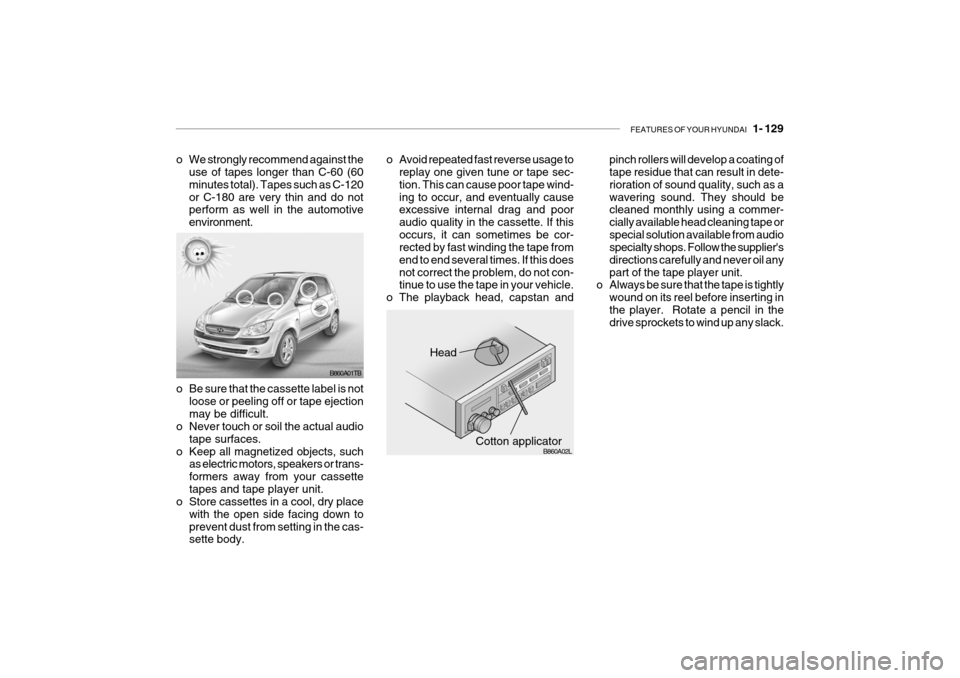
pinch rollers will develop a coating of tape residue that can result in dete- rioration of sound quality, such as awavering sound. They should be cleaned monthly using a commer- cially available head cleaning tape orspecial solution available from audio specialty shops. Follow the supplier's directions carefully and never oil anypart of the tape player unit.
o Always be sure that the tape is tightly
wound on its reel before inserting inthe player. Rotate a pencil in the drive sprockets to wind up any slack.
Head
Cotton applicator
B860A01TB
B860A02L
o Be sure that the cassette label is not
loose or peeling off or tape ejection may be difficult.
o Never touch or soil the actual audio
tape surfaces.
o Keep all magnetized objects, such as electric motors, speakers or trans-formers away from your cassettetapes and tape player unit.
o Store cassettes in a cool, dry place
with the open side facing down toprevent dust from setting in the cas- sette body.
o We strongly recommend against the
use of tapes longer than C-60 (60 minutes total). Tapes such as C-120or C-180 are very thin and do not perform as well in the automotive environment. o Avoid repeated fast reverse usage to
replay one given tune or tape sec-tion. This can cause poor tape wind-ing to occur, and eventually cause excessive internal drag and poor audio quality in the cassette. If thisoccurs, it can sometimes be cor- rected by fast winding the tape from end to end several times. If this doesnot correct the problem, do not con- tinue to use the tape in your vehicle.
o The playback head, capstan and
Page 144 of 256
2- 2 DRIVING YOUR HYUNDAI
C010A01O-AAT
WARNING: ENGINE EXHAUST CAN BE DANGEROUS!
Engine exhaust fumes can be extremely dangerous. If, at any time, you smell exhaust fumes inside the vehicle, open the windows immediately. o Do not inhale exhaust fumes. Exhaust fumes contain carbon monoxide, a colorless, odorless gas that can cause unconsciousness and death by asphyxiation. o Be sure the exhaust system does not leak. The exhaust system should be checked whenever the vehicle is raised to change the oil or for any other purpose. If you hear a change in the sound of the exhaust or if you drive over something that strikes the underneath side of the car, have the exhaust system checked as soon as possible by your Hyundai dealer. o Do not run the engine in an enclosed area. Letting the engine idle in your garage, even with the garage door open, is a hazardous practice. Never run the engine in your garage any longer than it takes to start the engine and back the car out. o Avoid idling the engine for prolonged periods with people inside the car. If it is necessary to idle the engine for a prolonged period with people inside the car, be sure to do so only in an open area with the air intake set at "Fresh" and fan operating at one of the higher speeds so fresh air is drawn into the interior. If you must drive with the tail gate open because you are carrying objects that make this necessary: 1. Close all windows. 2. Open side vents. 3. Set the air intake control at "Fresh", the air flow control at "Floor" or "Face" and the fan at one of the higher speeds.
To assure proper operation of the ventilation system, be sure the ventilation air intakes located just in front ofthe windshield are kept clear of snow, ice, leaves or other obstructions.
!
Page 155 of 256

DRIVING YOUR HYUNDAI 2- 13
ing action returns to normal, taking care to keep the car under control at
all times. If the braking action doesnot return to normal, stop as soon as it is safe to do so and call your Hyundai dealer for assistance.
o Don't coast down hills with the car out of gear. This is extremely haz-
ardous. Keep the car in gear at alltimes, use the brakes to slow down,
then shift to a lower gear so that engine braking will help you main-tain a safe speed.
o Don't "ride" the brake pedal. Rest-
ing your foot on the brake pedal
while driving can be dangerous be- cause it can result in the brakes overheating and losing their effec-tiveness. It also increases the wear of the brake components.
o If a tire goes flat while you are driving, apply the brakes gently andkeep the car pointed straight ahead while you slow down. When you are
moving slowly enough for it to be safe to do so, pull off the road and stop in a safe place.
o If your car is equipped with an auto- matic transaxle, don't let your carcreep forward. To avoid creepingforward, keep your foot on the brake
pedal when the car is stopped. o Use caution when parking on a hill.
Engage the parking brake and place
the gear selector lever in "P" (auto-matic transaxle) or in first or reverse gear (manual transaxle). If your car is facing downhill, turn the frontwheels into the curb to help keep the car from rolling. If your car is facing
uphill, turn the front wheels awayfrom the curb to help keep the car from rolling. If there is no curb or if it is requiredby other conditions to keep the car from rolling, block the wheels.
o Under some conditions your park-
ing brake can freeze in the engagedposition. This is most likely to hap- pen when there is an accumulationof snow or ice around or near the rear brakes or if the brakes are wet. If there is a risk that the parkingbrake may freeze, apply it only tem- porarily while you put the gear se- lector lever in "P" (automatic) or infirst or reverse gear (manual transaxle) and block the rear wheels so the car cannot roll. Then releasethe parking brake. C120A03A-AAT ANTI-LOCK BRAKE SYSTEM (If Installed) The Anti-Lock Brake System (ABS) is designed to prevent wheel lock-up during sudden braking or on hazard-ous road surfaces. The ABS control module monitors the wheel speed and controls the pressure applied to eachbrake. Thus, in emergency situations or on slick roads, ABS will increase vehicle control during braking. NOTE:
o A click sound may be heard in the
engine compartment when the ve- hicle begins to move after the en- gine is started. These conditions are normal and indicate that theanti-lock brake system (Electronic Stability Program) is functioning properly.
o During ABS (ESP) operation, a slight pulsation may be felt in the
o Do not hold the vehicle on the up-
grade with the accelerator pedal. Thiscan cause the transmission to over-heat. Always use the brake pedal or parking brake.
Page 255 of 256

INDEX 10- 5
Outside rear view mirror heater .................................. 1-76
P Parking Brake ............................................................. 1-77
Power outlet ................................................................ 1-68
Power Steering Fluid Level ......................................... 6-27
Power Windows .......................................................... 1-15
R
Rear Seat ................................................................... 1-19
Folding rear seatback and seat cushion ..................1-20
Rear Seat Entry .......................................................... 1-19
Rear seat warning ....................................................... 1-22
Rear Window Defroster Switch ................................... 1-66
S Seat Adjustable ................................................................ 1-16
Front ........................................................................ 1-16
Seatback Holder ......................................................... 1-81
Seat Pocket ................................................................ 1-82
Seat Warmer .............................................................. 1-22
Seat Belts 3-Point system ........................................................ 1-25
2-Point system ........................................................ 1-27
Adjustabl e height ..................................................... 1-25
Adjusting your seat belt ........................................... 1-26
Care of seat belts .................................................... 1-24
Precautions .............................................................. 1-23
Smooth corneri ng ........................................................ 2-16Spectacle C
ase .......................................................... 1-73
Speedometer .............................................................. 1-57
Starting ........................................................................ 2-5
Steering Wheel Freeplay ............................................. 6-20
Steering Wheel Tilt Lever ........................................... 1-86
Stereo Radio Operation
(K220, K240, M280, H446) ..... 1-99, 1-104, 1-109, 1-120
Stereo Sound System ................................................ 1-97
Sun Visor .................................................................... 1-85
Sunroof ....................................................................... 1-71
Opening the sunroof ................................................ 1-71
Reseting the sunroof system ................................... 1-72
Tilting the sunroof .................................................... 1-72
T Tachometer ................................................................. 1-57
Tail gate ..................................................................... 1-81
Theft-Alarm system .................................................... 1-11
Tires Balancing .................................................................. 8-5
Chains ...................................................................... 8-4
If you have a flat tire ................................................ 3-6
Information ................................................................ 8-3
Pressure ................................................................... 8-3
Replacement ............................................................. 8-5
Rotation .................................................................... 8-5
Snow tires ................................................................ 8-4
Spare tire .................................................................. 3-5
Traction ..................................................................... 8-5