Drive Distance Hyundai Getz 2010 Owner's Manual
[x] Cancel search | Manufacturer: HYUNDAI, Model Year: 2010, Model line: Getz, Model: Hyundai Getz 2010Pages: 256, PDF Size: 7.84 MB
Page 64 of 256
1- 52 FEATURES OF YOUR HYUNDAI
other time, you should slow the vehicle and bring it to a complete stop in a safe location off the roadway.The brake warning light indicates that the brake fluid level in the brake master cylinder is low and hydraulic brake fluidconforming to DOT 3 or DOT 4 specifi- cations should be added. After adding fluid, if no other trouble is found, the carshould be immediately and carefully driven to a Hyundai dealer for inspec- tion. If further trouble is experienced,the vehicle should not be driven at all but taken to a dealer by a professional towing service.Your Hyundai is equipped with dual- diagonal braking systems. This means you still have braking on two wheelseven if one of the dual systems should fail. With only one of the dual systems working, more than normal pedal traveland greater pedal pressure are re- quired to stop the car. Also, the car will not stop in as short a distance with onlyhalf of the brake system working. If the brakes fail while you are driving, shift to a lower gear for additional enginebraking and stop the car as soon as it is safe to do so.
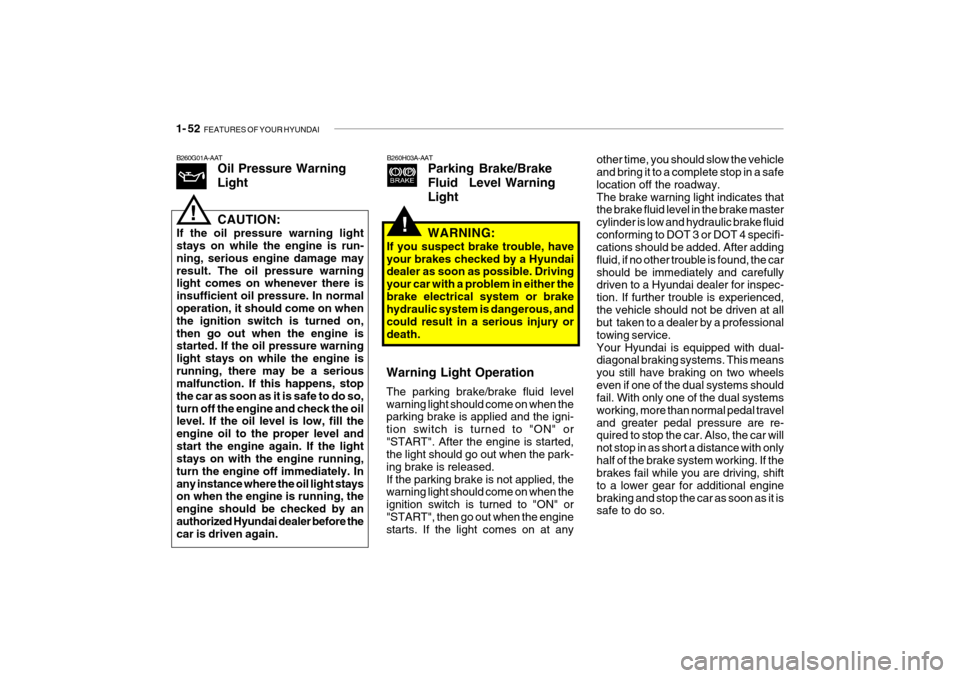
B260H03A-AAT
Parking Brake/Brake
Fluid Level WarningLight
Warning Light Operation The parking brake/brake fluid level warning light should come on when the parking brake is applied and the igni- tion switch is turned to "ON" or"START". After the engine is started, the light should go out when the park- ing brake is released.If the parking brake is not applied, the warning light should come on when the ignition switch is turned to "ON" or"START", then go out when the engine starts. If the light comes on at any WARNING:
If you suspect brake trouble, have your brakes checked by a Hyundai dealer as soon as possible. Driving your car with a problem in either thebrake electrical system or brake hydraulic system is dangerous, and could result in a serious injury ordeath.
!
B260G01A-AAT Oil Pressure Warning Light
!CAUTION:
If the oil pressure warning light stays on while the engine is run- ning, serious engine damage mayresult. The oil pressure warning light comes on whenever there is insufficient oil pressure. In normaloperation, it should come on when the ignition switch is turned on, then go out when the engine is started. If the oil pressure warning light stays on while the engine isrunning, there may be a serious malfunction. If this happens, stop the car as soon as it is safe to do so,turn off the engine and check the oil level. If the oil level is low, fill the engine oil to the proper level andstart the engine again. If the light stays on with the engine running, turn the engine off immediately. Inany instance where the oil light stays on when the engine is running, the engine should be checked by anauthorized Hyundai dealer before the car is driven again.
Page 70 of 256
1- 58 FEATURES OF YOUR HYUNDAI
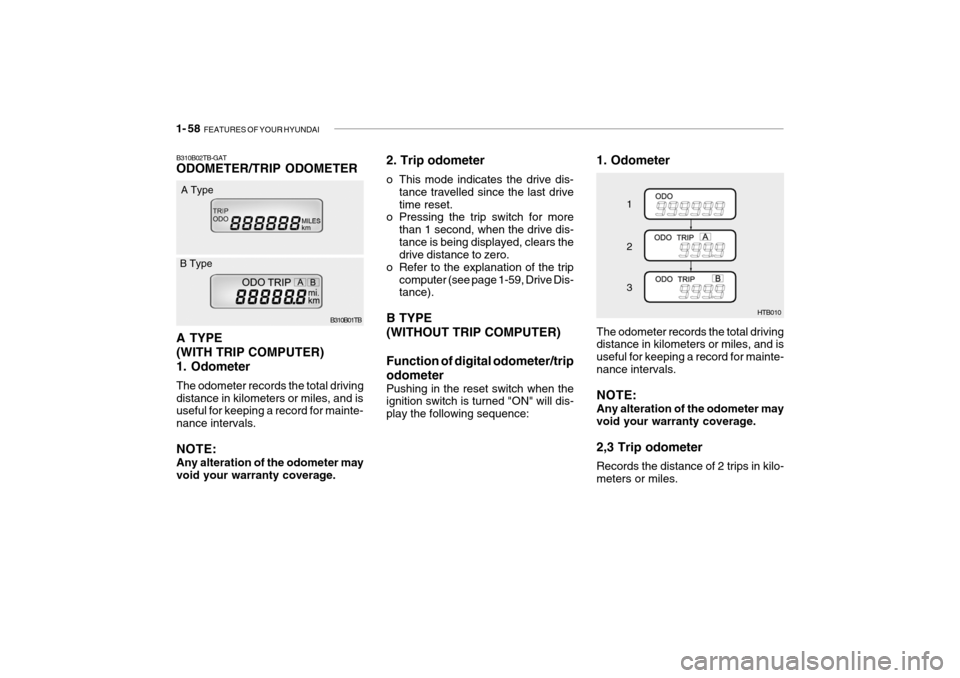
1. Odometer
HTB010
1 2 3
The odometer records the total driving distance in kilometers or miles, and is useful for keeping a record for mainte-nance intervals. NOTE: Any alteration of the odometer may void your warranty coverage. 2,3 Trip odometer Records the distance of 2 trips in kilo- meters or miles.B310B02TB-GAT ODOMETER/TRIP ODOMETER A TYPE (WITH TRIP COMPUTER)1. Odometer The odometer records the total driving distance in kilometers or miles, and is useful for keeping a record for mainte- nance intervals. NOTE: Any alteration of the odometer may void your warranty coverage. B310B01TB
A Type
B Type 2. Trip odometer
o This mode indicates the drive dis-
tance travelled since the last drive time reset.
o Pressing the trip switch for more
than 1 second, when the drive dis-tance is being displayed, clears the drive distance to zero.
o Refer to the explanation of the trip computer (see page 1-59, Drive Dis-tance).
B TYPE (WITHOUT TRIP COMPUTER) Function of digital odometer/trip odometer
Pushing in the reset switch when the ignition switch is turned "ON" will dis- play the following sequence:
Page 71 of 256
FEATURES OF YOUR HYUNDAI 1- 59
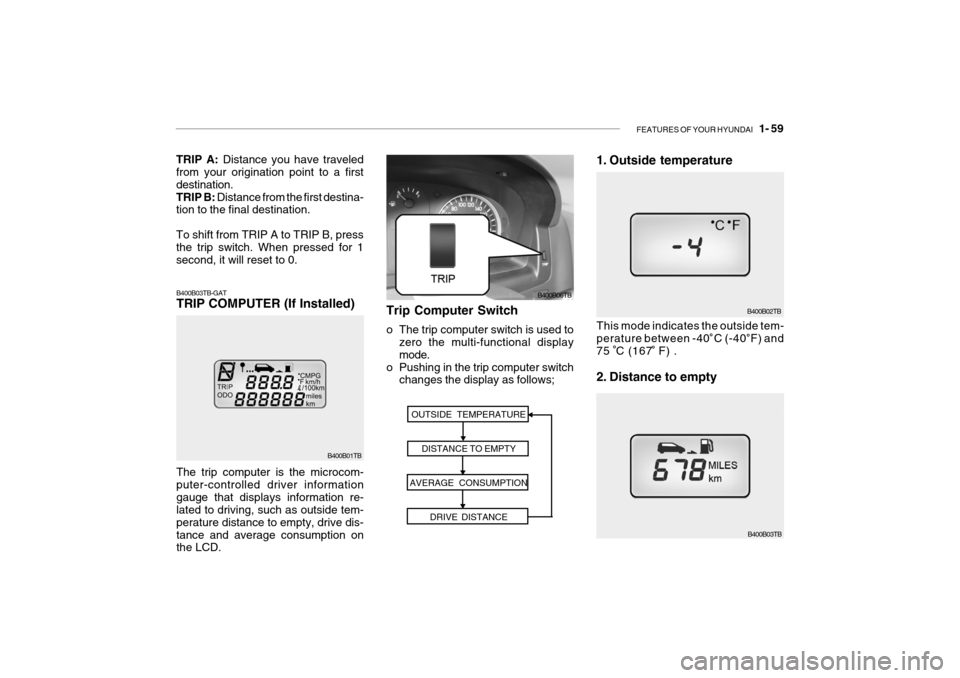
The trip computer is the microcom- puter-controlled driver informationgauge that displays information re- lated to driving, such as outside tem- perature distance to empty, drive dis-tance and average consumption on the LCD.
B400B01TB
B400B03TB-GAT TRIP COMPUTER (If Installed)
TRIP A:
Distance you have traveled
from your origination point to a first destination.TRIP B: Distance from the first destina-
tion to the final destination. To shift from TRIP A to TRIP B, press the trip switch. When pressed for 1 second, it will reset to 0.
OUTSIDE TEMPERATUREDISTANCE TO EMPTY
AVERAGE CONSUMPTION DRIVE DISTANCE
Trip Computer Switch
o The trip computer switch is used tozero the multi-functional display mode.
o Pushing in the trip computer switch changes the display as follows;
B400B06TB
B400B03TB
1. Outside temperature This mode indicates the outside tem- perature between -40 C (-40 F) and
75 C (167 F) .
2. Distance to empty
B400B02TB
Page 72 of 256
1- 60 FEATURES OF YOUR HYUNDAI
B400B04TB
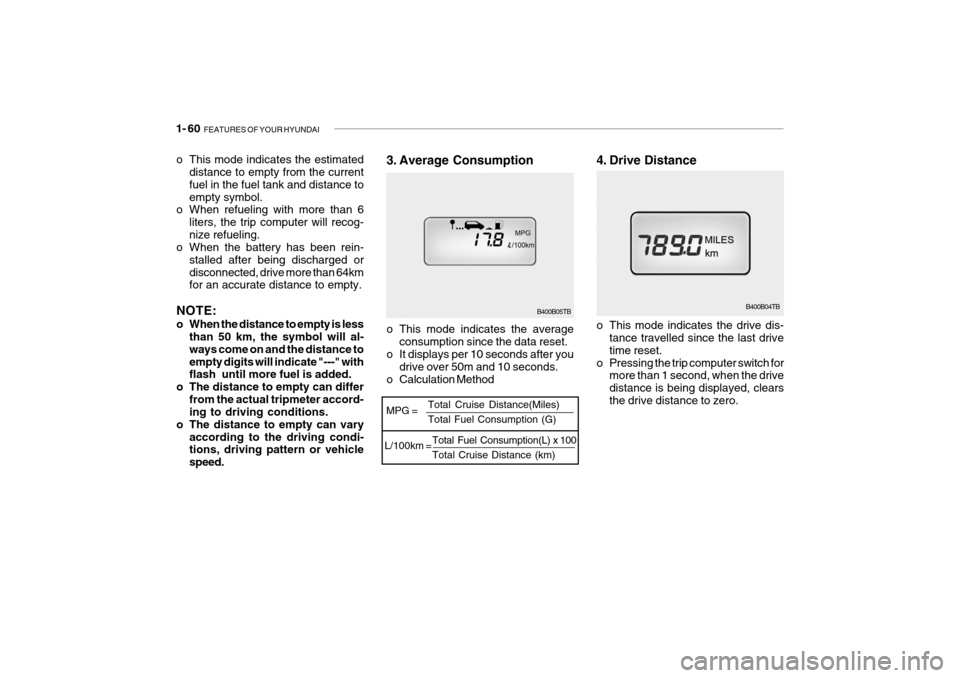
4. Drive Distance
o This mode indicates the drive dis-
tance travelled since the last drive time reset.
o Pressing the trip computer switch for more than 1 second, when the drivedistance is being displayed, clearsthe drive distance to zero.
Total Fuel Consumption(L) x 100 Total Cruise Distance (km)B400B05TB
MPG =
L/100km = Total Cruise Distance(Miles) Total Fuel Consumption (G)
o This mode indicates the estimated
distance to empty from the current fuel in the fuel tank and distance toempty symbol.
o When refueling with more than 6
liters, the trip computer will recog-nize refueling.
o When the battery has been rein-
stalled after being discharged ordisconnected, drive more than 64km for an accurate distance to empty.
NOTE:
o When the distance to empty is less than 50 km, the symbol will al- ways come on and the distance toempty digits will indicate "---" with flash until more fuel is added.
o The distance to empty can differ
from the actual tripmeter accord-ing to driving conditions.
o The distance to empty can vary
according to the driving condi-tions, driving pattern or vehicle speed. 3. Average Consumption
o This mode indicates the average
consumption since the data reset.
o It displays per 10 seconds after you
drive over 50m and 10 seconds.
o Calculation Method
Page 156 of 256
2- 14 DRIVING YOUR HYUNDAI
WARNING:
ABS (ESP) will not prevent accidents due to improper or dangerous driv- ing maneuvers. Even though vehicle control is improved during emer-gency braking, always maintain a safe distance between you and ob- jects ahead. Vehicle speeds shouldalways be reduced during extreme road conditions. The braking distance for cars equipped with an anti-lock braking system may be longer than for those without it in the following road con-ditions.
o Driving on rough, gravel or snow- covered roads.
o Driving with tire chains installed.
o Driving on roads where the road surface is pitted or has different surface height.!
During these conditions, the vehicle should be driven at reduced speeds. The safety features of an ABS (ESP)equipped vehicle should not be tested by high speed driving or cornering. This could endanger the safety ofyourself or others.
CAUTION:
Driving with varying tire or wheel size may cause the ESP system to malfunction. When replacing tires, make sure they are the same size asyour original tires.!
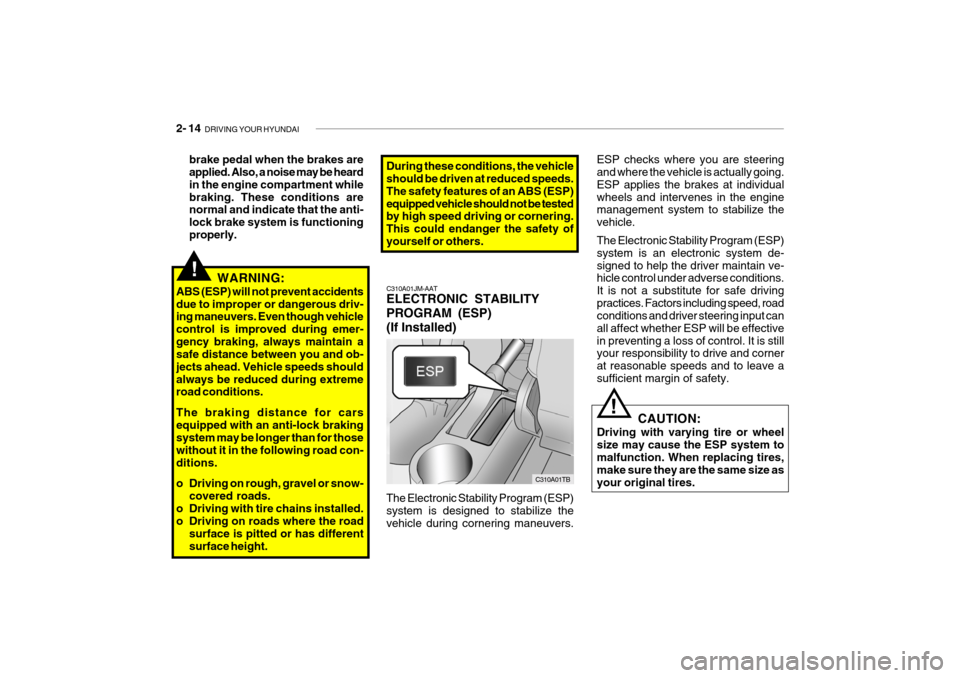
C310A01JM-AAT ELECTRONIC STABILITY PROGRAM (ESP)(If Installed) ESP checks where you are steering and where the vehicle is actually going. ESP applies the brakes at individualwheels and intervenes in the engine management system to stabilize the vehicle. The Electronic Stability Program (ESP) system is an electronic system de-signed to help the driver maintain ve- hicle control under adverse conditions. It is not a substitute for safe drivingpractices. Factors including speed, road conditions and driver steering input can all affect whether ESP will be effectivein preventing a loss of control. It is still your responsibility to drive and corner at reasonable speeds and to leave asufficient margin of safety.
C310A01TB
The Electronic Stability Program (ESP)system is designed to stabilize thevehicle during cornering maneuvers.
brake pedal when the brakes are applied. Also, a noise may be heard in the engine compartment whilebraking. These conditions are normal and indicate that the anti- lock brake system is functioningproperly.
Page 157 of 256
DRIVING YOUR HYUNDAI 2- 15
!WARNING:
Electronic stability program is only a driving aid; all normal precautionsfor driving in inclement weather and on slippery road surfaces should be observed.
C310B01JM-AAT ESP ON/OFF Mode When the ESP is operating, the ESP indicator in the instrument cluster will blink. If you turn the system off by pressingthe ESP switch, the ESP-OFF indica- tor will come on and stay on. In the ESP-OFF mode, the stability controlwill be deactivated. Adjust your driving accordingly. To turn the system back on, press the switch again. The ESP-OFF indicator should go off. NOTE: The ESP mode will automatically be turned ON after the engine is turned off and restarted. C310D01JM-AAT Indicators and Warning The indicators should illuminate when the ignition key is turned to ON orSTART but should go out after three seconds. If the indicators do not illuminate, or theESP or ESP-OFF indicator does not go out after 3 seconds, have the vehicle checked by an authorized dealer. Should there be any unusual conditions in the device while driving, ESP-OFFindicator illuminates as a warning. If ESP-OFF indicator illuminates, pull your car to a safe place and stop theengine. Then, start the engine again to check if the ESP-OFF indicator goes out. If the indicator remains lit even after the engine has been started, have your carchecked by an authorized Hyundai dealer.
C140A02A-GAT DRIVING FOR ECONOMY You can save fuel and get more kilo- meters from your car if you followthese suggestions:
o Drive smoothly. Accelerate at a
moderate rate. Don't make "jack- rabbit" starts or full-throttle shifts and maintain a steady cruisingspeed. Don't race between stop- lights. Try to adjust your speed to that of the other traffic so you don'thave to change speeds unneces- sarily. Avoid heavy traffic whenever possible.Always maintain a safe distance from other vehicles so you can avoid unnecessary braking. This also re-duces brake wear.
o Drive at a moderate speed. The faster
you drive, the more fuel your caruses. Driving at a moderate speed, especially on the highway, is one of the most effective ways to reducefuel consumption.
Page 159 of 256

DRIVING YOUR HYUNDAI 2- 17
C160B01A-GAT Snowy or Icy Conditions To drive your vehicle in deep snow, it may be necessary to use snow tires orto install tire chains on your tires. If snow tires are needed, it is necessary to select tires equivalent in size andtype to the original equipment tires. Failure to do so may adversely affect the safety and handling of your car.Speeding, rapid acceleration, sudden brake applications, and sharp turns are potentially very hazardous prac-tices. During deceleration, use engine braking to the fullest extent. Sudden brake applications on snowy or icyroads may cause skids to occur. You need to keep sufficient distance be- tween the vehicle in front and yourvehicle. Also, apply the brake gently. It should be noted that installing tire chains on the tire will provide a greaterdriving force, but will not prevent side skids. NOTE: Tire chains are not legal in all coun- tries. Check the country laws before fitting tire chains. C160C01A-AAT Use High Quality Ethylene Glycol Coolant Your Hyundai is delivered with high quality ethylene glycol coolant in the cooling system. It is the only type ofcoolant that should be used because it helps prevent corrosion in the cooling system, lubricates the water pump andprevents freezing. Be sure to replace or replenish your coolant in accor- dance with the maintenance schedulein Section 5. Before winter, have your coolant tested to assure that its freez- ing point is sufficient for the tempera-tures anticipated during the winter.
C160D01A-AAT Check Battery and Cables Winter puts additional burdens on the battery system. Visually inspect thebattery and cables as described in Section 6. The level of charge in your battery can be checked by your Hyun-dai dealer or a service station. C160E01A-AAT Change to "Winter Weight" Oil if Necessary In some climates it is recommended that a lower viscosity "winter weight" oil be used during cold weather. See Section 9 for recommendations. If youaren't sure what weight oil you should use, consult your Hyundai dealer.
Page 193 of 256

VEHICLE MAINTENANCE REQUIREMENTS 5- 7
SEVERE DRIVING CONDITIONS
A - Repeatly driving short distance of less than 8km(5miles) in normal
tempera ture or less than 16km(10miles) in freezing temperature
B - Extensive engine idling or low speed driving for long distances
C - Driving on rough, dusty, muddy, unpaved, graveled or salt-spread roads
D - Driving in areas using salt or other corrosive materials or in very cold weather E - Driving in sandy areas
F - Driving in heavy traffic area over 32°C(90°F)
G - Driving on uphill, downhill, or mountain road
H - Towing a Trailer, or using a camper, or roof rack
I - Driving as a patrol car, taxi, other commercial use or vehicle towing
J - Driving over 170 Km/h(100 MPH)
K - Frequently driving in stop-and-go conditions
R R RR
I I I I
RR R
European community Only Except European community
ENGINE OIL AND FILTER AIR CLEANER FILTER SPARK PLUGSTIMING BELT BRAKE PADS, CALIPERS AND ROTORS REAR BRAKE DRUMS/LININGS/PADS,PARKING BRAKE STEERING GEAR BOX, LINKAGE & BOOTS/LOWER ARM BALL JOINTDRIVESHAFTS AND BOOTS MANUAL TRANSAXLE OIL AUTOMATIC TRANSAXLEFLUID
AIR CONDITIONER FILTER (For Evaporator and Blower unit)
F040A02TB-GAT
MAINTENANCE UNDER SEVERE USAGE CONDITIONS
The following items must be serviced more frequently on cars normally used under severe driving conditions. Refer to the chart below for the appropriate maintenance intervals. R : Replace I : Inspect and, after inspection, clean, adjust, repair or replace if necessary
MAINTENANCE ITEM
EVERY 7,500 KM OR 6 MONTHS MORE FREQUENTLY MORE FREQUENTLYEVERY 60,000 KM OR 48 MONTHS MORE FREQUENTLY MORE FREQUENTLY MORE FREQUENTLY EVERY 15,000 KM OR 12 MONTHS EVERY 120,000 KM EVERY 90,000 KMEVERY 100,000 KM MORE FREQUENTLY A, B, C, D, E, F, G, H, I, KC, E B, HD, E, F, G, I C, D, G, H C, D, G, H C, D, E, F C, D, E, F C, D, E, G, H, I, J A, C, E, F, G, H, I C, E
MAINTENANCE
INTERVALS DRIVING
CONDITION
MAINTENANCE
OPERATION
Page 226 of 256
DO-IT-YOURSELF MAINTENANCE 6- 29
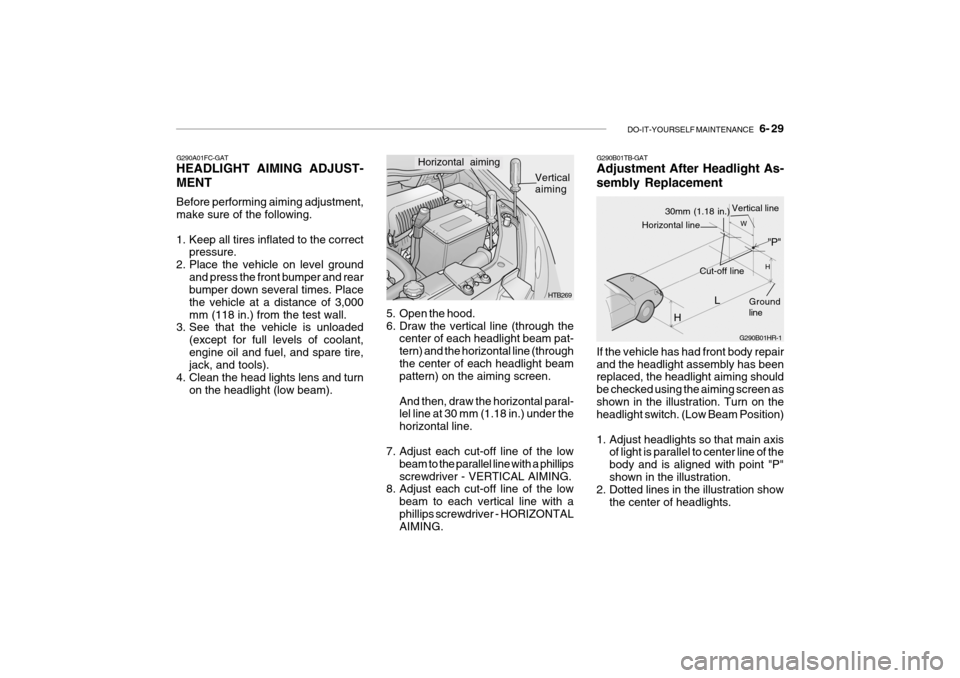
If the vehicle has had front body repair and the headlight assembly has been replaced, the headlight aiming should be checked using the aiming screen asshown in the illustration. Turn on the headlight switch. (Low Beam Position)
1. Adjust headlights so that main axis
of light is parallel to center line of the body and is aligned with point "P"shown in the illustration.
2. Dotted lines in the illustration show
the center of headlights.
G290B01TB-GAT Adjustment After Headlight As- sembly Replacement
G290B01HR-1
L
W
H
H Cut-off line
Ground line
"P"
Horizontal line
30mm (1.18 in.) Vertical line
5. Open the hood.
6. Draw the vertical line (through the
center of each headlight beam pat-tern) and the horizontal line (throughthe center of each headlight beam pattern) on the aiming screen. And then, draw the horizontal paral- lel line at 30 mm (1.18 in.) under the horizontal line.
7. Adjust each cut-off line of the low beam to the parallel line with a phillipsscrewdriver - VERTICAL AIMING.
8. Adjust each cut-off line of the low
beam to each vertical line with aphillips screwdriver - HORIZONTAL AIMING. HTB269
Horizontal aiming
Vertical aiming
G290A01FC-GAT HEADLIGHT AIMING ADJUST- MENT Before performing aiming adjustment, make sure of the following.
1. Keep all tires inflated to the correct
pressure.
2. Place the vehicle on level ground and press the front bumper and rear bumper down several times. Place the vehicle at a distance of 3,000mm (118 in.) from the test wall.
3. See that the vehicle is unloaded
(except for full levels of coolant,engine oil and fuel, and spare tire, jack, and tools).
4. Clean the head lights lens and turn on the headlight (low beam).