Atf Hyundai Grand Santa Fe 2014 Owner's Manual
[x] Cancel search | Manufacturer: HYUNDAI, Model Year: 2014, Model line: Grand Santa Fe, Model: Hyundai Grand Santa Fe 2014Pages: 718, PDF Size: 13.5 MB
Page 534 of 718
589
Driving your vehicle
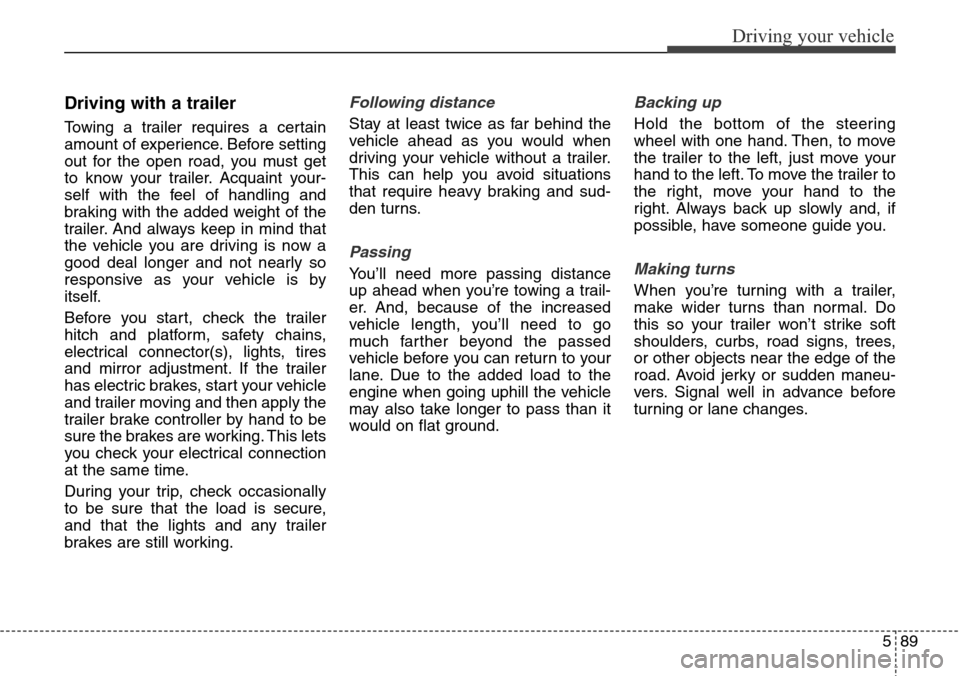
Driving with a trailer
Towing a trailer requires a certain
amount of experience. Before setting
out for the open road, you must get
to know your trailer. Acquaint your-
self with the feel of handling and
braking with the added weight of the
trailer. And always keep in mind that
the vehicle you are driving is now a
good deal longer and not nearly so
responsive as your vehicle is by
itself.
Before you start, check the trailer
hitch and platform, safety chains,
electrical connector(s), lights, tires
and mirror adjustment. If the trailer
has electric brakes, start your vehicle
and trailer moving and then apply the
trailer brake controller by hand to be
sure the brakes are working. This lets
you check your electrical connection
at the same time.
During your trip, check occasionally
to be sure that the load is secure,
and that the lights and any trailer
brakes are still working.
Following distance
Stay at least twice as far behind the
vehicle ahead as you would when
driving your vehicle without a trailer.
This can help you avoid situations
that require heavy braking and sud-
den turns.
Passing
You’ll need more passing distance
up ahead when you’re towing a trail-
er. And, because of the increased
vehicle length, you’ll need to go
much farther beyond the passed
vehicle before you can return to your
lane. Due to the added load to the
engine when going uphill the vehicle
may also take longer to pass than it
would on flat ground.
Backing up
Hold the bottom of the steering
wheel with one hand. Then, to move
the trailer to the left, just move your
hand to the left. To move the trailer to
the right, move your hand to the
right. Always back up slowly and, if
possible, have someone guide you.
Making turns
When you’re turning with a trailer,
make wider turns than normal. Do
this so your trailer won’t strike soft
shoulders, curbs, road signs, trees,
or other objects near the edge of the
road. Avoid jerky or sudden maneu-
vers. Signal well in advance before
turning or lane changes.
Page 683 of 718
Specifications & Consumer information
6 8
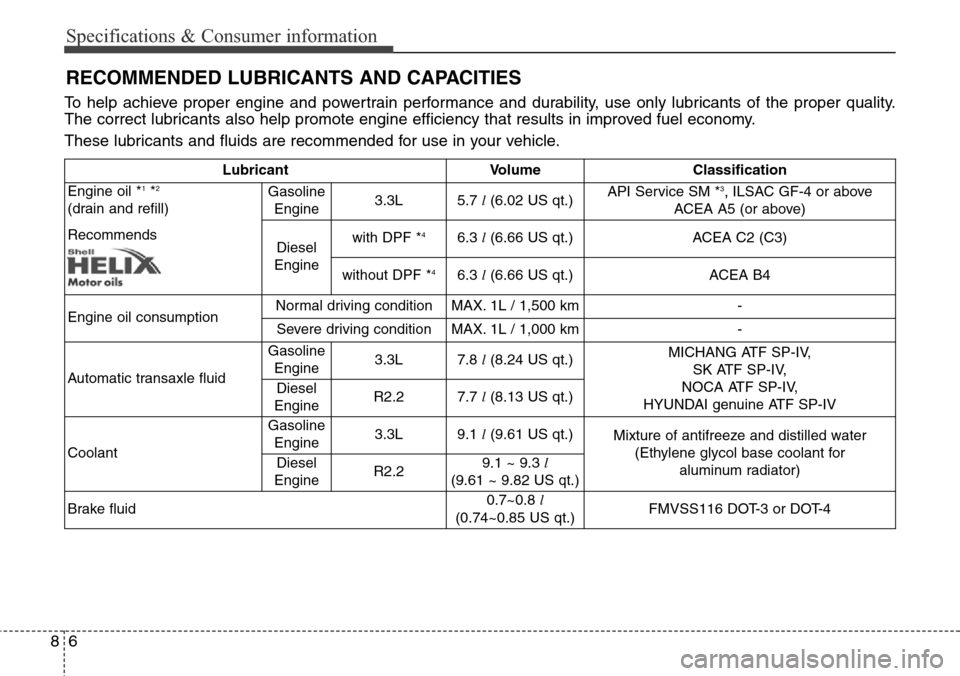
RECOMMENDED LUBRICANTS AND CAPACITIES
To help achieve proper engine and powertrain performance and durability, use only lubricants of the proper quality.
The correct lubricants also help promote engine efficiency that results in improved fuel economy.
These lubricants and fluids are recommended for use in your vehicle.
Lubricant Volume Classification
Engine oil *
1*2
(drain and refill)
RecommendsGasoline
Engine3.3L5.7 l(6.02 US qt.)API Service SM *
3, ILSAC GF-4 or above
ACEA A5 (or above)
Diesel
Enginewith DPF *
46.3 l(6.66 US qt.)
ACEA C2 (C3)
without DPF *
46.3 l(6.66 US qt.)
ACEA B4
Engine oil consumption Normal driving condition MAX. 1L / 1,500 km -
Severe driving condition MAX. 1L / 1,000 km -
Automatic transaxle fluid Gasoline
Engine3.3L7.8 l(8.24 US qt.)MICHANG ATF SP-IV,
SK ATF SP-IV,
NOCA ATF SP-IV,
HYUNDAI genuine ATF SP-IV Diesel
EngineR2.27.7 l(8.13 US qt.)
Coolant
Gasoline
Engine3.3L9.1 l(9.61 US qt.)Mixture of antifreeze and distilled water
(Ethylene glycol base coolant for
aluminum radiator)
Diesel
EngineR2.29.1 ~ 9.3 l
(9.61 ~ 9.82 US qt.)
Brake fluid0.7~0.8 l
(0.74~0.85 US qt.)FMVSS116 DOT-3 or DOT-4