ECU Hyundai Grandeur 2002 User Guide
[x] Cancel search | Manufacturer: HYUNDAI, Model Year: 2002, Model line: Grandeur, Model: Hyundai Grandeur 2002Pages: 230, PDF Size: 3.82 MB
Page 138 of 230
DRIVING YOUR HYUNDAI 2- 9
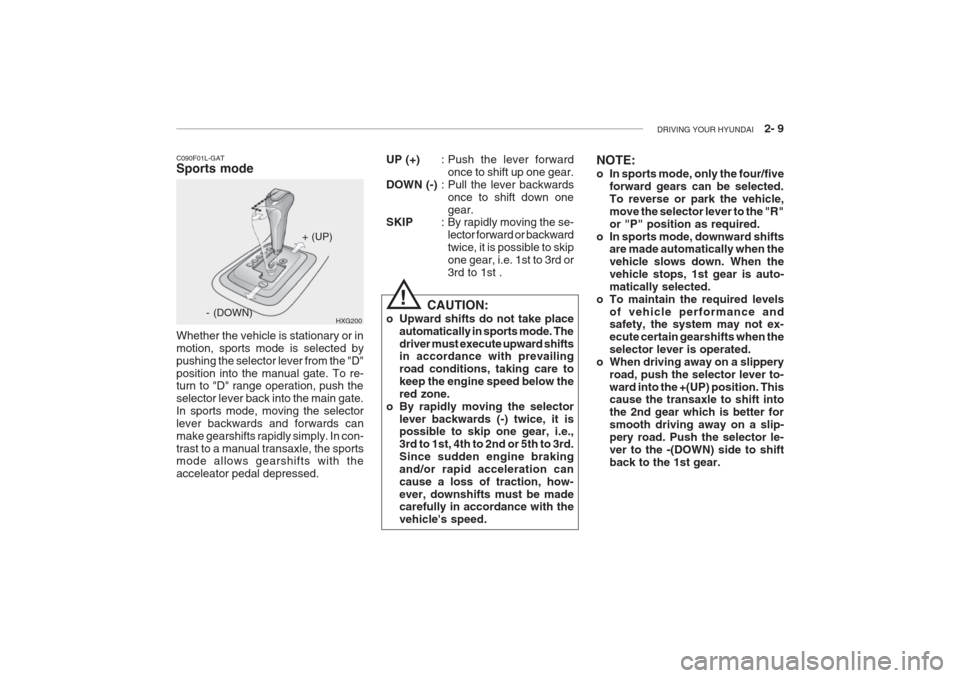
C090F01L-GAT Sports mode Whether the vehicle is stationary or in motion, sports mode is selected bypushing the selector lever from the "D"position into the manual gate. To re-
turn to "D" range operation, push the selector lever back into the main gate.In sports mode, moving the selectorlever backwards and forwards canmake gearshifts rapidly simply. In con-trast to a manual transaxle, the sports mode allows gearshifts with the acceleator pedal depressed. HXG200
+ (UP)
- (DOWN) UP (+)
: Push the lever forward
once to shift up one gear.
DOWN (-) : Pull the lever backwards
once to shift down onegear.
SKIP : By rapidly moving the se-
lector forward or backwardtwice, it is possible to skipone gear, i.e. 1st to 3rd or3rd to 1st . NOTE:
o In sports mode, only the four/five
forward gears can be selected. To reverse or park the vehicle,move the selector lever to the "R"or "P" position as required.
o In sports mode, downward shifts are made automatically when thevehicle slows down. When thevehicle stops, 1st gear is auto-matically selected.
o To maintain the required levels
of vehicle performance and safety, the system may not ex- ecute certain gearshifts when theselector lever is operated.
o When driving away on a slippery road, push the selector lever to-ward into the +(UP) position. This cause the transaxle to shift into the 2nd gear which is better forsmooth driving away on a slip-pery road. Push the selector le-ver to the -(DOWN) side to shiftback to the 1st gear.
! CAUTION:
o Upward shifts do not take place automatically in sports mode. The driver must execute upward shifts in accordance with prevailing road conditions, taking care tokeep the engine speed below thered zone.
o By rapidly moving the selector lever backwards (-) twice, it is possible to skip one gear, i.e., 3rd to 1st, 4th to 2nd or 5th to 3rd.Since sudden engine brakingand/or rapid acceleration can
cause a loss of traction, how-ever, downshifts must be made carefully in accordance with the vehicle's speed.
Page 147 of 230
2- 18 DRIVING YOUR HYUNDAI
C190C01Y-GAT Trailer Brakes If your trailer is equipped with a braking system, make sure it conforms to fed-eral and/or local regulations and that it
is properly installed and operating cor-rectly. NOTE: If you tow a trailer or vehicle, your car will require more frequent main-tenance due to the additional load.See "Maintenance Under SevereUsage Conditions" on page 5-6.
CAUTION:
o Never connect a trailer brake sys- tem directly to the vehicle brakesystem.
o When towing a trailer on steep grades (in excess of 12%) pay
close attention to the engine cool- ant temperature gauge to ensure
the engine does not overheat. Ifthe needle of the coolant tem-
perature gauge moves across thedial towards "H" (HOT), pull over and stop as soon as it is safe to
C190B01S-AATTrailer Hitches Select the proper hitch and ball combi- nation, making sure that it's location is compatible with that of the trailer or vehicle being towed.Use a quality non-equalizing hitch whichdistributes the tongue load uniformlythroughout the chassis. The hitch should be bolted securely to the car and installed by a qualifiedtechnician. DO NOT USE A HITCHDESIGNED FOR TEMPORARY IN-STALLATION AND NEVER USE ONETHAT ATTACHES ONLY TO THE BUMPER.
C180A01A-AAT USE OF LIGHTS Check your lights regularly for correct operation and always keep them clean.When driving during the day in condi-tions of poor visibility, it is helpful todrive with headlights on low beam. This enables you to be seen as well as to see. C190A01A-GAT TRAILER OR VEHICLE TOWING If you are considering towing with your car, you should first check with your Province Department of Motor Vehiclesto determine their legal requirements.Since laws vary from province to prov-ince the requirements for towing trail- ers, cars, or other types of vehicles or apparatus may differ. Ask your Hyundaidealer for further details before towing.
CAUTION:
Do not do any towing with your carduring its first 2,000 km (1,200 miles)in order to allow the engine to prop-erly break in. Failure to heed thiscaution may result in serious en- gine or transaxle damage.
!
!
Page 149 of 230
2- 20 DRIVING YOUR HYUNDAI
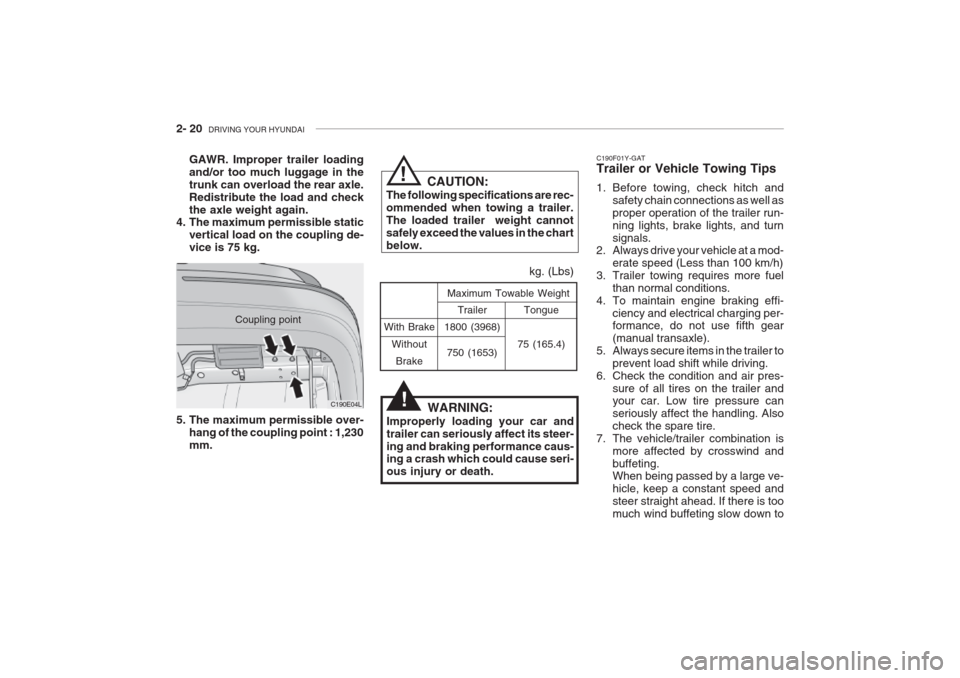
With Brake
WithoutBrake Tongue
75 (165.4)
Maximum Towable Weight
kg. (Lbs)
Trailer
1800 (3968)
750 (1653)
WARNING:
Improperly loading your car and trailer can seriously affect its steer-ing and braking performance caus- ing a crash which could cause seri- ous injury or death. C190F01Y-GAT Trailer or Vehicle Towing Tips
1. Before towing, check hitch and
safety chain connections as well as proper operation of the trailer run-ning lights, brake lights, and turnsignals.
2. Always drive your vehicle at a mod-
erate speed (Less than 100 km/h)
3. Trailer towing requires more fuel
than normal conditions.
4. To maintain engine braking effi-
ciency and electrical charging per- formance, do not use fifth gear (manual transaxle).
5. Always secure items in the trailer to prevent load shift while driving.
6. Check the condition and air pres-
sure of all tires on the trailer and your car. Low tire pressure can seriously affect the handling. Alsocheck the spare tire.
7. The vehicle/trailer combination is more affected by crosswind andbuffeting. When being passed by a large ve- hicle, keep a constant speed andsteer straight ahead. If there is toomuch wind buffeting slow down to
Coupling point
C190E04L
GAWR. Improper trailer loadingand/or too much luggage in thetrunk can overload the rear axle.Redistribute the load and checkthe axle weight again.
4. The maximum permissible static
vertical load on the coupling de-vice is 75 kg. CAUTION:
The following specifications are rec-ommended when towing a trailer.The loaded trailer weight cannotsafely exceed the values in the chartbelow.
!
!
5. The maximum permissible over- hang of the coupling point : 1,230 mm.
Page 150 of 230
DRIVING YOUR HYUNDAI 2- 21
14.When going down a hill, shift into a
lower gear and use the engine brak- ing effect.When ascending a long grade,downshift the transaxle to a lower gear and reduce speed to reduce chances of engine overloading and/or overheating.
15.If you have to stop while going uphill, do not hold the vehicle inplace by pressing on the accelera- tor. This can cause the automatic transaxle to overheat. Use the park-ing brake or footbrake.
NOTE: When towing, check transaxle fluid more frequently.
CAUTION:
If overheating should occur whentowing, (temperature gauge readsnear red zone), taking the followingaction may reduce or eliminate theproblem.
get out of the other vehicle's airturbulence.
8. When parking your car and trailer,
especially on a hill, be sure to followall the normal precautions. Turn your front wheel into the curb, set the parking brake firmly, and putthe transaxle in 1st or Reverse(manual) or Park (automatic). Inaddition, place wheel chocks ateach of the trailer's tires.
9. If the trailer has electric brakes,
start your vehicle and trailer mov-ing, and then apply the trailer brakecontroller by hand to be sure thebrakes are working. This lets youcheck your electrical connection at the same time.
10.During your trip, check occasion- ally to be sure that the load is secure, and that the lights and anytrailer brakes are still working.
11.Avoid jerky starts, sudden accel- eration or sudden stops.
12.Avoid sharp turns and rapid lane changes.
13.Avoid holding the brake pedal down too long or too frequently. This couldcause the brakes to overheat, re- sulting in reduced braking efficien- cy. 1. Turn off the air conditioner.
2. Reduce highway speed.
3. Select a lower gear when going
uphill.
4. While in stop and go traffic, place the gear selector in park or neutraland idle the engine at a higher speed.
!
Page 152 of 230
3- 2 WHAT TO DO IN AN EMERGENCY
D010A01A-AAT IF THE ENGINE WILL NOT START
WARNING:
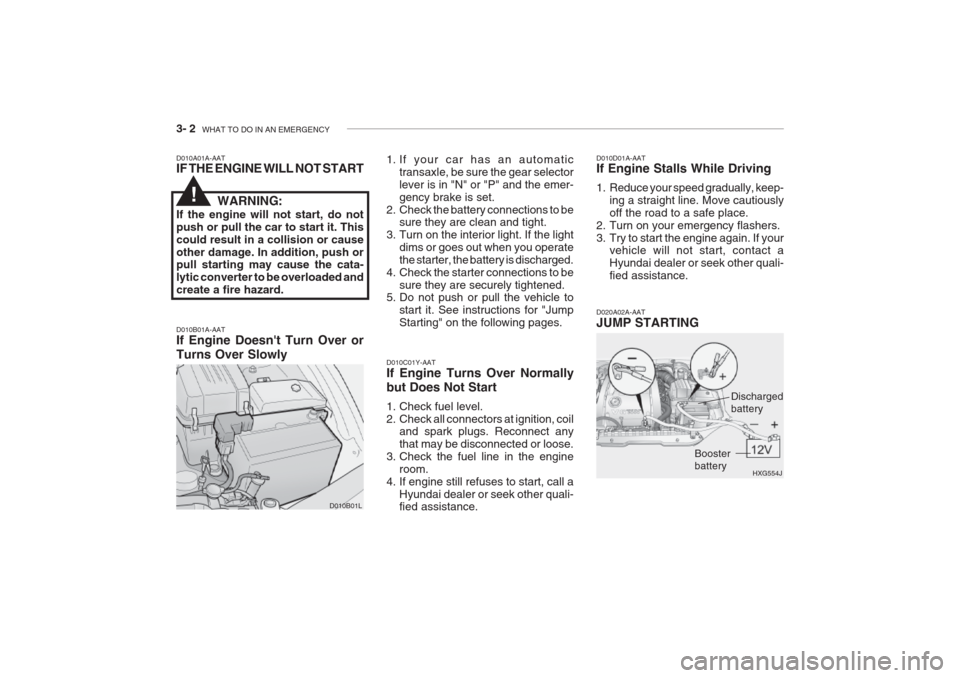
If the engine will not start, do not push or pull the car to start it. Thiscould result in a collision or causeother damage. In addition, push or pull starting may cause the cata- lytic converter to be overloaded andcreate a fire hazard. D010B01A-AAT If Engine Doesn't Turn Over or Turns Over Slowly 1. If your car has an automatic
transaxle, be sure the gear selector lever is in "N" or "P" and the emer-gency brake is set.
2. Check the battery connections to be sure they are clean and tight.
3. Turn on the interior light. If the light dims or goes out when you operatethe starter, the battery is discharged.
4. Check the starter connections to be sure they are securely tightened.
5. Do not push or pull the vehicle to
start it. See instructions for "JumpStarting" on the following pages. D010D01A-AAT If Engine Stalls While Driving
1. Reduce your speed gradually, keep-
ing a straight line. Move cautiously off the road to a safe place.
2. Turn on your emergency flashers.
3. Try to start the engine again. If your vehicle will not start, contact aHyundai dealer or seek other quali-fied assistance.
D010C01Y-AAT If Engine Turns Over Normally but Does Not Start
1. Check fuel level.
2. Check all connectors at ignition, coil and spark plugs. Reconnect anythat may be disconnected or loose.
3. Check the fuel line in the engine
room.
4. If engine still refuses to start, call a Hyundai dealer or seek other quali- fied assistance.
D010B01L
D020A02A-AAT JUMP STARTING
HXG554J
Dischargedbattery
Booster battery
!
Page 160 of 230
3- 10 WHAT TO DO IN AN EMERGENCY
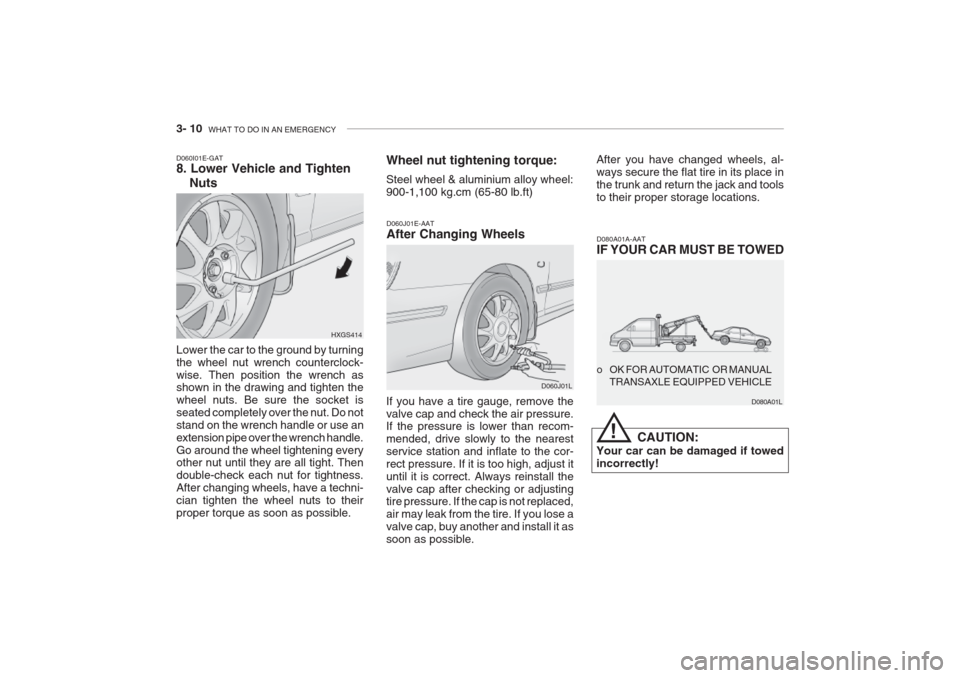
Lower the car to the ground by turning the wheel nut wrench counterclock-wise. Then position the wrench as shown in the drawing and tighten the wheel nuts. Be sure the socket isseated completely over the nut. Do notstand on the wrench handle or use anextension pipe over the wrench handle.Go around the wheel tightening every other nut until they are all tight. Then double-check each nut for tightness.After changing wheels, have a techni-cian tighten the wheel nuts to theirproper torque as soon as possible.
D060I01E-GAT 8. Lower Vehicle and Tighten
Nuts
HXGS414Wheel nut tightening torque: Steel wheel & aluminium alloy wheel: 900-1,100 kg.cm (65-80 lb.ft)
D060J01E-AAT After Changing Wheels
If you have a tire gauge, remove the valve cap and check the air pressure. If the pressure is lower than recom- mended, drive slowly to the nearestservice station and inflate to the cor-rect pressure. If it is too high, adjust ituntil it is correct. Always reinstall thevalve cap after checking or adjusting tire pressure. If the cap is not replaced, air may leak from the tire. If you lose avalve cap, buy another and install it assoon as possible. D060J01LAfter you have changed wheels, al-ways secure the flat tire in its place inthe trunk and return the jack and toolsto their proper storage locations.
D080A01A-AAT IF YOUR CAR MUST BE TOWED
CAUTION:
Your car can be damaged if towed incorrectly! o OK FOR AUTOMATIC OR MANUAL
TRANSAXLE EQUIPPED VEHICLE
D080A01L
!
Page 175 of 230
VEHICLE MAINTENANCE REQUIREMENTS 5- 7
F060A01A-AAT EXPLANATION OF SCHEDULED MAINTENANCE ITEMS F060M01A-AAT
o Engine Oil and Filter The engine oil and filter should be changed at the intervals specified in the maintenance schedule. If the caris being driven in severe conditions,more frequent oil and filter changesare required. F060B01A-AAT
o Drive Belts Inspect all drive belts for evidence of cuts, cracks, excessive wear or oil and replace if necessary. Drive belts should be checked periodically forproper tension and adjusted as nec-essary. After installing a new filter, run theengine for several minutes, and checkfor leaks at the connections. Fuelfilters should be installed by trainedtechnicians. F060D01A-AAT
o Fuel Lines, Fuel Hoses and
Connections
Check the fuel lines, fuel hoses and connections for leakage and damage. Have a trained technician replace anydamaged or leaking parts immedi-ately. F060E01A-AAT
o Timing Belt Inspect all parts related to the timing belt for damage and deformation.Replace any damaged parts immedi-ately. F060G01A-AAT
o Vapor Hose and Fuel Filler Cap The vapor hose and fuel filler cap should be inspected at those inter-vals specified in the maintenanceschedule. Make sure that a new va-por hose or fuel filler cap is correctlyreplaced. F060F01A-AAT
o Vacuum, Crankcase Ventila-
tion Hoses
Inspect the surface of hoses for evi-
dence of heat and/or mechanical dam-age. Hard and brittle rubber, crack-ing, tears, cuts, abrasions, and ex- cessive swelling indicate deteriora- tion. Particular attention should bepaid to examine those hose surfacesnearest to high heat sources, such asthe exhaust manifold. Inspect the hose routing to assure
that the hoses do not come in contactwith any heat source, sharp edges ormoving component which might cause heat damage or mechanical wear. Inspect all hose connections, such asclamps and couplings, to make surethey are secure, and that no leaks arepresent. Hoses should be replacedimmediately if there is any evidence of deterioration or damage.
F060C01A-AAT
o Fuel Filter A clogged filter can limit the speed at which the vehicle may be driven, dam-age the emission system and causehard starting. If an excessive amountof foreign matter accumulates in thefuel tank, the filter may require re- placement more frequently.
Page 186 of 230
DO-IT-YOURSELF MAINTENANCE 6- 9
G050D02A-AAT To Change the Engine Coolant The engine coolant should be changed at those intervals specified in the ve- hicle maintenance schedule in Sec-tion 5.
CAUTION:
Engine coolant can damage thefinish of your car. If you spill en- gine coolant on the car, wash it off thoroughly with clean water.
1. Park the car on level ground, set the parking brake and remove the radiator cap when cool.
2. Be sure your drain receptacle is in place. Open the drain cock on theradiator. Allow all the engine coolant to drain from the cooling system,then securely close the drain cock.
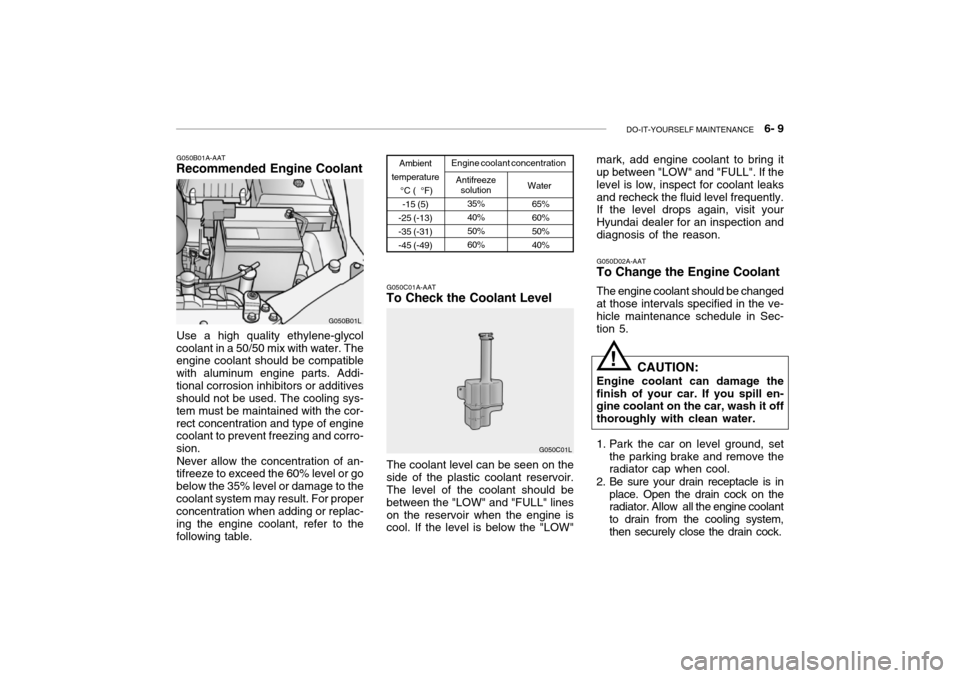
Use a high quality ethylene-glycol
coolant in a 50/50 mix with water. The engine coolant should be compatible with aluminum engine parts. Addi-tional corrosion inhibitors or additives should not be used. The cooling sys- tem must be maintained with the cor-rect concentration and type of engine coolant to prevent freezing and corro- sion.
Never allow the concentration of an-
tifreeze to exceed the 60% level or gobelow the 35% level or damage to thecoolant system may result. For proper concentration when adding or replac- ing the engine coolant, refer to thefollowing table.
Ambient
temperature °C ( °F)-15 (5)
-25 (-13) -35 (-31)-45 (-49) Engine coolant concentration
Antifreeze solution
Water
G050C01A-AAT
To Check the Coolant Level
The coolant level can be seen on the side of the plastic coolant reservoir. The level of the coolant should be between the "LOW" and "FULL" lineson the reservoir when the engine is cool. If the level is below the "LOW" G050C01L
65% 60%50%40%
35%40%50%60%
G050B01A-AAT
Recommended Engine Coolant
G050B01L mark, add engine coolant to bring it up between "LOW" and "FULL". If the level is low, inspect for coolant leaksand recheck the fluid level frequently. If the level drops again, visit your Hyundai dealer for an inspection anddiagnosis of the reason.
!
Page 211 of 230

6- 34 DO-IT-YOURSELF MAINTENANCE
G200C01L-GAT JUNCTION BOX DESCRIPTION Under Hood Junction Box
G200C01L
NOTE: Not all junction box description in this manual
may be applicable to your vehicle. It is accurate at the time of printing. When you inspect the junction box on your vehicle, refer to the junction box label. DESCRIPTION
FUEL PUMP
HEAD LIGHT(Lo-LH) ABS
INJECTOR
A/C COMPRESSOR A/T
MAIN
IGNITION COIL
OXYGEN SENSOR EGR
HORN
HEAD LIGHT(HI)
HEAD LIGHT(Lo-RH) DRL
FOG LIGHT DIODE 1
SPARE
SPARE
SPARE
SPARE
DIODE 2
BLOWER
POWER FUSE 2 POWER AMPSUNROOF
TAIL LIGHT
POWER FUSE 1 ECU
REAR DEFOGGER CONDENSER
POWER WINDOW IGNITION1/2ABS 1/2
RADIATOR FUSE
RATING
20A15A10A10A10A20A30A 20A 15A 15A10A15A20A15A15A 30A 20A15A10A 30A 30A20A15A20A30A10A30A20A40A
30A/30A30A/30A 30A PROTECTED COMPONENTS
Fuel pump relay
Head light relay (Low-LH)
ABS controls, Cruise control module, ETS control module
Limp home valve, ETS controls, Injector
A/C relay
A/T control relay, TCM, Engine control relayMFI controls
Ignition coil, A/T pulse generator, ECM, Ignition failure
sensor, E/TCM
ETS relay, MFI controls
A/C relay, MFI controls, EGR solenoid
Horn relay
Head light relay (High)
HID head light relay
DRL control module, Siren
Fog light relay - -----
Blower relayFuse 4, 20, 24, 25
Audio amp module
Data link connector, Sunroof relay, Home link connector
Tail light relayFuse 1, 7, 17, 18, 19
ETS control module, ECM, E/TCM, Generator
Rear window defogger relay
A/C fan relay #1
Power window relay, IMS controls
Ignition switchABS controlsRadiator fan relay