ABS Hyundai Grandeur 2003 Owner's Manual
[x] Cancel search | Manufacturer: HYUNDAI, Model Year: 2003, Model line: Grandeur, Model: Hyundai Grandeur 2003Pages: 235, PDF Size: 14.25 MB
Page 14 of 235

YOUR VEHICLE AT A GLANCE
Turn Signal Indicator Lights ABS Service Reminder Indicator Traction Control Indicator Light Seat Belt Warning LightHigh Beam Indicator Light Trunk Lid Open Warning Light Front Fog Indicator LightLow Oil Pressure Warning LightParking Brake/Low Brake Fluid Level Warning Light Charging System Warning Light Door Ajar Warning Light and Chime Low Fuel Level Warning Light SRS (Airbag) Service Reminder Indicator Cruise Indicator Light Stop/Tail Light Failure Warning Light Malfunction Indicator Light
B255A01L-GAT INDICATOR SYMBOLS ON THE INSTRUMENT PANEL * More detailed explanations of these items will be found beginning on page 1-42
Page 17 of 235
FEATURES OF YOUR HYUNDAI 1- 3
B010F01A-AAT Operation in Foreign Countries If you are going to drive your Hyundai in another country, be sure to:
o Observe all regulations regarding
registration and insurance.
o Determine that acceptable fuel is available.
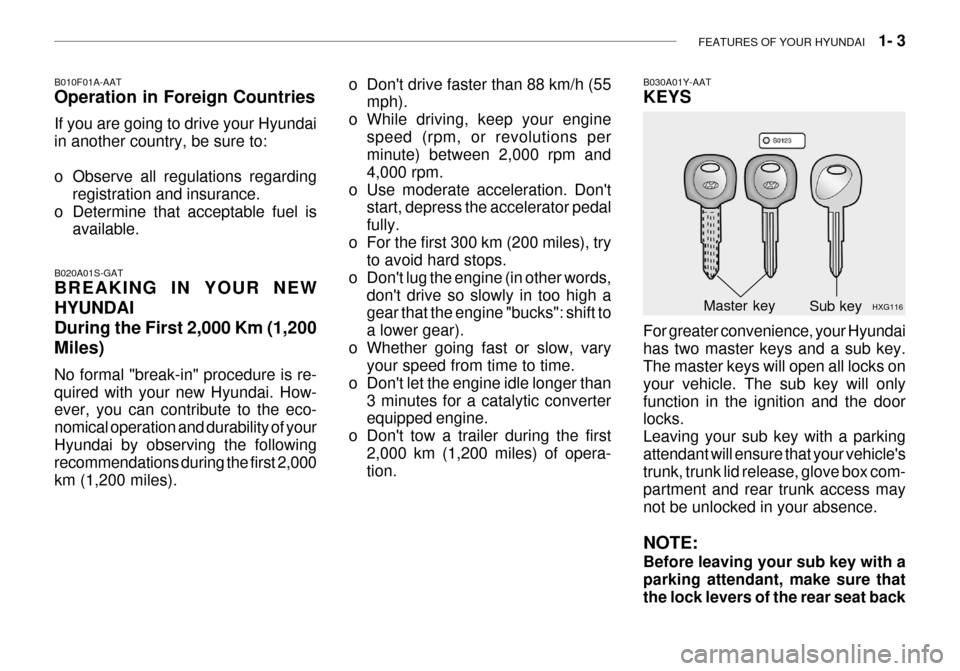
B020A01S-GAT BREAKING IN YOUR NEW HYUNDAI During the First 2,000 Km (1,200 Miles) No formal "break-in" procedure is re- quired with your new Hyundai. How- ever, you can contribute to the eco- nomical operation and durability of yourHyundai by observing the following recommendations during the first 2,000 km (1,200 miles). B030A01Y-AAT KEYS For greater convenience, your Hyundai has two master keys and a sub key. The master keys will open all locks on your vehicle. The sub key will onlyfunction in the ignition and the door locks. Leaving your sub key with a parkingattendant will ensure that your vehicle's trunk, trunk lid release, glove box com- partment and rear trunk access maynot be unlocked in your absence. NOTE: Before leaving your sub key with a parking attendant, make sure thatthe lock levers of the rear seat back
HXG116
Master key Sub key
o Don't drive faster than 88 km/h (55
mph).
o While driving, keep your engine speed (rpm, or revolutions per minute) between 2,000 rpm and 4,000 rpm.
o Use moderate acceleration. Don't start, depress the accelerator pedalfully.
o For the first 300 km (200 miles), try to avoid hard stops.
o Don't lug the engine (in other words, don't drive so slowly in too high a gear that the engine "bucks": shift to a lower gear).
o Whether going fast or slow, vary your speed from time to time.
o Don't let the engine idle longer than 3 minutes for a catalytic converter equipped engine.
o Don't tow a trailer during the first 2,000 km (1,200 miles) of opera-tion.
Page 18 of 235
1- 4 FEATURES OF YOUR HYUNDAI
B030B01L B880A01A-GAT IMMOBILIZER SYSTEM (If installed) The immobilizer system is an anti-theft device, designed to deter automobile theft.
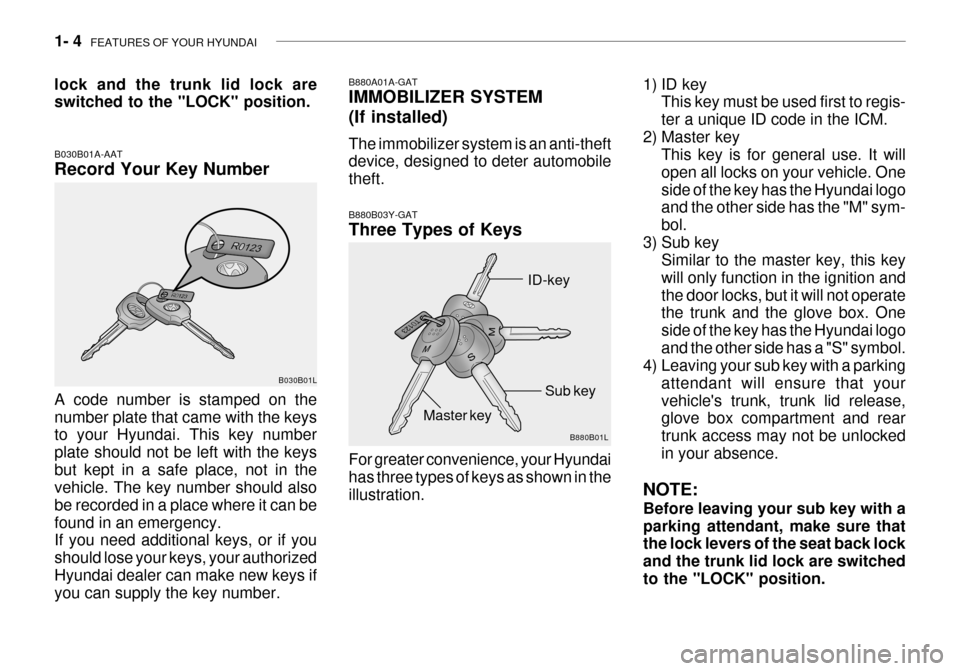
B030B01A-AAT Record Your Key Number A code number is stamped on the number plate that came with the keys to your Hyundai. This key number plate should not be left with the keysbut kept in a safe place, not in the vehicle. The key number should also be recorded in a place where it can befound in an emergency. If you need additional keys, or if you should lose your keys, your authorizedHyundai dealer can make new keys if you can supply the key number. B880B03Y-GAT Three Types of Keys
1) ID key
This key must be used first to regis- ter a unique ID code in the ICM.
2) Master key This key is for general use. It willopen all locks on your vehicle. Oneside of the key has the Hyundai logo and the other side has the "M" sym- bol.
3) Sub key Similar to the master key, this keywill only function in the ignition andthe door locks, but it will not operate the trunk and the glove box. One side of the key has the Hyundai logoand the other side has a "S" symbol.
4) Leaving your sub key with a parking
attendant will ensure that yourvehicle's trunk, trunk lid release, glove box compartment and rear trunk access may not be unlockedin your absence.
NOTE: Before leaving your sub key with a parking attendant, make sure that the lock levers of the seat back lock and the trunk lid lock are switchedto the "LOCK" position.
For greater convenience, your Hyundaihas three types of keys as shown in theillustration. ID-key
Master key Sub key
B880B01L
lock and the trunk lid lock are switched to the "LOCK" position.
Page 37 of 235
FEATURES OF YOUR HYUNDAI 1- 23
WARNING:
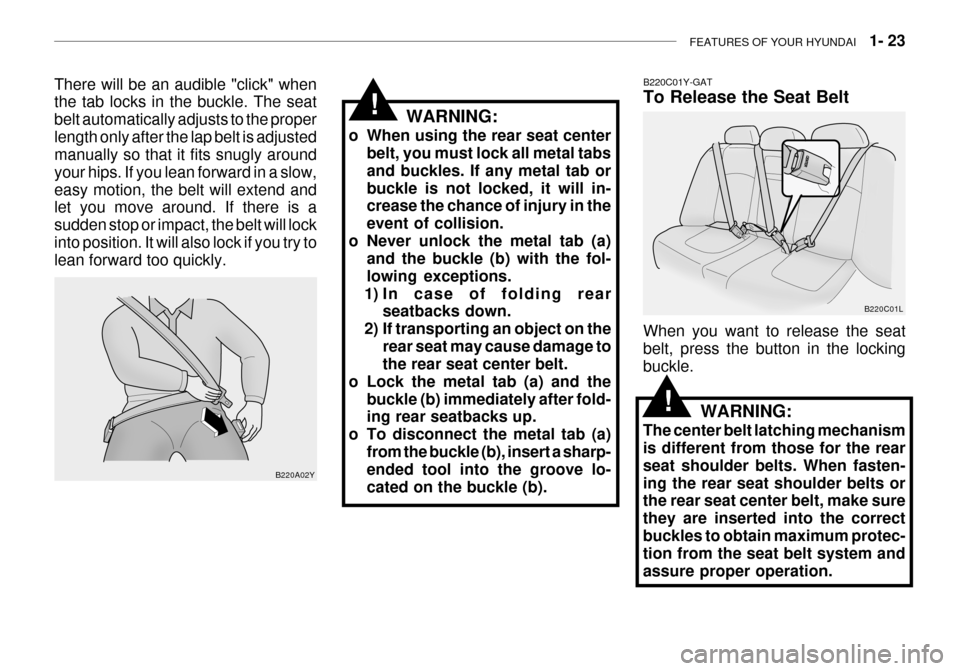
o When using the rear seat center belt, you must lock all metal tabs and buckles. If any metal tab orbuckle is not locked, it will in- crease the chance of injury in the event of collision.
o Never unlock the metal tab (a) and the buckle (b) with the fol-lowing exceptions.
1) In case of folding rear seatbacks down.
2) If transporting an object on the rear seat may cause damage to the rear seat center belt.
o Lock the metal tab (a) and the buckle (b) immediately after fold-ing rear seatbacks up.
o To disconnect the metal tab (a) from the buckle (b), insert a sharp-ended tool into the groove lo- cated on the buckle (b).!
B220C01L
B220C01Y-GAT To Release the Seat Belt When you want to release the seat belt, press the button in the locking buckle.
WARNING:
The center belt latching mechanismis different from those for the rear seat shoulder belts. When fasten-ing the rear seat shoulder belts or the rear seat center belt, make sure they are inserted into the correctbuckles to obtain maximum protec- tion from the seat belt system and assure proper operation.
!
B220A02Y
There will be an audible "click" when the tab locks in the buckle. The seat belt automatically adjusts to the properlength only after the lap belt is adjusted manually so that it fits snugly around your hips. If you lean forward in a slow,easy motion, the belt will extend and let you move around. If there is a sudden stop or impact, the belt will lockinto position. It will also lock if you try to lean forward too quickly.
Page 56 of 235

1- 42 FEATURES OF YOUR HYUNDAI
B260C02L-GAT
TRACTION CONTROL INDICATOR LIGHT(If installed)
The traction control indicators change operations according to the switch conditions and whether the system is in operation or not. They will also illu-minate when the ignition key is turned to the "ON" or "START" position, but should go out after three seconds. Ifthe TCS indicator stays on, take your car to your authorized Hyundai dealer and have the system checked. Seesection 2 for more information about the TCS system.
B260D01A-AAT TURN SIGNAL INDICATOR LIGHTS
The blinking green arrows on the in- strument panel show the direction indi- cated by the turn signals. If the arrowcomes on but does not illuminate, blinks more rapidly than normal, or does not illuminate at all, a malfunction in theturn signal system is indicated. Your dealer should be consulted for repairs. B260F01A-AAT
HIGH BEAM INDICATOR LIGHT
The high beam indicator light comes on whenever the headlights areswitched to the high beam or flash position.
B260E01L-GAT
SEAT BELT WARNING LIGHT
The seat belt warning light blinks for about 6 seconds when the ignition key is turned from the "OFF" position to"ON" or "START". B260K01S-AAT TRUNK LID OPEN WARNING LIGHT
This light remains on unless the trunk lid is completely closed.
B260P01L-GAT
ABS SERVICE REMINDER INDICATOR
When the key is turned to the "ON" position, the Anti-Lock Brake System SRI will come on and then go off in a few seconds. If the ABS SRI remainson, comes on while driving, or does not come on when the key is turned to the "ON" position, this indicates that theremay be a problem with the ABS. If this occurs, have your vehicle checked by your Hyundai dealer assoon as possible. The normal braking system will still be operational, but without the assistance of the anti-lockbrake system. WARNING:
If the both ABS SRI and ParkingBrake/Brake fluid level warninglights remain "ON" or come on while driving, there may be a problem
with E.B.D. (Electronic Brake ForceDistribution). If this occurs, avoid sudden stops and have your vehicle checked byyour Hyundai dealer as soon as possible.
!
Page 133 of 235

2. DRIVING YOUR HYUNDAIBefore Starting the Engine ............................................................. 2-3
Key Positions .................................................................................. 2-3Starting ............................................................................................ 2-4
Operating the Manual Transaxle .................................................... 2-5
Automatic Transaxle ....................................................................... 2-7
Anti-Lock Brake System (ABS) ..................................................... 2-11
Traction Control System (TCS) ..................................................... 2-12
Good Braking Practices ................................................................ 2-13
Driving for Economy ..................................................................... 2-14
Winter Driving ............................................................................... 2-16
Trailer or Vehicle Towing .............................................................. 2-18
2
Page 143 of 235

DRIVING YOUR HYUNDAI 2- 11
C120A02A-AAT ANTI-LOCK BRAKE SYSTEM (If installed) The Anti-Lock Brake System (ABS) is designed to prevent wheel lock-up during sudden braking or on hazard-ous road surfaces. The ABS control module monitors the wheel speed and controls the pressure applied to eachbrake. Thus, in emergency situations or on slick roads, ABS will increase vehicle control during braking. NOTE: During ABS operation, a slight pul- sation may be felt in the brake pedalwhen the brakes are applied. Also, a noise may be heard in the engine compartment while driving. Theseconditions are normal and indicate that the anti-lock brake system is functioning properly. WARNING:
ABS will not prevent accidents dueto improper or dangerous drivingmaneuvers. Even though vehicle control is improved during emer- gency braking, always maintain asafe distance between you and ob- jects ahead. Vehicle speeds should always be reduced during extremeroad conditions. The braking distance for cars equipped with an anti-lock brakingsystem may be longer than for those without it in the following road con- ditions. During these conditions the vehicle should be driven at reduced speeds.
o Rough, gravel or snow-covered roads.
o With tire chains installed.
o On roads where the road surface is pitted or has different surfaceheight.
The safety features of an ABSequipped vehicle should not betested by high speed driving or cornering. This could endanger the safety of yourself or others.
ating or shifting gears. On a slippery surface, an abrupt change in vehi- cle speed can cause the drive wheelsto lose traction and the vehicle to go out of control.
!
!WARNING:
o Avoid high cornering speeds.
o Do not make quick steering wheel movements, such as sharp lane changes or fast, sharp turns.
o Always wear your seat belts.
o In a collision crash, an unbelted person is significantly more likelyto die than a person wearing aseatbelt.
o The risk of rollover is greatly in-
creased if you lose control ofyour vehicle at highway speeds.
o Loss of control often occurs if
two or more wheels drop off theroadway and the driver oversteers to reenter the roadway.
o In the event your vehicle leaves
the roadway, do not steer sharply.Instead, slow down before pull- ing back into the travel lanes.
o Never exceed posted speed lim- its.
Page 170 of 235

4- 4 CORROSION PREVENTION AND APPEARANCE CARE
trol chemicals are used, you should pay particular attention to the under- side of the car. Start by rinsing the carto remove dust and loose dirt. In win- ter, or if you have driven through mud or muddy water, be sure to thoroughlyclean the underside as well. Use a hard direct stream of water to remove accumulations of mud or corrosivematerials. High pressure car washes may cause water to enter your vehicle. Use a good quality car-washing solu-tion and follow the manufacturer's di- rections on the package. These are available at your Hyundai dealer orauto parts outlet. Don't use strong household detergents, gasoline, strong solvents or abrasive cleaning powdersas these may damage the finish. Use a clean sponge or cloth, rinse it frequently and don't damage the finishby rubbing too hard. For stubborn spots, dampen them frequently and remove them a little at a time. To clean whitewall tires, use a stiff brush or soapy steel-wool scouring pad.To clean plastic wheel covers, use a clean sponge or soft cloth and water. To clean cast aluminum alloy wheels, use a mild soap or neutral detergent. Do not use abrasive cleaners. Protectthe bare-metal surfaces by cleaning, polishing and waxing. Because alumi- num is subject to corrosion, be sure togive aluminum alloy wheels special attention in winter. If you drive on salted roads, clean the wheels thor-oughly afterwards. After washing, be sure to rinse thor- oughly. If soapy water dries on the finish, streaking will result. When the weather is warm and the humidity low, you may find it neces- sary to rinse each section immediatelyafter washing to avoid streaking. After rinsing, dry the car using a damp chamois or soft, absorbent cloth. The reason for drying the car is to removewater from the car so it will dry without water spots. Don't rub, this can dam- age the finish. If you find any nicks or scratches in the paint, use touch-up paint to coverthem to prevent corrosion. To protect the paintwork of the car against corro- sion, you must clean your Hyundai (atleast once a month). Give special at- tention to the removal of salt, mud and other substances on the underside ofthe splashboards of the car. Make sure that the outlets and the underside of the doors are open. Paint damagecan be caused by small accumulation of tar, industrial precipitation, tree resin, insects and bird droppings, when notremoved immediately. If water alone is not strong enough to remove the accu- mulated dirt, use a mild car washingsolution. Be sure to rinse the surface after washing to remove the solution. Never allow the solution to dry on thepainted surfaces.
Page 215 of 235

6- 34 DO-IT-YOURSELF MAINTENANCE
G200C01L-GAT JUNCTION BOX DESCRIPTION Under Hood Junction Box
G200C01L
NOTE: Not all junction box description in this manual
may be applicable to your vehicle. It is accurate at the time of printing. When you inspect the junction box on your vehicle, refer to the junction box label. DESCRIPTION
FUEL PUMP
HEAD LIGHT(Lo-LH) ABS
INJECTOR
A/C COMPRESSOR A/T
MAIN
IGNITION COIL
OXYGEN SENSOR EGR
HORN
HEAD LIGHT(HI)
HEAD LIGHT(Lo-RH) DRL
FOG LIGHT DIODE 1
SPARE
SPARE
SPARE
SPARE
DIODE 2
BLOWER
POWER FUSE 2 POWER AMPSUNROOF
TAIL LIGHT
POWER FUSE 1 ECU
REAR DEFOGGER CONDENSER
POWER WINDOW IGNITION1/2ABS 1/2
RADIATOR FUSE
RATING
20A15A10A10A10A20A30A 20A 15A 15A10A15A20A15A15A 30A 20A15A10A 30A 30A20A15A20A30A10A30A20A40A
30A/30A30A/30A 30A PROTECTED COMPONENTS
Fuel pump relay
Head light relay (Low-LH)
ABS controls, Cruise control module, ETS control module
Limp home valve, ETS controls, Injector
A/C relay
A/T control relay, TCM, Engine control relayMFI controls
Ignition coil, A/T pulse generator, ECM, Ignition failure
sensor, E/TCM
ETS relay, MFI controls
A/C relay, MFI controls, EGR solenoid
Horn relay
Head light relay (High)
HID head light relay
DRL control module, Siren
Fog light relay - -----
Blower relayFuse 4, 20, 24, 25
Audio amp module
Data link connector, Sunroof relay, Home link connector
Tail light relayFuse 1, 7, 17, 18, 19
ETS control module, ECM, E/TCM, Generator
Rear window defogger relay
A/C fan relay #1
Power window relay, IMS controls
Ignition switchABS controlsRadiator fan relay
Page 218 of 235

7- 2 EMISSION CONTROL SYSTEMS
H010A01A-GAT
EMISSION CONTROL SYSTEM (If Installed)
Your Hyundai is equipped with an
emission control system to meet all requirements of the Emission prohibi-tion rules of your province.
There are three emission control sys-
tems which are as follows.
1) Crankcase emission control sys-
tem
2) Evaporative emission control sys- tem
3) Exhaust emission control system
In order to assure the proper function
of the emission control systems, it is recommended that you have your car inspected and maintained by an au-thorized Hyundai dealer in accordance with the maintenance schedule in this manual. H010B01A-AAT
1. Crankcase Emission Control
System
The positive crankcase ventilation
system is employed to prevent airpollution caused by blow-by gasesbeing emitted from the crankcase. This system supplies fresh air to the crankcase through the air intake hose.Inside the crankcase, the fresh air mixes with blow-by gases, which then pass through the PCV valve and intothe induction system.
H010C02Y-GAT
2. Evaporative Emission
Control System
The Evaporative Emission Control
System is designed to prevent fuel vapors from escaping into the atmo- sphere. Canister
While the engine is inoperative, fuel
vapors generated inside the fuel tank are absorbed and stored in the canis- ter. When the engine is running, the fuel vapors absorbed in the canisterare drawn into the induction system through the purge control solenoidvalve. Purge Control Solenoid Valve
The purge control solenoid valve is
controlled by the ECM; when the en- gine coolant temperature is low, and during idling, it closes, so that evapo- rated fuel is not taken into the surgetank. After engine warm-up, during ordinary driving, it opens so as to introduce evaporated fuel to the surgetank.
H010D01A-AAT
3. Exhaust Emission Control
System
The exhaust emission control system
is a highly effective system whichcontrols exhaust emission while main- taining good vehicle performance.
H010E01Y-GAT
EGR System
This system helps control nitrogen
oxides by recirculating a part of the exhaust gas into the engine, therebyreducing cylinder combustion tem- perature.