engine Hyundai Grandeur 2004 Owner's Guide
[x] Cancel search | Manufacturer: HYUNDAI, Model Year: 2004, Model line: Grandeur, Model: Hyundai Grandeur 2004Pages: 235, PDF Size: 6.64 MB
Page 134 of 235

2. DRIVING YOUR HYUNDAI
Before Starting the Engine ............................................................. 2-3
Key Positions .................................................................................. 2-3Starting............................................................................................ 2-4
Operating the Manual Transaxle .................................................... 2-5
Automatic Transaxle ....................................................................... 2-7
Anti-Lock Brake System (ABS) ..................................................... 2-11
Traction Control System (TCS) ..................................................... 2-12
Good Braking Practices ................................................................ 2-13
Driving for Economy ..................................................................... 2-15
Winter Driving ............................................................................... 2-16
Trailer or Vehicle Towing .............................................................. 2-18
2
Page 135 of 235

2- 2 DRIVING YOUR HYUNDAI
C010A01A-AAT
WARNING: ENGINE EXHAUST CAN BE DANGEROUS!
Engine exhaust fumes can be extremely dangerous. If, at any time, you smell exhaust fumes inside the vehicle, open the windows immediately. o Do not inhale exhaust fumes. Exhaust fumes contain carbon monoxide, a colorless, odorless gas that can cause unconsciousness and death by asphyxiation. o Be sure the exhaust system does not leak. The exhaust system should be checked whenever the vehicle is raised to change the oil or for any other purpose. If you hear a change in the sound of the exhaust or if you drive over something that strikes the underneath sideof the car, have the exhaust system checked as soon as possible by your Hyundai dealer. o Do not run the engine in an enclosed area. Letting the engine idle in your garage, even with the garage door open, is a hazardous practice. Never run theengine in your garage any longer than it takes to start the engine and back the car out. o Avoid idling the engine for prolonged periods with people inside the car. If it is necessary to idle the engine for a prolonged period with people inside the car, be sure to do so only inan open area with the air intake set at "Fresh" and the fan operating at one of the higher speeds so fresh air is drawn into the interior. If you must drive with the trunk open because you are carrying objects that make this necessary:1. Close all windows. 2. Open side vents. 3. Set the air intake control at "Fresh", the air flow control at "Floor" or "Face" and the fan at one of the higher speeds.
To assure proper operation of the ventilation system, be sure the ventilation air intakes located just in front ofthe windshield are kept clear of snow, ice, leaves or other obstructions.!
Page 136 of 235
DRIVING YOUR HYUNDAI 2- 3
C020A01A-AAT BEFORE STARTING THE EN- GINE Before you start the engine, you should always:
1. Look around the vehicle to be sure
there are no flat tires, puddles of oil, water or other indications of pos-sible trouble.
2. After entering the car, check to be
sure the parking brake is engaged.
3. Check that all windows, and lights are clean.
4. Check that the interior and exterior mirrors are clean and in position.
5. Check your seat, seatback and
headrest to be sure they are in theirproper positions.
6. Lock all the doors.
7. Fasten your seat belt and be sure
that all other occupants have fas- tened theirs.
8. Turn off all lights and accessories that are not needed.
9. When you turn the ignition switch to
"ON", check that all appropriate warning lights are operating and that you have sufficient fuel. C030A01A-GAT COMBINATION IGNITION SWITCHTo Start the Engine
o If your Hyundai is equipped with a
manual transaxle, place the shift lever in neutral and depress the clutch pedal fully.
o If your Hyundai has an automatic transaxle, place the shift lever in "P"(park).
o To start the engine, insert the igni-
tion key and turn it to the "START"position. Release it as soon as the engine starts. Do not hold the key in the "START" position for more than15 seconds.
NOTE: For safety, the engine will not start if the shift lever is not in "P" or "N"Position (Automatic transaxle).
10.Check the operation of warning
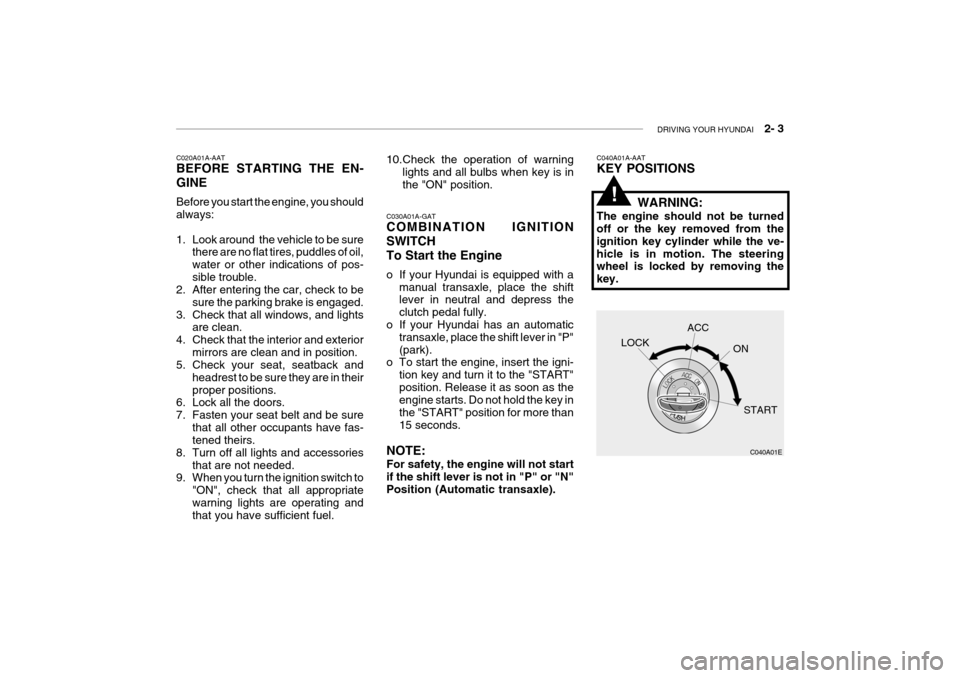
lights and all bulbs when key is inthe "ON" position.C040A01A-AAT KEY POSITIONS
WARNING:
The engine should not be turned off or the key removed from the ignition key cylinder while the ve-hicle is in motion. The steering wheel is locked by removing the key.
C040A01E
LOCK
ACC
ON
START
!
Page 137 of 235
2- 4 DRIVING YOUR HYUNDAI
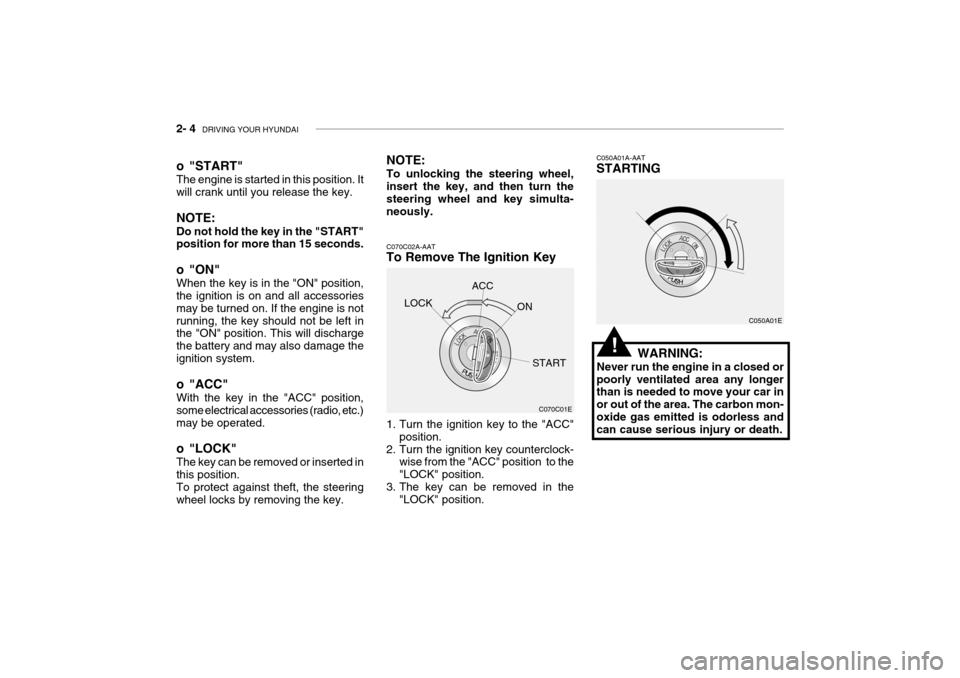
C070C01E
C070C02A-AAT
To Remove The Ignition Key
1. Turn the ignition key to the "ACC"
position.
2. Turn the ignition key counterclock- wise from the "ACC" position to the "LOCK" position.
3. The key can be removed in the "LOCK" position. C050A01A-AAT STARTING
C050A01E
WARNING:
Never run the engine in a closed or poorly ventilated area any longer than is needed to move your car in or out of the area. The carbon mon-oxide gas emitted is odorless and can cause serious injury or death.
LOCK
ACC
ON
START
o "START" The engine is started in this position. It will crank until you release the key. NOTE: Do not hold the key in the "START" position for more than 15 seconds.
o "ON" When the key is in the "ON" position, the ignition is on and all accessories may be turned on. If the engine is notrunning, the key should not be left in the "ON" position. This will discharge the battery and may also damage theignition system.
o "ACC" With the key in the "ACC" position, some electrical accessories (radio, etc.)may be operated.
o "LOCK" The key can be removed or inserted in this position. To protect against theft, the steering wheel locks by removing the key. NOTE: To unlocking the steering wheel, insert the key, and then turn the steering wheel and key simulta-neously.
!
Page 138 of 235
DRIVING YOUR HYUNDAI 2- 5
C050B01A-GAT Normal Conditions: The Starting Procedure:
1. Insert key, and fasten the seat belt.
2. Depress the clutch pedal fully and
place the gearshift lever (manual transaxle) in neutral or the selector lever (automatic transaxle) in "P" (park) position.
3. After turning the ignition key to the "ON" position, make certain all warn-ing lights and gauges are function-ing properly before starting the en- gine.
WARNING:
Be sure that the clutch is fully de- pressed when starting a manualtransaxle vehicle. Otherwise, there is the potential to cause damage to the vehicle or injury to someoneinside or outside the vehicle as a result of the forward or backward movement of the vehicle that willoccur if the clutch is not depressed when the vehicle is started. 4. Turn the ignition key to the "Start"
position and release it when the engine starts.
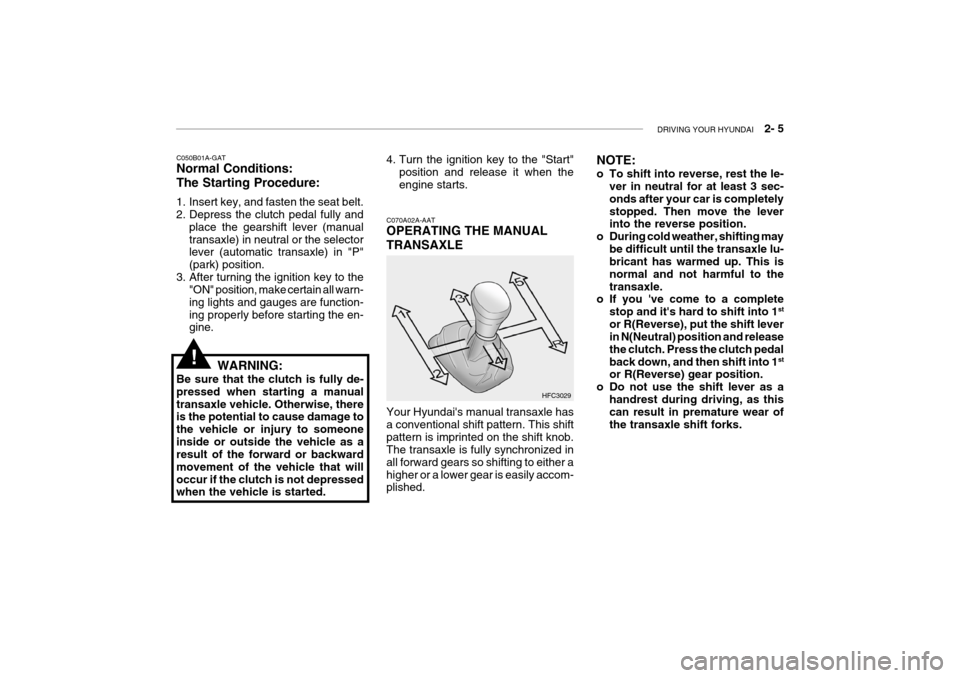
C070A02A-AAT OPERATING THE MANUAL TRANSAXLE
HFC3029
Your Hyundai's manual transaxle has a conventional shift pattern. This shiftpattern is imprinted on the shift knob. The transaxle is fully synchronized in all forward gears so shifting to either ahigher or a lower gear is easily accom- plished. NOTE:
o To shift into reverse, rest the le-
ver in neutral for at least 3 sec- onds after your car is completelystopped. Then move the lever into the reverse position.
o During cold weather, shifting may
be difficult until the transaxle lu-bricant has warmed up. This is normal and not harmful to thetransaxle.
o If you 've come to a complete
stop and it's hard to shift into 1 st
or R(Reverse), put the shift lever in N(Neutral) position and release the clutch. Press the clutch pedalback down, and then shift into 1 st
or R(Reverse) gear position.
o Do not use the shift lever as a
handrest during driving, as this can result in premature wear of the transaxle shift forks.
!
Page 139 of 235

2- 6 DRIVING YOUR HYUNDAI
C070D03O-AAT Good Driving Practices
o Never take the car out of gear and
coast down a hill. This is extremely hazardous. Always leave the car in gear.
o Don't "ride" the brakes. This can
cause them to overheat and mal-function. Instead, when you are driv- ing down a long hill, slow down andshift to a lower gear. When you do this, engine braking will help slow the car.
o Slow down before shifting to a lower gear. This will help avoid over-rev-ving the engine, which can causedamage.
o Slow down when you encounter
cross winds. This gives you muchbetter control of your car.
o Be sure the car is completely stopped
before you attempt to shift into re-verse. The transaxle can be dam- aged if you do not. To shift into reverse, depress the clutch, movethe shift lever to neutral, wait three seconds, then shift to the reverse position.
o Exercise extreme caution when driv- ing on a slippery surface. Be espe-cially careful when braking, acceler-
C070B01A-AAT Using the Clutch The clutch should be pressed all the way to the floor before shifting, then released slowly. The clutch pedal should always be used after fully re-turning to the original position. Do not rest your foot on the clutch pedal while driving. This can cause unnecessarywear. Do not partially engage the clutch to hold the car on an incline. This causes unnecessary wear. Use theparking brake to hold the car on an incline. Do not operate the clutch pedal rapidly and repeatedly. CAUTION:
When downshifting from fifth gear to fourth gear, caution should be taken not to inadvertently press thegear lever sideways in such a man- ner that second gear is engaged. Such a drastic downshift may causethe engine speed to increase to the point that the tachometer will enter the red-zone. Such over-revving ofthe engine may possibly cause en- gine damage. C070E03A-GAT RECOMMENDED SHIFT POINTS
1-2 2-33-4 4-5
Shift
from-to Recommended
20 km/h (15 mph) 40 km/h (25 mph) 55 km/h (35 mph) 75 km/h (45 mph)
The shift points as shown above are recommended for optimum fueleconomy and performance.
!
Page 141 of 235
2- 8 DRIVING YOUR HYUNDAI
C090C01A-AAT o R(Reverse): Use for backing up the vehicle. Bring the car to a complete stop before shift- ing the selector lever to "R" position. C090D02A-AAT o N (Neutral): In the "N" position, the transaxle is in neutral, which means that no gearsare engaged. The engine can be started with the shift lever in "N" position, although this is not recommended ex-cept if the engine stalls while the car is moving. C090E01L-GAT o D (Drive): Use for normal driving. This position is used for most city and highway driving, for starting from a full stop to maximumspeed. The transaxle will automati- cally shift through a four/five gear sequency, giving best economy andpower.
C090B01A-AAT The Function of Each Position Is As Follows: o P (Park): Use to hold the vehicle in place when parking or while starting the engine.Whenever parking the car, apply the parking brake and shift the selector lever to the "P" (Park) position.
CAUTION:
Never place the selector lever in the"P" (Park) position unless the ve-hicle is fully stopped. Failure to observe this caution will cause se- vere damage to the transaxle.
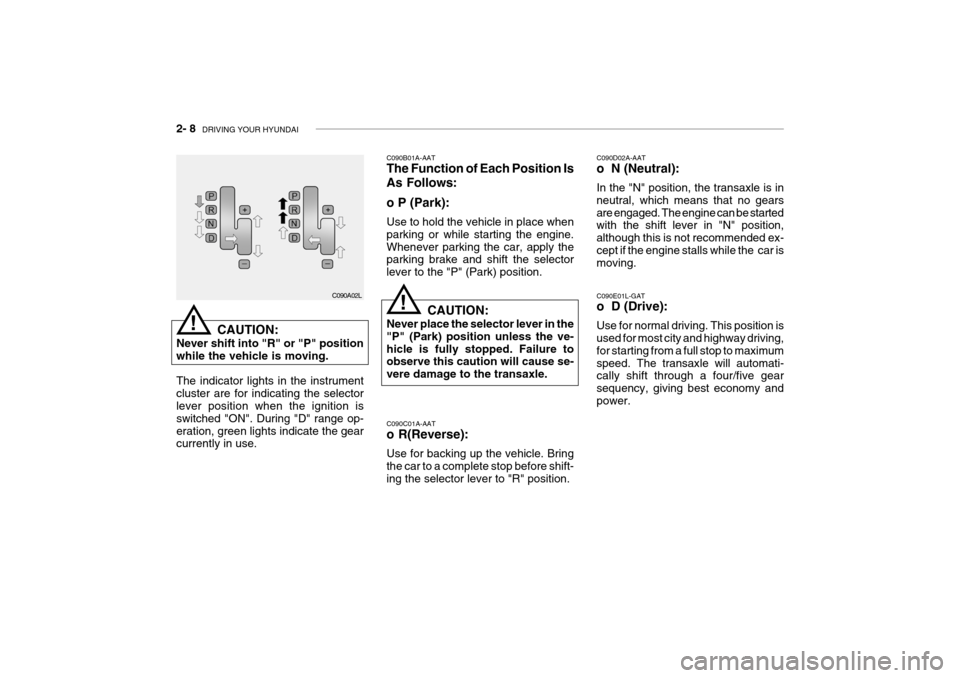
C090A02L
CAUTION:
Never shift into "R" or "P" positionwhile the vehicle is moving. The indicator lights in the instrument cluster are for indicating the selector lever position when the ignition is switched "ON". During "D" range op-eration, green lights indicate the gear currently in use.
!
!
Page 142 of 235
DRIVING YOUR HYUNDAI 2- 9
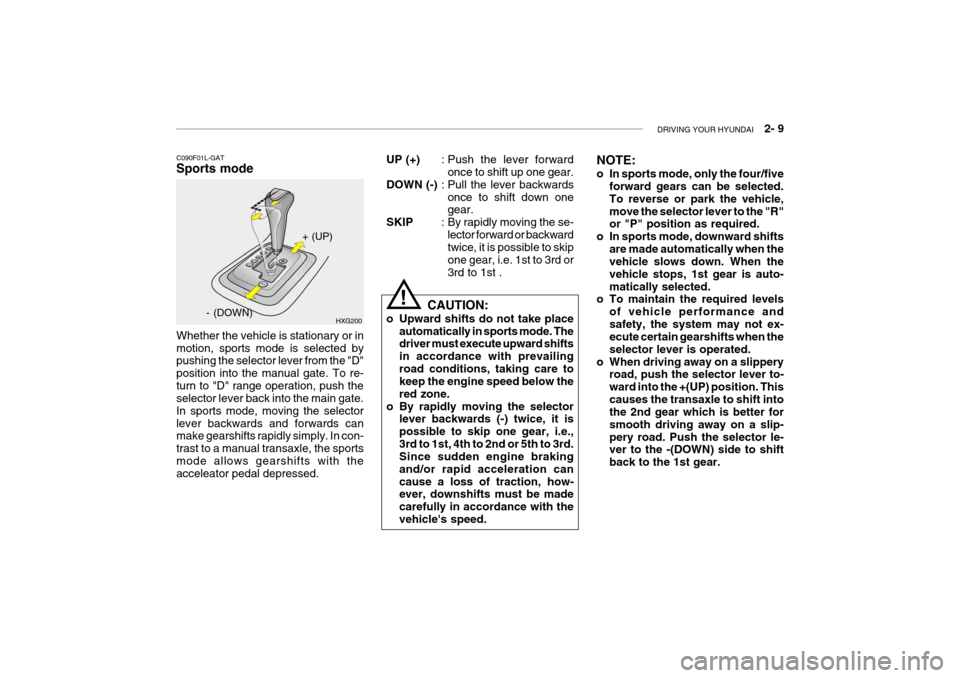
C090F01L-GAT Sports mode Whether the vehicle is stationary or in motion, sports mode is selected by pushing the selector lever from the "D" position into the manual gate. To re-turn to "D" range operation, push the selector lever back into the main gate. In sports mode, moving the selectorlever backwards and forwards can make gearshifts rapidly simply. In con- trast to a manual transaxle, the sportsmode allows gearshifts with the acceleator pedal depressed. HXG200
+ (UP)
- (DOWN) UP (+)
: Push the lever forward
once to shift up one gear.
DOWN (-) : Pull the lever backwards
once to shift down onegear.
SKIP : By rapidly moving the se-
lector forward or backwardtwice, it is possible to skip one gear, i.e. 1st to 3rd or3rd to 1st . NOTE:
o In sports mode, only the four/five
forward gears can be selected. To reverse or park the vehicle,move the selector lever to the "R" or "P" position as required.
o In sports mode, downward shifts
are made automatically when thevehicle slows down. When the vehicle stops, 1st gear is auto-matically selected.
o To maintain the required levels
of vehicle performance andsafety, the system may not ex- ecute certain gearshifts when the selector lever is operated.
o When driving away on a slippery road, push the selector lever to-ward into the +(UP) position. Thiscauses the transaxle to shift into the 2nd gear which is better for smooth driving away on a slip-pery road. Push the selector le- ver to the -(DOWN) side to shift
back to the 1st gear.
! CAUTION:
o Upward shifts do not take place automatically in sports mode. The driver must execute upward shifts in accordance with prevailingroad conditions, taking care to keep the engine speed below the red zone.
o By rapidly moving the selector lever backwards (-) twice, it ispossible to skip one gear, i.e.,3rd to 1st, 4th to 2nd or 5th to 3rd. Since sudden engine braking and/or rapid acceleration can
cause a loss of traction, how- ever, downshifts must be made carefully in accordance with thevehicle's speed.
Page 143 of 235

2- 10 DRIVING YOUR HYUNDAI
C090H01L-GAT NOTE:
o For smooth and safe operation,
depress the brake pedal when shifting from "Neutral" positionor "Park" position to a forward or reverse gear.
o The ignition key must be in the "ON" position and the brake pedalfully depressed in order to move the shift lever from the "P" (Park)position to any of the other posi- tions.
o It is always possible to shift from "R", "N", "D" position to "P" po-sition. The vehicle must be fully stopped to avoid transaxle dam-age. C090I01L-GAT
CAUTION:
o Shift into "R" and "P" position only when the vehicle has com- pletely stopped.
o Do not accelerate the engine in
reverse or any of the forwardpositions with the brakes applied.
o Always apply the footbrake when shifting from "P" or "N", to "R" or"D" position.
o Do not use the "P" (Park) posi- tion in place of the parking brake.Always set the parking brake, shift the transaxle into "P" (Park)position and turn off the ignition when you leave the vehicle, even momentarily. Never leave the ve-hicle unattended while the en- gine is running.
o Check the automatic transaxle fluid level regularly, and add fluidas necessary.
o See the maintenance schedule for the proper fluid reco-mendation. C090N03O-AAT Good Driving Practices
o Never move the gear selector lever
from "P" or "N" to any other position with the accelerator pedal de- pressed.
o Never move the gear selector lever
into "P" when the vehicle is in mo-tion.
o Be sure the car is completely stopped before you attempt to shift into "R".
o Never take the car out of gear and
coast down a hill. This may be ex- tremely hazardous. Always leave the car in gear when moving.
o Do not "ride" the brakes. This can cause them to overheat and mal-function. Instead, when you are driv- ing down a long hill, slow down andshift to a lower gear. When you do this, engine braking will help slow the car.
o Slow down before shifting to a lower gear. Otherwise, the lower gear maynot be engaged.
o Always use the parking brake. Do not depend on placing the transaxlein "P" to keep the car from moving.
o Exercise extreme caution when driv- ing on a slippery surface. Be espe-cially careful when braking, acceler-
!
Page 144 of 235

DRIVING YOUR HYUNDAI 2- 11
C120A02A-AAT ANTI-LOCK BRAKE SYSTEM (If installed) The Anti-Lock Brake System (ABS) is designed to prevent wheel lock-upduring sudden braking or on hazard- ous road surfaces. The ABS control module monitors the wheel speed andcontrols the pressure applied to each brake. Thus, in emergency situations or on slick roads, ABS will increasevehicle control during braking. WARNING:
ABS will not prevent accidents due to improper or dangerous driving maneuvers. Even though vehiclecontrol is improved during emer- gency braking, always maintain a safe distance between you and ob-jects ahead. Vehicle speeds should always be reduced during extreme road conditions.The braking distance for cars equipped with an anti-lock braking system may be longer than for thosewithout it in the following road con- ditions. During these conditions the vehicleshould be driven at reduced speeds.
ating or shifting gears. On a slippery surface, an abrupt change in vehi- cle speed can cause the drive wheelsto lose traction and the vehicle to go out of control.!
!WARNING:
o Avoid high cornering speeds.
o Do not make quick steering wheel movements, such as sharp lane changes or fast, sharp turns.
o Always wear your seat belts.
o In a collision crash, an unbelted person is significantly more likelyto die than a person wearing aseatbelt.
o The risk of rollover is greatly in-
creased if you lose control ofyour vehicle at highway speeds.
o Loss of control often occurs if
two or more wheels drop off theroadway and the driver oversteers to reenter the roadway.
o In the event your vehicle leaves the roadway, do not steer sharply.Instead, slow down before pull- ing back into the travel lanes.
o Never exceed posted speed lim- its. o Excessive depressing of the
accelerater pedal in slippery driv-ing conditions such as pulling out of deep snow or mud may cause severe damage to thetransaxle. Rocking the vehicle is not recommended. Rather, use an appropriate towing method.
NOTE: During ABS operation, a slight pul- sation may be felt in the brake pedal when the brakes are applied. Also,a noise may be heard in the engine compartment while driving. These conditions are normal and indicatethat the anti-lock brake system is functioning properly.