lock Hyundai H-100 Truck 2012 Owner's Guide
[x] Cancel search | Manufacturer: HYUNDAI, Model Year: 2012, Model line: H-100 Truck, Model: Hyundai H-100 Truck 2012Pages: 217, PDF Size: 9.37 MB
Page 99 of 217
2
DRIVING YOUR HYUNDAI
3
!
BEFORE STARTING THE EN- GINE
C020A02A-AAT Before you start the engine, you should always:
1. Look around the vehicle to be sure
there are no flat tires, puddles of oil, water or other indications of pos- sible trouble.
2. After entering the car, check to be sure the parking brake is engaged.
3. Check that all windows, and lights are clean.
4. Check that the interior and exterior
mirrors are clean and in position.
5. Check your seat, seatback and headrest to be sure they are in theirproper positions.
6. Lock all the doors.
7. Fasten your seat belt and be sure
that all other occupants have fas- tened theirs.
8. Turn off all lights and accessories
that are not needed.
9. When you turn the ignition switch to "ON", check that all appropriatewarning lights are operating andthat you have sufficient fuel.
10.Check the operation of warning
lights and all bulbs when key is inthe "ON" position.
!WARNING:
To ensure that sufficient vacuum exists within the brake system dur-ing cold weather start-up condi- tions, it is necessary to run the engine at idle for several secondsafter starting the engine.
WARNING:
Always wear appropriate shoes when operating your vehicle. Unsuitable shoes (high heels, ski boots,etc.)may interfere with your ability to use the brake and accelerator pedal, and the clutch (if installed).!WARNING:
Driving while distracted can result in a loss of vehicle control, that may lead to an accident, severe personal
injury, and death. The driver’s pri-mary responsibility is in the safe and legal operation of a vehicle, and use of any handheld devices, otherequipment, or vehicle systems which take the driver’s eyes, attention and focus away from the safe operationof a vehicle or which are not permis- sible by law should never be used during operation of the vehicle.
Page 100 of 217
2 DRIVING YOUR HYUNDAI
4
!
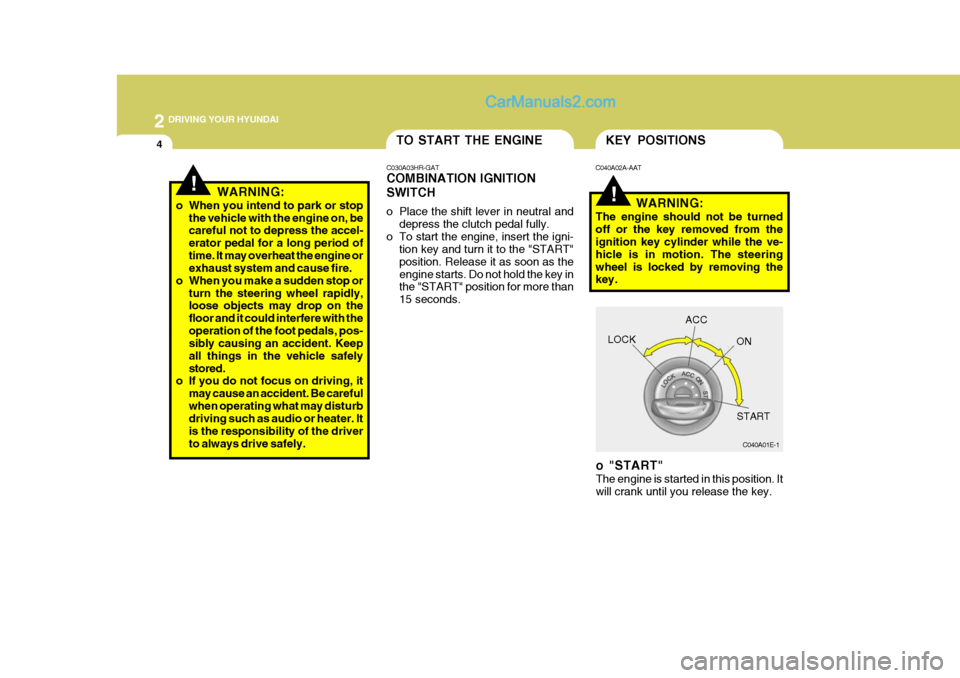
KEY POSITIONS
C040A01E-1
LOCK
ACC
ON
START
o "START" The engine is started in this position. It will crank until you release the key.
C040A02A-AAT
WARNING:
The engine should not be turned off or the key removed from the ignition key cylinder while the ve- hicle is in motion. The steeringwheel is locked by removing the key.
!WARNING:
o When you intend to park or stop the vehicle with the engine on, be careful not to depress the accel- erator pedal for a long period oftime. It may overheat the engine or exhaust system and cause fire.
o When you make a sudden stop or
turn the steering wheel rapidly,loose objects may drop on the floor and it could interfere with theoperation of the foot pedals, pos- sibly causing an accident. Keep all things in the vehicle safelystored.
o If you do not focus on driving, it
may cause an accident. Be carefulwhen operating what may disturb driving such as audio or heater. It is the responsibility of the driverto always drive safely.
TO START THE ENGINE
C030A03HR-GAT COMBINATION IGNITION SWITCH
o Place the shift lever in neutral and depress the clutch pedal fully.
o To start the engine, insert the igni- tion key and turn it to the "START" position. Release it as soon as theengine starts. Do not hold the key in the "START" position for more than 15 seconds.
Page 101 of 217
2
DRIVING YOUR HYUNDAI
5
C070C01A-AAT
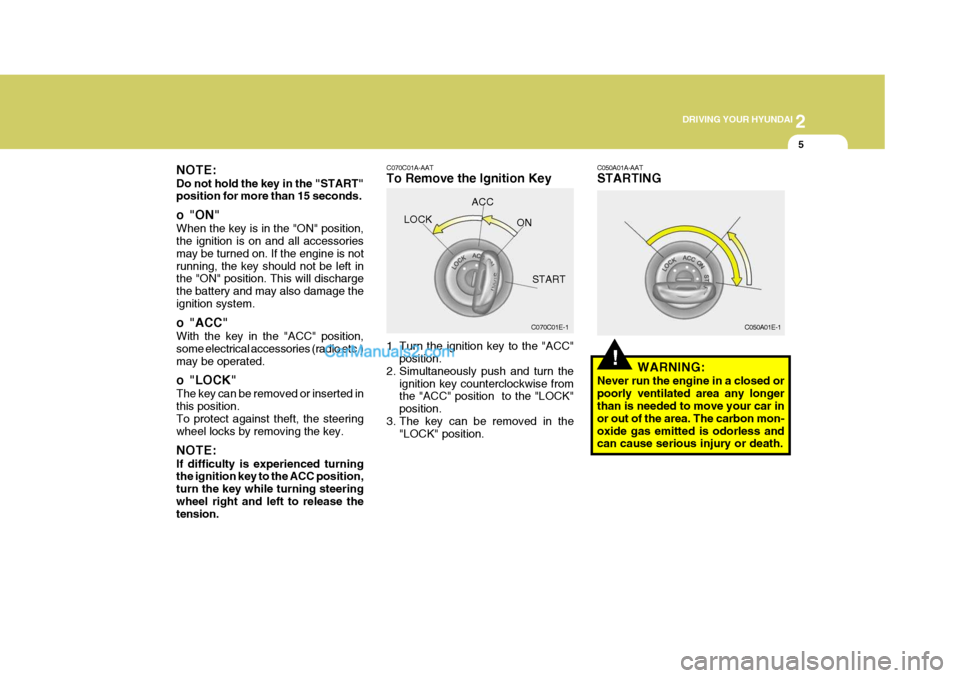
To Remove the Ignition Key
1. Turn the ignition key to the "ACC"
position.
2. Simultaneously push and turn the
ignition key counterclockwise from the "ACC" position to the "LOCK" position.
3. The key can be removed in the "LOCK" position.
NOTE: Do not hold the key in the "START" position for more than 15 seconds.
o "ON" When the key is in the "ON" position, the ignition is on and all accessories may be turned on. If the engine is notrunning, the key should not be left in the "ON" position. This will discharge the battery and may also damage theignition system.
o "ACC" With the key in the "ACC" position, some electrical accessories (radio etc.)may be operated.
o "LOCK" The key can be removed or inserted in this position. To protect against theft, the steering wheel locks by removing the key. NOTE: If difficulty is experienced turning the ignition key to the ACC position, turn the key while turning steeringwheel right and left to release the tension.
C070C01E-1
LOCK
ACC
ON
START
!
C050A01A-AAT STARTING
WARNING:
Never run the engine in a closed or poorly ventilated area any longer than is needed to move your car in or out of the area. The carbon mon-oxide gas emitted is odorless and can cause serious injury or death. C050A01E-1
Page 102 of 217
2 DRIVING YOUR HYUNDAI
6
!
C055B01HR-GAT STARTING AND STOPPING THE ENGINE FOR TURBO CHARGERINTERCOOLER (Diesel Engine)
(1) Do not race, accelerate suddenly,
or accelerate immediately the en- gine after starting it. If the engine iscold, allow the engine to idle for several seconds before it is driven to ensure sufficient lubrication ofthe turbo charger unit. WARNING:
Be sure that the clutch is fully de- pressed when starting a manual transmission vehicle. Otherwisethere is the potential to cause dam- age to the vehicle or injury to some- one inside or outside the vehicle asa result of the forward or backward movement of the vehicle that will occur if the clutch is not depressedwhen the vehicle is started.
5. Turn the ignition key to the "START" position and release it when the engine starts.
C050B01HP
NOTE: If the engine were not started within 10 seconds after the preheating is completed, turn the ignition key oncemore to the "LOCK" position, and then to the "ON" position, in order to preheat again. Amber lamp ON Amber lamp OFF
C051A01O-GAT STARTING FOR THE DIESEL ENGINE ENGINE COLD
o Turn the ignition key to position
"ON" and wait for the pre-heat indi- cator light to go out.
o Operate the starter until the engine
runs.
ENGINE WARM Operate the starter. If the engine does not respond on the first attempt, wait several seconds and try again usingthe pre-heat. C050B01HR-GAT NORMAL CONDITIONS The Starting Procedure:
1. Insert key, and fasten the seat belt.
2. Depress the clutch pedal fully and place the gearshift lever in neutral.
3. After turning the ignition key to the
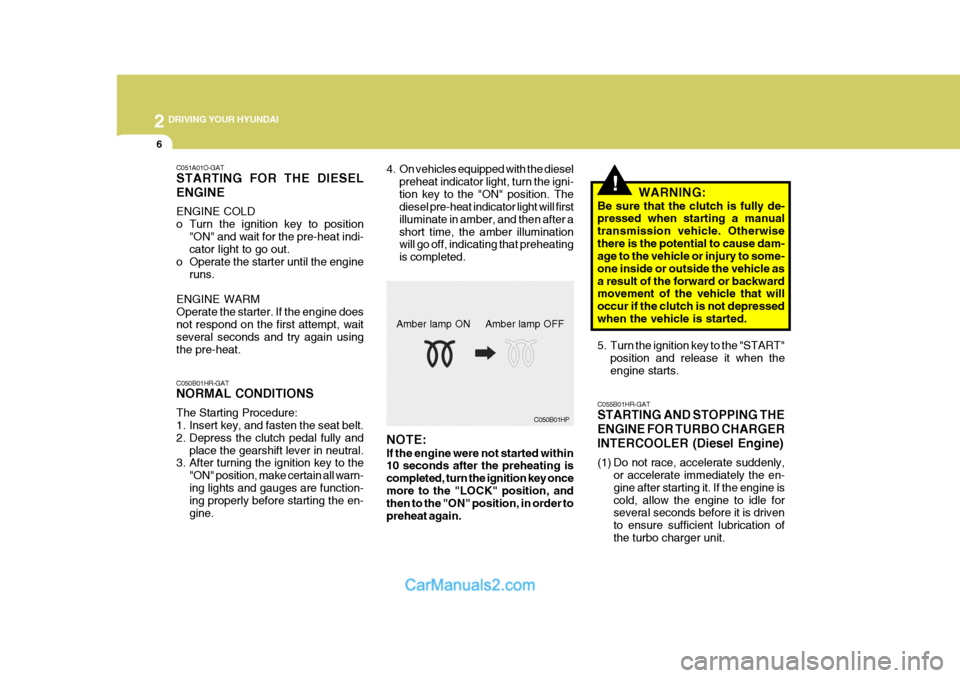
"ON" position, make certain all warn-ing lights and gauges are function- ing properly before starting the en- gine. 4. On vehicles equipped with the diesel
preheat indicator light, turn the igni-tion key to the "ON" position. The diesel pre-heat indicator light will first illuminate in amber, and then after ashort time, the amber illumination will go off, indicating that preheating is completed.
Page 104 of 217
2 DRIVING YOUR HYUNDAI
8
C070D02O-AAT Good Driving Practices
o Never take the car out of gear andcoast down a hill. This is extremely hazardous. Always leave the car in gear.
o Don't "ride" the brakes. This can cause them to overheat and mal-function. Instead, when you are driv- ing down a long hill, slow down andshift to a lower gear. When you do this, engine braking will help slow the car.
o Slow down before shifting to a lower gear. This will help avoid over-rev-ving the engine, which can causedamage.
o Slow down when you encounter
cross winds. This gives you muchbetter control of your car.
o Be sure the car is completely stopped
before you attempt to shift into re-verse. The transmission can be dam- aged if you do not. To shift into reverse, depress the clutch, movethe shift lever to neutral, wait three seconds, then shift to the reverse position.
o Exercise extreme caution when driv- ing on a slippery surface. Be espe-
C070E03A-GAT RECOMMENDED SHIFT POINTS
Shift
from-to Recommended
The shift points as shown above are recommended for optimum fuel economy and performance. 20 km/h (15 mph) 40 km/h (25 mph)55 km/h (35 mph)75 km/h (45 mph)
1-22-33-44-5
C070B01A-AAT Using the Clutch The clutch should be pressed all the way to the floor before shifting, then released slowly. If your vehicle isequipped with an ignition lock switch, the engine will not start when starting the engine without depressing the clutchpedal. (if equipped) The clutch pedal should always be used after fully return- ing to the original position. Do not restyour foot on the clutch pedal while driving. This can cause unnecessary wear. Do not partially engage the clutchto hold the car on an incline. This causes unnecessary wear. Use the parking brake to hold the car on anincline. Do not operate the clutch pedal rapidly and repeatedly.
CAUTION:
When downshifting from fifth gear to fourth gear, caution should be taken not to inadvertently press the gear lever sideways in such a man-ner that second gear is engaged. Such a drastic downshift may cause the engine speed to increase to thepoint that the tachometer will enter the red-zone. Such over-revving of the engine may possibly cause en-gine damage.
!
!WARNING:
If your vehicle has a manual trans- mission not equipped with a ignition lock switch, it may move and causea serious accident when starting the engine without depressing the clutch pedal while the parking brake is re-leased and the shift lever not in the N (Neutral) position.
Page 105 of 217
2
DRIVING YOUR HYUNDAI
9LOCKING DIFFERENTIAL
!
cially careful when braking, acceler- ating or shifting gears. On a slipperysurface, an abrupt change in ve- hicle speed can cause the drive wheels to lose traction and the ve-hicle to go out of control.
WARNING:
o Avoid high cornering speeds.
o Do not make quick steering wheel movements, such as sharp lane changes or fast, sharp turns.
o Always wear your seat belts. In a collis ion crash, an unbelted person
is significantly more likely to die than a person wearing a seatbelt.
o The risk of rollover is greatly in-
creased if you lose control ofyour vehicle at highway speeds.
o Loss of control often occurs if
two or more wheels drop off theroadway and the driver oversteers to reenter the roadway.
o In the event your vehicle leaves the roadway, do not steer sharply.Instead, slow down before pull- ing back into the travel lanes.
o Never exceed posted speed lim- its. D190A01HR-GAT (If Installed) A locking differential, if equipped, is for the rear wheel differential only. Thefeatures of this locking differential are described below: Just as with a conventional differential,the wheel on one side is allowed to turn at a different speed from the wheel on the other side when the vehicle iscornering. The difference between the locking differential and a conventional differential is that if the wheel on oneside of the vehicle loses traction, a greater amount of torque is applied to the rear wheel on the other side toimprove traction. NOTE: In a stationary position, the LD (Locking Differential) will operate when the difference of the revolu- tion speed between the rear rightwheel and the rear left wheel oc- curs.
The following procedures can be used to confirm that the locking differentialis functioning properly:
(1) Position the vehicle so that one
wheel is on a dry paved surface and the other on ice, snow, mud, etc. Drive the vehicle, and observe theoperation of the locking differential. The vehicle should not become stuck if the differential is function-ing properly.
(2) Depress the accelerator pedal
gradually, and then when traction isgood, depress it forcefully. If the vehicle accelerates well, the differ- ential is functioning properly.
Page 106 of 217
2 DRIVING YOUR HYUNDAI
10
o Don't coast down hills with the carout of gear. This is extremely haz- ardous. Keep the car in gear at all times, use the brakes to slow down, then shift to a lower gear so thatengine braking will help you main- tain a safe speed.
o Don't "ride" the brake pedal. Rest- ing your foot on the brake pedalwhile driving can be dangerous be- cause it can result in the brakesoverheating and losing their effec- tiveness. It also increases the wear of the brake components.
o If a tire goes flat while you are driving, apply the brakes gently and
keep the car pointed straight aheadwhile you slow down. When you are moving slowly enough for it to be safe to do so, pull off the road andstop in a safe place.
o Use caution when parking on a hill.
Engage the parking brake and place
the gear selector lever in first or reverse gear. If your car is facing downhill, turn the front wheels intothe curb to help keep the car from rolling. If your car is facing uphill,
!
GOOD BRAKING PRACTICES
C130A01HR-GAT
WARNING:
Objects should not extend higher than the top of the front seatbacks. If there were an accident or a sud-den stop, such objects could move forward and cause damage to the vehicle or injure the occupants.
o After being parked, check to be sure the parking brake is not engaged and that the parking brake indicator light is out before driving away.
o Driving through water may get the brakes wet. They can also get wet when the car is washed. Wet brakescan be dangerous! Your car will not stop as quickly if the brakes are wet. Wet brakes may cause the car to
pull to one side. To dry the brakes, apply the brakes lightly until the braking action returns to normal,taking care to keep the car under control at all times. If the braking action does not return to normal,stop as soon as it is safe to do so and call your Hyundai dealer for assistance.
CAUTION:
o Never start the engine with the gearshift lever placed in the for-ward or reverse while one of therear wheels is jacked up and the other in contact with the ground; doing so may cause the vehicleto jump forward.
o If one of the rear wheels begins
to spin in mud, snow, etc., thevehicle can sometimes be driven out by depressing the accelera- tor pedal further; however, avoidrunning the engine continuously at high rpm because doing so could damage the locking differ-ential.
!
Page 107 of 217
2
DRIVING YOUR HYUNDAI
11
turn the front wheels away from the curb to help keep the car from roll-ing. If there is no curb or if it is required by other conditions to keep the carfrom rolling, block the wheels.
o Under some conditions your park-
ing brake can freeze in the engagedposition. This is most likely to hap- pen when there is an accumulation of snow or ice around or near therear brakes or if the brakes are wet. If there is a risk that the parking brake may freeze, apply it only tem-porarily while you put the gear se- lector lever in first or reverse gear and block the rear wheels so the carcannot roll. Then release the park- ing brake.
o Do not hold the vehicle on the up- grade with the accelerator pedal.This can cause the transmission to overheat. Always use the brakepedal or parking brake.DRIVING FOR ECONOMY
C140A01A-GAT You can save fuel and get more kilo- meters from your car if you follow these suggestions:
o Drive smoothly. Accelerate at a moderate rate. Don't make "jack- rabbit" starts or full-throttle shiftsand maintain a steady cruising speed. Don't race between stop- lights. Try to adjust your speed tothat of the other traffic so you don't have to change speeds unneces- sarily. Avoid heavy traffic wheneverpossible. Always maintain a safe distance from other vehicles so you can avoidunnecessary braking. This also re- duces brake wear.
o Drive at a moderate speed. The faster you drive, the more fuel yourcar uses. Driving at a moderate speed, especially on the highway, isone of the most effective ways to reduce fuel consumption.
o Don't "ride" the brake or clutch pedal. This can increase fuel consumptionand also increase wear on these components. In addition, driving withyour foot resting on the brake pedal may cause the brakes to overheat,
!WARNING:
Always, confirm the position of the brake and accelerator pedal before driving. If you don’t check the posi-tion of the accelerator and brake pedal before driving, you may de- press the accelerator instead of thebrake pedal. It may cause a serious accident.
CAUTION:
Do not operate the parking brakewhile the vehicle is moving except in an emergency situation. It could dam-age the vehicle system and make endanger driving safety.
!
Page 110 of 217
2 DRIVING YOUR HYUNDAI
14
C160K01A-AAT Carry Emergency Equipment Depending on the severity of the weather where you drive your car, you should carry appropriate emergencyequipment. Some of the items you may want to carry include tire chains, tow straps or chains, flashlight, emer-gency flares, sand, a shovel, jumper cables, a window scraper, gloves, ground cloth, coveralls, a blanket, etc.
C160J01A-AAT Don't Let Ice and Snow Accumu- late Underneath Under some conditions, snow and ice can build up under the fenders andinterfere with the steering. When driv- ing in severe winter conditions where this may happen, you should periodi-cally check underneath the car to be sure the movement of the front wheels and the steering components is notobstructed.
C160G01A-AAT To Keep Locks from Freezing To keep the locks from freezing, squirt an approved de-icer fluid or glycerineinto the key opening. If a lock is cov- ered with ice, squirt it with an approved de-icing fluid to remove the ice. If thelock is frozen internally, you may be able to thaw it out by using a heated key. Handle the heated key with careto avoid injury. C160H01A-AAT Use Approved Anti-Freeze in Window Washer System To keep the water in the window washer system from freezing, add an approved anti-freeze solution in accordance with instructions on the container. Windowwasher anti-freeze is available from Hyundai dealers and most auto parts outlets. Do not use engine coolant orother types of anti-freeze as these may damage the finish. C160I01HR-GAT Don't Let Your Parking Brake Freeze Under some conditions your parking brake can freeze in the engaged posi-tion. This is most likely to happen when there is an accumulation of snow or ice around or near the rear brakes orif the brakes are wet. If there is a risk the parking brake may freeze, apply it only temporarily while you put the gearselector lever in first or reverse gear and block the rear wheels so the car cannot roll. Then release the parkingbrake.
Page 117 of 217
3 WHAT TO DO IN AN EMERGENCY
2
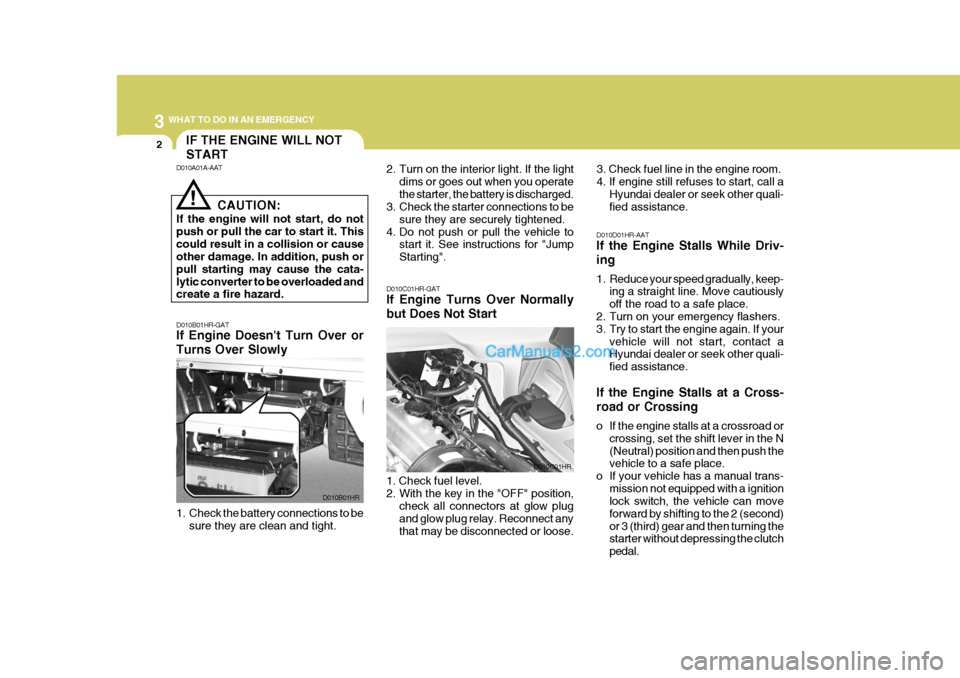
D010B01HR-GAT If Engine Doesn't Turn Over or Turns Over Slowly 2. Turn on the interior light. If the light
dims or goes out when you operate the starter, the battery is discharged.
3. Check the starter connections to be
sure they are securely tightened.
4. Do not push or pull the vehicle to start it. See instructions for "JumpStarting".
D010C01HR-GAT If Engine Turns Over Normally but Does Not Start 3. Check fuel line in the engine room. 4. If engine still refuses to start, call a
Hyundai dealer or seek other quali- fied assistance.
D010D01HR-AAT If the Engine Stalls While Driv- ing
1. Reduce your speed gradually, keep- ing a straight line. Move cautiously off the road to a safe place.
2. Turn on your emergency flashers.
3. Try to start the engine again. If your vehicle will not start, contact aHyundai dealer or seek other quali- fied assistance.
If the Engine Stalls at a Cross- road or Crossing
o If the engine stalls at a crossroad or crossing, set the shift lever in the N (Neutral) position and then push the vehicle to a safe place.
o If your vehicle has a manual trans- mission not equipped with a ignitionlock switch, the vehicle can move forward by shifting to the 2 (second)or 3 (third) gear and then turning the starter without depressing the clutch pedal.
D010A01A-AAT
!
D010B01HR D010C01HR
IF THE ENGINE WILL NOT START
CAUTION:
If the engine will not start, do not push or pull the car to start it. Thiscould result in a collision or cause other damage. In addition, push or pull starting may cause the cata-lytic converter to be overloaded and create a fire hazard.
1. Check the battery connections to be sure they are clean and tight. 1. Check fuel level. 2. With the key in the "OFF" position,
check all connectors at glow plugand glow plug relay. Reconnect anythat may be disconnected or loose.