wheel Hyundai H-100 Truck 2012 Owner's Guide
[x] Cancel search | Manufacturer: HYUNDAI, Model Year: 2012, Model line: H-100 Truck, Model: Hyundai H-100 Truck 2012Pages: 217, PDF Size: 9.37 MB
Page 152 of 217

5
VEHICLE MAINTENANCE REQUIREMENTS
13
G080U01P-GAT
o Wheel Bearing Grease
Check the wheel bearings and grease according to the maintenance sched- ule. For inspection procedures, see Shop Manual. F070Q01A-AAT
o Air Conditioning Refrigerant
Check the air conditioning lines and connections for leakage and damage. Check air conditioning performanceaccording to the relevant shop manual if necessary.
Page 157 of 217

6
DO-IT-YOURSELF MAINTENANCE
5
G020A01HR-GAT Engine Compartment The following should be checked regu- larly:
o Engine oil level and condition
o Transmission fluid level and condi-
tion
o Brake fluid level
o Engine coolant level
o Windshield washer fluid level
o Accessory drive belt condition
o Engine coolant hose condition
o Fluid leaks (on or below compo- nents)
o Power steering fluid level
o Battery condition
o Air filter condition G020C01HR-GAT Vehicle Interior The following should be checked each time when the vehicle is driven:
o Lights operation
o Windshield wiper operation
o Horn operation
o Defroster, heater system operation
(and air conditioning, if installed)
o Steering operation and condition
o Mirror condition and operation
o Turn signal operation
o Accelerator pedal operation
o Brake operation, including parking
brake
o Manual transmission operation, in- cluding clutch operation
o Seat control condition and operation
o Seat belt condition and operation
o Sunvisor operation If you notice anything that does not operate correctly or appears to be functioning incorrectly, inspect it care-fully and seek assistance from your Hyundai dealer if service is needed.
G020B01A-AAT Vehicle Exterior The following should be checked monthly:
o Overall appearance and condition
o Wheel condition and wheel nut torque
o Exhaust system condition
o Light condition and operation
o Windshield glass condition
o Wiper blade condition
o Paint condition and body corrosion
o Fluid leaks
o Door and hood lock condition
o Tire pressure and condition
(including spare tire)
GENERAL CHECKS
Page 173 of 217
6
DO-IT-YOURSELF MAINTENANCE
21
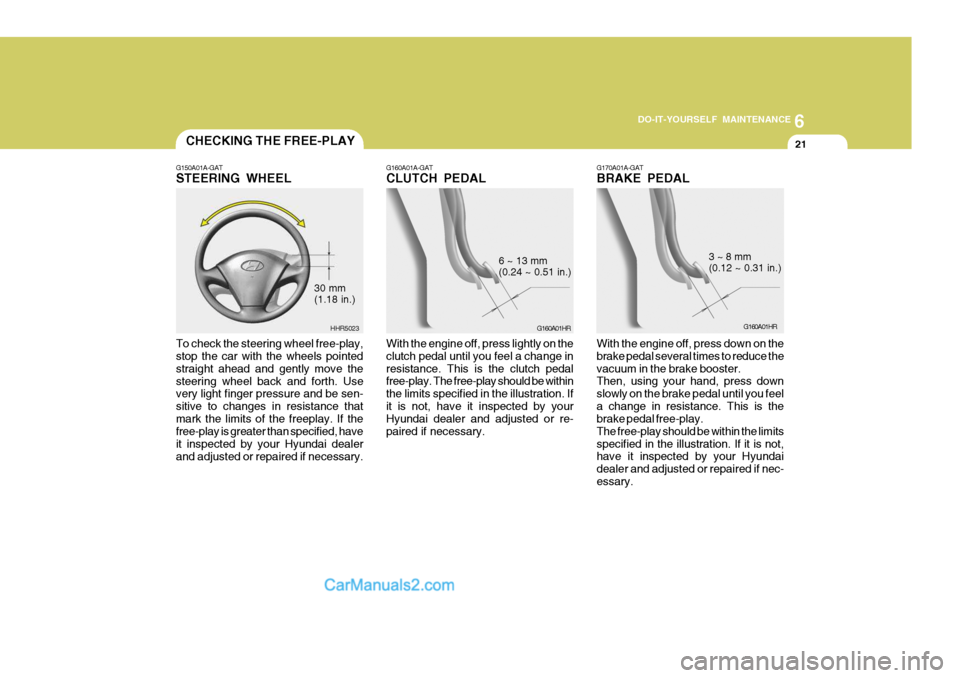
G160A01A-GAT CLUTCH PEDAL
G160A01HR
6 ~ 13 mm (0.24 ~ 0.51 in.)
With the engine off, press lightly on the clutch pedal until you feel a change inresistance. This is the clutch pedal free-play. The free-play should be within the limits specified in the illustration. Ifit is not, have it inspected by your Hyundai dealer and adjusted or re- paired if necessary.
CHECKING THE FREE-PLAY
G150A01A-GAT STEERING WHEEL To check the steering wheel free-play, stop the car with the wheels pointed straight ahead and gently move thesteering wheel back and forth. Use very light finger pressure and be sen- sitive to changes in resistance thatmark the limits of the freeplay. If the free-play is greater than specified, have it inspected by your Hyundai dealerand adjusted or repaired if necessary. HHR5023
30 mm (1.18 in.)
G170A01A-GAT BRAKE PEDAL
G160A01HR
3 ~ 8 mm (0.12 ~ 0.31 in.)
With the engine off, press down on the brake pedal several times to reduce thevacuum in the brake booster. Then, using your hand, press down slowly on the brake pedal until you feela change in resistance. This is the brake pedal free-play. The free-play should be within the limitsspecified in the illustration. If it is not, have it inspected by your Hyundai dealer and adjusted or repaired if nec-essary.
Page 201 of 217

8CONSUMER INFORMATION
4
HHR5019!
I050A01HR-GAT TIRE CHAINS Tire chains, if necessary should be installed on the rear wheels. Be surethat the chains are installed in accor- dance with the manufacturer's instruc- tions.To minimize tire and chain wear, do not continue to use tire chains when they are no longer needed.
I040A02S-GAT SNOW TIRES If you equip your car with snow tires, they should be the same size and havethe same load capacity as the original tires. Snow tires should be installed on all four wheels; otherwise, poor han-dling may result. Snow tires should carry 28 kPa (4 psi) more air pressure than the pressurerecommended for the standard tires on the tire label on the driver's door edge, or up to the maximum pressureshown on the tire sidewall whichever is less. Do not drive faster than 120 km/h (75mph) when your car is equipped with snow tires. I060A01HP-GAT TIRE ROTATION
WARNING:
o When driving on roads covered with snow or ice, drive at less than 30 km/h (20 mph).
o Use the SAE "S" class or wire & plastic chains.
o If you have noise caused by chains
contacting the body, retighten the chain to avoid contact with the vehicle body.
o To prevent body damage, retighten the chains after driving 0.5 ~ 1 km. HHR5020
With Spare tire
Without Spare tire
Page 202 of 217

8
CONSUMER INFORMATION
5
!
!
I070A01A-AAT TIRE BALANCING A tire that is out of balance may affect handling and tire wear. The tires on your Hyundai were balanced before the car was delivered but may needbalancing again during the years you own the car. Whenever a tire is dismounted forrepair, it should be rebalanced before
being reinstalled on the car. I080A01A-AAT TIRE TRACTION Tire traction can be reduced if you drive on worn tires, tires that are im-properly inflated or on slippery road surfaces. Tires should be replaced when tread wear indicators appear. Toreduce the possibility of losing control, slow down whenever there is rain, snow or ice on the road. I090A01S-GAT WHEN TO REPLACE TIRES
Tires should be rotated every 5,000 km (3,000 miles). If you notice that tires arewearing unevenly between rotations, have the car checked by a Hyundai dealer so the cause may be corrected.After rotating, adjust the tire pressures and be sure to check wheel nut torque.
WARNING:
Do not mix bias-ply and radial-ply tires under any circumstances. Thismay cause dangerous handling char- acteristics.
Wear indicator
1.6 mm (0.06 in.)
OHR048101 WARNING:
o Driving on worn-out tires is dan- gerous! Worn-out tires can cause loss of braking effectiveness,steering control and traction.
When replacing tires, never mix radial and bias-ply tires on thesame car. If you replace radial tires with bias-ply tires, they must be installed in sets of four.
o Using tires and wheels of other than the recommended sizes maycause unusual handling charac-teristics that may cause death, serious injury or property dam- age.
The original tires on your car have treadwear indicators. The tread wear indica-tors appear when the tread depth is 1.6 mm (0.06 in.). The tire should be re- placed when these appear as a solid baracross two or more grooves of the tread. Always replace your tires with those of the recommended size. If youchange wheels, the new wheel's rim width and offset must meet Hyundai specification.
Page 204 of 217

8
CONSUMER INFORMATION
7
o Wheel size designation Wheels are also marked with important information that you need if you ever have to replace one. The following ex-plains what the letters and numbers in the wheel size designation mean. Example wheel size designation:
5.5JX15 5.5 - Rim width in inches. J - Rim contour designation. 15 - Rim diameter in inches. o Tire speed ratings The chart below lists many of the differ- ent speed ratings currently being used for passenger car tires. The speed rat-ing is part of the tire size designation on the sidewall of the tire. This symbol corresponds to that tire's designedmaximum safe operating speed.
3. Checking tire life (TIN : Tire
Identification Number)
Any tires that are over 6 years old, based on the manufacturing date, (in- cluding the spare tire) should be re-placed by new ones. You can find the manufacturing date on the tire sidewall (possibly on the inside of the wheel),displaying the DOT Code. The DOT Code is a series of numbers on a tire consisting of numbers and English let-ters. The manufacturing date is desig- nated by the last four digits (characters) of the DOT code. DOT : XXXX XXXX OOOO The front part of the DOT means a plantcode number, tire size and tread pattern and the last four numbers indicate week and year manufactured.For example: DOT XXXX XXXX 1611 represents that the tire was produced in the 16thweek of 2011.
Speed
Rating
Symbol Maximum Speed
180 km/h (112 mph) 190 km/h (118 mph)210 km/h (130 mph)240 km/h (149 mph)
Above 240 km/h (149 mph)
S
T
HV
Z
Page 206 of 217

8
CONSUMER INFORMATION
9
I100A03HR-GAT SPARE TIRE AND TOOLS Your Hyundai is delivered with the fol- lowing: Spare tire and wheel Jack, Jack handle Wheel nut wrench,Spare tire carrier wrench
I100A01HRA
These grades are molded on the side- walls of passenger vehicle tires. Thetires available as standard or optional equipment on your vehicle may vary with respect to grade.
o Traction - AA, A, B & C The traction grades, from highest to lowest, are AA, A, B and C. Those grades represent the tire’s ability tostop on wet pavement as measured under controlled conditions on speci- fied government test surfaces of as-phalt and concrete. A tire marked C may have poor traction performance. o Temperature -A, B & C The temperature grades are A (the high- est), B, and C, representing the tire’s resistance to the generation of heat andits ability to dissipate heat when tested under controlled conditions on a speci- fied indoor laboratory test wheel.Sustained high temperature can cause the material of the tire to degenerate and reduce tire life, and excessive tem-perature can lead to sudden tire failure. Grades B and A represent higher levels of performance on the laboratory testwheel than the minimum required by law.
!WARNING:
The traction grade assigned to this tire is based on straight-ahead brak- ing traction tests, and does not in- clude acceleration, cornering, hy-droplaning, or peak traction charac- teristics.!WARNING: Tire temperature
The temperature grade for this tire is established for a tire that is properlyinflated and not overloaded. Exces- sive speed, underinflation, or exces- sive loading, either separately or incombination, can cause heat build- up and possible sudden tire failure. This can cause loss of vehicle con-trol and serious injury or death.
Page 208 of 217

9 VEHICLE SPECIFICATIONS
2
1st 2nd3rd 4th 5thReverse
Double Cab
Standard Cab
4,795 1,740 1,9652,430 1,485 1,320 High Deck
Standard Cab
1,420
TypeWheel Free PlayRack Stroke Oil Pump Type
Rack and pinion 0 ~ 30 mm (0 ~ 1.18 in.)146 mm (5.75 in.) Vane type
J020HR01HR-GAT POWER STEERING
Long Wheel Base
Front Rear mm
ITEMS
Overall Length Overall WidthOverall Height Wheel Base Wheel Tread
Extra Long Wheel Base Low Deck
Standard Cab
5,120 1,740 1,965 2,6401,485 1,320
J010A01HR-GAT MEASUREMENT
Low Deck
J090A01HR-GATTRANSMISSION Manual Transmission
2.6 N/A 3.986 2.1551.414 1.000 0.8133.814
ITEMS
Gear Ratio2.5 TCI 4.270 2.282
Page 209 of 217

9
VEHICLE SPECIFICATIONS
3
J030A01HR-GAT TIRE
Hydraulic with brake booster Ventilated disc type Drum type Cable operated on rear wheel
J060A01HR-GAT FUEL SYSTEM
J050A01HR-GATBRAKE
Type Front Brake TypeRear Brake Type Parking Brake
Front Rear Front Rear Tire Size
Low Deck
195/70R15C-6PR 155R12C-8PR
Full size 1EAFull size 1EAStandard Spare
High Deck
195/70R15C-8PR -
Full size 1EA
Fuel tank Capacity Liter
65 Imp.gal
14.3
Page 211 of 217

9
VEHICLE SPECIFICATIONS
5
Items
ENGINE OIL (DIESEL) Recommends ENGINE OIL CONSUMPTION MANUAL TRANSMISSION OIL POWER STEERING OIL COOLANT BRAKE FLUID FRONT, REAR WHEEL BEARING REAR AXLE OIL A2.5
LUBRICATION CHART
Recommended in field
API CF-4 or ABOVE, ACEA B2 or B3 API service CF-4 or above, ACEA B4 NORMAL DRIVING CONDITION SEVERE DRIVING CONDITION HYUNDAI GENUINE PARTS MTF 75W/85 (API GL-4)HYUNDAI GENUINE PARTS MTF 75W/85 (API GL-4) API service GL-4 SAE 75W/85 PSF-3HIGH QUALITY ETHYLENE GLYCOL BASE FOR ALUMINUM RADIATOR DOT 3, DOT 4 or equivalentSAE J310a, MULTI-PURPOSE GREASE NLGI-2 or equivalent SAE 90 (-30°C ~ 30°C) SAE 140 (ABOVE 30°C)
API GL-5 SAE 80 (BELOW -30°C)
J080A04HR-GAT
Quantity (liter)
Engine Oil : 5.7 at Oil Pan : 5.1 at Oil Filter : 0.6
7.4 Max. 1L/1,500 Km Max. 1L/1,000 Km 2.41.95 3.0 0.8 8 As required As required 2.6 N/A : 1.5 2.5 TCI/A2.5 : 1.7
API GL-4
2.6 N/A 2.5 TCI
2.6 N/A 2.5 TCI A2.5