stop start Hyundai H350 2015 User Guide
[x] Cancel search | Manufacturer: HYUNDAI, Model Year: 2015, Model line: H350, Model: Hyundai H350 2015Pages: 473, PDF Size: 26.4 MB
Page 166 of 473
3-104
Convenient features of your vehicle
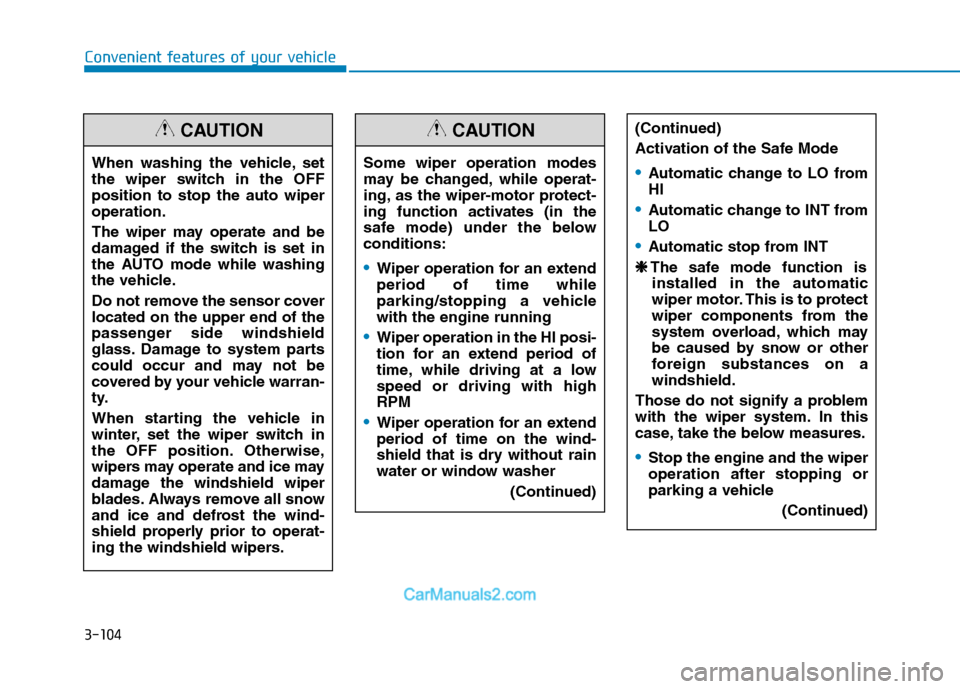
When washing the vehicle, set
the wiper switch in the OFFposition to stop the auto wiperoperation.
The wiper may operate and be
damaged if the switch is set in
the AUTO mode while washing
the vehicle.
Do not remove the sensor cover located on the upper end of the
passenger side windshield
glass. Damage to system parts
could occur and may not be
covered by your vehicle warran-
ty.
When starting the vehicle in
winter, set the wiper switch in
the OFF position. Otherwise,
wipers may operate and ice may
damage the windshield wiper
blades. Always remove all snow
and ice and defrost the wind-
shield properly prior to operat-
ing the windshield wipers.
CAUTION(Continued)
Activation of the Safe Mode
Automatic change to LO from HI
Automatic change to INT from LO
Automatic stop from INT
❈
❈ The safe mode function is
installed in the automatic
wiper motor. This is to protect
wiper components from the
system overload, which may
be caused by snow or other
foreign substances on awindshield.
Those do not signify a problem
with the wiper system. In this
case, take the below measures.
Stop the engine and the wiper operation after stopping or
parking a vehicle (Continued)
Some wiper operation modes
may be changed, while operat-
ing, as the wiper-motor protect-
ing function activates (in the
safe mode) under the belowconditions:
Wiper operation for an extend period of time while
parking/stopping a vehiclewith the engine running
Wiper operation in the HI posi-
tion for an extend period of
time, while driving at a lowspeed or driving with highRPM
Wiper operation for an extend period of time on the wind-
shield that is dry without rain
water or window washer (Continued)
CAUTION
Page 272 of 473
Driving your vehicle
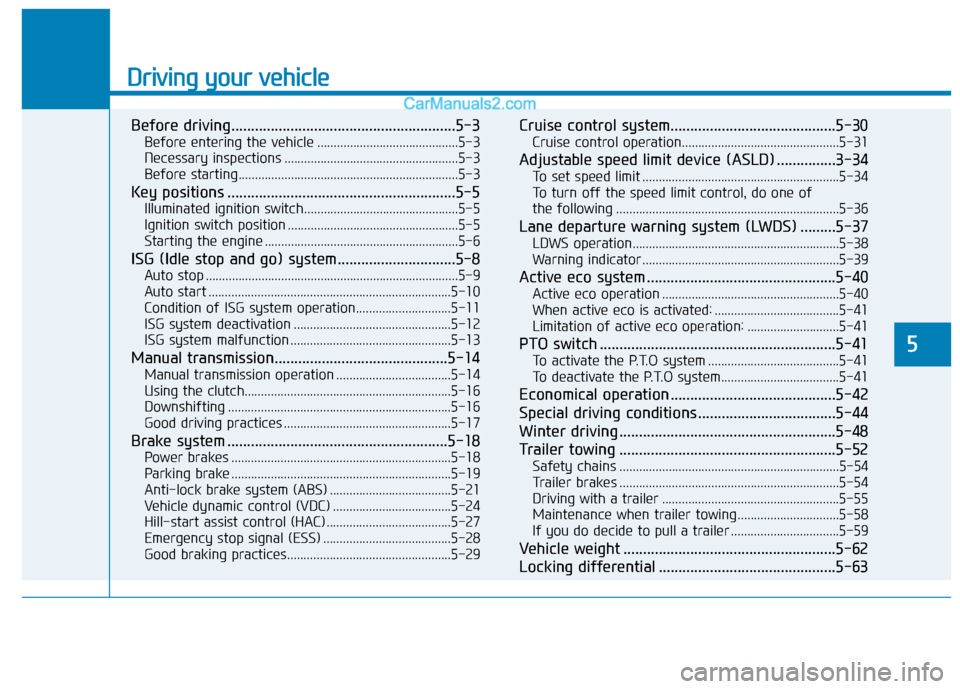
Before driving.........................................................5-3Before entering the vehicle ...........................................5-3
Necessary inspections .....................................................5-3
Before starting...................................................................5-3
Key positions ..........................................................5-5 Illuminated ignition switch...............................................5-5
Ignition switch position ....................................................5-5
Starting the engine ...........................................................5-6
ISG (Idle stop and go) system..............................5-8 Auto stop .............................................................................5-9
Auto start ..........................................................................5-10
Condition of ISG system operation.............................5-11
ISG system deactivation ................................................5-12
ISG system malfunction .................................................5-13
Manual transmission............................................5-14 Manual transmission operation ...................................5-14
Using the clutch...............................................................5-16
Downshifting ....................................................................5-16
Good driving practices ...................................................5-17
Brake system ........................................................5-18 Power brakes ...................................................................5-18
Parking brake ...................................................................5-19
Anti-lock brake system (ABS) .....................................5-21
Vehicle dynamic control (VDC) ....................................5-24
Hill-start assist control (HAC) ......................................5-27
Emergency stop signal (ESS) .......................................5-28
Good braking practices..................................................5-29 Cruise control system..........................................5-30
Cruise control operation................................................5-31
Adjustable speed limit device (ASLD) ...............3-34 To set speed limit ............................................................5-34
To turn off the speed limit control, do one of
the following ....................................................................5-36
Lane departure warning system (LWDS) .........5-37 LDWS operation...............................................................5-38
Warning indicator ............................................................5-39
Active eco system ................................................5-40 Active eco operation ......................................................5-40
When active eco is activated: ......................................5-41
Limitation of active eco operation: ............................5-41
PTO switch ............................................................5-41 To activate the P.T.O system ........................................5-41
To deactivate the P.T.O system....................................5-41
Economical operation ..........................................5-42
Special driving conditions ...................................5-44
Winter driving .......................................................5-48
Trailer towing .......................................................5-52 Safety chains ...................................................................5-54
Trailer brakes ...................................................................5-54
Driving with a trailer ......................................................5-55
Maintenance when trailer towing ...............................5-58
If you do decide to pull a trailer .................................5-59
Vehicle weight ......................................................5-62
Locking differential .............................................5-63
5
Page 279 of 473
5-8
If the engine were not started within 10 seconds after the pre-
heating is completed, turn the
ignition key once more to theLOCK position during 10 seconds,
and then to the ON position, in
order to preheat again.
Starting and stopping the engine
for turbocharger intercooler
1. Do not race or accelerate the
engine immediately after starting.
If the engine is cold, idle for sever-
al seconds before sufficient lubri-cation is ensured in the tur-bocharger unit.
2. After high speed or extended driv- ing, requiring a heavy engine load,
idle the engine about 1 minute
before turning it off.
This idle time will allow the tur-bocharger to cool prior to shutting
the engine off. Your vehicle may be equipped withthe ISG system, which reduces fuel
consumption by automatically shut-
ting down the engine, when the vehi-
cle is at a standstill. (For example :
red light, stop sign and traffic jam)
The engine starts automatically as
soon as the starting conditions aremet.
The ISG system is ON whenever the
engine is running.
When the engine automatically
starts by the ISG system, some
warning lights (ABS, VDC, VDC
OFF, EBD) may turn on for a fewseconds.
This happens because of low bat-
tery voltage. It does not mean thesystem is malfunctioning.
NOTICE
NOTICE
Driving your vehicle
Do not turn the engine off
immediately after it has been
subjected to a heavy load.
Doing so may cause severe
damage to the engine or turbo
charger unit.
CAUTION
II
SS GG (( IIDD LLEE SS TT OO PP AA NN DD GG OO ))
S
S YY SSTT EEMM (( IIFF EE QQ UUIIPP PPEEDD ))
Page 281 of 473

5-10
Driving your vehicle
(continued)
Also, a message "Auto Stop deac-
tivated. start manually will appear
on the LCD display. Turn the igni-
tion switch to the START position
to start the engine manually. Or if
you fasten the seat belt or closethe driver's door(or engine hood),
ISG system will be activate.Auto start
To restart the engine from idlestop mode
shift lever is in the N (Neutral) posi- tion.
The engine will start and the green
AUTO STOP indicator ( ) on the
instrument cluster will go out.
The engine will also restart automatically without the dri-
ver’s any actions if the followingoccurs:
- The fan speed of manual climate control system is set above the 3rdposition when the air conditioning ison.
- When a certain amount of time has passed with the climate control sys-tem on.
- The fan speed of manual climate control system is set above the 1stposition when the defroster is on.
- The brake vacuum pressure is low.
- The battery charging status is low.
- The vehicle speed exceeds 5 km/h.
The green AUTO STOP indicator
( ) on the instrument cluster will
blink for 5 seconds and a message
"Auto Start" will appear on the LCD
display.
Page 282 of 473
5-11
Driving your vehicle
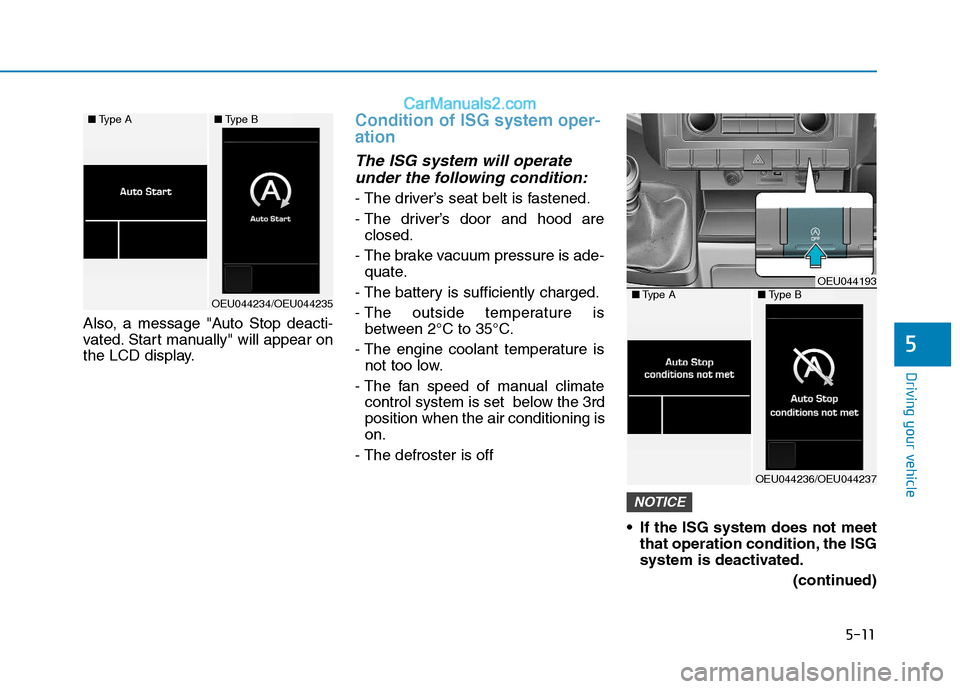
Also, a message "Auto Stop deacti-
vated. Start manually" will appear on
the LCD display.
Condition of ISG system oper- ation
The ISG system will operateunder the following condition:
- The driver’s seat belt is fastened.
- The driver’s door and hood are closed.
- The brake vacuum pressure is ade- quate.
- The battery is sufficiently charged.
- The outside temperature is between 2°C to 35°C.
- The engine coolant temperature is not too low.
- The fan speed of manual climate control system is set below the 3rd position when the air conditioning ison.
- The defroster is off
If the ISG system does not meetthat operation condition, the ISG
system is deactivated.
(continued)
NOTICE
5
■Type A■Type B
OEU044234/OEU044235
OEU044193■Type A■Type B
OEU044236/OEU044237
Page 284 of 473
5-13
Driving your vehicle
5
ISG system malfunction
The system may not operatewhen:
- The ISG related sensors or system error occurs.
The yellow AUTO STOP indicator
( ) on the instrument cluster will
stay on after blinking for 5 seconds
and the light on the ISG OFF button
will illuminate.
If the ISG OFF button light is not turned off by pressing the ISG
OFF button again or if the ISG
system continuously does not
work correctly, we recommend
that you contact an authorized
HYUNDAI dealer.
(Continued)(Continued)
When the ISG OFF button light
comes on, it may stop illuminat-
ing after driving your vehicle at
approximately 80 km/h for a
maximum of two hours and set-
ting the fan speed control knob
below the 2nd position. If the
ISG OFF button light continuesto be illuminated in spite of the
procedure, we recommend that
you contact an authorized
HYUNDAI dealer.
NOTICE
When the engine is in Idle Stop
mode, it's possible to restart theengine without the driver taking
any action.
Before leaving the vehicle or
doing anything in the engine
room area, stop the engine by
turning the ignition switch tothe LOCK(OFF) position or
removing the ignition key.
WARNING
Page 285 of 473
5-14
Driving your vehicle
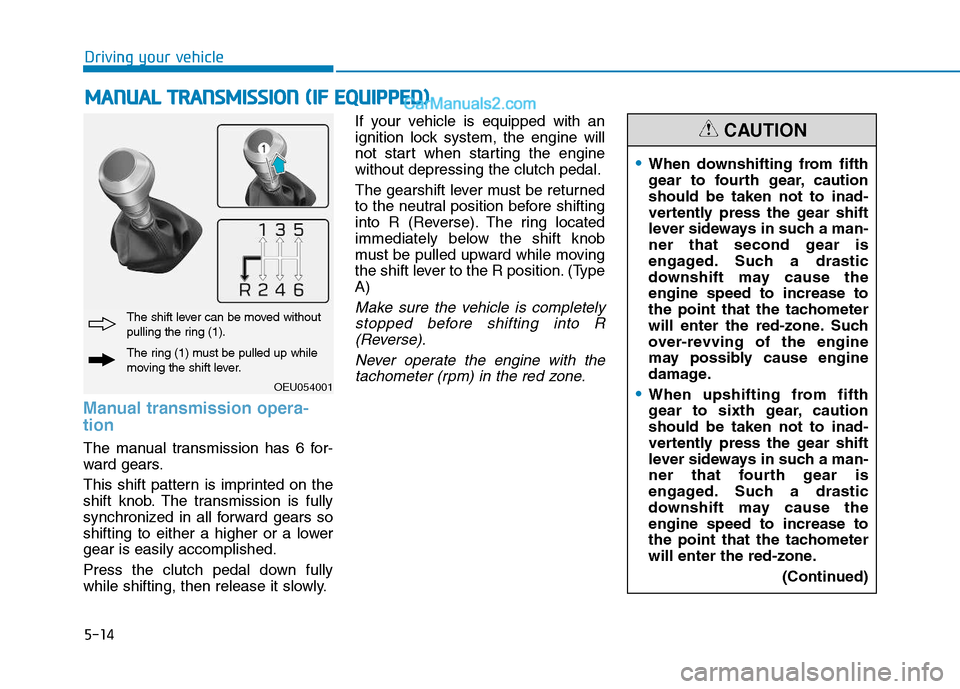
Manual transmission opera- tion
The manual transmission has 6 for-
ward gears.
This shift pattern is imprinted on the
shift knob. The transmission is fully
synchronized in all forward gears so
shifting to either a higher or a lowergear is easily accomplished.
Press the clutch pedal down fully
while shifting, then release it slowly.If your vehicle is equipped with an
ignition lock system, the engine will
not start when starting the enginewithout depressing the clutch pedal.
The gearshift lever must be returned
to the neutral position before shifting
into R (Reverse). The ring located
immediately below the shift knob
must be pulled upward while moving
the shift lever to the R position. (TypeA)
Make sure the vehicle is completely
stopped before shifting into R(Reverse).
Never operate the engine with thetachometer (rpm) in the red zone.
MM AANN UU AALL TT RR AA NN SSMM IISS SSIIOO NN (( IIFF EE QQ UUIIPP PPEEDD ))
OEU054001
The ring (1) must be pulled up while
moving the shift lever.
The shift lever can be moved without
pulling the ring (1).
When downshifting from fifth
gear to fourth gear, cautionshould be taken not to inad-
vertently press the gear shift
lever sideways in such a man-
ner that second gear is
engaged. Such a drastic
downshift may cause theengine speed to increase to
the point that the tachometer
will enter the red-zone. Such
over-revving of the engine
may possibly cause engine
damage.
When upshifting from fifth
gear to sixth gear, cautionshould be taken not to inad-
vertently press the gear shift
lever sideways in such a man-
ner that fourth gear is
engaged. Such a drastic
downshift may cause theengine speed to increase to
the point that the tachometer
will enter the red-zone.
(Continued)
CAUTION
Page 286 of 473
5-15
Driving your vehicle
5 During cold weather, shifting maybe difficult until the transmission
lubricant has warmed up. This is
normal and not harmful to the
transmission.
If you've come to a complete stop and it's hard to shift into 1st or R
(Reverse), put the shift lever in N
(Neutral) position and release the
clutch. Press the clutch pedal back
down, and then shift into 1st or R
(Reverse) gear position.
To avoid premature clutch
wear and damage, do not
drive with your foot resting on
the clutch pedal. Also, don’t
use the clutch to hold the
vehicle stopped on an uphill
grade, while waiting for a traf-
fic light, etc.
Do not use the shift lever as a
handrest during driving, asthis can result in prematurewear of the transmission shift
forks.
When operating the clutch
pedal, press the clutch pedal
down fully. If you don’t press
the clutch pedal fully, the
clutch may be damaged or
noise may occur.
To prevent possible damage
to the clutch system, do not
start with the 2nd (second)
gear engaged except when
you start on a slippery road.
CAUTION
Before leaving the driver’s
seat, always set the parking
brake fully and shut the
engine off. Then make surethe transmission is shifted
into 1st gear when the vehicle
is parked on a level or uphill
grade, and shifted into R
(Reverse) on a downhill
grade. Unexpected and sud-
den vehicle movement canoccur if these precautions are
not followed in the order iden-tified.
If your vehicle has a manual transmission not equipped
with an ignition lock switch, it
may move and cause a seri-
ous accident when startingthe engine without depress-
ing the clutch pedal while theparking brake is released and
the shift lever not in theN(Neutral) position.
(Continued)
WARNING (Continued)Such over-revving of the
engine may possibly cause
engine damage.
Do not downshift more than 2
gears or downshift the gearwhen the engine is running athigh speed (5,000 RPM or
higher). Such a downshifting
may damage the engine,
clutch and the transmission.
Page 293 of 473
5-22
Driving your vehicle
The ABS continuously senses the
speed of the wheels. If the wheels
are going to lock, the ABS system
repeatedly modulates the hydraulic
brake pressure to the wheels.
When you apply your brakes under
conditions which may lock the
wheels, you may hear a “tik-tik’’
sound from the brakes, or feel a cor-
responding sensation in the brake
pedal. This is normal and it means
your ABS is active.
In order to obtain the maximum ben-
efit from your ABS in an emergencysituation, do not attempt to modulate
your brake pressure and do not try to
pump your brakes. Press your brake
pedal as hard as possible or as hard
as the situation warrants and allow
the ABS to control the force being
delivered to the brakes.A click sound may be heard in the
engine compartment when the
vehicle begins to move after the
engine is started. These condi-tions are normal and indicate that
the anti-lock brake system is func-
tioning properly.
Even with the anti-lock brake sys-
tem, your vehicle still requires suf-
ficient stopping distance. Always
maintain a safe distance from the
vehicle in front of you.
Always slow down when cornering. The anti-lock brake system cannot
prevent accidents resulting from
excessive speeds.
On loose or uneven road surfaces, operation of the anti-lock brake
system may result in a longer stop-
ping distance than for vehicles
equipped with a conventional
brake system.NOTICE(Continued)
Rough, gravel or snow-cov-
ered roads.
With tire chains installed.
On roads where the road sur-
face is pitted or has differentsurface height.
The safety features of an ABS
(or VDC) equipped vehicle
should not be tested by high
speed driving or cornering. This
could endanger the safety of
yourself or others.
Page 294 of 473
5-23
Driving your vehicle
5
When you jump start your vehicle
because of a drained battery, the
engine may not run as smoothly
and the ABS warning light may
turn on at the same time. This hap-
pens because of the low battery
voltage. It does not mean yourABS is malfunctioning.
Do not pump your brakes!
Have the battery rechargedbefore driving the vehicle.
NOTICE
W-78
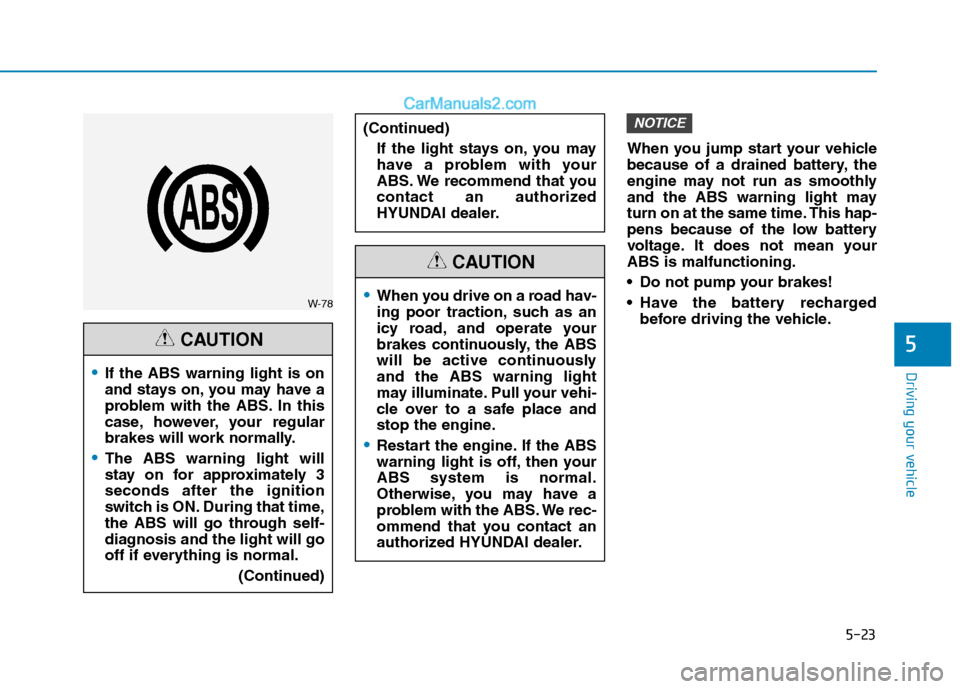
If the ABS warning light is on
and stays on, you may have a
problem with the ABS. In this
case, however, your regular
brakes will work normally.
The ABS warning light will
stay on for approximately 3seconds after the ignition
switch is ON. During that time,
the ABS will go through self-
diagnosis and the light will go
off if everything is normal.
(Continued)
CAUTION
When you drive on a road hav-
ing poor traction, such as an
icy road, and operate your
brakes continuously, the ABS
will be active continuouslyand the ABS warning light
may illuminate. Pull your vehi-
cle over to a safe place and
stop the engine.
Restart the engine. If the ABS
warning light is off, then yourABS system is normal.
Otherwise, you may have a
problem with the ABS. We rec-
ommend that you contact an
authorized HYUNDAI dealer.
CAUTION
(Continued)
If the light stays on, you may
have a problem with your
ABS. We recommend that you
contact an authorized
HYUNDAI dealer.