trailer Hyundai H350 2015 User Guide
[x] Cancel search | Manufacturer: HYUNDAI, Model Year: 2015, Model line: H350, Model: Hyundai H350 2015Pages: 473, PDF Size: 26.4 MB
Page 330 of 473
5-59
Driving your vehicle
5
If you do decide to pull a trail- er
Here are some important points if
you decide to pull a trailer:
Consider using a sway control. Youcan ask a hitch dealer about sway control.
Do not do any towing with your vehicle during its first 2,000 km
(1,200 miles) in order to allow the
engine to properly break in. Failure
to heed this caution may result in
serious engine or transmission
damage.
When towing a trailer, we recom- mend that you consult an author-
ized HYUNDAI dealer on addition-
al requirements such as a towingkit, etc.
Always drive your vehicle at a mod- erate speed (Max speed for stan-
dard trailer is 80 km/h (50 mph)). ❇ Special trailer 100 km/h (60
mph) is allowed but trailer need
special approval from TÜV. On a long uphill grade, do not
exceed 70 km/h (45 mph) or the
posted towing speed limit,
whichever is lower.
Fuel consumption will increase due to the additional required power to
tow trailer and additional trans-
portation weight at the trailer.
To prevent vehicle damage :
Due to higher load during
trailer usage, overheating
might occur in hot days or
during uphill driving. If the
coolant gauge indicates over-
heating, switch off the A/C
and stop the vehicle in a safe
area to cool down the engine.
When towing check transmis-
sion fluid more frequently.
If your vehicle is not equipped
with the air conditioner, youshould install a condenser fan
to improve engine perform-
ance when towing a trailer.
CAUTION
Page 331 of 473
5-60
Driving your vehicle
ItemBus
Va n
Truck
N1* 1
N2*1
Long Long Short Long Short Long Short
Overall length mm(inch) 6,195
(243.9) 6,195
(243.9) 5,515
(217.1) 6,195
(243.9) 5,515
(217.1) 6,167
(242.8) 5,724
(225.4)
Maximum trailer
weight kg(lbs.) Without
brake
System 750 (1,653) 750 (1,653) 750 (1,653) 750 (1,653) 750 (1,653) 750 (1,653) 750 (1,653)
With brake System 2,500
(5,511) 3,000
(6,613) 3,000
(6,613) 2,500
(5,511) 2,500
(5,511) 3,000
(6,613) 3,000
(6,613)
Maximum permissible
static vertical load on
the coupling device kg(lbs.) 100 (220) 120 (264) 120 (264) 100 (220) 100 (220) 120 (264) 120 (264)
Recommended distance fromrear wheel center to coupling
point mm(inch) 1,686 (66.4) 1,686 (66.4) 1,241 (48.9) 1,686 (66.4) 1,241 (48.9) 1,756 (69.1) 1,548 (60.9)
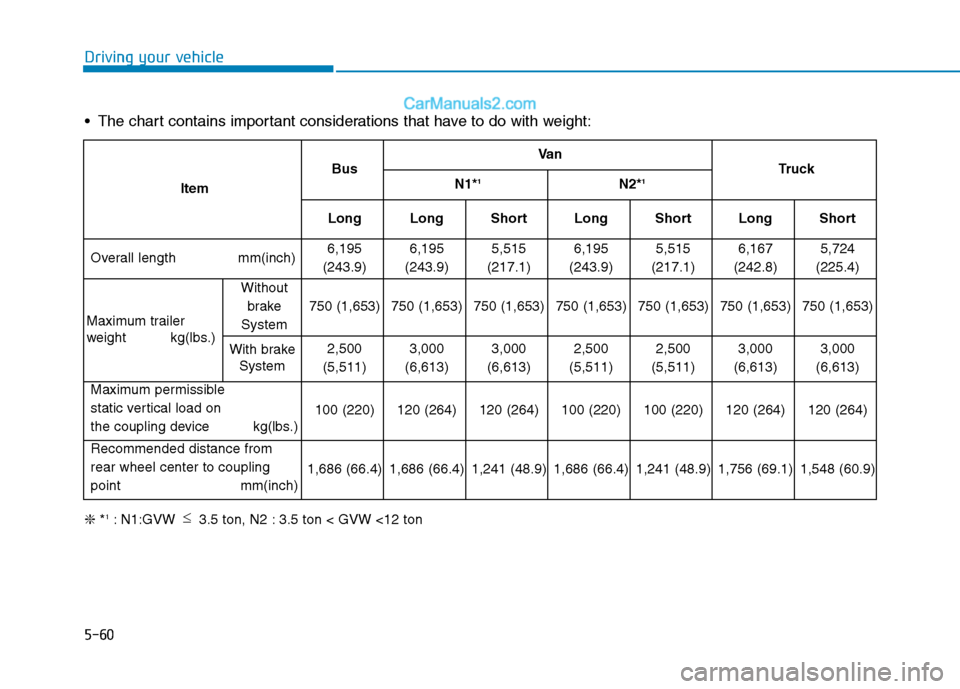
The chart contains important considerations that have to do with weight: ❇
*1
: N1:GVW 3.5 ton, N2 : 3.5 ton < GVW <12 ton
Page 332 of 473
5-61
Driving your vehicle
5
Trailer weight
How heavy can a trailer safely be? It
should never weigh more than the
maximum trailer weight with trailer
brakes. But even that can be too
heavy.
It depends on how you plan to use
your trailer. For example, speed, alti-
tude, road grades, outside tempera-
ture and how often your vehicle is
used to pull a trailer are all important.
The ideal trailer weight can also
depend on any special equipment
that you have on your vehicle.
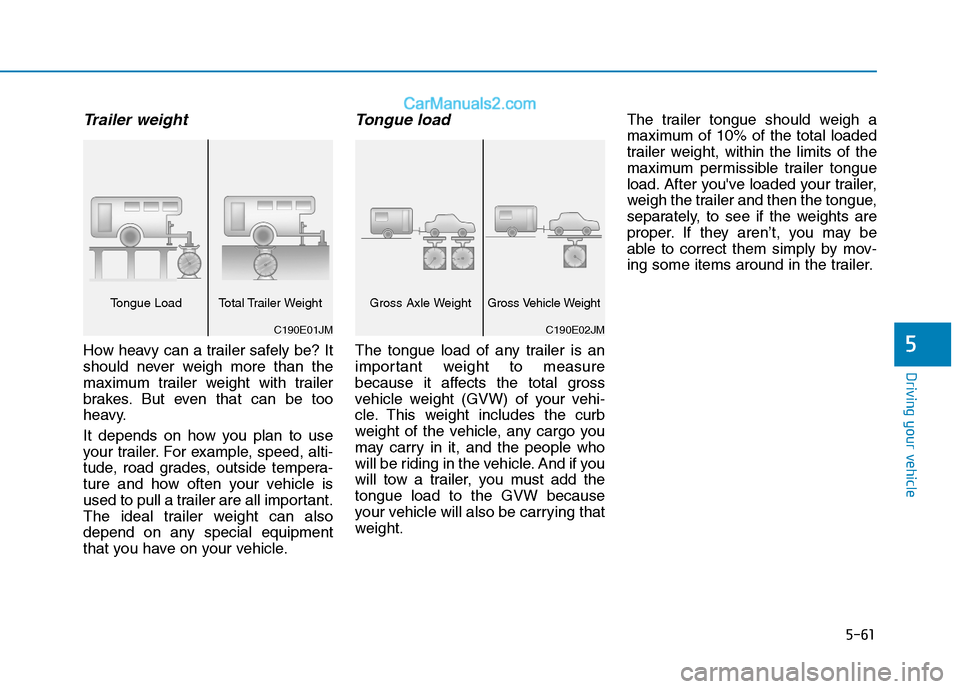
Tongue load
The tongue load of any trailer is an
important weight to measure
because it affects the total gross
vehicle weight (GVW) of your vehi-
cle. This weight includes the curb
weight of the vehicle, any cargo you
may carry in it, and the people who
will be riding in the vehicle. And if you
will tow a trailer, you must add thetongue load to the GVW because
your vehicle will also be carrying that
weight.The trailer tongue should weigh a
maximum of 10% of the total loaded
trailer weight, within the limits of the
maximum permissible trailer tongue
load. After you've loaded your trailer,
weigh the trailer and then the tongue,
separately, to see if the weights are
proper. If they aren’t, you may be
able to correct them simply by mov-
ing some items around in the trailer.
C190E01JM
Tongue Load Total Trailer Weight
C190E02JM
Gross Axle WeightGross Vehicle Weight
Page 333 of 473
5-62
Driving your vehicle
This section will guide you in the
proper loading of your vehicle and/or
trailer, to keep your loaded vehicle
weight within its design rating capa-
bility, with or without a trailer.
Properly loading your vehicle will
provide maximum return of the vehi-
cle design performance. Before load-
ing your vehicle, familiarize yourself
with the following terms for determin-
ing your vehicle's weight ratings, with
or without a trailer, from the vehicle's
specifications and the certificationlabel:
Base curb weight
This is the weight of the vehicle including a full tank of fuel and all
standard equipment. It does not
include passengers, cargo, or option-al equipment.
Vehicle curb weight
This is the weight of your new vehicle
when you picked it up from your deal-
er plus any aftermarket equipment.
Cargo weight
This figure includes all weight added
to the Base Curb Weight, includingcargo and optional equipment.
GAW (Gross axle weight)
This is the total weight placed on each axle (front and rear) - including
vehicle curb weight and all payload.
GAWR (Gross axle weight rat- ing)
This is the maximum allowable
weight that can be carried by a single
axle (front or rear). These numbers
are shown on the certification label.
The total load on each axle must
never exceed its GAWR.
GVW (Gross vehicle weight)
This is the Base Curb Weight plus
actual Cargo Weight plus passen-
gers.
Take the following precautions:
Never load a trailer with more weight in the rear than in the
front. The front should be
loaded with approximately60% of the total trailer load;the rear should be loaded with
approximately 40% of the totaltrailer load.
Never exceed the maximum weight limits of the trailer or
trailer towing equipment.
Improper loading can result in
damage to your vehicle and/or
personal injury. Checkweights and loading at a com-
mercial scale or highway
patrol office equipped withscales.
An improperly loaded trailer
can cause loss of vehicle con-
trol.
WARNING
VV
EEHH IICC LLEE WW EEIIGG HH TT
Page 357 of 473
6-22
What to do in an emergency
The compact spare tire should notbe used on any other wheels, nor
should standard tires, snow tires,
wheel covers or trim rings be used
with the compact spare wheel. Ifsuch use is attempted, damage tothese items or other car compo-
nents may occur.
Do not use more than one compact spare tire at a time.
Do not tow a trailer while the com- pact spare tire is installed.Towing service
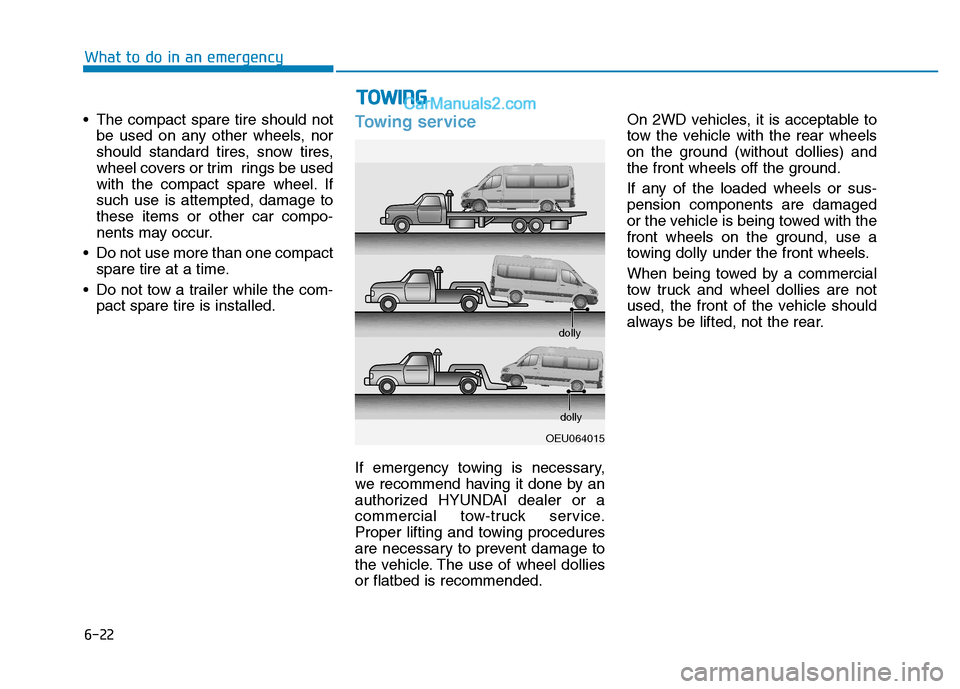
If emergency towing is necessary,
we recommend having it done by an
authorized HYUNDAI dealer or a
commercial tow-truck service.
Proper lifting and towing procedures
are necessary to prevent damage to
the vehicle. The use of wheel dolliesor flatbed is recommended. On 2WD vehicles, it is acceptable to
tow the vehicle with the rear wheels
on the ground (without dollies) and
the front wheels off the ground.
If any of the loaded wheels or sus- pension components are damaged
or the vehicle is being towed with the
front wheels on the ground, use a
towing dolly under the front wheels.
When being towed by a commercial
tow truck and wheel dollies are not
used, the front of the vehicle should
always be lifted, not the rear.
TT
OO WW IINN GG
OEU064015 dolly
dolly
Page 381 of 473
7-18
Maintenance
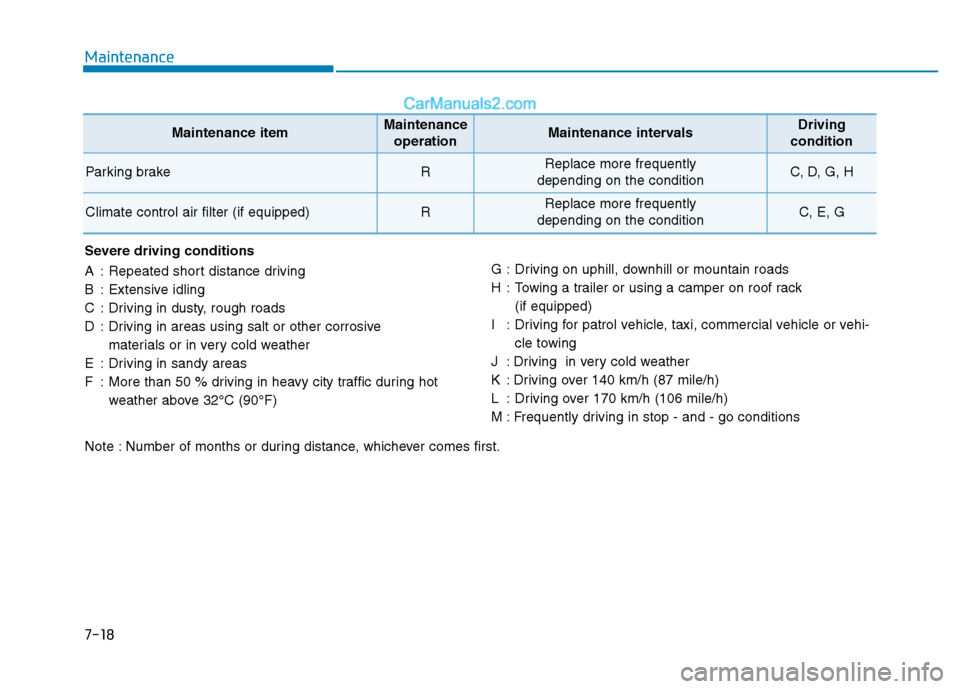
Severe driving conditions
A : Repeated short distance driving
B : Extensive idling
C : Driving in dusty, rough roads
D : Driving in areas using salt or other corrosive materials or in very cold weather
E : Driving in sandy areas
F : More than 50 % driving in heavy city traffic during hot weather above 32°C (90°F) G : Driving on uphill, downhill or mountain roads
H : Towing a trailer or using a camper on roof rack
(if equipped)
I : Driving for patrol vehicle, taxi, commercial vehicle or vehi- cle towing
J : Driving in very cold weather
K : Driving over 140 km/h (87 mile/h)
L : Driving over 170 km/h (106 mile/h)
M : Frequently driving in stop - and - go conditions
Maintenance itemMaintenance operationMaintenance intervalsDriving
condition
Parking brakeRReplace more frequently
depending on the conditionC, D, G, H
Climate control air filter (if equipped)RReplace more frequently
depending on the conditionC, E, G
Note : Number of months or during distance, whichever comes first.
Page 422 of 473
7-59
7
Maintenance
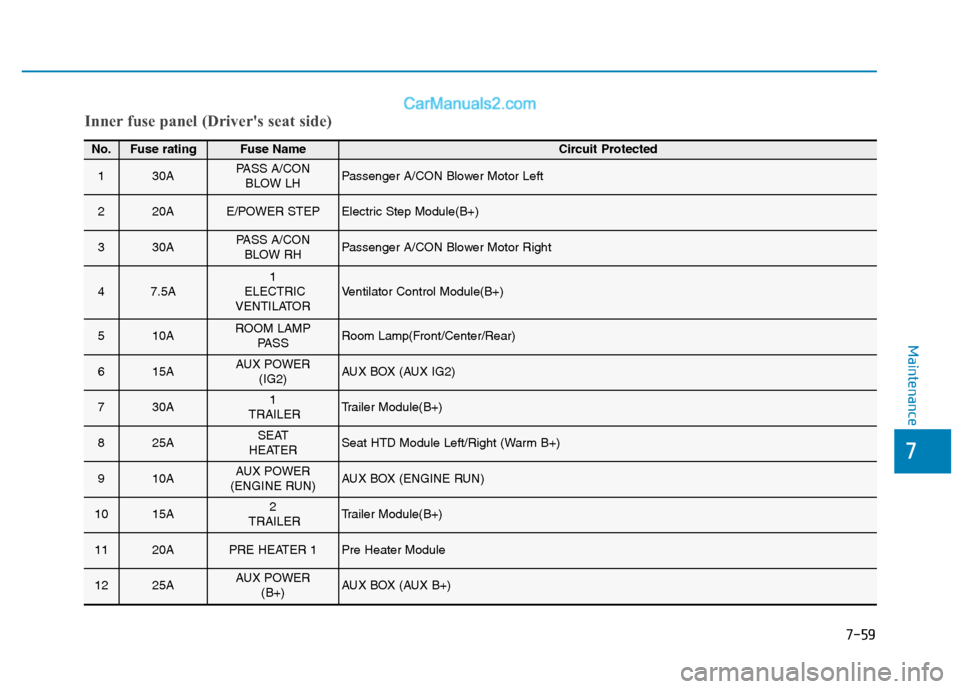
Inner fuse panel (Driver's seat side)
No.Fuse ratingFuse Name Circuit Protected
130APASS A/CONBLOW LHPassenger A/CON Blower Motor Left
220AE/POWER STEPElectric Step Module(B+)
330APASS A/CONBLOW RHPassenger A/CON Blower Motor Right
47.5A1
ELECTRIC
VENTILATORVentilator Control Module(B+)
510AROOM LAMP PASSRoom Lamp(Front/Center/Rear)
615AAUX POWER (IG2)AUX BOX (AUX IG2)
730A1
TRAILERTrailer Module(B+)
825ASEAT
HEATERSeat HTD Module Left/Right (Warm B+)
910AAUX POWER
(ENGINE RUN)AUX BOX (ENGINE RUN)
1015A2
TRAILERTrailer Module(B+)
1120APRE HEATER 1Pre Heater Module
1225AAUX POWER (B+)AUX BOX (AUX B+)
Page 423 of 473
7-60
Maintenance
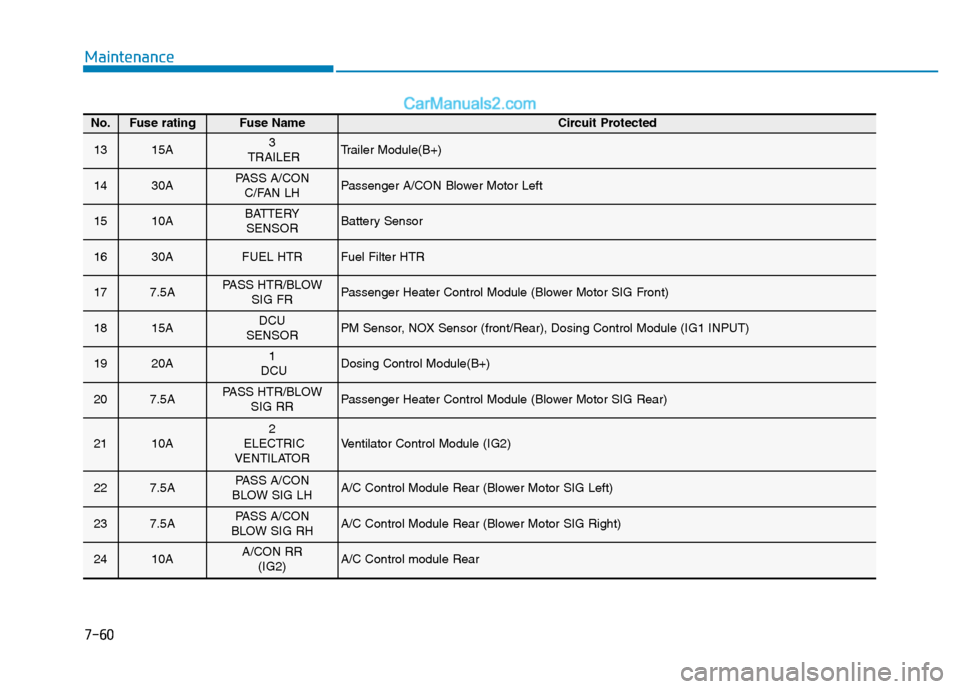
No.Fuse ratingFuse Name Circuit Protected
1315A3
TRAILERTrailer Module(B+)
1430APASS A/CON C/FAN LHPassenger A/CON Blower Motor Left
1510ABATTERYSENSORBattery Sensor
1630AFUEL HTRFuel Filter HTR
177.5APASS HTR/BLOW SIG FRPassenger Heater Control Module (Blower Motor SIG Front)
1815ADCU
SENSORPM Sensor, NOX Sensor (front/Rear), Dosing Control Module (IG1 INPUT)
1920A1
DCUDosing Control Module(B+)
207.5APASS HTR/BLOW SIG RRPassenger Heater Control Module (Blower Motor SIG Rear)
2110A2
ELECTRIC
VENTILATORVentilator Control Module (IG2)
227.5APASS A/CON
BLOW SIG LHA/C Control Module Rear (Blower Motor SIG Left)
237.5APASS A/CON
BLOW SIG RHA/C Control Module Rear (Blower Motor SIG Right)
2410AA/CON RR (IG2)A/C Control module Rear
Page 425 of 473
7-62
Maintenance
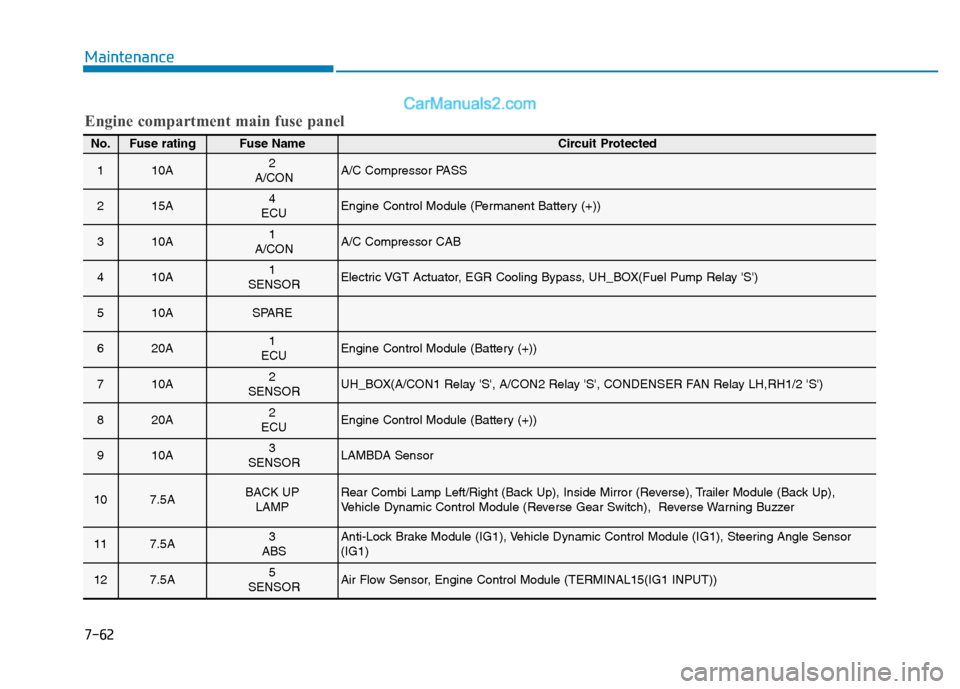
Engine compartment main fuse panel
No.Fuse ratingFuse Name Circuit Protected
110A2
A/CONA/C Compressor PASS
215A4
ECUEngine Control Module (Permanent Battery (+))
310A1
A/CONA/C Compressor CAB
410A1
SENSORElectric VGT Actuator, EGR Cooling Bypass, UH_BOX(Fuel Pump Relay 'S')
510ASPARE
620A1
ECUEngine Control Module (Battery (+))
710A2
SENSORUH_BOX(A/CON1 Relay 'S', A/CON2 Relay 'S', CONDENSER FAN Relay LH,RH1/2 'S')
820A2
ECUEngine Control Module (Battery (+))
910A3
SENSORLAMBDA Sensor
107.5ABACK UP LAMPRear Combi Lamp Left/Right (Back Up), Inside Mirror (Reverse), Trailer Module (Back Up),
Vehicle Dynamic Control Module (Reverse Gear Switch), Reverse Warning Buzzer
117.5A3
ABSAnti-Lock Brake Module (IG1), Vehicle Dynamic Control Module (IG1), Steering Angle Sensor (IG1)
127.5A5
SENSORAir Flow Sensor, Engine Control Module (TERMINAL15(IG1 INPUT))
Page 472 of 473
I-7
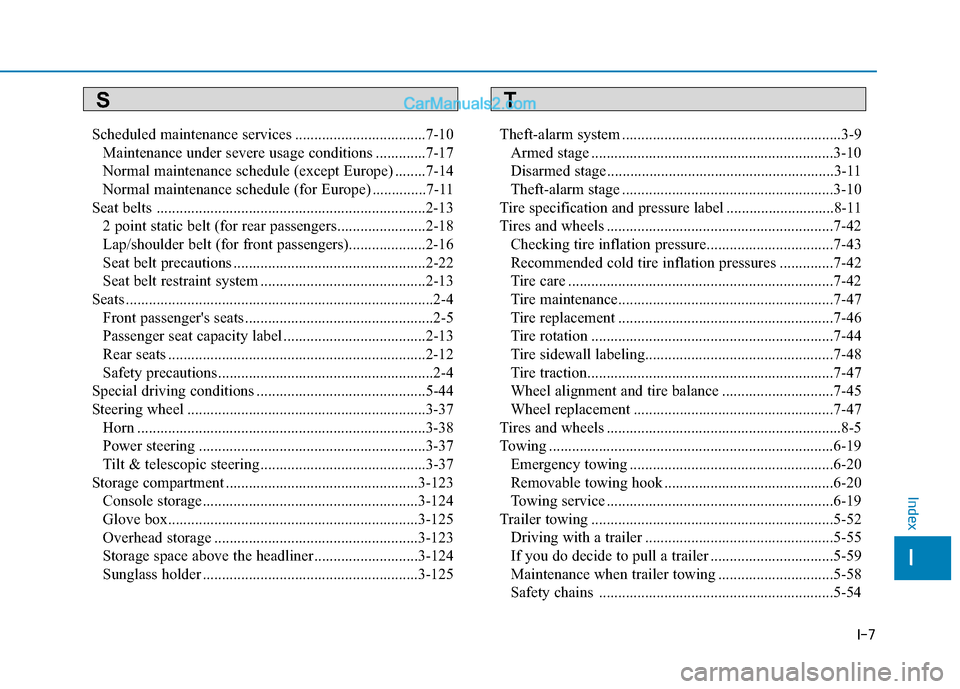
Scheduled maintenance services ..................................7-10
Maintenance under severe usage conditions .............7-17
Normal maintenance schedule (except Europe) ........7-14
Normal maintenance schedule (for Europe) ..............7-11
Seat belts ......................................................................2-13 2 point static belt (for rear passengers.......................2-18
Lap/shoulder belt (for front passengers)....................2-16
Seat belt precautions ..................................................2-22
Seat belt restraint system ...........................................2-13
Seats ................................................................................2-4
Front passenger's seats .................................................2-5
Passenger seat capacity label .....................................2-13
Rear seats ...................................................................2-12
Safety precautions........................................................2-4
Special driving conditions ............................................5-44
Steering wheel ..............................................................3-37 Horn ...........................................................................3-38
Power steering ...........................................................3-37
Tilt & telescopic steering ...........................................3-37
Storage compartment ..................................................3-123
Console storage........................................................3-124
Glove box.................................................................3-125
Overhead storage .....................................................3-123
Storage space above the headliner...........................3-124
Sunglass holder ........................................................3-125 Theft-alarm system .........................................................3-9
Armed stage ...............................................................3-10
Disarmed stage ...........................................................3-11
Theft-alarm stage .......................................................3-10
Tire specification and pressure label ............................8-11
Tires and wheels ...........................................................7-42 Checking tire inflation pressure.................................7-43
Recommended cold tire inflation pressures ..............7-42
Tire care .....................................................................7-42
Tire maintenance........................................................7-47
Tire replacement ........................................................7-46
Tire rotation ...............................................................7-44
Tire sidewall labeling.................................................7-48
Tire traction................................................................7-47
Wheel alignment and tire balance .............................7-45
Wheel replacement ....................................................7-47
Tires and wheels .............................................................8-5
Towing ..........................................................................6-19 Emergency towing .....................................................6-20
Removable towing hook ............................................6-20
Towing service ...........................................................6-19
Trailer towing ...............................................................5-52
Driving with a trailer .................................................5-55
If you do decide to pull a trailer ................................5-59
Maintenance when trailer towing ..............................5-58
Safety chains .............................................................5-54
I
Index
TS