Battery Hyundai H350 2015 Owner's Guide
[x] Cancel search | Manufacturer: HYUNDAI, Model Year: 2015, Model line: H350, Model: Hyundai H350 2015Pages: 473, PDF Size: 26.4 MB
Page 340 of 473
6-5
What to do in an emergency
6
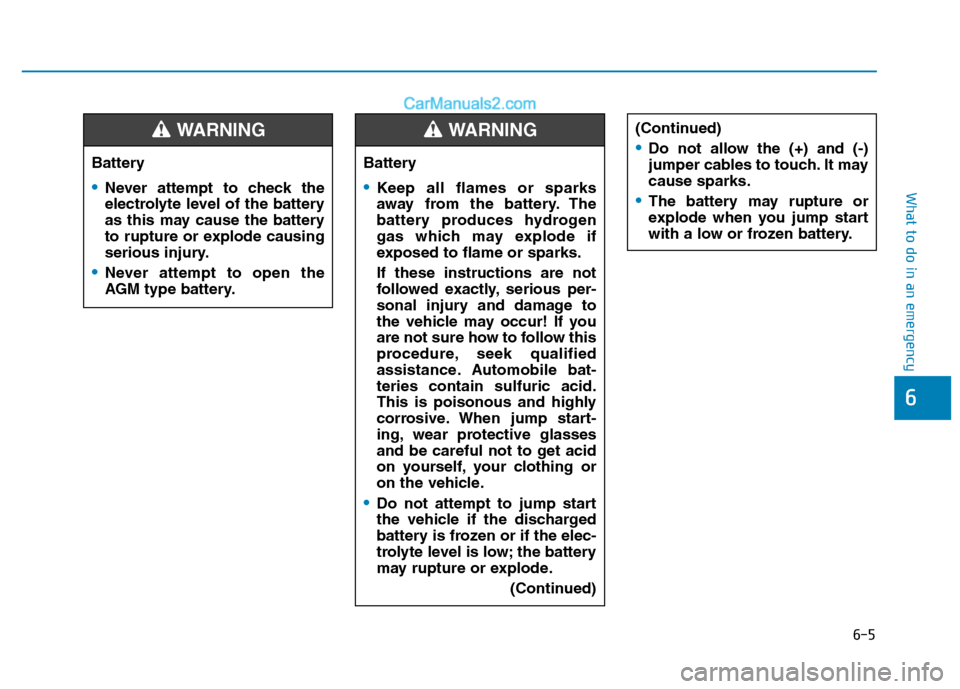
Battery
•Never attempt to check the
electrolyte level of the battery
as this may cause the battery
to rupture or explode causing
serious injury.
Never attempt to open the
AGM type battery.
WARNING
Battery
Keep all flames or sparks
away from the battery. The
battery produces hydrogen
gas which may explode if
exposed to flame or sparks. If these instructions are not
followed exactly, serious per-
sonal injury and damage to
the vehicle may occur! If you
are not sure how to follow this
procedure, seek qualified
assistance. Automobile bat-teries contain sulfuric acid.
This is poisonous and highly
corrosive. When jump start-
ing, wear protective glasses
and be careful not to get acid
on yourself, your clothing or
on the vehicle.
Do not attempt to jump start
the vehicle if the discharged
battery is frozen or if the elec-
trolyte level is low; the battery
may rupture or explode.(Continued)
WARNING (Continued)
Do not allow the (+) and (-)
jumper cables to touch. It maycause sparks.
The battery may rupture or
explode when you jump start
with a low or frozen battery.
Page 341 of 473
6-6
What to do in an emergency
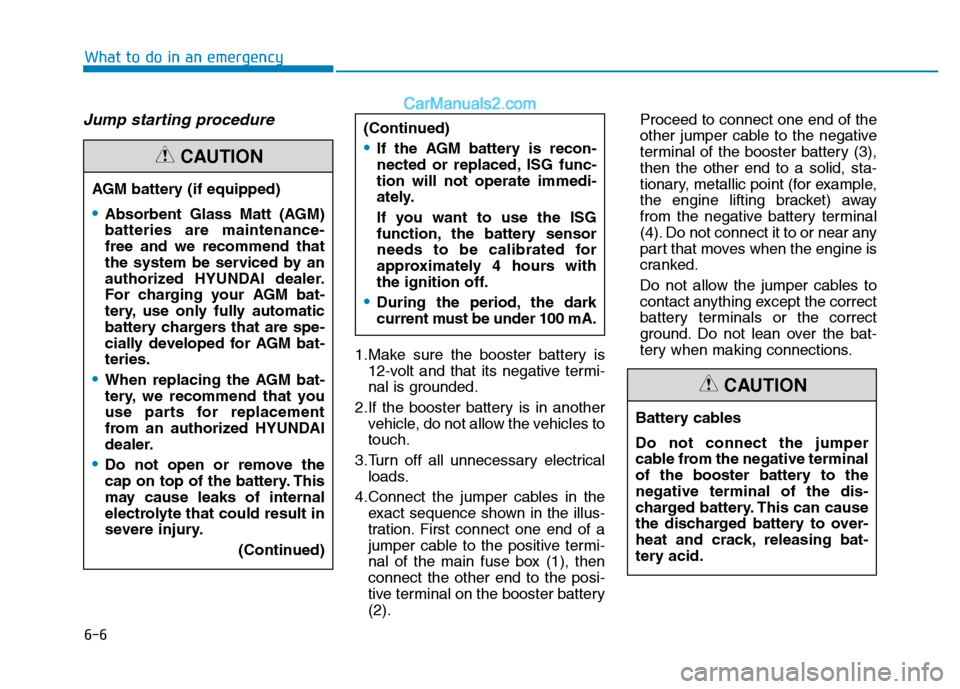
Jump starting procedure
1.Make sure the booster battery is12-volt and that its negative termi-
nal is grounded.
2.If the booster battery is in another vehicle, do not allow the vehicles totouch.
3.Turn off all unnecessary electrical loads.
4.Connect the jumper cables in the exact sequence shown in the illus-
tration. First connect one end of a
jumper cable to the positive termi-
nal of the main fuse box (1), thenconnect the other end to the posi-
tive terminal on the booster battery(2). Proceed to connect one end of the
other jumper cable to the negative
terminal of the booster battery (3),then the other end to a solid, sta-
tionary, metallic point (for example,
the engine lifting bracket) away
from the negative battery terminal
(4). Do not connect it to or near any
part that moves when the engine is
cranked.
Do not allow the jumper cables to contact anything except the correct
battery terminals or the correct
ground. Do not lean over the bat-
tery when making connections.
AGM battery (if equipped)
Absorbent Glass Matt (AGM) batteries are maintenance-free and we recommend that
the system be serviced by an
authorized HYUNDAI dealer.
For charging your AGM bat-
tery, use only fully automatic
battery chargers that are spe-
cially developed for AGM bat-teries.
When replacing the AGM bat-
tery, we recommend that you
use parts for replacement
from an authorized HYUNDAI
dealer.
Do not open or remove the
cap on top of the battery. This
may cause leaks of internal
electrolyte that could result in
severe injury.
(Continued)
(Continued)
If the AGM battery is recon-
nected or replaced, ISG func-tion will not operate immedi-
ately.
If you want to use the ISG
function, the battery sensor
needs to be calibrated for
approximately 4 hours with
the ignition off.
During the period, the dark
current must be under 100 mA.
CAUTION
Battery cables Do not connect the jumper
cable from the negative terminal
of the booster battery to thenegative terminal of the dis-
charged battery. This can cause
the discharged battery to over-
heat and crack, releasing bat-
tery acid.
CAUTION
Page 342 of 473
6-7
What to do in an emergency
5.Start the engine of the vehicle withthe booster battery and let it run at
2,000 rpm, then start the engine of
the vehicle with the discharged
battery.
If the cause of your battery discharg-
ing is not apparent, we recommendthat the system be checked by an authorized HYUNDAI dealer.
Push-starting
Your manual transmission-equipped
vehicle should not be push-startedbecause it might damage the emis-sion control system. If your temperature gauge indicates
overheating, you experience a loss
of power, or hear loud pinging or
knocking, the engine is probably too
hot. If this happens, you should:
1.Pull off the road and stop as soon
as it is safe to do so.
2.Place the shift lever in neutral and set the parking brake. If the air con-
ditioning is on, turn it off.
3.If engine coolant is running out under the vehicle or steam is com-ing out from the hood, stop the
engine. Do not open the hood until
the coolant has stopped running
or the steaming has stopped. If
there is no visible loss of engine
coolant and no steam, leave the
engine running and check to be
sure the engine cooling fan is oper-
ating. If the fan is not running, turn
the engine off.
6
Never tow a vehicle to start it
because the sudden surge for-
ward when the engine startscould cause a collision with the
tow vehicle.
WARNING
IIFF TT HH EE EE NN GGIINN EE OO VVEERR HH EEAA TTSS
Page 364 of 473
7
Maintenance
7
Maintenance
Engine compartment .............................................7-3
Maintenance services ...........................................7-5Owner's responsibility ......................................................7-5
Owner maintenance precautions ..................................7-5
Engine compartment precautions (Diesel engine) ....7-7
Owner maintenance ...............................................7-8 Owner maintenance schedule ........................................7-8
Scheduled maintenance services ......................7-10 Normal maintenance schedule (for Europe) ............7-11
Normal maintenance schedule (except Europe) .....7-14
Maintenance under severe usage conditions ..........7-17
Explanation of scheduled maintenance items ..7-19
Engine oil ..............................................................7-22 Checking the engine oil level ....................................7-22
Changing the engine oil and filter ..............................7-23
Engine coolant......................................................7-24 Checking the coolant level ...........................................7-24
Changing the coolant .....................................................7-26
Brake/Clutch fluid ..............................................7-27 Checking the brake/clutch fluid level ........................7-27
Power steering fluid ............................................7-28 Checking the power steering fluid level ...................2-28
Checking the power steering hose.............................2-29
Washer fluid .........................................................7-29 Checking the washer fluid level ...............................7-29 Parking brake .......................................................7-30
Checking the parking brake .........................................7-30
Fuel filter (For diesel).........................................7-30 Draining water from fuel filter ....................................7-30
Fuel filter cartridge replacement ................................7-30
Manual transmission and rearaxle oil ..............7-31 Check and adding oil ......................................................7-31
Change the gear oil ........................................................7-31
Air cleaner ............................................................7-31 Filter replacement ...........................................................7-31
Climate control air filter .....................................7-33 Filter inspection ...............................................................7-33
Filter replacement ...........................................................7-33
Wiper blades .........................................................7-34 Blade inspection ..............................................................7-34
Blade replacement ..........................................................7-35
Battery...................................................................7-37 For best battery service................................................7-37
Battery capacity label ...................................................7-40
Battery recharging .......................................................7-40
Reset items .......................................................................7-41
Tires and wheels ..................................................7-42 Tire care ............................................................................7-42
Recommended cold tire inflation pressures.............7-42
Checking tire inflation pressure ..................................7-43
7
Page 366 of 473
7-3
7
Maintenance
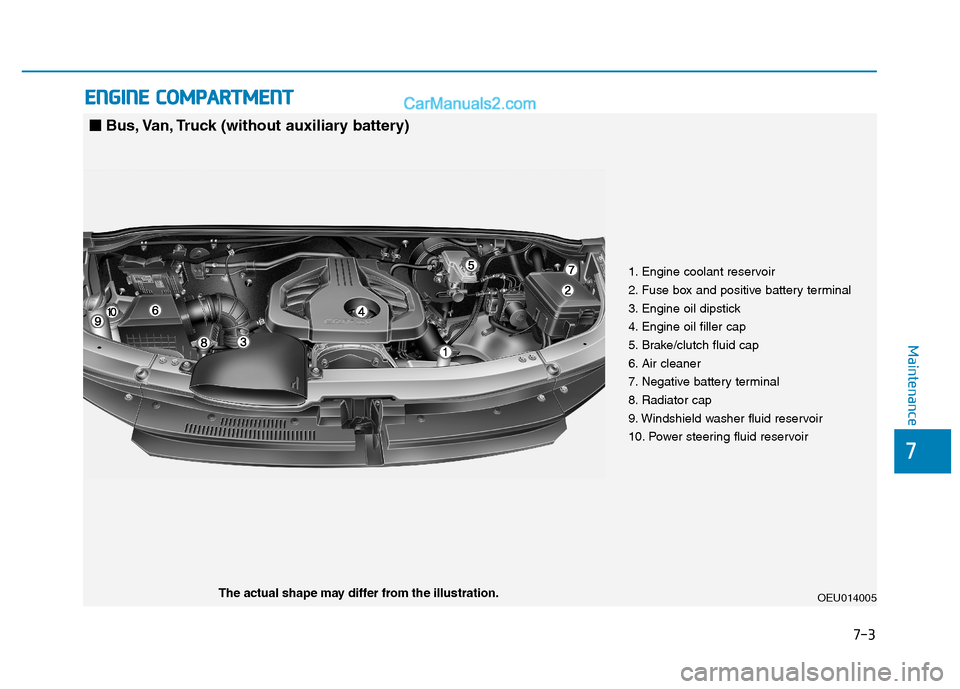
EENN GGIINN EE CC OO MM PPAA RRTTMM EENN TT
1. Engine coolant reservoir
2. Fuse box and positive battery terminal
3. Engine oil dipstick
4. Engine oil filler cap
5. Brake/clutch fluid cap
6. Air cleaner
7. Negative battery terminal
8. Radiator cap
9. Windshield washer fluid reservoir
10. Power steering fluid reservoir
OEU014005
The actual shape may differ from the illustration.
■■
Bus, Van, Truck (without auxiliary battery)
Page 367 of 473
7-4
Maintenance
OEU014006
The actual shape may differ from the illustration.
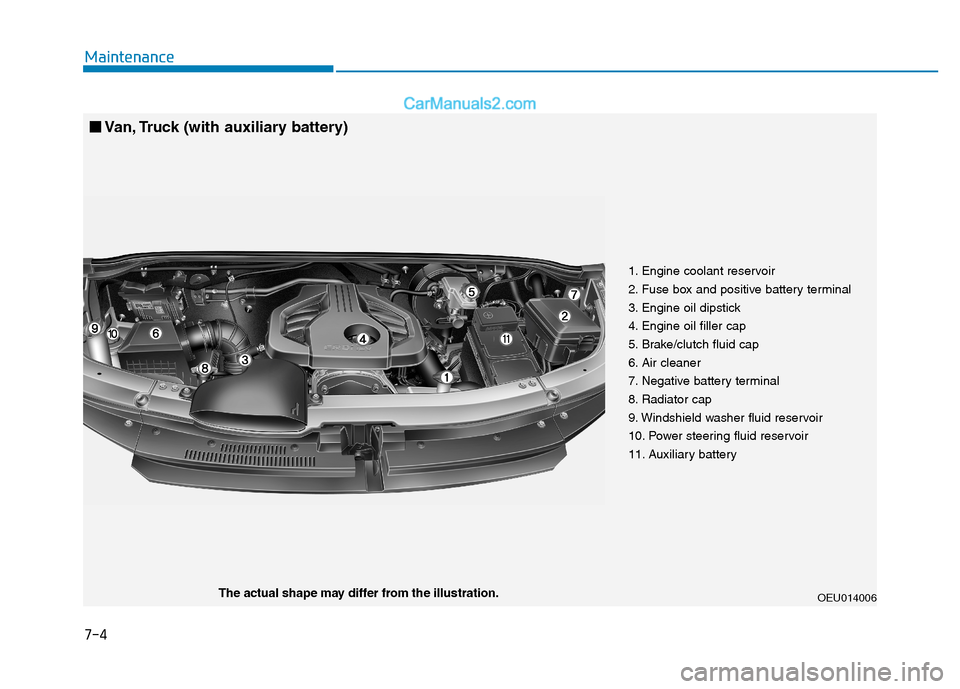
■
■
Van, Truck (with auxiliary battery)
1. Engine coolant reservoir
2. Fuse box and positive battery terminal
3. Engine oil dipstick
4. Engine oil filler cap
5. Brake/clutch fluid cap
6. Air cleaner
7. Negative battery terminal
8. Radiator cap
9. Windshield washer fluid reservoir
10. Power steering fluid reservoir
11. Auxiliary battery
Page 369 of 473
7-6
Maintenance
Maintenance work
Performing maintenance work
on a vehicle can be danger-
ous. You can be seriously
injured while performing
some maintenance proce-
dures. If you lack sufficient
knowledge and experience or
the proper tools and equip-
ment to do the work, we rec-ommend that the system be
serviced by an authorized
HYUNDAI dealer.
Working under the hood with
the engine running is danger-
ous. It becomes even more
dangerous when you wear
jewelry or loose clothing.These can become entangled
in moving parts and result in
injury.(Continued)
WARNING Continued)
Therefore, if you must run the
engine while working under
the hood, make certain that
you remove all jewelry (espe-
cially rings, bracelets, watch-
es, and necklaces) and all
neckties, scarves, and similar
loose clothing before gettingnear the engine or coolingfans.
Do not put heavy objects or
apply excessive force on top
of the engine cover (ifequipped) or fuel related
parts.
When you inspect the fuel system (fuel lines and fuel
injection devices), we recom-
mend that you contact an
authorized HYUNDAI dealer.
Do not drive long time with
the engine cover (if equipped)
removed.
When checking the engine
room, do not go near fire.
Fuel, washer fluid, etc. are
flammable oils that may cause
fire.
Before touching the battery,
ignition cables and electrical
wiring, you should disconnect
the battery "-" terminal. You
may get an electric shock
from the electric current. (Continued)
CAUTION
Page 372 of 473
7-9
7
Maintenance
At least monthly:
Check coolant level in the enginecoolant reservoir.
Check the operation of all exterior lights, including the stoplights, turn
signals and hazard warning flash-
ers.
Check the inflation pressures of all tires including the spare.
At least twice a year
(i.e., every Spring and Fall) :
Check radiator, heater and air con- ditioning hoses for leaks or dam-
age.
Check windshield washer spray and wiper operation. Clean wiper
blades with clean cloth dampened
with washer fluid.
Check headlight alignment.
Check muffler, exhaust pipes, shields and clamps.
Check the lap/shoulder belts for wear and function.
Check for worn tires and loose wheel lug nuts.
At least once a year :
Clean body, door and hood drainholes.
Clean and lubricate door hinges and checks, and hood hinges.
Clean and lubricate door and hood locks and latches.
Clean and lubricate door rubber weatherstrips.
Check the air conditioning system.
Check the power steering fluid level.
Clean battery and terminals.
Check the brake and clutch fluid level.
Page 375 of 473
7-12
Maintenance
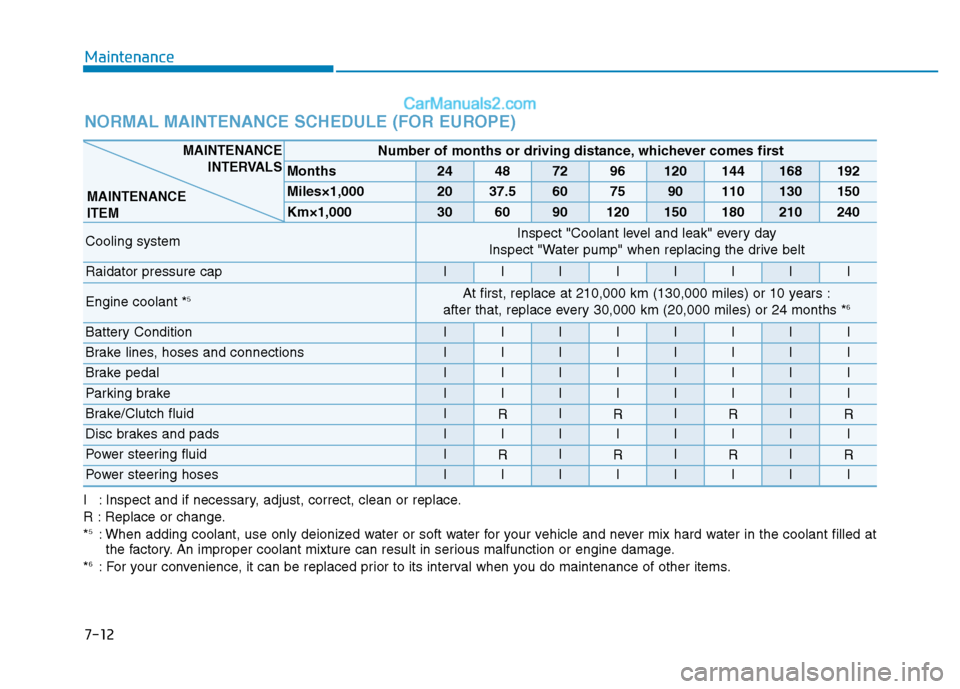
NORMAL MAINTENANCE SCHEDULE (FOR EUROPE)
Number of months or driving distance, whichever comes first
Months24487296120144168192
Miles×1,0002037.5607590110130150
Km×1,000306090120150180210240
Cooling systemInspect "Coolant level and leak" every day
Inspect "Water pump" when replacing the drive belt
Raidator pressure capIIIIIIII
Engine coolant * 5At first, replace at 210,000 km (130,000 miles) or 10 years :
after that, replace every 30,000 km (20,000 miles) or 24 months * 6
Battery ConditionIIIIIIII
Brake lines, hoses and connectionsIIIIIIII
Brake pedalIIIIIIII
Parking brakeIIIIIIII
Brake/Clutch fluidIRIRIRIR
Disc brakes and padsIIIIIIII
Power steering fluidIRIRIRIR
Power steering hosesIIIIIIII
MAINTENANCE
INTERVALS
MAINTENANCE ITEM
I : Inspect and if necessary, adjust, correct, clean or replace.
R : Replace or change.* 5
: When adding coolant, use only deionized water or soft water for your vehicle and never mix hard water in the coolant filled at
the factory. An improper coolant mixture can result in serious malfunction or engine damage.
* 6
: For your convenience, it can be replaced prior to its interval when you do maintenance of other items.
Page 378 of 473
7-15
7
Maintenance
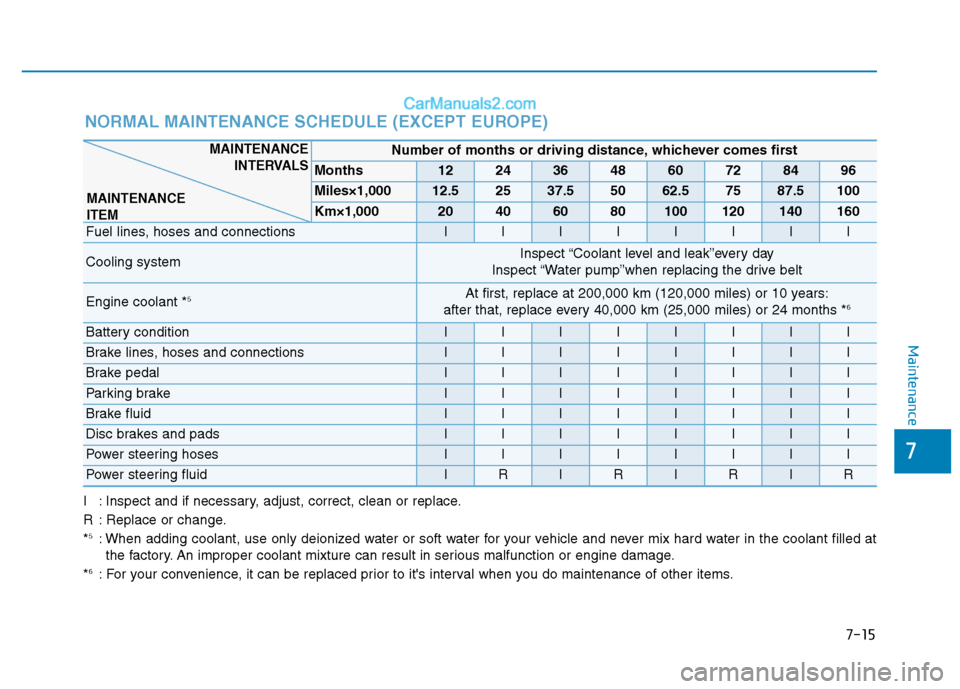
NORMAL MAINTENANCE SCHEDULE (EXCEPT EUROPE)
Number of months or driving distance, whichever comes first
Months1224364860728496
Miles×1,00012.52537.55062.57587.5100
Km×1,00020406080100120140160
Fuel lines, hoses and connectionsIIIIIIII
Cooling systemInspect “Coolant level and leak”every day
Inspect “Water pump”when replacing the drive belt
Engine coolant * 5At first, replace at 200,000 km (120,000 miles) or 10 years:
after that, replace every 40,000 km (25,000 miles) or 24 months * 6
Battery conditionIIIIIIII
Brake lines, hoses and connectionsIIIIIIII
Brake pedalIIIIIIII
Parking brakeIIIIIIII
Brake fluidIIIIIIII
Disc brakes and padsIIIIIIII
Power steering hosesIIIIIIII
Power steering fluidIRIRIRIR
MAINTENANCE
INTERVALS
I : Inspect and if necessary, adjust, correct, clean or replace.
R : Replace or change.*5
: When adding coolant, use only deionized water or soft water for your vehicle and never mix hard water in the coolant filled at
the factory. An improper coolant mixture can result in serious malfunction or engine damage.
* 6
: For your convenience, it can be replaced prior to it's interval when you do maintenance of other items.
MAINTENANCE ITEM