ECO mode Hyundai H350 2015 Service Manual
[x] Cancel search | Manufacturer: HYUNDAI, Model Year: 2015, Model line: H350, Model: Hyundai H350 2015Pages: 473, PDF Size: 26.4 MB
Page 284 of 473
5-13
Driving your vehicle
5
ISG system malfunction
The system may not operatewhen:
- The ISG related sensors or system error occurs.
The yellow AUTO STOP indicator
( ) on the instrument cluster will
stay on after blinking for 5 seconds
and the light on the ISG OFF button
will illuminate.
If the ISG OFF button light is not turned off by pressing the ISG
OFF button again or if the ISG
system continuously does not
work correctly, we recommend
that you contact an authorized
HYUNDAI dealer.
(Continued)(Continued)
When the ISG OFF button light
comes on, it may stop illuminat-
ing after driving your vehicle at
approximately 80 km/h for a
maximum of two hours and set-
ting the fan speed control knob
below the 2nd position. If the
ISG OFF button light continuesto be illuminated in spite of the
procedure, we recommend that
you contact an authorized
HYUNDAI dealer.
NOTICE
When the engine is in Idle Stop
mode, it's possible to restart theengine without the driver taking
any action.
Before leaving the vehicle or
doing anything in the engine
room area, stop the engine by
turning the ignition switch tothe LOCK(OFF) position or
removing the ignition key.
WARNING
Page 298 of 473
5-27
Driving your vehicle
5
VDC OFF usage
When Driving
The VDC OFF mode should only be
used briefly to help free the vehicle if
stuck in snow or mud by temporarily
stopping operation of the VDC to
maintain wheel torque.
To turn VDC off while driving, press
the VDC OFF button while driving on
a flat road surface.To prevent damage to thetransaxle:
Do not allow wheel(s) of one
axle to spin excessively while
the VDC, ABS, and brake warn-
ing lights are displayed. The
repairs would not be covered by
the vehicle warranty. Reduce
engine power and do not spin
the wheel(s) excessively while
these lights are displayed.
When operating the vehicle on a dynamometer, ensure the VDC isturned off (VDC OFF light illumi-nated).
Information
Turning the VDC off does not affect
ABS or standard brake system opera-
tion.
Hill-Start Assist Control (HAC) (if equipped)
The Hill-Start Assist Control (HAC)
prevents the vehicle from rolling
backwards when starting a vehicle
from a stop on a hill. The system
operates the brakes automatically for
approximately 2 seconds and releas-
es the brake when the acceleratorpedal is depressed or after 2 sec-
onds.
i
NOTICE
Always be ready to depress the
accelerator pedal when starting
off on an incline. The HAC acti-
vates only for approximately 2seconds.
WARNING
Page 312 of 473
5-41
Driving your vehicle
5
When the Active ECO is activated,it does not turn off even though the
engine is restarted again. To turn
off the system, press the active
ECO button again.
If Active ECO is turned off, it will return to the ECO mode.
When Active ECO is activated:
Vehicle speed may drop.
When driving up a hill, you mayfeel the engine torque change.
Limitation of Active ECO oper- ation :
If the following conditions occur while
Active ECO is operating, the system
operation is limited even thoughthere is no change in the ECO indi-
cator.
When the coolant temperature islow:The system will be limited until
engine performance becomes nor-mal.
When driving up a hill: The system will be limited to gain
power when driving uphill because
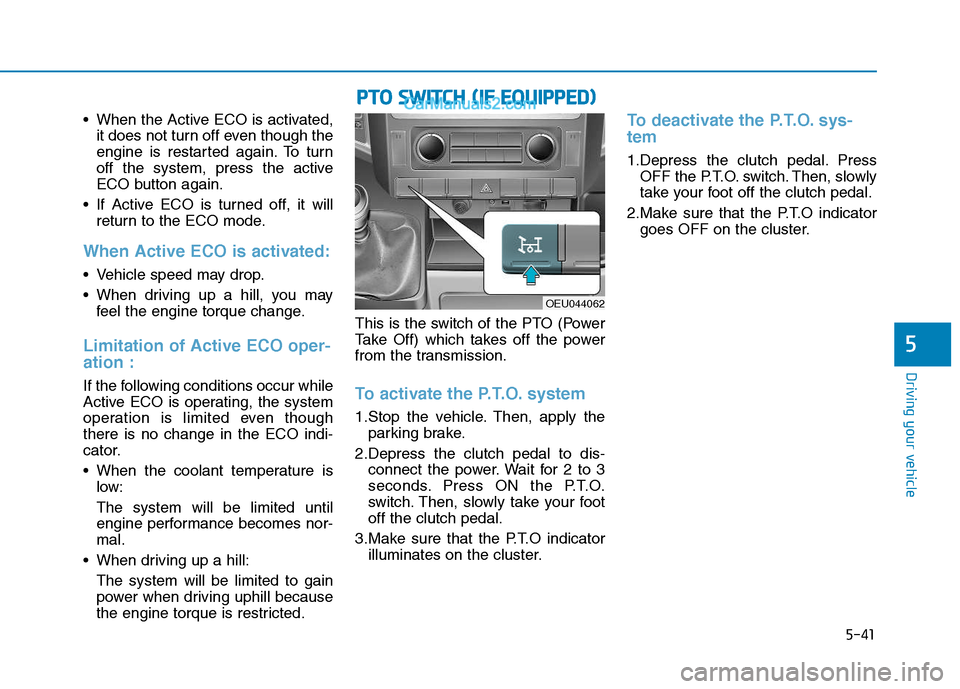
the engine torque is restricted. This is the switch of the PTO (Power
Take Off) which takes off the power
from the transmission.To activate the P.T.O. system
1.Stop the vehicle. Then, apply the
parking brake.
2.Depress the clutch pedal to dis- connect the power. Wait for 2 to 3
seconds. Press ON the P.T.O.
switch. Then, slowly take your footoff the clutch pedal.
3.Make sure that the P.T.O indicator illuminates on the cluster.
To deactivate the P.T.O. sys- tem
1.Depress the clutch pedal. PressOFF the P.T.O. switch. Then, slowly
take your foot off the clutch pedal.
2.Make sure that the P.T.O indicator goes OFF on the cluster.
PPTTOO SS WW IITT CCHH (( IIFF EE QQ UUIIPP PPEEDD ))
OEU044062
Page 313 of 473
5-42
Driving your vehicleE
ECCOO NNOO MM IICC AA LL OO PPEERR AA TTIIOO NN
Your vehicle's fuel economy depends
mainly on your style of driving, where
you drive and when you drive.
Each of these factors affects how
many kilometers (miles) you can get
from a liter (gallon) of fuel. To operate
your vehicle as economically as pos-
sible, use the following driving sug-
gestions to help save money in bothfuel and repairs:
Drive smoothly. Accelerate at a
moderate rate. Don't make "jack-
rabbit" starts or full-throttle shifts
and maintain a steady cruising
speed. Don't race between stop-
lights. Try to adjust your speed to
the traffic so you don't have to
change speeds unnecessarily.
Avoid heavy traffic whenever pos-
sible. Always maintain a safe dis-
tance from other vehicles so you
can avoid unnecessary braking.
This also reduces brake wear.
Drive at a moderate speed. The faster you drive, the more fuel your
vehicle uses. Driving at a moderate
speed, especially on the highway,
is one of the most effective ways toreduce fuel consumption. Don't "ride" the brake or clutch
pedal. This can increase fuel con-
sumption and also increase wear
on these components. In addition,
driving with your foot resting on the
brake pedal may cause the brakes
to overheat, which reduces their
effectiveness and may lead to
more serious consequences.
Take care of your tires. Keep them inflated to the recommended pres-
sure. Incorrect inflation, either too
much or too little, results in unnec-
essary tire wear. Check the tirepressures at least once a month.
Be sure that the wheels are aligned correctly. Improper align-ment can result from hitting curbs
or driving too fast over irregular
surfaces. Poor alignment causes
faster tire wear and may also result
in other problems as well as
greater fuel consumption.
When the power is still con-
nected, activating the P.T.O.
system may incur deadly dam-
age to the gear.
The P.T.O. system should be
activated within the permissi-
ble toque.
- Activation of the P.T.O., goingbeyond the permissible maxi-
mum toque, may incur deadly
damage to the P.T.O. gear andtransmission.
Before activating the P.T.O.
system, depress the clutch
pedal, when the P.T.O switch is
pressed OFF. (For the manualtransmission.)
- The P.T.O. gear may be dam-aged and become uncontrol-
lable.
WARNING
Page 403 of 473
7-40
Maintenance
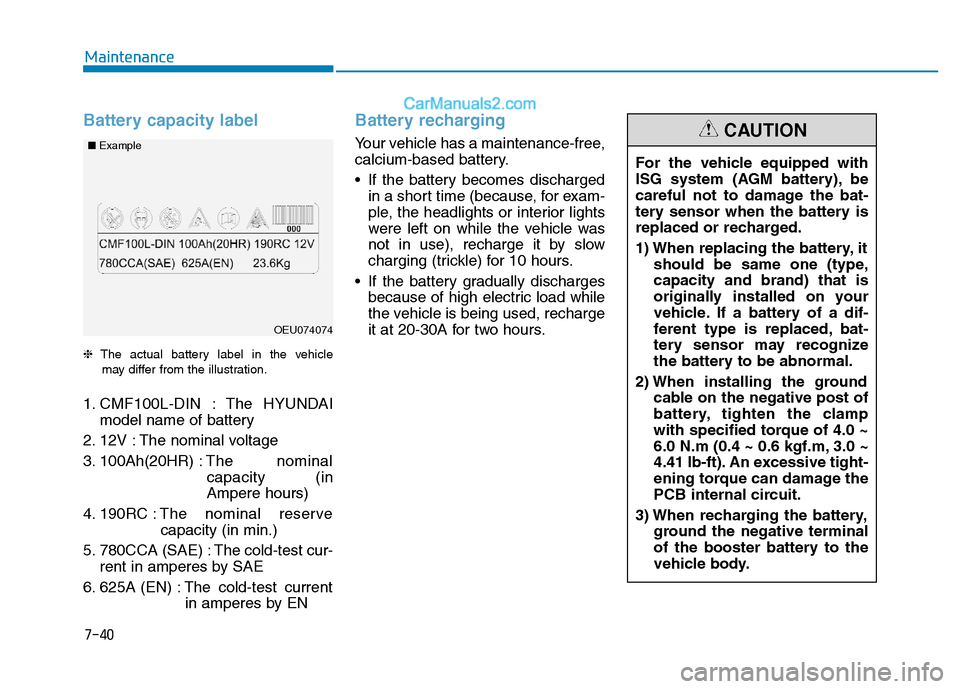
Battery capacity label
❈The actual battery label in the vehicle
may differ from the illustration.
1. CMF100L-DIN : The HYUNDAI model name of battery
2. 12V : The nominal voltage
3. 100Ah(20HR) : The nominal
capacity (in Ampere hours)
4. 190RC : The nominal reserve
capacity (in min.)
5. 780CCA (SAE) : The cold-test cur- rent in amperes by SAE
6. 625A (EN) : The cold-test current in amperes by EN
Battery recharging
Your vehicle has a maintenance-free,
calcium-based battery.
If the battery becomes dischargedin a short time (because, for exam-
ple, the headlights or interior lights
were left on while the vehicle was
not in use), recharge it by slow
charging (trickle) for 10 hours.
If the battery gradually discharges because of high electric load while
the vehicle is being used, recharge
it at 20-30A for two hours. For the vehicle equipped with
ISG system (AGM battery), be
careful not to damage the bat-
tery sensor when the battery is
replaced or recharged.
1) When replacing the battery, it
should be same one (type, capacity and brand) that is
originally installed on your
vehicle. If a battery of a dif-
ferent type is replaced, bat-
tery sensor may recognize
the battery to be abnormal.
2) When installing the ground cable on the negative post of
battery, tighten the clamp
with specified torque of 4.0 ~
6.0 N.m (0.4 ~ 0.6 kgf.m, 3.0 ~
4.41 lb-ft). An excessive tight-
ening torque can damage the
PCB internal circuit.
3) When recharging the battery, ground the negative terminal
of the booster battery to the
vehicle body.CAUTION
OEU074074
■
Example
Page 464 of 473
8-11
8
Specifications & Consumer information
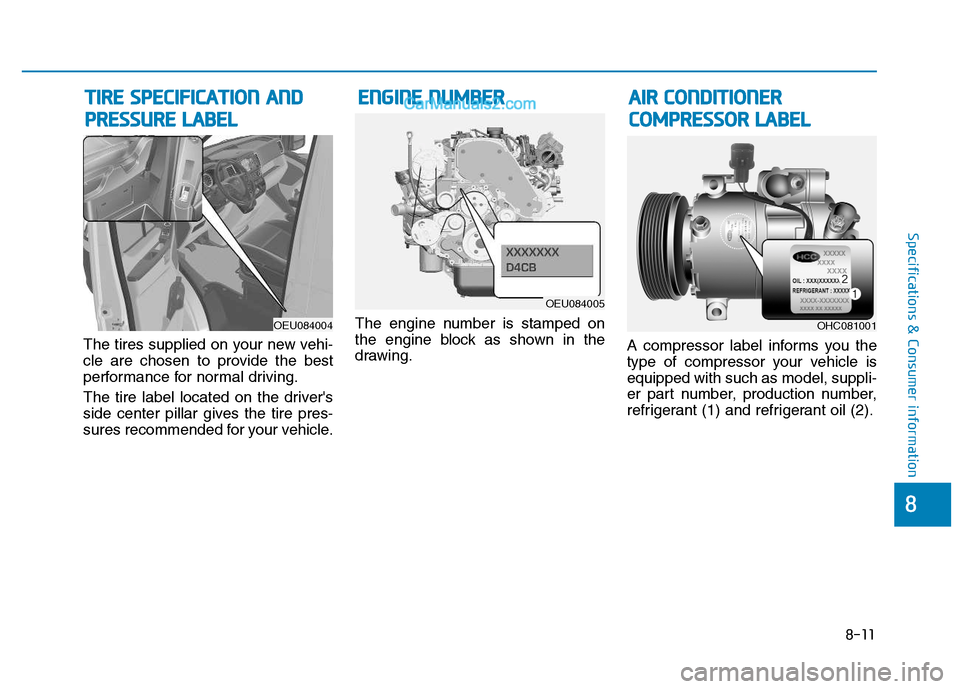
The tires supplied on your new vehi-
cle are chosen to provide the best
performance for normal driving.
The tire label located on the driver's
side center pillar gives the tire pres-
sures recommended for your vehicle.The engine number is stamped on
the engine block as shown in the
drawing.
A compressor label informs you the
type of compressor your vehicle isequipped with such as model, suppli-
er part number, production number,
refrigerant (1) and refrigerant oil (2).
TT
IIRR EE SS PP EECCIIFF IICC AA TTIIOO NN AA NN DD
P
P RR EESSSSUU RREE LL AA BBEELL E
E
NN GGIINN EE NN UU MM BBEERR
OEU084004
OEU084005
OHC081001
AA IIRR CC OO NNDDIITT IIOO NNEERR
C
C OO MM PPRR EESSSSOO RR LL AA BBEELL
Page 467 of 473
I-2Active eco system .........................................................5-40
Active eco operation ..................................................5-40
Limitation of active eco operation:............................5-41
When active eco is activated: ....................................5-41
Adjustable speed limit device (ASLD) ........................3-34
Air bag - supplemental restraint system .......................2-25 Air bag warning light.................................................2-28
Do not install a child restraint on the front passenger seat ..........................................................2-27
Driver's and front passenger's air bag........................2-31
How does the air bag operate? ..................................2-26
SRS care.....................................................................2-39
SRS components and functions .................................2-29
Additional safety precautions .......................................2-40
Air bag warning labels .................................................2-42
Air cleaner ....................................................................7-31
Air conditioner compressor label .................................8-11
Air conditioning system .................................................8-3
Appearance care ...........................................................7-79
Battery...........................................................................7-37 Battery capacity label ................................................7-40
Battery recharging......................................................7-40
For best battery service ..............................................7-37
Reset items .................................................................7-41 Before driving .................................................................5-3
Before entering the vehicle ..........................................5-3
Before starting .............................................................5-3
Necessary inspections ..................................................5-3
Brake system.................................................................5-18
Anti-lock brake system (ABS) ..................................5-21
Emergency stop signal (ESS) ....................................5-28
Good braking practices ..............................................5-29
Hill-start assist control (HAC)...................................5-27
Parking brake .............................................................5-19
Power brakes..............................................................5-18
Vehicle dynamic control (VDC) ................................5-24
Brake/Clutch fluid ........................................................7-27
Bulb wattage ...................................................................8-4
Cargo bed (for van) ....................................................3-129
Caring for disc ................................................................4-5
CD Player (For RDS Model)........................................4-13
CD Player .....................................................................4-16
Ceiling ventilator ........................................................3-122
Climate control air filter ...............................................7-33
Climate control system ...............................................3-110
Checking the amount of air conditioner refrigerant and compressor lubricant.......................................3-120
Climate control air filter ..........................................3-119
Fuel-fired heater .......................................................3-119
Heating and air conditioning....................................3-111
Index
A
C
B
Page 471 of 473
I-6Multi-display.................................................................3-50
AV information ..........................................................3-53
Drive info. mode ........................................................3-53
Function description ..................................................3-51
Information Mode ......................................................3-54
Main display ..............................................................3-50
Trip computer ............................................................3-53
Turn by turn navigation .............................................3-54
User Settings Mode ...................................................3-55
Warning Messages .....................................................3-57
Multimedia system .........................................................4-2
Owner maintenance ........................................................7-8
Parking assist system ....................................................3-88
Front/rear parking assist system type ........................3-92
Rear parking assist system type.................................3-89
Parking brake ................................................................7-30
Power steering fluid......................................................7-28 Checking the power steering fluid level ....................2-28
Checking the power steering hose .............................2-29
PTO switch ...................................................................5-41 RADIO 1 (RADIO,AUX) ...........................................4-45
RADIO 2 (RADIO,USB,AUX) (Except RDS Model)
..4-49
RADIO 2 (RADIO,USB,AUX) (For RDS Model) ......4-48
Rear door ......................................................................3-22 Child-protector rear door lock ...................................3-25
Closing the rear doors from the outside ....................3-25
Opening the left-hand rear door ................................3-24
Opening the rear doors to an angle of 180° or 270° ..3-24
Opening/closing from the inside ...............................3-23
Opening/closing from the outside .............................3-23
Rearview camera ..........................................................3-94
Recommended lubricants and capacities........................8-7
Remote keyless entry......................................................3-6
Battery replacement .....................................................3-8
Remote keyless entry system operations .....................3-6
Transmitter precautions ...............................................3-7
Removing and storing the spare tire...............................6-9
Jacking instructions .....................................................6-9
A type ...........................................................................6-9
B type .........................................................................6-11
Changing tires ............................................................6-14
Index
R
P
O
Page 473 of 473
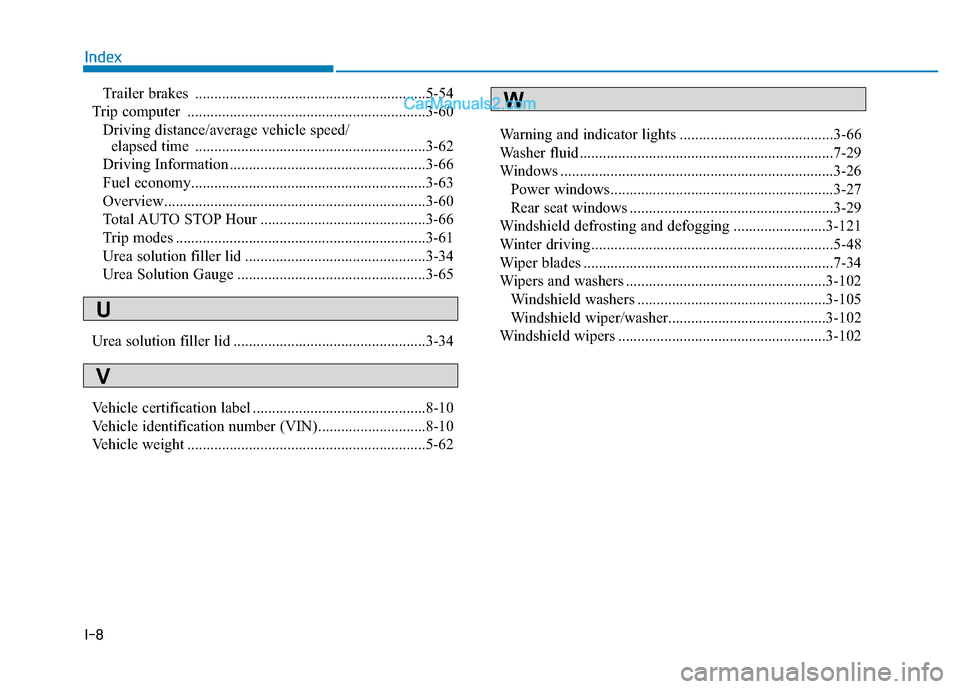
I-8Trailer brakes ............................................................5-54
Trip computer ..............................................................3-60 Driving distance/average vehicle speed/elapsed time ............................................................3-62
Driving Information ...................................................3-66
Fuel economy.............................................................3-63
Overview....................................................................3-60
Total AUTO STOP Hour ...........................................3-66
Trip modes .................................................................3-61
Urea solution filler lid ...............................................3-34
Urea Solution Gauge .................................................3-65
Urea solution filler lid ..................................................3-34
Vehicle certification label .............................................8-10
Vehicle identification number (VIN)............................8-10
Vehicle weight ..............................................................5-62 Warning and indicator lights ........................................3-66
Washer fluid ..................................................................7-29
Windows .......................................................................3-26
Power windows..........................................................3-27
Rear seat windows .....................................................3-29
Windshield defrosting and defogging ........................3-121
Winter driving...............................................................5-48
Wiper blades .................................................................7-34
Wipers and washers ....................................................3-102 Windshield washers .................................................3-105
Windshield wiper/washer.........................................3-102
Windshield wipers ......................................................3-102
Index
V
W
U