parking brake HYUNDAI I10 2010 Owner's Guide
[x] Cancel search | Manufacturer: HYUNDAI, Model Year: 2010, Model line: I10, Model: HYUNDAI I10 2010Pages: 354, PDF Size: 37.04 MB
Page 246 of 354
What to do in an emergency
8
6
F070200APA
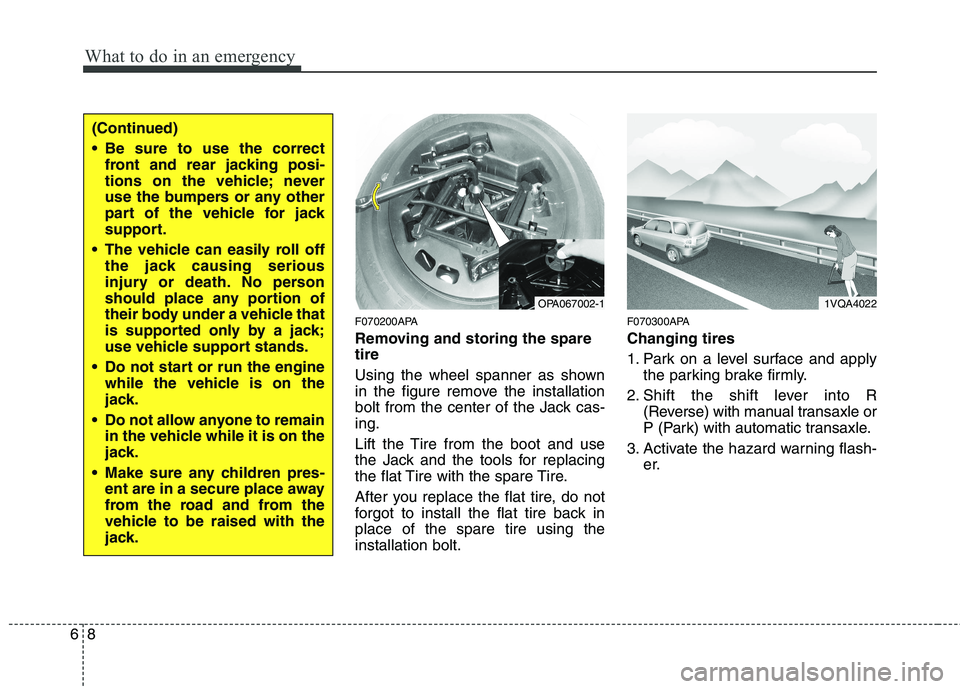
Removing and storing the spare tire
Using the wheel spanner as shown
in the figure remove the installation
bolt from the center of the Jack cas-ing.
Lift the Tire from the boot and use
the Jack and the tools for replacing
the flat Tire with the spare Tire.
After you replace the flat tire, do not
forgot to install the flat tire back inplace of the spare tire using theinstallation bolt. F070300APA Changing tires
1. Park on a level surface and apply
the parking brake firmly.
2. Shift the shift lever into R (Reverse) with manual transaxle or
P (Park) with automatic transaxle.
3. Activate the hazard warning flash- er.
OPA067002-1
(Continued)
Be sure to use the correctfront and rear jacking posi-
tions on the vehicle; never
use the bumpers or any other
part of the vehicle for jack
support.
The vehicle can easily roll off the jack causing serious
injury or death. No person
should place any portion of
their body under a vehicle that
is supported only by a jack;
use vehicle support stands.
Do not start or run the engine while the vehicle is on the
jack.
Do not allow anyone to remain in the vehicle while it is on the
jack.
Make sure any children pres- ent are in a secure place away
from the road and from the
vehicle to be raised with the
jack.
1VQA4022
Page 247 of 354
69
What to do in an emergency
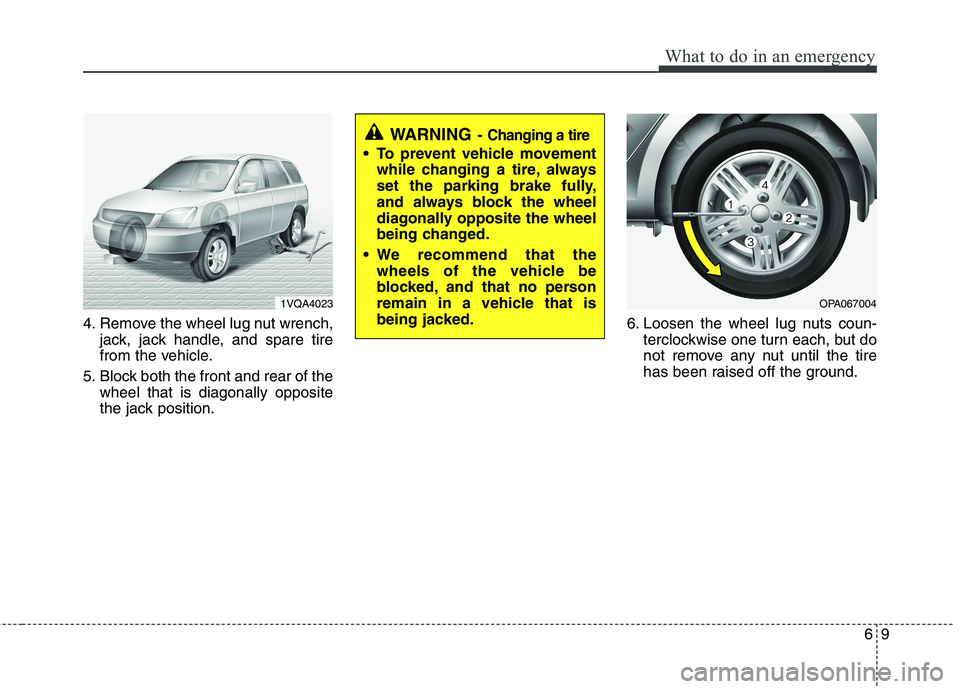
4. Remove the wheel lug nut wrench,jack, jack handle, and spare tire
from the vehicle.
5. Block both the front and rear of the wheel that is diagonally opposite
the jack position. 6. Loosen the wheel lug nuts coun-
terclockwise one turn each, but do
not remove any nut until the tire
has been raised off the ground.
1VQA4023OPA067004
WARNING - Changing a tire
To prevent vehicle movement
while changing a tire, always
set the parking brake fully,
and always block the wheel
diagonally opposite the wheel
being changed.
We recommend that the wheels of the vehicle be
blocked, and that no person
remain in a vehicle that is
being jacked.
Page 259 of 354
621
What to do in an emergency
When towing your vehicle in an emer- gency without wheel dollies :
1. Set the ignition switch in the ACC posi-tion.
2. Place the transaxle shift lever in N (Neutral).
3. Release the parking brake.
F080200APA
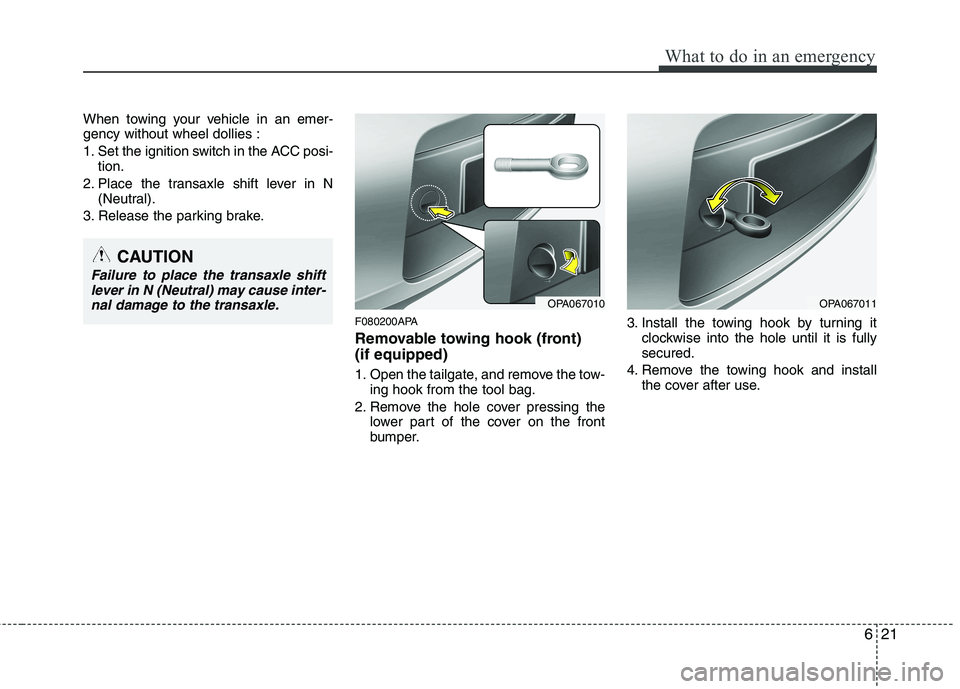
Removable towing hook (front) (if equipped)
1. Open the tailgate, and remove the tow-ing hook from the tool bag.
2. Remove the hole cover pressing the lower part of the cover on the front
bumper. 3. Install the towing hook by turning it
clockwise into the hole until it is fullysecured.
4. Remove the towing hook and install the cover after use.
CAUTION
Failure to place the transaxle shift
lever in N (Neutral) may cause inter-nal damage to the transaxle.
OPA067010OPA067011
Page 261 of 354
623
What to do in an emergency
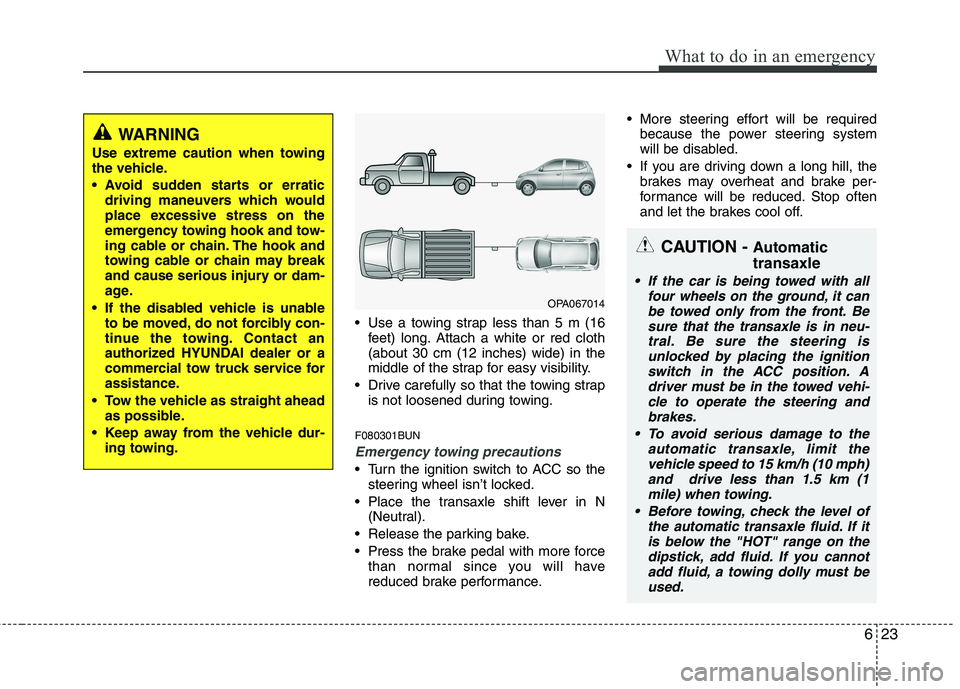
Use a towing strap less than 5 m (16feet) long. Attach a white or red cloth (about 30 cm (12 inches) wide) in the
middle of the strap for easy visibility.
Drive carefully so that the towing strap is not loosened during towing.
F080301BUN
Emergency towing precautions
Turn the ignition switch to ACC so the steering wheel isn’t locked.
Place the transaxle shift lever in N (Neutral).
Release the parking bake.
Press the brake pedal with more force than normal since you will have
reduced brake performance. More steering effort will be required
because the power steering system
will be disabled.
If you are driving down a long hill, the brakes may overheat and brake per-
formance will be reduced. Stop often
and let the brakes cool off.
WARNING
Use extreme caution when towing
the vehicle.
driving maneuvers which would
place excessive stress on the
emergency towing hook and tow-
ing cable or chain. The hook and
towing cable or chain may break
and cause serious injury or dam-
age.
If the disabled vehicle is unable to be moved, do not forcibly con-
tinue the towing. Contact an
authorized HYUNDAI dealer or a
commercial tow truck service for
assistance.
Tow the vehicle as straight ahead as possible.
Keep away from the vehicle dur- ing towing.
OPA067014
CAUTION - Automatic transaxle
If the car is being towed with all
four wheels on the ground, it can
be towed only from the front. Be sure that the transaxle is in neu-tral. Be sure the steering is unlocked by placing the ignition
switch in the ACC position. A driver must be in the towed vehi-cle to operate the steering and brakes.
To avoid serious damage to the automatic transaxle, limit thevehicle speed to 15 km/h (10 mph)and drive less than 1.5 km (1 mile) when towing.
Before towing, check the level of the automatic transaxle fluid. If itis below the "HOT" range on the dipstick, add fluid. If you cannot
add fluid, a towing dolly must be used.
Page 263 of 354
7
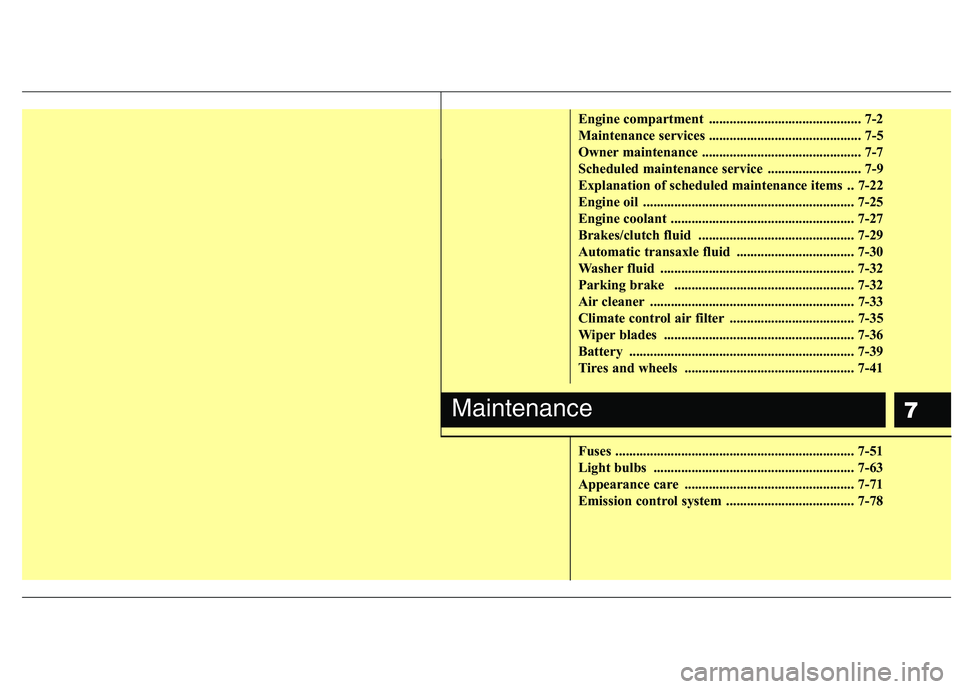
Engine compartment ............................................ 7-2
Maintenance services ............................................ 7-5
Owner maintenance .............................................. 7-7
Scheduled maintenance service ........................... 7-9
Explanation of scheduled maintenance items .. 7-22
Engine oil ............................................................. 7-25
Engine coolant ..................................................... 7-27
Brakes/clutch fluid ............................................. 7-29
Automatic transaxle fluid .................................. 7-30
Washer fluid ........................................................ 7-32
Parking brake .................................................... 7-32
Air cleaner ........................................................... 7-33
Climate control air filter .................................... 7-35
Wiper blades ....................................................... 7-36
Battery ................................................................. 7-39
Tires and wheels ................................................. 7-41
Fuses ..................................................................... 7-51
Light bulbs .......................................................... 7-63
Appearance care ................................................. 7-71
Emission control system ..................................... 7-78
Maintenance
Page 269 of 354
77
Maintenance
OWNER MAINTENANCE
G030000AEN
The following lists are vehicle checks and
inspections that should be performed by
the owner or an authorized HYUNDAIdealer at the frequencies indicated to
help ensure safe, dependable operation
of your vehicle.
Any adverse conditions should be
brought to the attention of your dealer as
soon as possible.
These Owner Maintenance Checks are
generally not covered by warranties and
you may be charged for labor, parts and
lubricants used. Owner maintenance schedule
G030101AUN
When you stop for fuel:
Check the engine oil level.
Check coolant level in coolant reser-
voir.
Check the windshield washer fluid level.
Look for low or under-inflated tires. G030102AUN
While operating your vehicle:
Note any changes in the sound of the
exhaust or any smell of exhaust fumes
in the vehicle.
Check for vibrations in the steering wheel. Notice any increased steering
effort or looseness in the steering
wheel, or change in its straight-aheadposition.
Notice if your vehicle constantly turns slightly or “pulls” to one side when trav-
eling on smooth, level road.
When stopping, listen and check for unusual sounds, pulling to one side,
increased brake pedal travel or “hard-
to-push” brake pedal.
If any slipping or changes in the oper- ation of your transaxle occurs, check
the transaxle fluid level.
Check automatic transaxle P (Park) function.
Check parking brake.
Check for fluid leaks under your vehicle (water dripping from the air condition-
ing system during or after use is nor-mal).
WARNING
Be careful when checking your
engine coolant level when the
engine is hot. Scalding hot coolant
and steam may blow out under
pressure. This could cause burns
or other serious injury.
Page 274 of 354
Maintenance
12
7
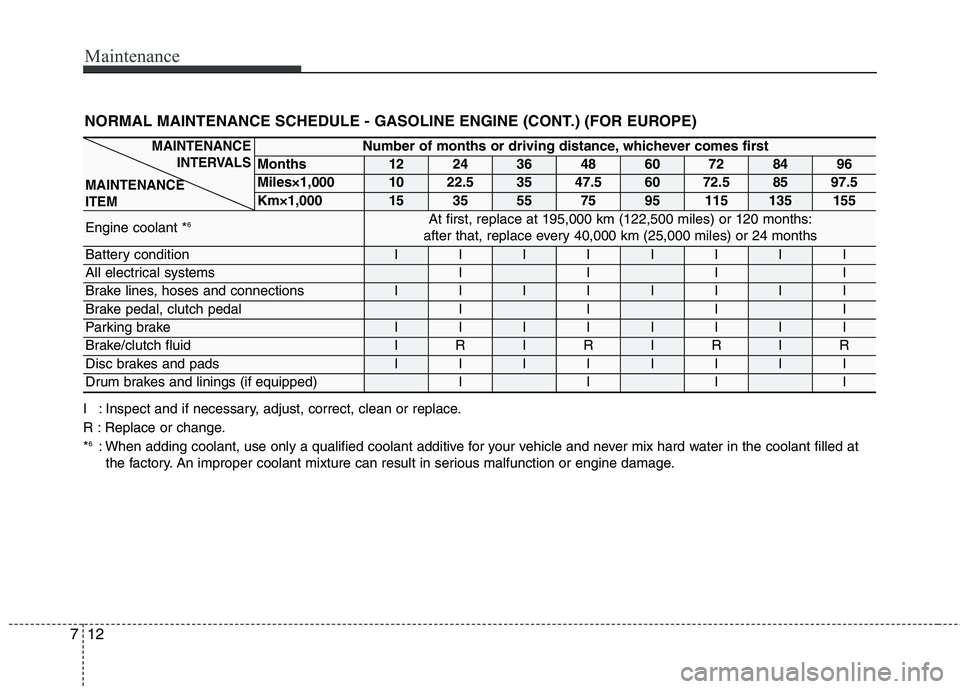
I : Inspect and if necessary, adjust, correct, clean or replace.
R : Replace or change.* 6
: When adding coolant, use only a qualified coolant additive for your vehicle and never mix hard water in the coolant filled at
the factory. An improper coolant mixture can result in serious malfunction or engine damage.
NORMAL MAINTENANCE SCHEDULE - GASOLINE ENGINE (CONT.) (FOR EUROPE)
Number of months or driving distance, whichever comes first
Months1224364860728496
Miles×1,0001022.53547.56072.58597.5
Km×1,0001535557595115135155
Engine coolant *
6At first, replace at 195,000 km (122,500 miles) or 120 months:
after that, replace every 40,000 km (25,000 miles) or 24 months
Battery conditionIIIIIIII
All electrical systemsIIII
Brake lines, hoses and connectionsIIIIIIII
Brake pedal, clutch pedalIIII
Parking brakeIIIIIIII
Brake/clutch fluidIRIRIRIR
Disc brakes and padsIIIIIIII
Drum brakes and linings (if equipped)IIII
MAINTENANCE INTERVALS
MAINTENANCE ITEM
Page 277 of 354
715
Maintenance
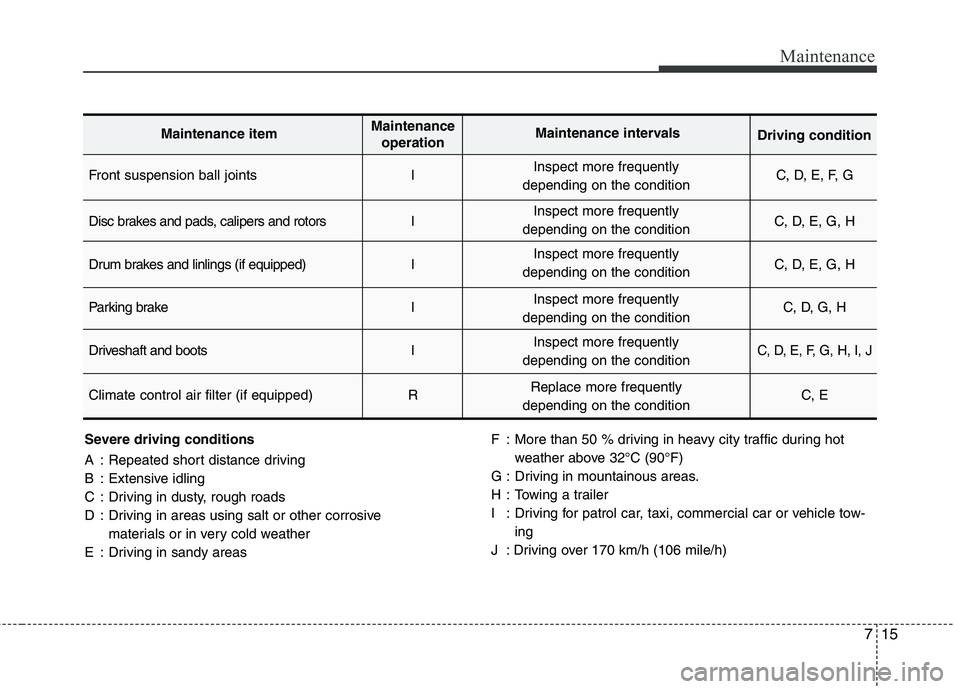
Severe driving conditions
A : Repeated short distance driving
B : Extensive idling
C : Driving in dusty, rough roads
D : Driving in areas using salt or other corrosive materials or in very cold weather
E : Driving in sandy areas F : More than 50 % driving in heavy city traffic during hot
weather above 32°C (90°F)
G : Driving in mountainous areas.
H : Towing a trailer
I : Driving for patrol car, taxi, commercial car or vehicle tow- ing
J : Driving over 170 km/h (106 mile/h)
Front suspension ball joints I C, D, E, F, G
Disc brakes and pads, calipers and rotors I C, D, E, G, H
Drum brakes and linlings (if equipped) I C, D, E, G, H
Parking brake I C, D, G, H
Driveshaft and boots I
C, D, E, F, G, H, I, J
Climate control air filter (if equipped) R C, E
Maintenance itemMaintenance
operation Maintenance intervals
Driving condition
Inspect more frequently
depending on the condition
Inspect more frequently
depending on the condition
Inspect more frequently
depending on the condition
Inspect more frequently
depending on the condition
Inspect more frequently
depending on the condition
Replace more frequently
depending on the condition
Page 280 of 354
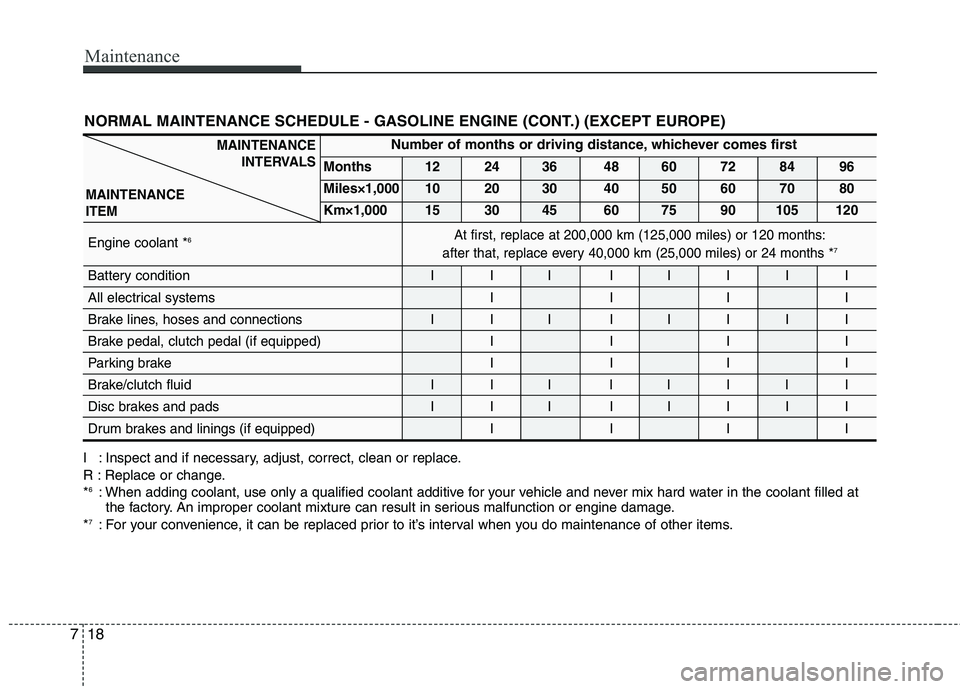
Maintenance
18
7
NORMAL MAINTENANCE SCHEDULE - GASOLINE ENGINE (CONT.) (EXCEPT EUROPE)
I : Inspect and if necessary, adjust, correct, clean or replace.
R : Replace or change.* 6
: When adding coolant, use only a qualified coolant additive for your vehicle and never mix hard water in the coolant filled at
the factory. An improper coolant mixture can result in serious malfunction or engine damage.
* 7
: For your convenience, it can be replaced prior to it’s interval when you do maintenance of other items.
MAINTENANCE
INTERVALS
MAINTENANCE ITEMNumber of months or driving distance, whichever comes first
Months 12 24 36 48 60 72 84 96
Miles×1,000 10 20 30 40 50 60 70 80
Km×1,000 15 30 45 60 75 90 105 120
Engine coolant * 6
Battery condition I I I I I I I I
All electrical systems I I I I
Brake lines, hoses and connections I I I I I I I I
Brake pedal, clutch pedal (if equipped) I I I I
Parking brake I I I I
Brake/clutch fluid
III IIIII
Disc brakes and pads I I I I I I I I
Drum brakes and linings (if equipped) I I I I
At first, replace at 200,000 km (125,000 miles) or 120 months:
after that, replace every 40,000 km (25,000 miles) or 24 months * 7
Page 283 of 354
721
Maintenance
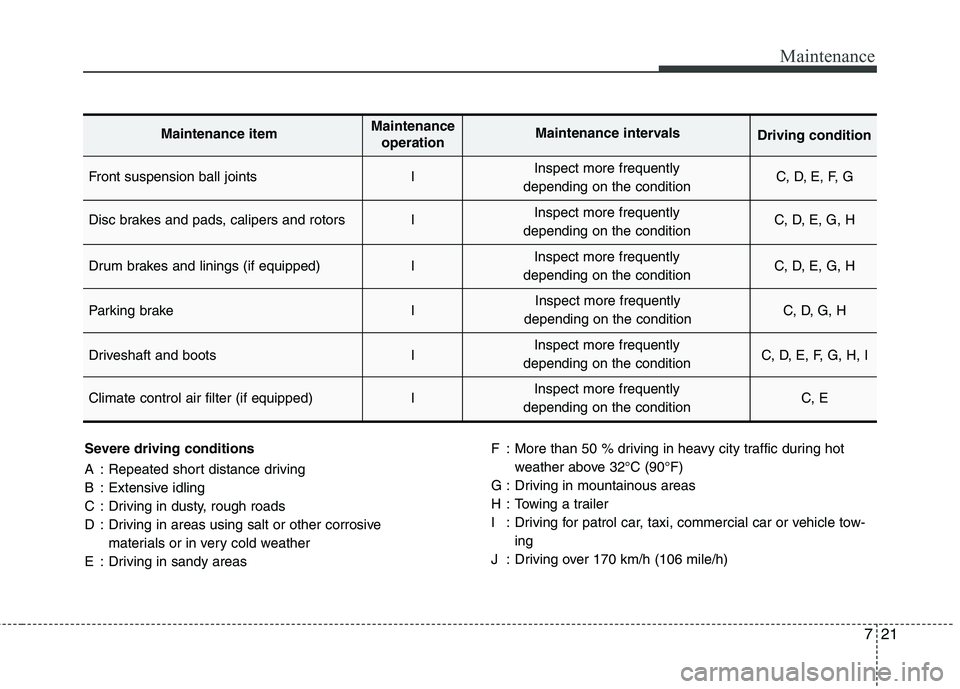
Severe driving conditions
A : Repeated short distance driving
B : Extensive idling
C : Driving in dusty, rough roads
D : Driving in areas using salt or other corrosive materials or in very cold weather
E : Driving in sandy areas F : More than 50 % driving in heavy city traffic during hot
weather above 32°C (90°F)
G : Driving in mountainous areas
H : Towing a trailer
I : Driving for patrol car, taxi, commercial car or vehicle tow- ing
J : Driving over 170 km/h (106 mile/h)
Front suspension ball joints I C, D, E, F, G
Disc brakes and pads, calipers and rotors I C, D, E, G, H
Drum brakes and linings (if equipped) I C, D, E, G, H
Parking brake I C, D, G, H
Driveshaft and boots I C, D, E, F, G, H, I
Climate control air filter (if equipped) I C, E
Maintenance itemMaintenance
operation Maintenance intervals
Driving condition
Inspect more frequently
depending on the condition
Inspect more frequently
depending on the condition
Inspect more frequently
depending on the condition
Inspect more frequently
depending on the condition
Inspect more frequently
depending on the condition
Inspect more frequently
depending on the condition