heat HYUNDAI I10 2011 Service Manual
[x] Cancel search | Manufacturer: HYUNDAI, Model Year: 2011, Model line: I10, Model: HYUNDAI I10 2011Pages: 354, PDF Size: 37.04 MB
Page 310 of 354
Maintenance
48
7
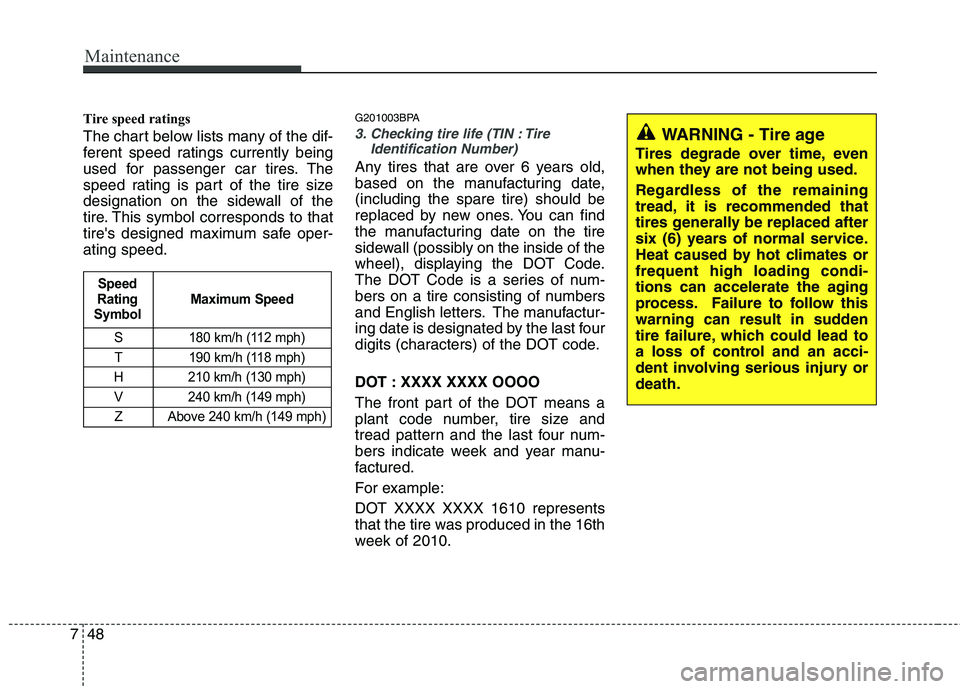
Tire speed ratings
The chart below lists many of the dif-
ferent speed ratings currently being
used for passenger car tires. The
speed rating is part of the tire size
designation on the sidewall of the
tire. This symbol corresponds to that
tire's designed maximum safe oper-ating speed. G201003BPA
3. Checking tire life (TIN : Tire
Identification Number)
Any tires that are over 6 years old,
based on the manufacturing date,(including the spare tire) should be
replaced by new ones. You can find
the manufacturing date on the tire
sidewall (possibly on the inside of the
wheel), displaying the DOT Code.
The DOT Code is a series of num-
bers on a tire consisting of numbers
and English letters. The manufactur-
ing date is designated by the last four
digits (characters) of the DOT code.
DOT : XXXX XXXX OOOO
The front part of the DOT means a
plant code number, tire size and
tread pattern and the last four num-
bers indicate week and year manu-
factured.
For example:
DOT XXXX XXXX 1610 represents
that the tire was produced in the 16th
week of 2010.
S 180 km/h (112 mph)
T 190 km/h (118 mph)
H 210 km/h (130 mph) V 240 km/h (149 mph)
Z Above 240 km/h (149 mph)
Maximum Speed
Speed
Rating
Symbol
WARNING - Tire age
Tires degrade over time, even
when they are not being used.
Regardless of the remaining
tread, it is recommended that
tires generally be replaced after
six (6) years of normal service.
Heat caused by hot climates orfrequent high loading condi-
tions can accelerate the aging
process. Failure to follow this
warning can result in sudden
tire failure, which could lead to
a loss of control and an acci-
dent involving serious injury ordeath.
Page 312 of 354
Maintenance
50
7
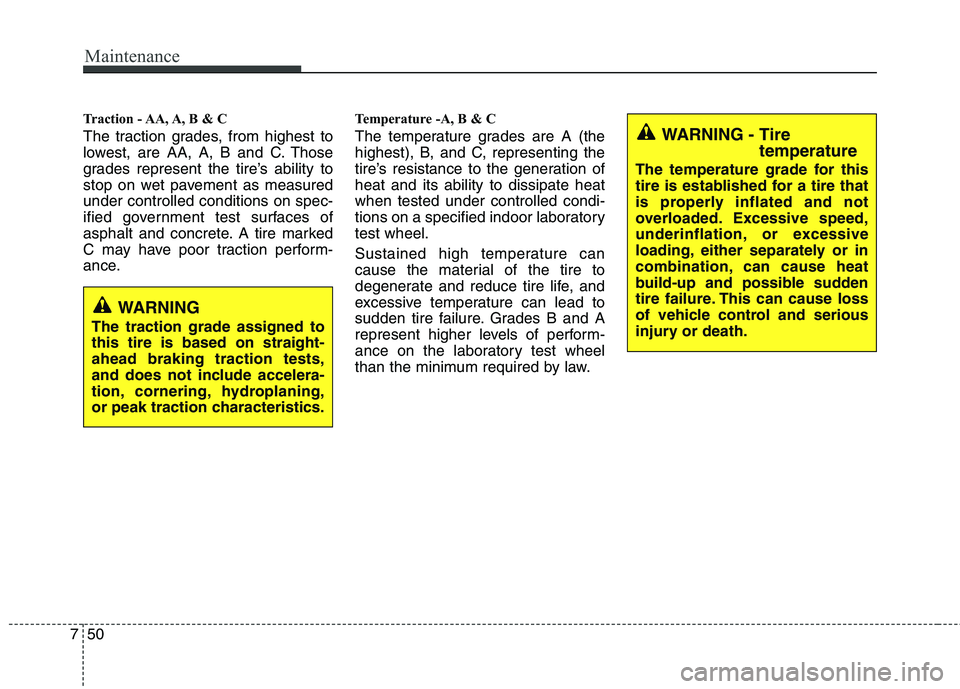
Traction - AA, A, B & C
The traction grades, from highest to
lowest, are AA, A, B and C. Those
grades represent the tire’s ability to
stop on wet pavement as measuredunder controlled conditions on spec-
ified government test surfaces of
asphalt and concrete. A tire marked
C may have poor traction perform-
ance. Temperature -A, B & C
The temperature grades are A (the
highest), B, and C, representing the
tire’s resistance to the generation ofheat and its ability to dissipate heatwhen tested under controlled condi-
tions on a specified indoor laboratorytest wheel.
Sustained high temperature can
cause the material of the tire to
degenerate and reduce tire life, and
excessive temperature can lead to
sudden tire failure. Grades B and A
represent higher levels of perform-
ance on the laboratory test wheel
than the minimum required by law.
WARNING - Tire
temperature
The temperature grade for this
tire is established for a tire that
is properly inflated and not
overloaded. Excessive speed,
underinflation, or excessive
loading, either separately or in
combination, can cause heat
build-up and possible sudden
tire failure. This can cause loss
of vehicle control and serious
injury or death.
WARNING
The traction grade assigned to this tire is based on straight-ahead braking traction tests,
and does not include accelera-
tion, cornering, hydroplaning,
or peak traction characteristics.
Page 318 of 354
Maintenance
56
7
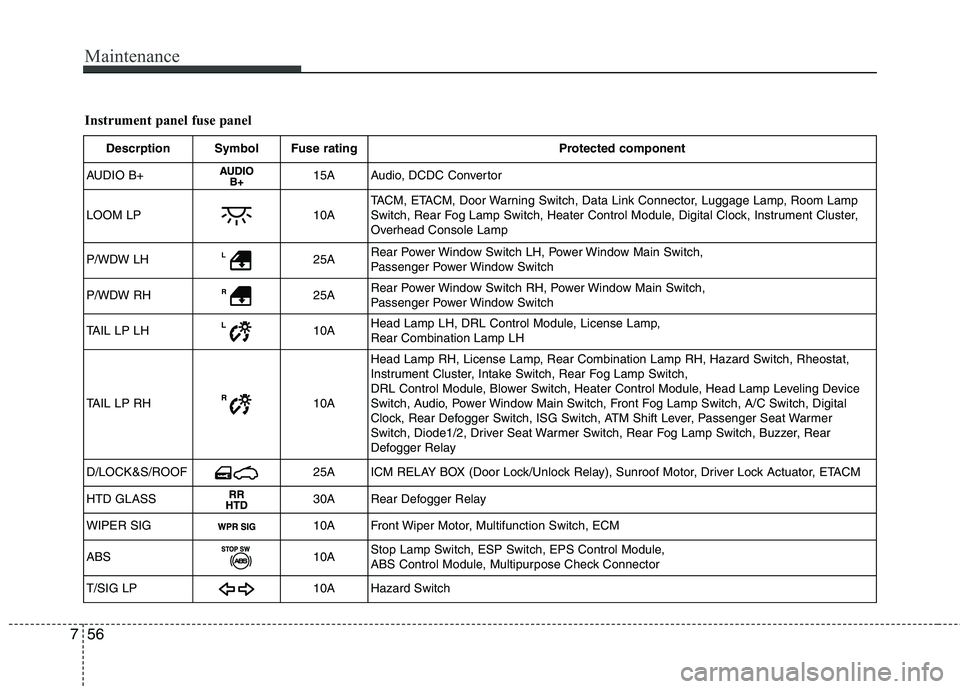
Instrument panel fuse panel
Descrption Symbol Fuse rating Protected component
AUDIO B+
15A Audio, DCDC Convertor
LOOM LP
10A TACM, ETACM, Door Warning Switch, Data Link Connector, Luggage Lamp, Room Lamp
Switch, Rear Fog Lamp Switch, Heater Control Module, Digital Clock, Instrument Cluster,
Overhead Console Lamp
P/WDW LH
25A Rear Power Window Switch LH, Power Window Main Switch,
Passenger Power Window Switch
P/WDW RH
25A Rear Power Window Switch RH, Power Window Main Switch,
Passenger Power Window Switch
TAIL LP LH
10A Head Lamp LH, DRL Control Module, License Lamp, Rear Combination Lamp LH
TAIL LP RH
10A Head Lamp RH, License Lamp, Rear Combination Lamp RH, Hazard Switch, Rheostat,
Instrument Cluster, Intake Switch, Rear Fog Lamp Switch,
DRL Control Module, Blower Switch, Heater Control Module, Head Lamp Leveling Device
Switch, Audio, Power Window Main Switch, Front Fog Lamp Switch, A/C Switch, Digital
Clock, Rear Defogger Switch, ISG Switch, ATM Shift Lever, Passenger Seat Warmer
Switch, Diode1/2, Driver Seat Warmer Switch, Rear Fog Lamp Switch, Buzzer, Rear
Defogger Relay
D/LOCK&S/ROOF
25A ICM RELAY BOX (Door Lock/Unlock Relay), Sunroof Motor, Driver Lock Actuator, ETACM
HTD GLASS
30A Rear Defogger Relay
WIPER SIG
10A Front Wiper Motor, Multifunction Switch, ECM
ABS
10A Stop Lamp Switch, ESP Switch, EPS Control Module,
ABS Control Module, Multipurpose Check Connector
T/SIG LP
10A Hazard Switch
Page 319 of 354

757
Maintenance
Descrption Symbol Fuse ratingProtected component
IGN COIL
15A DCDC Converter, ECM, Vehicle Speed Dendor, Condenser, Ignition Coil #1~#3,
Ignition Coil, Pulse Generator 'A'/'B', Transaxle Range Switch
B/UP LP
10A Back-Up Lamp Switch, Rear Parking Assist Sensor LH/RH,
Rear Parking Assist Sensor Center LH/RH
A/BAG IND
10A Instrument Cluster
A/BAG
15A SRS Control Module
CLUSTER
10A Instrument Cluster, Heater Control Module, TACM, ETACM,
Seat Belt Lever, ISG Off Switch, Rear Parking Assist Buzzer
MDPS
10A EPS Control Module
AUDIO ACC
10A Digital Clock, Audio, DCDC Converter
RR P/OUTLET
10A Front Power Outlet, Rear Power Outlet
CIGAR LIGHTER
15A Cigarette Lighter
START
10A ICM RELAY BOX(Burglar Alram Relay), Start Relay, ECM,
Transaxle Range Switch
H/LP
10A Instrument Cluster, E/R Fuse & Relay Box (RLY : R3/R4)
DRL
10A DRL Control Module
IG2
10A Head Lamp LH/RH, Head Lamp Leveling Device Switch, Intake Switch, TACM, ETACM,
Heater Control Module, Dual Pressure Switch, Rear Defogger Relay, Diode5, Power
Window Switch, E/R Fuse & Relay Box (RLY : R6)
Page 320 of 354
Maintenance
58
7
Descrption Symbol Fuse rating Protected component
FRT WIPER
25A Front Wiper Motor, Multifunctin Switch
RR FOG LP
10A Relay Fog Lamp Relay
SEAT HTD
15A Driver/Passenger Seat Warmer Switch
RR WIPER
15A Rear Wiper Motor, Sunroof Motor, Multifunctin Switch
STOP LP
10A Stop Lamp Switch, Stop Lamp Relay
HAZARD
10A Hazard Switch, ICM RELAY BOX(Hazard Lamp Relay)
HORN
10A Horn Relay, ICM RELAY BOX(Burglar Alram Relay)
F/FOG LAMP
10A Front Fog Lamp Relay
HTD IND
10A Rear Dfogger Switdh, Heater Control Module, ECM,
Driver/Passenger Power Outside Mirror
H/LP RH
10A Transaxle Range Switch, Instrument Cluster, ETAVM, PCM,
Rear Combination Lamp LH/RH, Back-Up Lamp Switch
Page 321 of 354
759
Maintenance
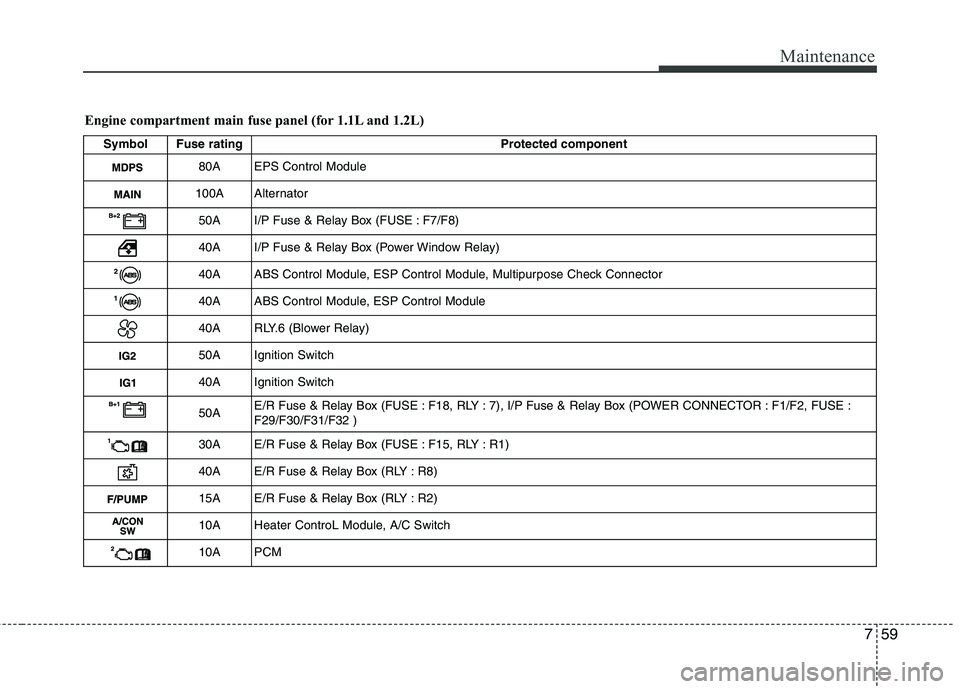
Engine compartment main fuse panel (for 1.1L and 1.2L)Symbol Fuse rating Protected component
80A EPS Control Module
100A Alternator
50A I/P Fuse & Relay Box (FUSE : F7/F8)
40A I/P Fuse & Relay Box (Power Window Relay)
40A ABS Control Module, ESP Control Module, Multipurpose Check Connector
40A ABS Control Module, ESP Control Module
40A RLY.6 (Blower Relay)
50A Ignition Switch
40A Ignition Switch
50AE/R Fuse & Relay Box (FUSE : F18, RLY : 7), I/P Fuse & Relay Box (POWER CONNECTOR : F1/F2, FUSE : F29/F30/F31/F32 )
30A E/R Fuse & Relay Box (FUSE : F15, RLY : R1)
40A E/R Fuse & Relay Box (RLY : R8)
15A E/R Fuse & Relay Box (RLY : R2)
10A Heater ControL Module, A/C Switch
10A PCM
Page 326 of 354
Maintenance
64
7
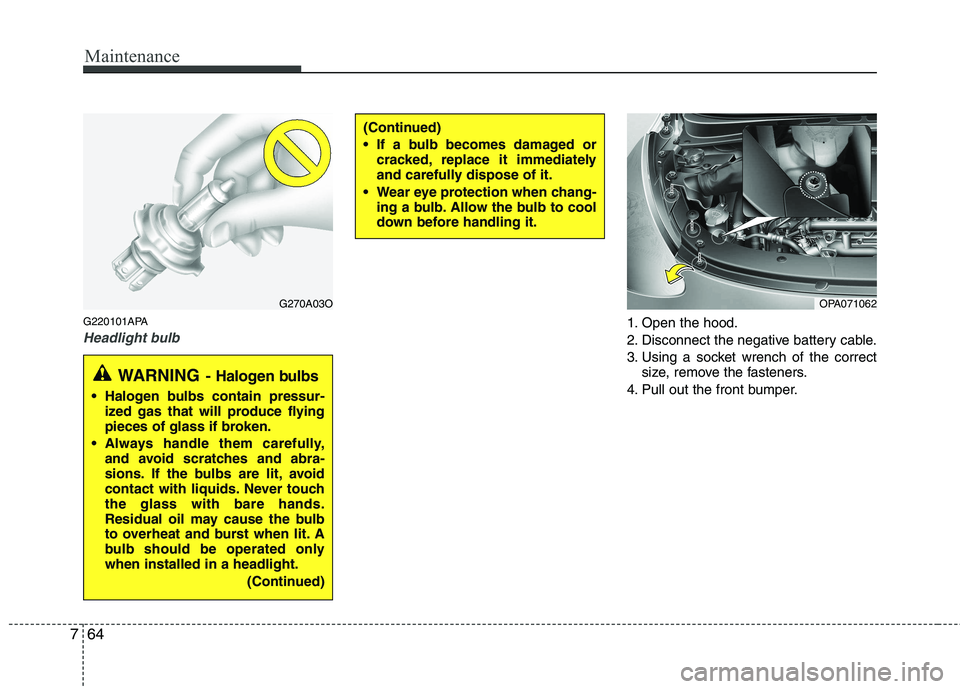
G220101APA
Headlight bulb1. Open the hood.
2. Disconnect the negative battery cable.
3. Using a socket wrench of the correct
size, remove the fasteners.
4. Pull out the front bumper.
(Continued)
If a bulb becomes damaged or cracked, replace it immediately
and carefully dispose of it.
Wear eye protection when chang- ing a bulb. Allow the bulb to cool
down before handling it.
G270A03O
WARNING - Halogen bulbs
Halogen bulbs contain pressur-
ized gas that will produce flying
pieces of glass if broken.
Always handle them carefully, and avoid scratches and abra-
sions. If the bulbs are lit, avoid
contact with liquids. Never touchthe glass with bare hands.
Residual oil may cause the bulb
to overheat and burst when lit. A
bulb should be operated onlywhen installed in a headlight.
(Continued)
OPA071062
Page 337 of 354
775
Maintenance
Moisture breeds corrosion Moisture creates the conditions in which
corrosion is most likely to occur. For
example, corrosion is accelerated by
high humidity, particularly when tempera-
tures are just above freezing. In such
conditions, the corrosive material is kept
in contact with the car surfaces by mois-
ture that is slow to evaporate.
Mud is particularly corrosive because it is
slow to dry and holds moisture in contact
with the vehicle. Although the mud
appears to be dry, it can still retain themoisture and promote corrosion.
High temperatures can also accelerate
corrosion of parts that are not properly
ventilated so the moisture can be dis-
persed. For all these reasons, it is par-
ticularly important to keep your car clean
and free of mud or accumulations of
other materials. This applies not only to
the visible surfaces but particularly to the
underside of the car.To help prevent corrosion
You can help prevent corrosion from get-
ting started by observing the following:
Keep your car clean
The best way to prevent corrosion is to
keep your car clean and free of corrosive
materials. Attention to the underside of
the car is particularly important.
If you live in a high-corrosion area —
where road salts are used, near the
ocean, areas with industrial pollution,
acid rain, etc.—, you should take extra
care to prevent corrosion. In winter,
hose off the underside of your car atleast once a month and be sure toclean the underside thoroughly when
winter is over.
give particular attention to the compo-
nents under the fenders and other
areas that are hidden from view. Do a
thorough job; just dampening the accu-
mulated mud rather than washing it
away will accelerate corrosion rather
than prevent it. Water under high pres-
sure and steam are particularly effec-
tive in removing accumulated mud and
corrosive materials.
rocker panels and frame members, be
sure that drain holes are kept open sothat moisture can escape and not be
trapped inside to accelerate corrosion.
Keep your garage dry
Don't park your car in a damp, poorly
ventilated garage. This creates a favor-
able environment for corrosion. This is
particularly true if you wash your car in
the garage or drive it into the garage
when it is still wet or covered with snow,
ice or mud. Even a heated garage can
contribute to corrosion unless it is well
ventilated so moisture is dispersed.
Page 353 of 354
I3
Index
Hazard warning flasher ················································· 4-47
Hood ············································································· 4-17
How to use this manual ·················································· 1-2
If the engine overheats ···················································· 6-6
If the engine will not start ·············································· 6-3
If you have a flat tire (with spare tire)····························· 6-7
If you have a flat tire (with tire mobility kit) ·················6-15
In case of an emergency while driving ··························· 6-2
Indicator symbols on the instrument cluster ·················· 1-6
Instrument cluster ························································· 4-31
Instrument panel overview ············································· 2-3
Interior features ····························································· 4-69
Interior light ·································································· 4-55
Interior overview ····························································· 2-2
ISG (Idle Stop And Go) ····················································5-6
Key positions ·································································· 5-4
Keys ················································································ 4-2 Light bulbs ···································································· 7-63
Lighting ········································································· 4-48
Maintenance services ······················································ 7-5
Manual transaxle ····························································· 5-9
Mirrors ·········································································· 4-28
Owner maintenance ························································ 7-7
Parking brake ······························································· 7-32
Rear parking assist system ··············································4-44
Recommended lubricants and capacities ························ 9-4
Remote keyless entry ······················································ 4-4
Road warning ·································································· 6-2
H
I
K
L
M
O
P
R