clutch HYUNDAI I10 2012 User Guide
[x] Cancel search | Manufacturer: HYUNDAI, Model Year: 2012, Model line: I10, Model: HYUNDAI I10 2012Pages: 354, PDF Size: 37.04 MB
Page 203 of 354
511
Driving your vehicle
E050102AUN
Downshifting
When you must slow down in heavy traf-
fic or while driving up steep hills, down-
shift before the engine starts to labor.
Downshifting reduces the chance of
stalling and gives better acceleration
when you again need to increase your
speed. When the vehicle is traveling
down steep hills, downshifting helps
maintain safe speed and prolongs brake
life.
E050200AUN Good driving practices
Never take the car out of gear andcoast down a hill. This is extremely
hazardous. Always leave the car in
gear.
Don't "ride" the brakes. This can cause them to overheat and malfunction.
Instead, when you are driving down a
long hill, slow down and shift to a lower
gear. When you do this, engine braking
will help slow the car. Slow down before shifting to a lower
gear. This will help avoid over-revving
the engine, which can cause damage.
Slow down when you encounter cross winds. This gives you much better con-
trol of your car.
Be sure the car is completely stopped before you attempt to shift into reverse.
The transaxle can be damaged if you
do not. To shift into reverse, depress
the clutch, move the shift lever to neu-
tral, wait 3 seconds, then shift to the
reverse position.
Exercise extreme caution when driving on a slippery surface. Be especially
careful when braking, accelerating or
shifting gears. On a slippery surface,
an abrupt change in vehicle speed can
cause the drive wheels to lose traction
and the vehicle to go out of control.
WARNING
Always buckle-up! In a collision, an unbelted occupant is signifi-
cantly more likely to be seriously
injured or killed than a properlybelted occupant.
Avoid high speeds when corner- ing or turning.
Do not make quick steering wheel movements, such as sharp
lane changes or fast, sharp turns.
The risk of rollover is greatly increased if you lose control of
your vehicle at highway speeds.
Loss of control often occurs if two or more wheels drop off the
roadway and the driver over-
steers to reenter the roadway.
In the event your vehicle leaves the roadway, do not steer sharply.
Instead, slow down before pulling
back into the travel lanes.
Never exceed posted speed lim- its.
Page 240 of 354
What to do in an emergency
2
6
ROAD WARNING
F010100AUN
Hazard warning flasher
The hazard warning flasher serves as a
warning to other drivers to exercise
extreme caution when approaching,
overtaking, or passing your vehicle. It should be used whenever emergency
repairs are being made or when the vehi-cle is stopped near the edge of a road-
way.
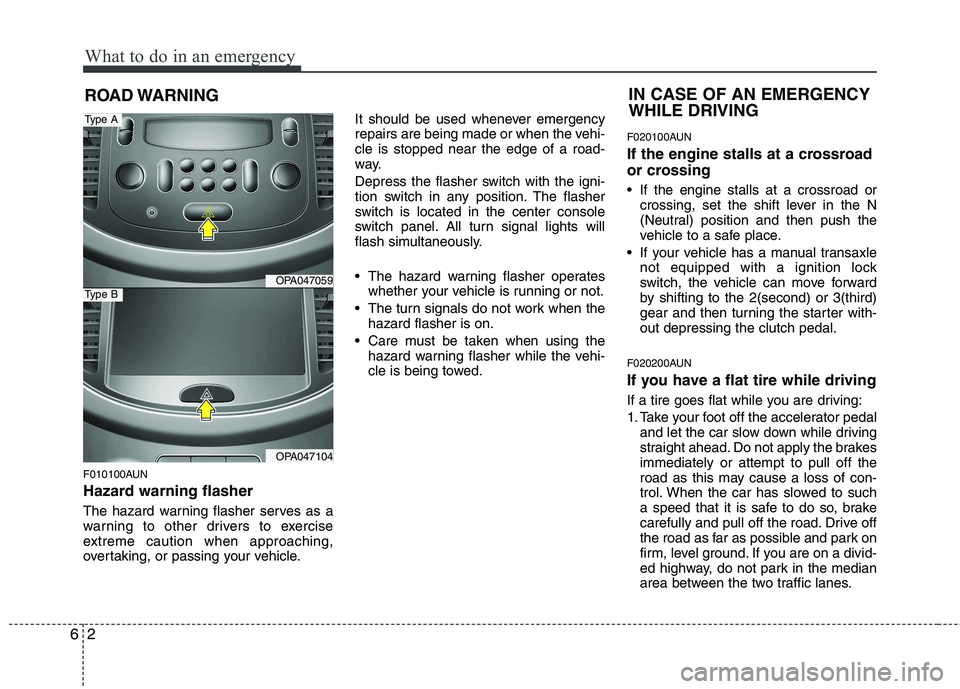
Depress the flasher switch with the igni-
tion switch in any position. The flasher
switch is located in the center console
switch panel. All turn signal lights will
flash simultaneously.
• The hazard warning flasher operates
whether your vehicle is running or not.
The turn signals do not work when the hazard flasher is on.
Care must be taken when using the hazard warning flasher while the vehi-
cle is being towed. F020100AUN
If the engine stalls at a crossroad
or crossing
If the engine stalls at a crossroad or
crossing, set the shift lever in the N
(Neutral) position and then push the
vehicle to a safe place.
If your vehicle has a manual transaxle not equipped with a ignition lock
switch, the vehicle can move forward
by shifting to the 2(second) or 3(third)
gear and then turning the starter with-out depressing the clutch pedal.
F020200AUN
If you have a flat tire while driving
If a tire goes flat while you are driving:
1. Take your foot off the accelerator pedal and let the car slow down while driving
straight ahead. Do not apply the brakesimmediately or attempt to pull off the
road as this may cause a loss of con-
trol. When the car has slowed to such
a speed that it is safe to do so, brake
carefully and pull off the road. Drive off
the road as far as possible and park on
firm, level ground. If you are on a divid-
ed highway, do not park in the median
area between the two traffic lanes.
IN CASE OF AN EMERGENCY WHILE DRIVING
OPA047059
OPA047104
Type A
Type B
Page 263 of 354
7
Engine compartment ............................................ 7-2
Maintenance services ............................................ 7-5
Owner maintenance .............................................. 7-7
Scheduled maintenance service ........................... 7-9
Explanation of scheduled maintenance items .. 7-22
Engine oil ............................................................. 7-25
Engine coolant ..................................................... 7-27
Brakes/clutch fluid ............................................. 7-29
Automatic transaxle fluid .................................. 7-30
Washer fluid ........................................................ 7-32
Parking brake .................................................... 7-32
Air cleaner ........................................................... 7-33
Climate control air filter .................................... 7-35
Wiper blades ....................................................... 7-36
Battery ................................................................. 7-39
Tires and wheels ................................................. 7-41
Fuses ..................................................................... 7-51
Light bulbs .......................................................... 7-63
Appearance care ................................................. 7-71
Emission control system ..................................... 7-78
Maintenance
Page 266 of 354
Maintenance
4
7
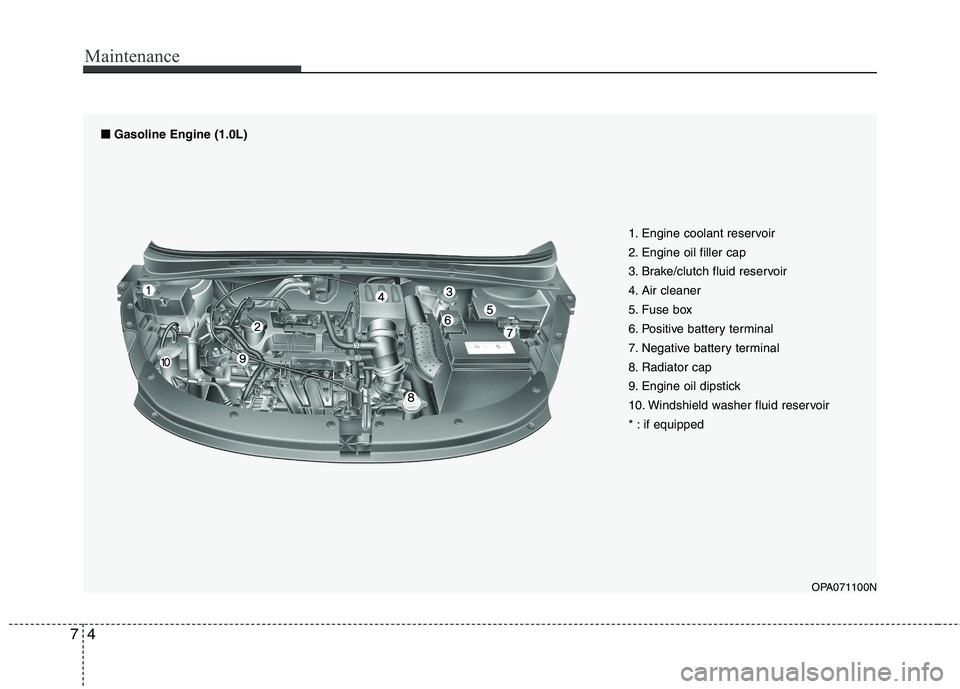
1. Engine coolant reservoir
2. Engine oil filler cap
3. Brake/clutch fluid reservoir
4. Air cleaner
5. Fuse box
6. Positive battery terminal
7. Negative battery terminal
8. Radiator cap
9. Engine oil dipstick
10. Windshield washer fluid reservoir
* : if equipped
■
■
Gasoline Engine (1.0L)
OPA071100N
Page 270 of 354
Maintenance
8
7
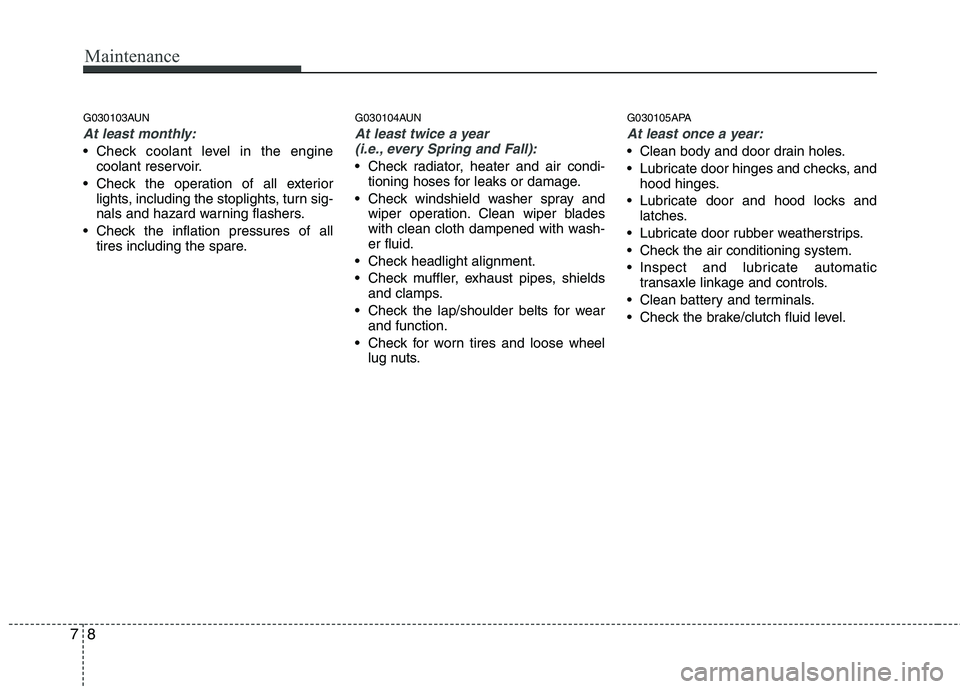
G030103AUN
At least monthly:
Check coolant level in the engine
coolant reservoir.
Check the operation of all exterior lights, including the stoplights, turn sig-
nals and hazard warning flashers.
Check the inflation pressures of all tires including the spare. G030104AUN
At least twice a year
(i.e., every Spring and Fall):
Check radiator, heater and air condi- tioning hoses for leaks or damage.
Check windshield washer spray and wiper operation. Clean wiper blades
with clean cloth dampened with wash-er fluid.
Check headlight alignment.
Check muffler, exhaust pipes, shields and clamps.
Check the lap/shoulder belts for wear and function.
Check for worn tires and loose wheel lug nuts. G030105APA
At least once a year:
Clean body and door drain holes.
Lubricate door hinges and checks, and
hood hinges.
Lubricate door and hood locks and latches.
Lubricate door rubber weatherstrips.
Check the air conditioning system.
Inspect and lubricate automatic transaxle linkage and controls.
Clean battery and terminals.
Check the brake/clutch fluid level.
Page 274 of 354
Maintenance
12
7
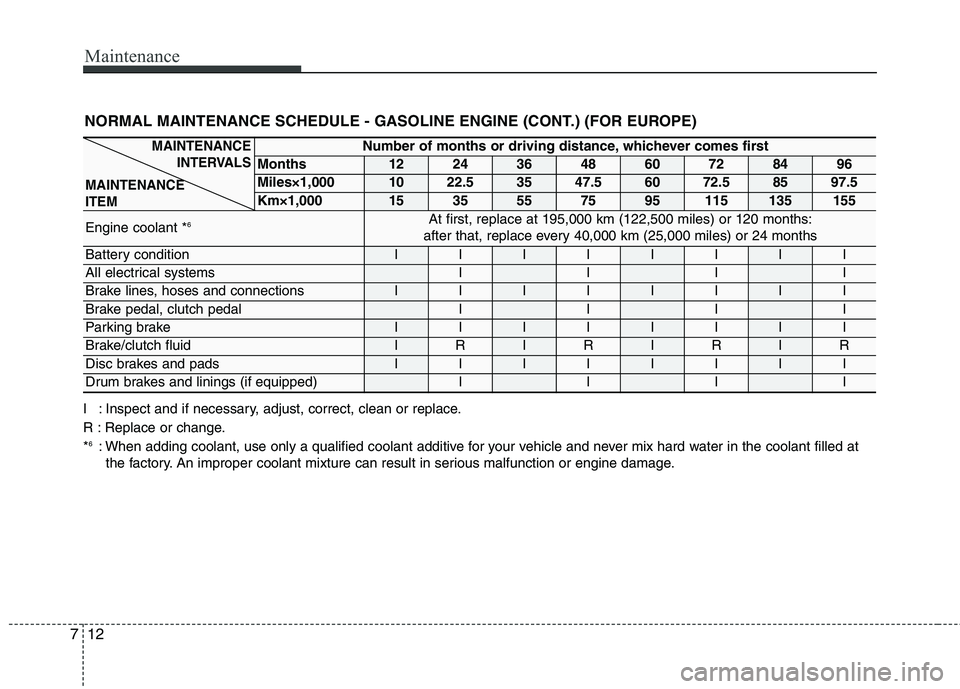
I : Inspect and if necessary, adjust, correct, clean or replace.
R : Replace or change.* 6
: When adding coolant, use only a qualified coolant additive for your vehicle and never mix hard water in the coolant filled at
the factory. An improper coolant mixture can result in serious malfunction or engine damage.
NORMAL MAINTENANCE SCHEDULE - GASOLINE ENGINE (CONT.) (FOR EUROPE)
Number of months or driving distance, whichever comes first
Months1224364860728496
Miles×1,0001022.53547.56072.58597.5
Km×1,0001535557595115135155
Engine coolant *
6At first, replace at 195,000 km (122,500 miles) or 120 months:
after that, replace every 40,000 km (25,000 miles) or 24 months
Battery conditionIIIIIIII
All electrical systemsIIII
Brake lines, hoses and connectionsIIIIIIII
Brake pedal, clutch pedalIIII
Parking brakeIIIIIIII
Brake/clutch fluidIRIRIRIR
Disc brakes and padsIIIIIIII
Drum brakes and linings (if equipped)IIII
MAINTENANCE INTERVALS
MAINTENANCE ITEM
Page 280 of 354
Maintenance
18
7
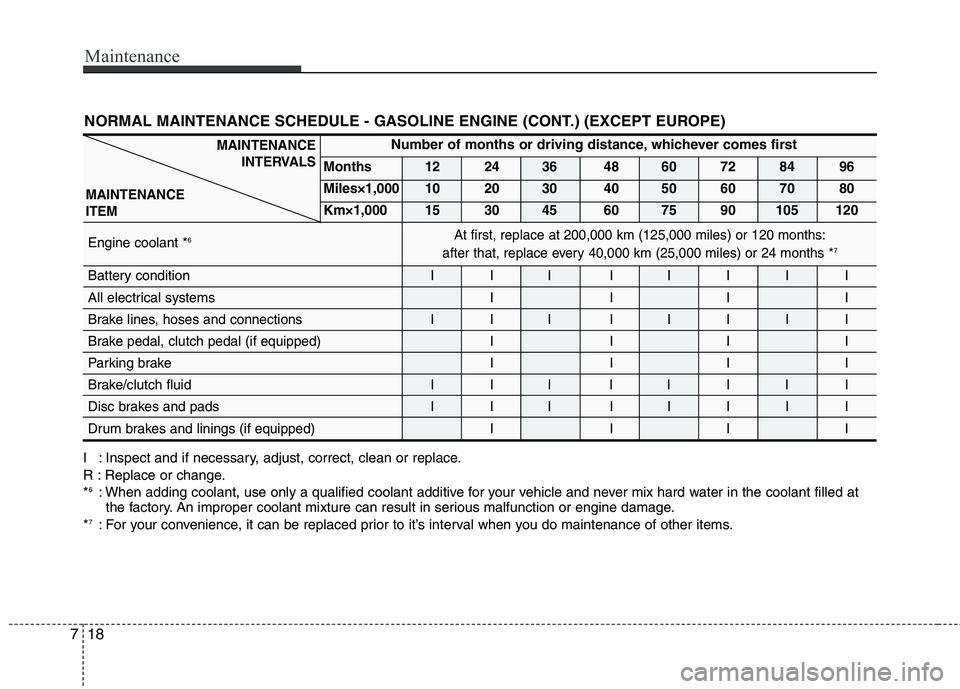
NORMAL MAINTENANCE SCHEDULE - GASOLINE ENGINE (CONT.) (EXCEPT EUROPE)
I : Inspect and if necessary, adjust, correct, clean or replace.
R : Replace or change.* 6
: When adding coolant, use only a qualified coolant additive for your vehicle and never mix hard water in the coolant filled at
the factory. An improper coolant mixture can result in serious malfunction or engine damage.
* 7
: For your convenience, it can be replaced prior to it’s interval when you do maintenance of other items.
MAINTENANCE
INTERVALS
MAINTENANCE ITEMNumber of months or driving distance, whichever comes first
Months 12 24 36 48 60 72 84 96
Miles×1,000 10 20 30 40 50 60 70 80
Km×1,000 15 30 45 60 75 90 105 120
Engine coolant * 6
Battery condition I I I I I I I I
All electrical systems I I I I
Brake lines, hoses and connections I I I I I I I I
Brake pedal, clutch pedal (if equipped) I I I I
Parking brake I I I I
Brake/clutch fluid
III IIIII
Disc brakes and pads I I I I I I I I
Drum brakes and linings (if equipped) I I I I
At first, replace at 200,000 km (125,000 miles) or 120 months:
after that, replace every 40,000 km (25,000 miles) or 24 months * 7
Page 291 of 354
729
Maintenance
BRAKE/CLUTCH FLUID
G080100APA
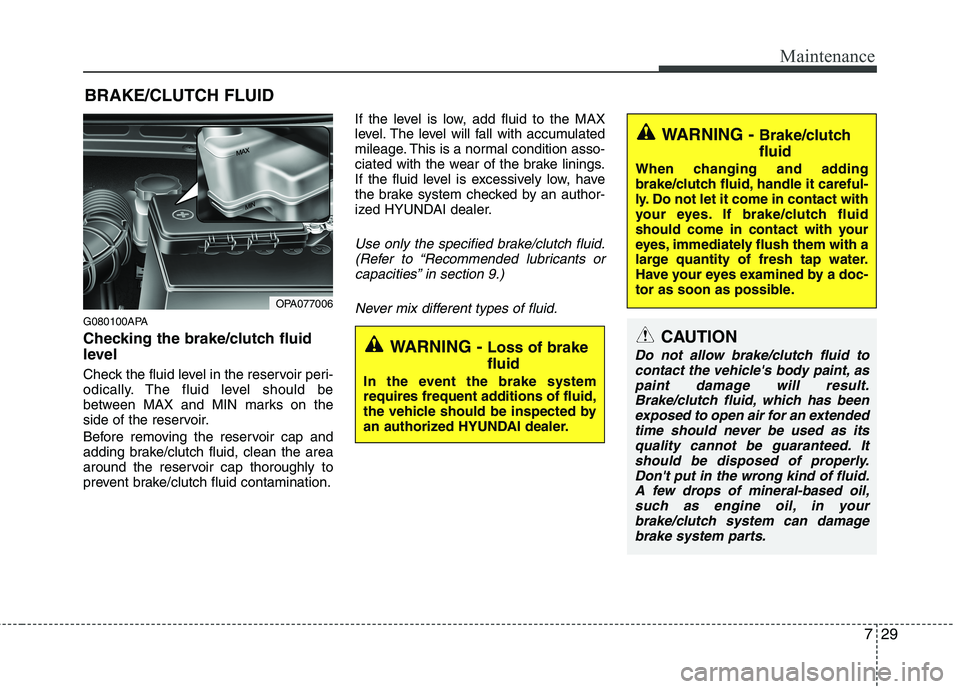
Checking the brake/clutch fluid
level
Check the fluid level in the reservoir peri-
odically. The fluid level should be
between MAX and MIN marks on the
side of the reservoir.
Before removing the reservoir cap and
adding brake/clutch fluid, clean the area
around the reservoir cap thoroughly to
prevent brake/clutch fluid contamination. If the level is low, add fluid to the MAX
level. The level will fall with accumulated
mileage. This is a normal condition asso-
ciated with the wear of the brake linings.
If the fluid level is excessively low, have
the brake system checked by an author-
ized HYUNDAI dealer.
Use only the specified brake/clutch fluid.
(Refer to “Recommended lubricants orcapacities” in section 9.)
Never mix different types of fluid.
OPA077006
WARNING - Loss of brake fluid
In the event the brake system
requires frequent additions of fluid,
the vehicle should be inspected by
an authorized HYUNDAI dealer.
WARNING - Brake/clutch fluid
When changing and adding
brake/clutch fluid, handle it careful-
ly. Do not let it come in contact with
your eyes. If brake/clutch fluid
should come in contact with your
eyes, immediately flush them with a
large quantity of fresh tap water.
Have your eyes examined by a doc-
tor as soon as possible.
CAUTION
Do not allow brake/clutch fluid to contact the vehicle's body paint, aspaint damage will result. Brake/clutch fluid, which has been exposed to open air for an extendedtime should never be used as its
quality cannot be guaranteed. Itshould be disposed of properly. Don't put in the wrong kind of fluid.A few drops of mineral-based oil,
such as engine oil, in your brake/clutch system can damagebrake system parts.
Page 349 of 354
Specifications
4
9
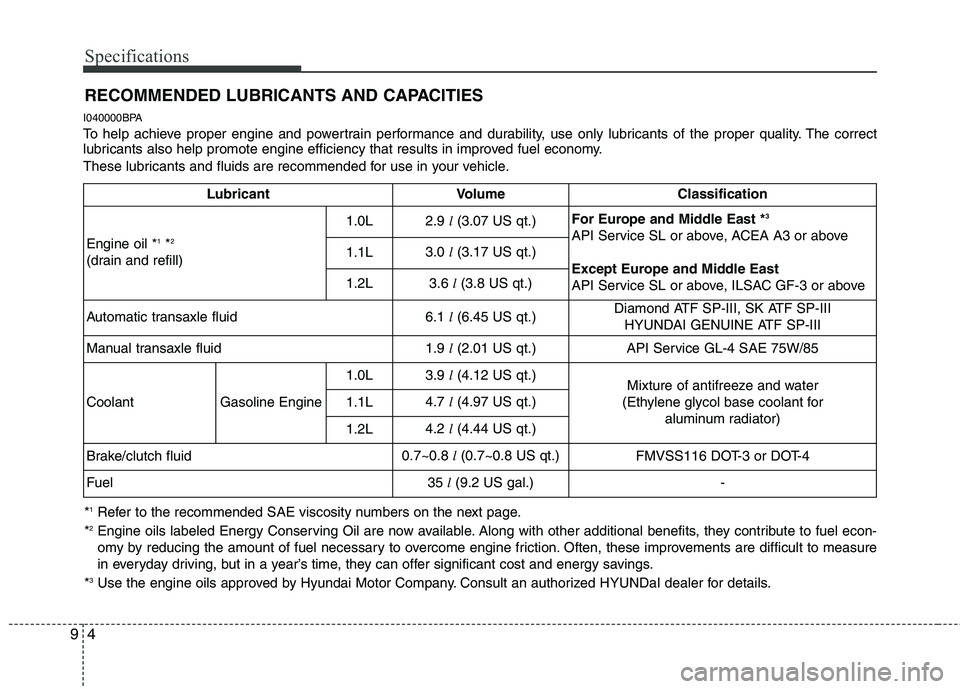
RECOMMENDED LUBRICANTS AND CAPACITIES
I040000BPA
To help achieve proper engine and powertrain performance and durability, use only lubricants of the proper quality. The correct
lubricants also help promote engine efficiency that results in improved fuel economy.
These lubricants and fluids are recommended for use in your vehicle.
* 1
Refer to the recommended SAE viscosity numbers on the next page.
* 2
Engine oils labeled Energy Conserving Oil are now available. Along with other additional benefits, they contribute to fuel econ-
omy by reducing the amount of fuel necessary to overcome engine friction. Often, these improvements are difficult to measure
in everyday driving, but in a year’s time, they can offer significant cost and energy savings.
* 3
Use the engine oils approved by Hyundai Motor Company. Consult an authorized HYUNDaI dealer for details. Lubricant Volume Classification
Engine oil *
1
*2
(drain and refill)
1.0L2.9 l(3.07 US qt.)For Europe and Middle East * 3
API Service SL or above, ACEA A3 or above
Except Europe and Middle East
API Service SL or above, ILSAC GF-3 or above
1.1L
3.0
l(3.17 US qt.)
1.2L 3.6
l(3.8 US qt.)
Automatic transaxle fluid 6.1
l(6.45 US qt.) Diamond ATF SP-III, SK ATF SP-III
HYUNDAI GENUINE ATF SP-III
Manual transaxle fluid 1.9
l(2.01 US qt.)
API Service GL-4 SAE 75W/85
Coolant Gasoline Engine
1.0L3.9 l(4.12 US qt.)Mixture of antifreeze and water
(Ethylene glycol base coolant for aluminum radiator)
1.1L
4.7
l(4.97 US qt.)
1.2L 4.2
l(4.44 US qt.)
Brake/clutch fluid 0.7~0.8
l(0.7~0.8 US qt.)
FMVSS116 DOT-3 or DOT-4
Fuel 35
l(9.2 US gal.)
-
Page 352 of 354
Index
2
I
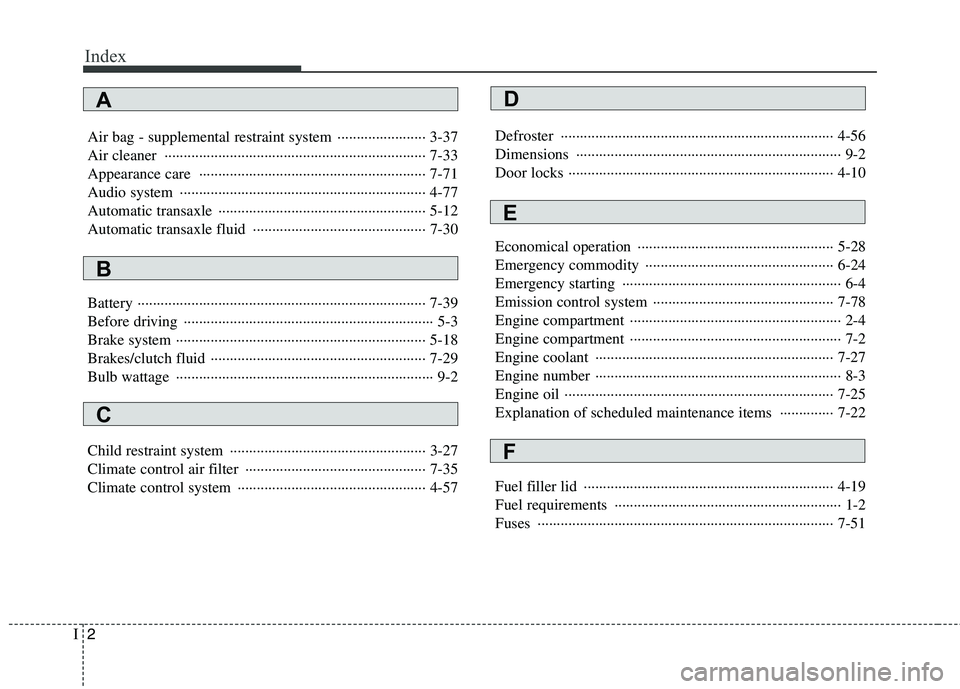
Air bag - supplemental restraint system ······················· 3-37
Air cleaner ···································································· 7-33
Appearance care ··························································· 7-71
Audio system ································································ 4-77
Automatic transaxle ······················································ 5-12
Automatic transaxle fluid ············································· 7-30
Battery ··········································································· 7-39
Before driving ································································· 5-3
Brake system ································································· 5-18
Brakes/clutch fluid ························································ 7-29
Bulb wattage ··································································· 9-2
Child restraint system ··················································· 3-27
Climate control air filter ··············································· 7-35
Climate control system ················································· 4-57 Defroster ······································································· 4-56
Dimensions ····································································· 9-2
Door locks ····································································· 4-10
Economical operation ··················································· 5-28
Emergency commodity ················································· 6-24
Emergency starting ························································· 6-4
Emission control system ··············································· 7-78
Engine compartment ······················································· 2-4
Engine compartment ······················································· 7-2
Engine coolant ······························································ 7-27
Engine number ································································ 8-3
Engine oil ······································································ 7-25
Explanation of scheduled maintenance items ·············· 7-22
Fuel filler lid ································································· 4-19
Fuel requirements ··························································· 1-2
Fuses ············································································· 7-51
A
B
C
D
E
F