maintenance schedule HYUNDAI I10 2012 Owner's Manual
[x] Cancel search | Manufacturer: HYUNDAI, Model Year: 2012, Model line: I10, Model: HYUNDAI I10 2012Pages: 354, PDF Size: 37.04 MB
Page 290 of 354
Maintenance
28
7
G070101AUN
Recommended engine coolant
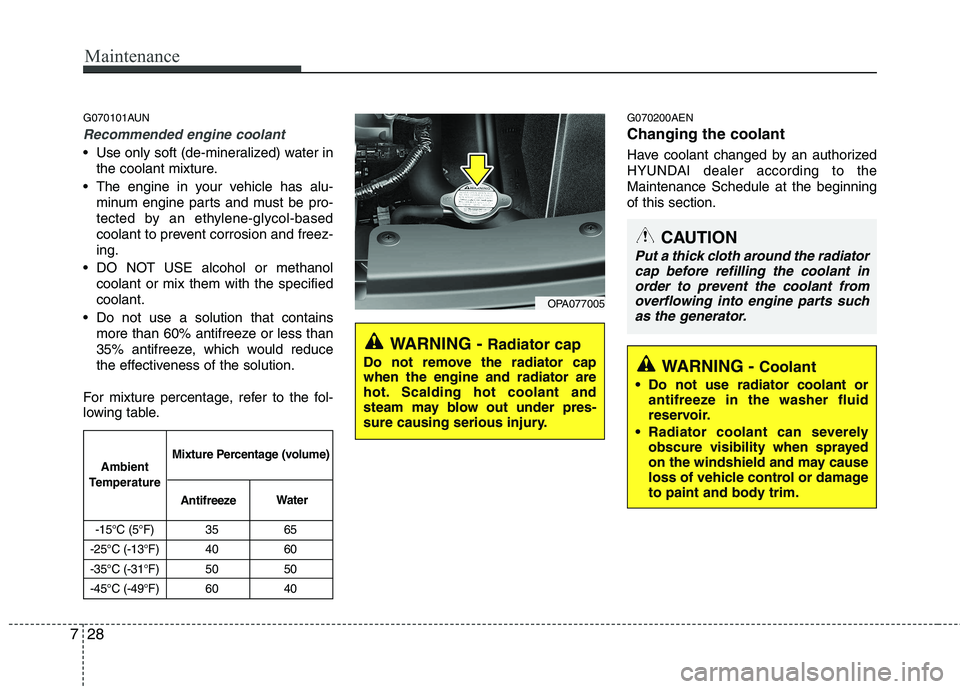
Use only soft (de-mineralized) water in
the coolant mixture.
The engine in your vehicle has alu- minum engine parts and must be pro-
tected by an ethylene-glycol-based
coolant to prevent corrosion and freez-ing.
DO NOT USE alcohol or methanol coolant or mix them with the specifiedcoolant.
Do not use a solution that contains more than 60% antifreeze or less than
35% antifreeze, which would reduce
the effectiveness of the solution.
For mixture percentage, refer to the fol-
lowing table. G070200AEN Changing the coolant
Have coolant changed by an authorized
HYUNDAI dealer according to theMaintenance Schedule at the beginningof this section.
-15°C (5°F) 35 65
-25°C (-13°F) 40 60
-35°C (-31°F) 50 50
-45°C (-49°F) 60 40
Ambient
Temperature Mixture Percentage (volume)
Antifreeze Water
WARNING -
Radiator cap
Do not remove the radiator cap when the engine and radiator are
hot. Scalding hot coolant and
steam may blow out under pres-
sure causing serious injury.
OPA077005
CAUTION
Put a thick cloth around the radiator cap before refilling the coolant in order to prevent the coolant from
overflowing into engine parts suchas the generator.
WARNING - Coolant
Do not use radiator coolant or antifreeze in the washer fluid
reservoir.
Radiator coolant can severely obscure visibility when sprayed
on the windshield and may cause
loss of vehicle control or damage
to paint and body trim.
Page 293 of 354
731
Maintenance
✽✽NOTICE
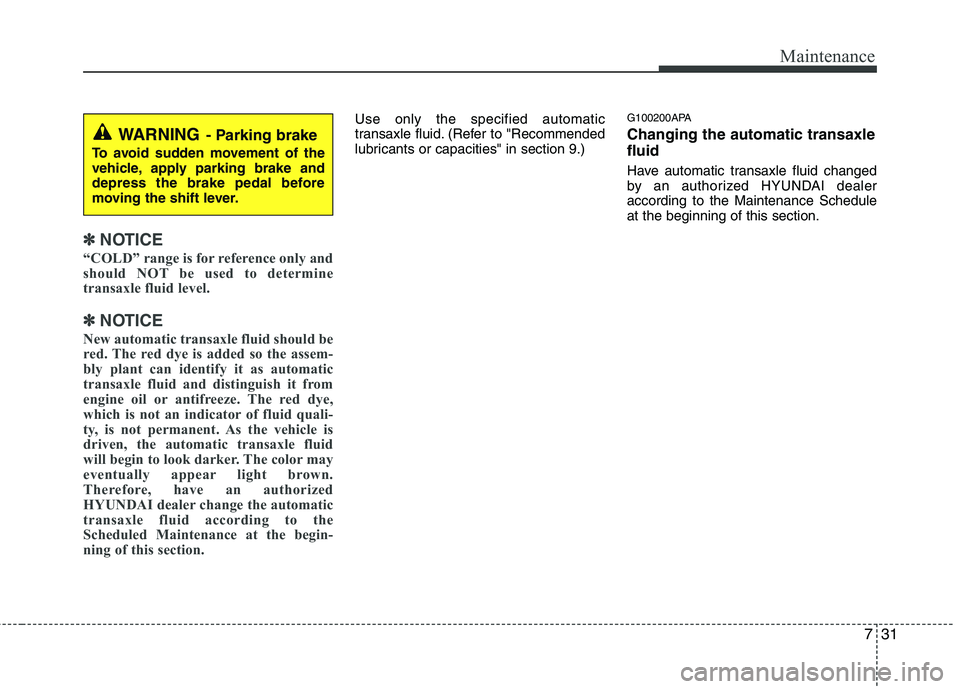
“COLD” range is for reference only and
should NOT be used to determine
transaxle fluid level.
✽
✽ NOTICE
New automatic transaxle fluid should be
red. The red dye is added so the assem-
bly plant can identify it as automatic
transaxle fluid and distinguish it from
engine oil or antifreeze. The red dye,
which is not an indicator of fluid quali-
ty, is not permanent. As the vehicle is
driven, the automatic transaxle fluid
will begin to look darker. The color may
eventually appear light brown.
Therefore, have an authorized
HYUNDAI dealer change the automatic
transaxle fluid according to the
Scheduled Maintenance at the begin-
ning of this section.
Use only the specified automatic
transaxle fluid. (Refer to "Recommended
lubricants or capacities" in section 9.) G100200APA Changing the automatic transaxle fluid
Have automatic transaxle fluid changed
by an authorized HYUNDAI dealeraccording to the Maintenance Scheduleat the beginning of this section.
WARNING
- Parking brake
To avoid sudden movement of the
vehicle, apply parking brake and
depress the brake pedal before
moving the shift lever.
Page 296 of 354

Maintenance
34
7
Replace the filter according to the
Maintenance Schedule.
If the vehicle is operated in extremely
dusty or sandy areas, replace the ele-ment more often than the usual recom-
mended intervals. (Refer to“Maintenance under severe usage condi-tions” in this section.)
CAUTION
Do not drive with the air cleaner removed; this will result in exces-sive engine wear.
When removing the air cleaner fil- ter, be careful that dust or dirtdoes not enter the air intake, or damage may result.
Use a HYUNDAI genuine part. Use of non-genuine parts could dam-age the air flow sensor or tur-bocharger (diesel engine only).
Page 297 of 354
735
Maintenance
CLIMATE CONTROL AIR FILTER
G170100APA Filter inspection
Exept Europe
The climate control air filter should be inspect and cleaned according to the
Maintenance Schedule. If the vehicle is
operated in severely air-polluted cities or
on dusty rough roads for a long period, itshould be inspected more frequently and
cleaned earlier. When you climate control
air filter, inspect it performing the follow-
ing procedure, and be careful to avoid
damaging other components.
For Europe
The climate control air filter should be replaced according to the Maintenance
Schedule. If the vehicle is operated in
severely air-polluted cities or on dusty
rough roads for a long period, it shouldbe inspected more frequently and
replaced earlier. When you replace the
climate control air filter, replace it per-
forming the following procedure, and be
careful to avoid damaging other compo-
nents. G170200APA Filter replacement
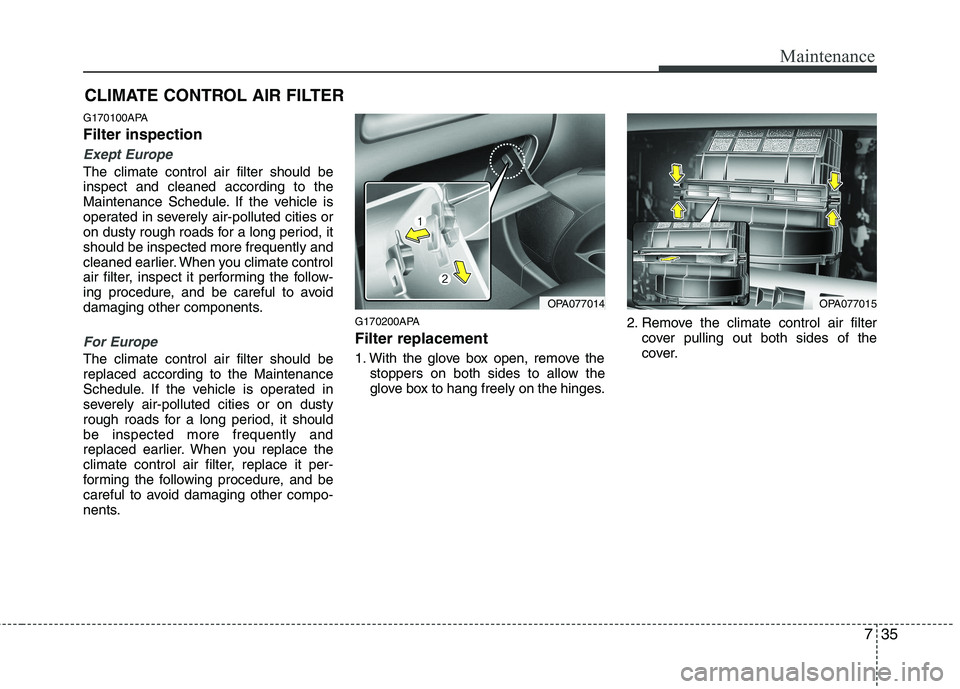
1. With the glove box open, remove the
stoppers on both sides to allow the
glove box to hang freely on the hinges. 2. Remove the climate control air filter
cover pulling out both sides of the
cover.
OPA077014OPA077015
Page 340 of 354
Maintenance
78
7
EMISSION CONTROL SYSTEM (IF EQUIPPED)
G270000AEN
The emission control system of your
vehicle is covered by a written limited
warranty. Please see the warranty infor-
mation contained in the Service Passport
in your vehicle.
Your vehicle is equipped with an emis-
sion control system to meet all applicable
emission regulations. There are three emission control sys-
tems, as follows.
(1) Crankcase emission control system
(2) Evaporative emission control system(3) Exhaust emission control system In order to assure the proper function of
the emission control systems, it is rec-
ommended that you have your car
inspected and maintained by an author-
ized HYUNDAI dealer in accordance with
the maintenance schedule in this manu-al. Caution for the Inspection and
Maintenance Test (With Electronic
Stability Program (ESP) system)
To prevent the vehicle from misfir-
ing during dynamometer testing,
turn the Electronic Stability
Program (ESP) system off by press-
ing the ESP switch.
After dynamometer testing is com- pleted, turn the ESP system back on
by pressing the ESP switch again. G270100AUN
1. Crankcase emission control
system
The positive crankcase ventilation sys-
tem is employed to prevent air pollution
caused by blow-by gases being emitted
from the crankcase. This system supplies
fresh filtered air to the crankcase through
the air intake hose. Inside the crankcase,
the fresh air mixes with blow-by gases,
which then pass through the PCV valveinto the induction system.
G270200AUN
2. Evaporative emission control system
The Evaporative Emission Control
System is designed to prevent fuel
vapors from escaping into the atmos-
phere.
Page 352 of 354
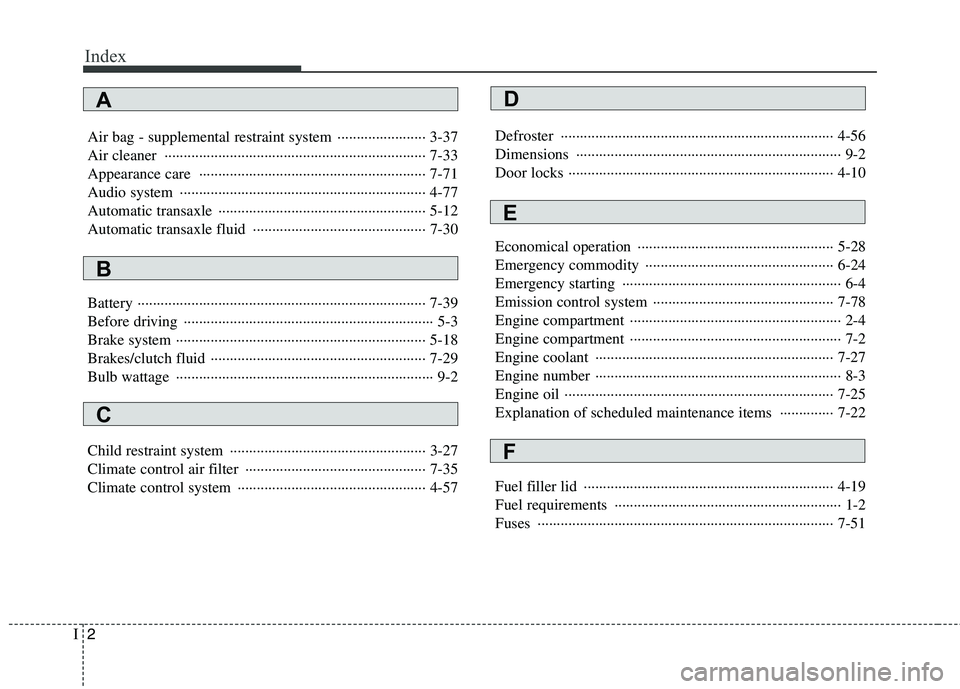
Index
2
I
Air bag - supplemental restraint system ······················· 3-37
Air cleaner ···································································· 7-33
Appearance care ··························································· 7-71
Audio system ································································ 4-77
Automatic transaxle ······················································ 5-12
Automatic transaxle fluid ············································· 7-30
Battery ··········································································· 7-39
Before driving ································································· 5-3
Brake system ································································· 5-18
Brakes/clutch fluid ························································ 7-29
Bulb wattage ··································································· 9-2
Child restraint system ··················································· 3-27
Climate control air filter ··············································· 7-35
Climate control system ················································· 4-57 Defroster ······································································· 4-56
Dimensions ····································································· 9-2
Door locks ····································································· 4-10
Economical operation ··················································· 5-28
Emergency commodity ················································· 6-24
Emergency starting ························································· 6-4
Emission control system ··············································· 7-78
Engine compartment ······················································· 2-4
Engine compartment ······················································· 7-2
Engine coolant ······························································ 7-27
Engine number ································································ 8-3
Engine oil ······································································ 7-25
Explanation of scheduled maintenance items ·············· 7-22
Fuel filler lid ································································· 4-19
Fuel requirements ··························································· 1-2
Fuses ············································································· 7-51
A
B
C
D
E
F
Page 354 of 354
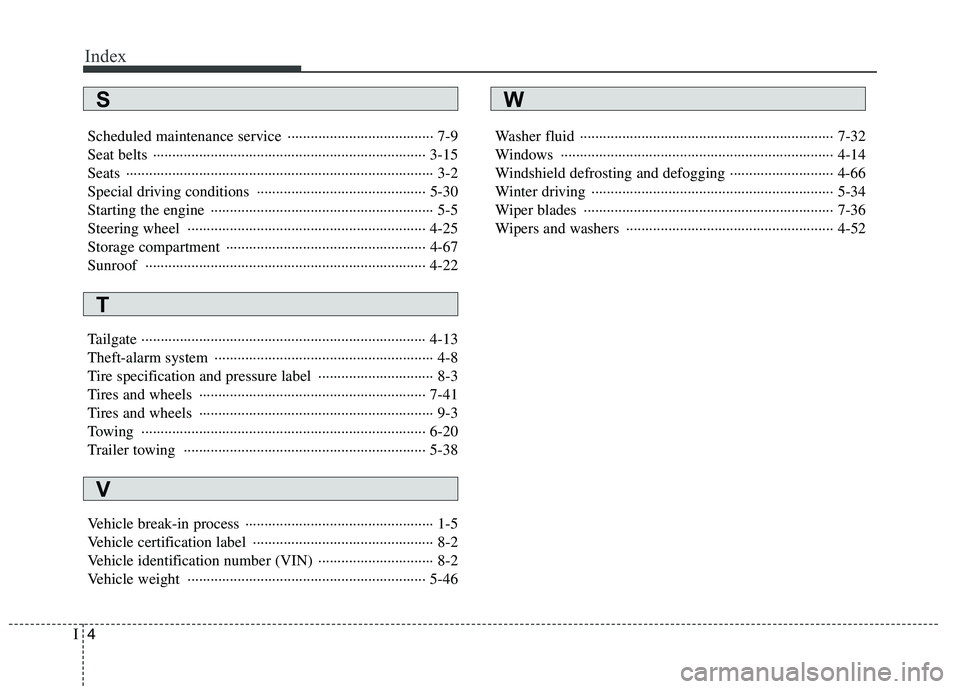
Index
4
I
Scheduled maintenance service ······································ 7-9
Seat belts ······································································· 3-15
Seats ················································································ 3-2
Special driving conditions ············································ 5-30
Starting the engine ·························································· 5-5
Steering wheel ······························································ 4-25
Storage compartment ···················································· 4-67
Sunroof ········································································· 4-22
Tailgate ·········································································· 4-13
Theft-alarm system ························································· 4-8
Tire specification and pressure label ······························ 8-3
Tires and wheels ··························································· 7-41
Tires and wheels ····························································· 9-3
Towing ·········································································· 6-20
Trailer towing ······························································· 5-38
Vehicle break-in process ················································· 1-5
Vehicle certification label ··············································· 8-2
Vehicle identification number (VIN) ······························ 8-2
Vehicle weight ······························································ 5-46 Washer fluid ·································································· 7-32
Windows ······································································· 4-14
Windshield defrosting and defogging ··························· 4-66
Winter driving ······························································· 5-34
Wiper blades ································································· 7-36
Wipers and washers ······················································ 4-52
V
W
T
S