seats HYUNDAI I10 2016 User Guide
[x] Cancel search | Manufacturer: HYUNDAI, Model Year: 2016, Model line: I10, Model: HYUNDAI I10 2016Pages: 343, PDF Size: 9.14 MB
Page 37 of 343
321
Safety system of your vehicle
CHILD RESTRAINT SYSTEM (CRS)
Children under age 13 must always ride
in the rear seats and must always be
properly restrained to minimize the risk of
injury in an accident, sudden stop or sud-
den maneuver. According to accident
statistics, children are safer when proper-
ly restrained in the rear seats than in the
front seat. Even with air bags, children
can be seriously injured or killed.
Children too large for a child restraint
must use the seat belts provided.Most countries have child restraint laws
which require children to travel in
approved child restraint devices. The
laws governing the age or height/weight
restrictions at which seat belts can be
used instead of child restraints differs
among countries, so you should be
aware of the specific requirements in
your country, and where you are travel-
ling.
Child restraint systems must be properly
placed and installed in the rear seat. You
must use a commercially available child
restraint system that meets the require-
ments of the Safety Standards of your
country.
Child restraint systems are generally
designed to be secured in a vehicle seat
by lap belt or the lap belt portion of a
lap/shoulder belt in the rear seats of the
vehicle.
Child Restraint System (CRS)
Infants and younger children must be
restrained in an appropriate rear-facing
or forward-facing CRS that has first been
properly secured to the rear seat of the
vehicle. Read and comply with the
instructions for installation and use pro-
vided by the manufacturer of the child
restraint.WARNING
Always properly restrain children in
the rear seats of the vehicle.
Children of all ages are safer when
restrained in the rear seat. A child
riding in the front passenger seat
can be forcefully struck by an inflat-
ing air bag resulting in SERIOUS
INJURY or DEATH.
WARNING
An improperly secured child
restraint can increase the risk of
SERIOUS INJURY or DEATH in an
accident. Always take the following
precautions when using a child
restraint system:
• NEVER install a child or infant
restraint in the front passenger’s
seat.
• Always properly secure the child
restraint to a rear seat of the vehi-
cle.
• Always follow the child restraint
system manufacturer’s instruc-
tions for installation and use.
(Continued)
Page 38 of 343
Safety system of your vehicle
22 3
Selecting a Child Restraint
System (CRS)
When selecting a CRS for your child,
always:
• Make sure the CRS has a label certify-
ing that it meets applicable Safety
Standards of your country.
• Select a child restraint system based
on your child’s height and weight. The
required label or the instructions for
use typically provide this information.
• Select a child restraint system that fits
the vehicle seating position where it
will be used.
• Read and comply with the warnings
and instructions for installation and use
provided with the child restraint system.
Child restraint system types
There are three main types of child
restraint systems: rear-facing seats, for-
ward-facing seats, and booster seats.
They are classified according to the
child’s age, height and weight.
Rear-facing child seats
WARNING
NEVER install a child or infant
restraint in the front passenger’s
seat.
Placing a rear-facing child restraint
in the front seat can result in SERI-
OUS INJURY or DEATH if the child
restraint is struck by an inflating air
bag.
(Continued)
• Always properly restrain your
child in the child restraint.
• Do not use an infant carrier or a
child safety seat that "hooks“ over
a seatback, it may not provide ade-
quate protection in an accident.
• After an accident, we recommend
a HYUNDAI dealer check the child
restraint system, seat belts,
ISOFIX lower anchorages and top-
tether anchorages.
Page 39 of 343
323
Safety system of your vehicle
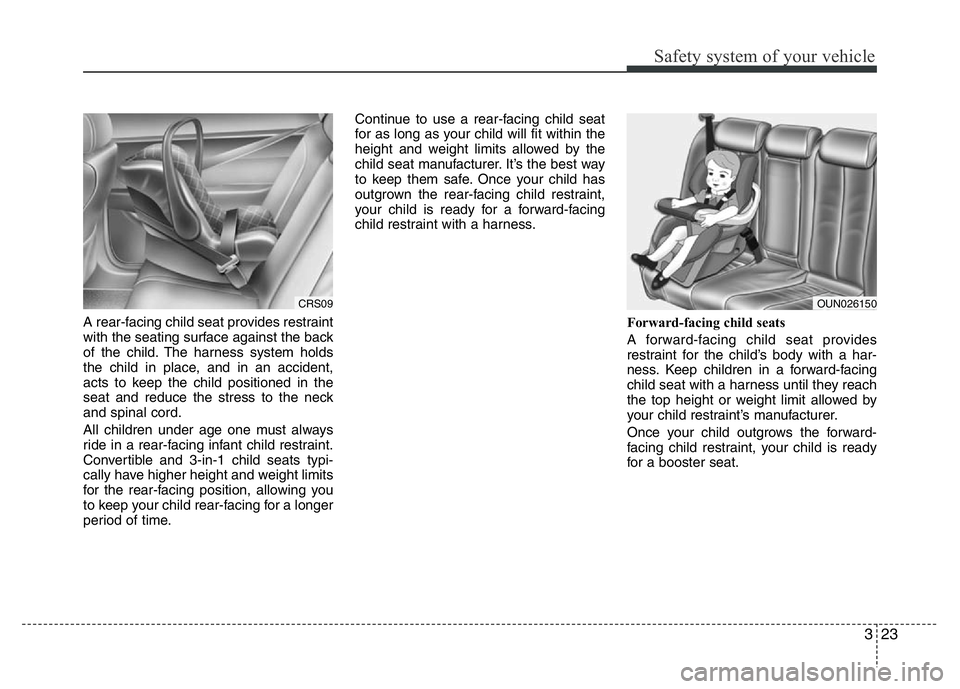
A rear-facing child seat provides restraint
with the seating surface against the back
of the child. The harness system holds
the child in place, and in an accident,
acts to keep the child positioned in the
seat and reduce the stress to the neck
and spinal cord.
All children under age one must always
ride in a rear-facing infant child restraint.
Convertible and 3-in-1 child seats typi-
cally have higher height and weight limits
for the rear-facing position, allowing you
to keep your child rear-facing for a longer
period of time.Continue to use a rear-facing child seat
for as long as your child will fit within the
height and weight limits allowed by the
child seat manufacturer. It’s the best way
to keep them safe. Once your child has
outgrown the rear-facing child restraint,
your child is ready for a forward-facing
child restraint with a harness.
Forward-facing child seats
A forward-facing child seat provides
restraint for the child’s body with a har-
ness. Keep children in a forward-facing
child seat with a harness until they reach
the top height or weight limit allowed by
your child restraint’s manufacturer.
Once your child outgrows the forward-
facing child restraint, your child is ready
for a booster seat.
CRS09OUN026150
Page 40 of 343
Safety system of your vehicle
24 3
Booster seats
A booster seat is a restraint designed to
improve the fit of the vehicle’s seat belt
system. A booster seat positions the seat
belt so that it fits properly over the lap of
your child. Keep your child in a booster
seat until they are big enough to sit in the
seat without a booster and still have the
seat belt fit properly.
For a seat belt to fit properly, the lap belt
must lie snugly across the upper thighs,
not the stomach. The shoulder belt
should lie snug across the shoulder and
chest and not across the neck or face.
Children under age 13 must always ride
in the rear seats and must always be
properly restrained to minimize the risk of
injury.Installing a Child Restraint
System (CRS) After selecting a proper child seat for
your child, check to make sure it fits prop-
erly in your vehicle. Follow the instruc-
tions provided by the manufacturer when
installing the child seat. Note these gen-
eral steps when installing the seat to your
vehicle:
•Properly secure the child restraint
system to the vehicle.All child seats
must be secured to the vehicle with the
lap belt or lap part of a lap/shoulder belt.
•Make sure the child restraint system
is firmly secured.After installing a
child seat to the vehicle, push and pull
the seat forward and from side-to-side
to verify that it is securely attached to
the seat. A child seatsecured with a
seat belt should be installed as firmly
as possible. However, some side-to-
side movement can be expected.
WARNING
Before installing your child
restraint system always:
• Read and follow the instructions
provided by the manufacturer of
the child restraint.
• Read and follow the instructions
regarding child restraint systems
in this manual.
Failure to follow all warnings and
instructions could increase the
risk of the SERIOUS INJURY or
DEATH if an accident occurs.
WARNING
A child restraint system in a closed
vehicle can become very hot. To
prevent burns, check the seating
surface and buckles before placing
your child in the child restraint.
Page 41 of 343
325
Safety system of your vehicle
Securing a child restraint system
with a lap belt or lap/shoulder belt
All child restraint system must be secured
to a vehicle rear seat with the lap belt or
the lap part of a lap/shoulder belt.
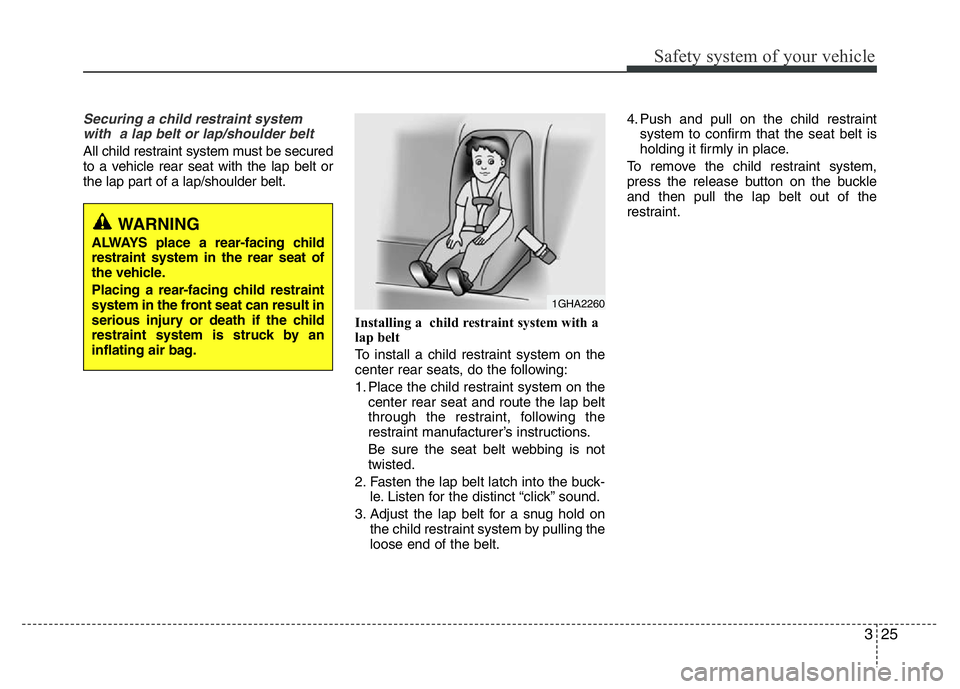
Installing a child restraint system with a
lap belt
To install a child restraint system on the
center rear seats, do the following:
1. Place the child restraint system on the
center rear seat and route the lap belt
through the restraint, following the
restraint manufacturer’s instructions.
Be sure the seat belt webbing is not
twisted.
2. Fasten the lap belt latch into the buck-
le. Listen for the distinct “click” sound.
3. Adjust the lap belt for a snug hold on
the child restraint system by pulling the
loose end of the belt.4. Push and pull on the child restraint
system to confirm that the seat belt is
holding it firmly in place.
To remove the child restraint system,
press the release button on the buckle
and then pull the lap belt out of the
restraint.
WARNING
ALWAYS place a rear-facing child
restraint system in the rear seat of
the vehicle.
Placing a rear-facing child restraint
system in the front seat can result in
serious injury or death if the child
restraint system is struck by an
inflating air bag.
1GHA2260
Page 42 of 343
Safety system of your vehicle
26 3
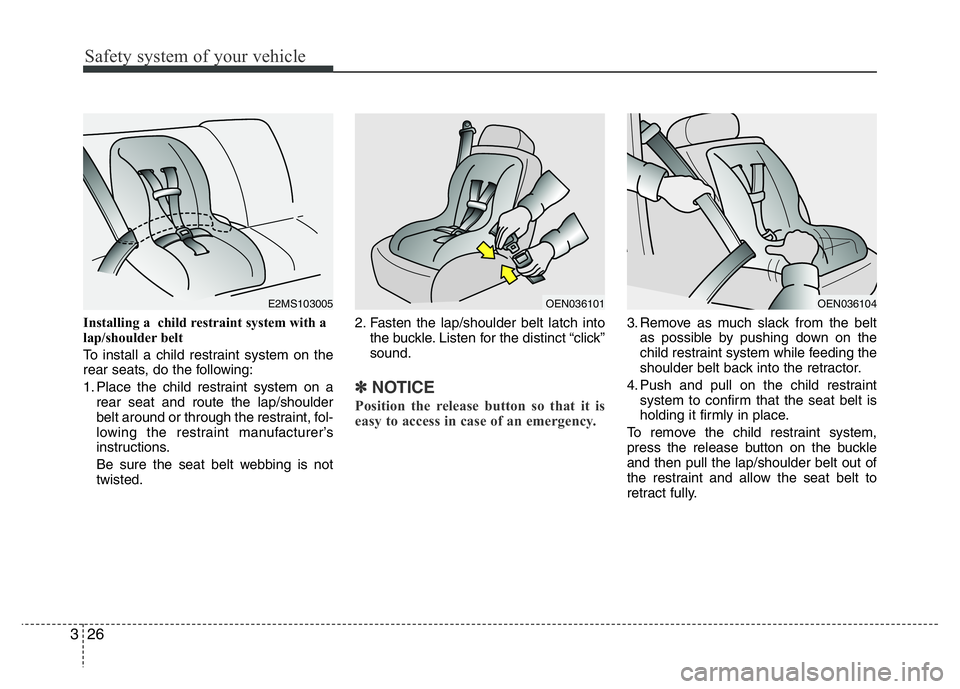
Installing a child restraint system with a
lap/shoulder belt
To install a child restraint system on the
rear seats, do the following:
1. Place the child restraint system on a
rear seat and route the lap/shoulder
belt around or through the restraint, fol-
lowing the restraint manufacturer’s
instructions.
Be sure the seat belt webbing is not
twisted.2. Fasten the lap/shoulder belt latch into
the buckle. Listen for the distinct “click”
sound.
✽NOTICE
Position the release button so that it is
easy to access in case of an emergency.
3. Remove as much slack from the belt
as possible by pushing down on the
child restraint system while feeding the
shoulder belt back into the retractor.
4. Push and pull on the child restraint
system to confirm that the seat belt is
holding it firmly in place.
To remove the child restraint system,
press the release button on the buckle
and then pull the lap/shoulder belt out of
the restraint and allow the seat belt to
retract fully.
OEN036104E2MS103005OEN036101
Page 46 of 343
Safety system of your vehicle
30 3
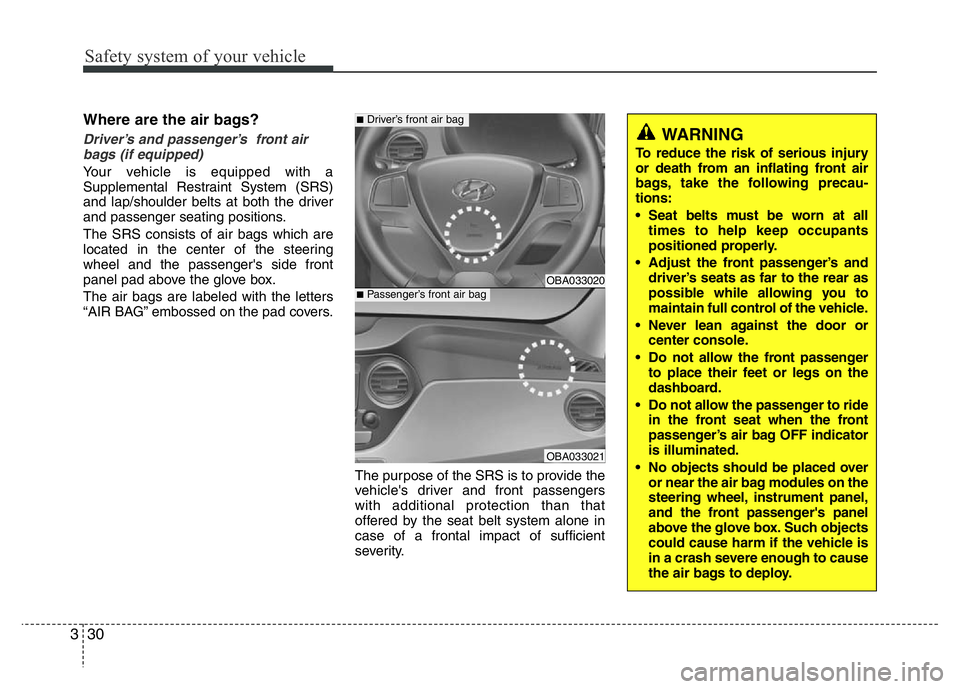
Where are the air bags?
Driver’s and passenger’s front air
bags (if equipped)
Your vehicle is equipped with a
Supplemental Restraint System (SRS)
and lap/shoulder belts at both the driver
and passenger seating positions.
The SRS consists of air bags which are
located in the center of the steering
wheel and the passenger's side front
panel pad above the glove box.
The air bags are labeled with the letters
“AIR BAG” embossed on the pad covers.
The purpose of the SRS is to provide the
vehicle's driver and front passengers
with additional protection than that
offered by the seat belt system alone in
case of a frontal impact of sufficient
severity.
WARNING
To reduce the risk of serious injury
or death from an inflating front air
bags, take the following precau-
tions:
• Seat belts must be worn at all
times to help keep occupants
positioned properly.
• Adjust the front passenger’s and
driver’s seats as far to the rear as
possible while allowing you to
maintain full control of the vehicle.
• Never lean against the door or
center console.
• Do not allow the front passenger
to place their feet or legs on the
dashboard.
• Do not allow the passenger to ride
in the front seat when the front
passenger’s air bag OFF indicator
is illuminated.
• No objects should be placed over
or near the air bag modules on the
steering wheel, instrument panel,
and the front passenger's panel
above the glove box. Such objects
could cause harm if the vehicle is
in a crash severe enough to cause
the air bags to deploy.
OBA033020
OBA033021
■Driver’s front air bag
■Passenger’s front air bag
Page 60 of 343
Safety system of your vehicle
44 3
SRS care
The SRS is virtually maintenance-free
and there are no parts you can safely
service by yourself. If the SRS air bag
warning light does not illuminate when
the ignition switch is in the ON position,
or continuously remains on, we recom-
mend that the system be immediately
inspected by an authorized HYUNDAI
dealer.
We recommend any work on the SRS
system, such as removing, installing,
repairing, or any work on the steering
wheel, the front passenger's panel, front
seats and roof rails be performed by an
authorized HYUNDAI dealer. Improper
handling of the SRS system may result in
serious personal injury.WARNING
To reduce the risk of serious injury
or death, take the following precau-
tions:
• Do not attempt to modify or dis-
connect the SRS components or
wiring, including the addition of
any kind of badges to the pad
covers or modifications to the
body structure.
• Do not place objects over or near
the air bag modules on the steer-
ing wheel, instrument panel, or
the front passenger's panel
above the glove box.
• Clean the air bag pad covers with
a soft cloth moistened with plain
water. Solvents or cleaners could
adversely affect the air bag cov-
ers and proper deployment of the
system.
• We recommend that inflated air
bags be replaced by an author-
ized HYUNDAI dealer.
(Continued)
(Continued)
• If components of the air bag sys-
tem must be discarded, or if the
vehicle must be scrapped, certain
safety precautions must be
observed. Consult an authorized
HYUNDAI dealer for the neces-
sary information. Failure to follow
these precautions could increase
the risk of personal injury.
Page 61 of 343
345
Safety system of your vehicle
Additional safety precautions
Passengers should not move out of or
change seats while the vehicle is mov-
ing.A passenger who is not wearing a
seat belt during a crash or emergency
stop can be thrown against the inside of
the vehicle, against other occupants, or
be ejected from the vehicle.
Do not use any accessories on seat
belts.Devices claiming to improve occu-
pant comfort or reposition the seat belt
can reduce the protection provided by
the seat belt and increase the chance of
serious injury in a crash
Do not modify the front seats.
Modification of the front seats could inter-
fere with the operation of the supplemen-
tal restraint system sensing components
or side air bags.
Do not place items under the front
seats.Placing items under the front
seats could interfere with the operation of
the supplemental restraint system sens-
ing components and wiring harnesses.
Adding equipment to or modifying
your air bag equipped vehicle
If you modify your vehicle by changing
your vehicle's frame, bumper system,
front end or side sheet metal or ride
height, this may affect the operation of
your vehicle's air bag system.
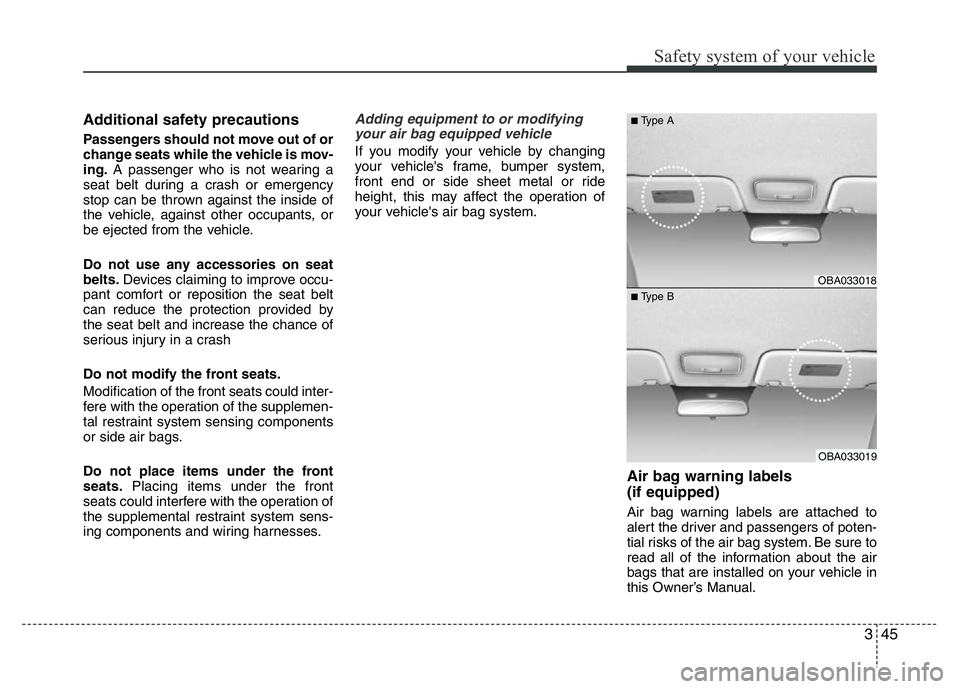
Air bag warning labels
(if equipped)
Air bag warning labels are attached to
alert the driver and passengers of poten-
tial risks of the air bag system. Be sure to
read all of the information about the air
bags that are installed on your vehicle in
this Owner’s Manual.
OBA033018
OBA033019
■Type A
■ Type B