Battery HYUNDAI I10 2016 Owner's Manual
[x] Cancel search | Manufacturer: HYUNDAI, Model Year: 2016, Model line: I10, Model: HYUNDAI I10 2016Pages: 343, PDF Size: 9.14 MB
Page 200 of 343
57
Driving your vehicle
ACC(Accessory)
With manual transaxle
Press the engine start/stop button when
the button is in the OFF position without
depressing the clutch pedal.
With automatic transaxle
Press the engine start/stop button while it
is in the OFF position without depressing
the brake pedal.
The steering wheel unlocks (if equipped
with anti-theft steering column lock) and
electrical accessories are usable.
If you leave the engine start/stop button
in the ACC position for more than one
hour, the battery power will turn off auto-
matically to prevent the battery from dis-
charging.
ON
With manual transaxle
Press the engine start/stop button when
the button is in the ACC position without
depressing the clutch pedal.
With automatic transaxle
Press the engine start/stop button while it
is in the ACC position without depressing
the brake pedal.
The warning lights can be checked
before the engine is started. If you leave
the engine start/stop button in the ON
position for more than one hour, the bat-
tery power will turn off automatically to
prevent the battery from discharging.
WARNING
To turn the engine off in an emer-
gency:
Press and hold the Engine
Start/Stop button for more than two
seconds OR Rapidly press and
release the Engine Start/Stop but-
ton three times (within three sec-
onds).
If the vehicle is still moving, you
can restart the engine without
depressing the brake pedal by
pressing the Engine Start/Stop but-
ton with the shift lever in the N
(Neutral) position.
Page 203 of 343
Driving your vehicle
10 5
✽ NOTICE
To prevent damage to the vehicle:
Do not press the Engine Start/Stop but-
ton for more than 10 seconds except
when the stop lamp fuse is disconnected.
When the stop lamp fuse is blown, you
can't start the engine normally. Replace
the fuse with a new one. If you are not
able to replace the fuse, you can start the
engine by pressing the engine start/stop
button for 10 seconds with the engine
start/stop button in the ACC position.
For your safety always depress the
brake and/or clutch pedal before start-
ing the engine.
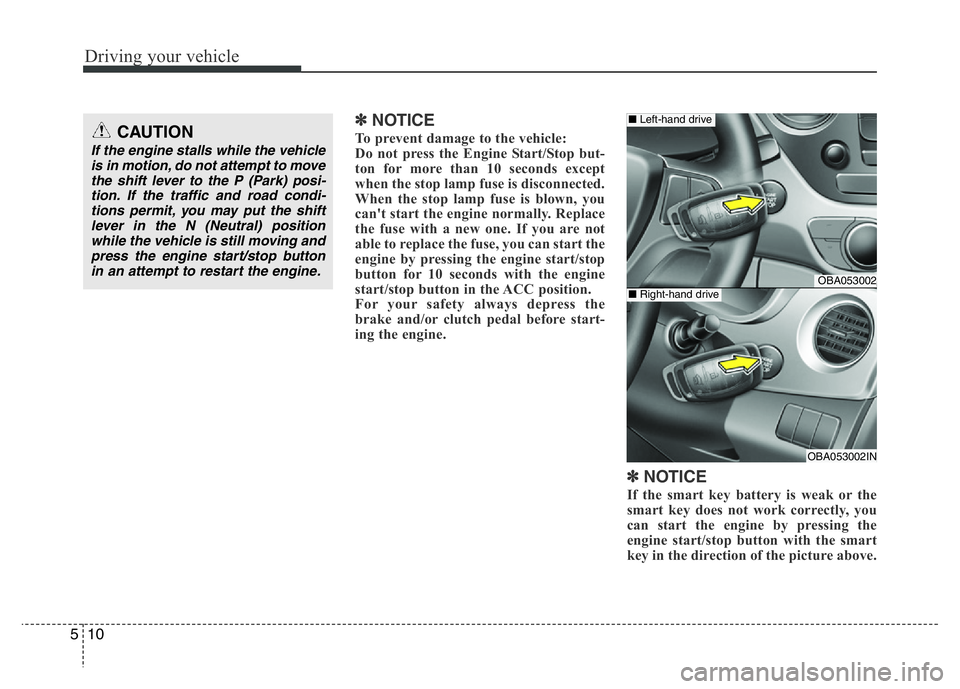
✽ NOTICE
If the smart key battery is weak or the
smart key does not work correctly, you
can start the engine by pressing the
engine start/stop button with the smart
key in the direction of the picture above.
OBA053002
OBA053002IN
■Left-hand drive
■Right-hand drive
CAUTION
If the engine stalls while the vehicle
is in motion, do not attempt to move
the shift lever to the P (Park) posi-
tion. If the traffic and road condi-
tions permit, you may put the shift
lever in the N (Neutral) position
while the vehicle is still moving and
press the engine start/stop button
in an attempt to restart the engine.
Page 218 of 343
525
Driving your vehicle
On loose or uneven road surfaces, oper-
ation of the anti-lock brake system may
result in a longer stopping distance than
for vehicles equipped with a conventional
brake system.
The ABS warning light ( ) will stay on
for several seconds after the ignition
switch is in the ON position. During that
time, the ABS will go through self-diag-
nosis and the light will go off if everything
is normal. If the light stays on, you may
have a problem with your ABS. We rec-
ommend that you contact an authorized
HYUNDAI dealer as soon as possible✽NOTICE
When you jump start your vehicle
because of a drained battery, the engine
may not run as smoothly and the ABS
warning light ( ) may turn on at the
same time. This happens because of the
low battery voltage. It does not mean
your ABS is malfunctioning. Have the
battery recharged before driving the
vehicle.WARNING
If the ABS warning light ( ) is on
and stays on, you may have a prob-
lem with the ABS. Your power
brakes will work normally. To
reduce the risk of serious injury or
death, we recommend that you con-
tact your HYUNDAI dealer as soon
as possible.
CAUTION
When you drive on a road having
poor traction, such as an icy road,
and apply your brakes continuous-
ly, the ABS will be active continu-
ously and the ABS warning light
( ) may illuminate. Pull your car
over to a safe place and turn the
engine off.
Restart the engine. If the ABS warn-
ing light is off, then your ABS sys-
tem is normal. Otherwise, you may
have a problem with your ABS sys-
tem. We recommend that you con-
tact an authorized HYUNDAI dealer
as soon as possible.
Page 236 of 343
63
What to do in an emergency
2. When the vehicle is stopped, turn on
your hazard warning flasher, set the
parking brake and put the transaxle in
P (automatic transaxle) or reverse
(manual transaxle).
3. Have all passengers get out of the
vehicle. Be sure they all get out on the
side of the vehicle that is away from
traffic.
4. When changing a flat tire, follow the
instruction provided later in this chap-
ter.
If the engine stalls while driving
1. Reduce your speed gradually, keeping
a straight line. Move cautiously off the
road to a safe place.
2. Turn on your hazard warning flasher.
3. Try to start the engine again. Try to
start the engine again. If your vehicle
will not start, we recommend that you
consult an authorized HYUNDAI deal-
er.
If the engine doesn't turn over or
turns over slowly
1. If your vehicle has an automatic
transaxle, be sure the shift lever is in N
(Neutral) or P (Park) and the emer-
gency brake is set.
2. Check the battery connections to be
sure they are clean and tight.
3. Turn on the interior light. If the light
dims or goes out when you operate the
starter, the battery is discharged.
4. Check the starter connections to be
sure they are securely tightened.
5. Do not push or pull the vehicle to start
it. See instructions for "Jump starting".
If the engine turns over normally
but does not start
1. Check the fuel level.
2. With the ignition switch in the LOCK/
OFF position, check all connectors at
the ignition coils and spark plugs.
Reconnect any that may be discon-
nected or loose.
3. Check the fuel line in the engine com-
partment.
4. If the engine still does not start, we rec-
ommend that you call an authorized
HYUNDAI dealer.
IF THE ENGINE DOES NOT START
WARNING
If the engine will not start, do not
push or pull the vehicle to start it.
This could result in a collision or
cause other damage. In addition,
push or pull starting may cause the
catalytic converter to overload and
create a fire.
Page 237 of 343
What to do in an emergency
4 6
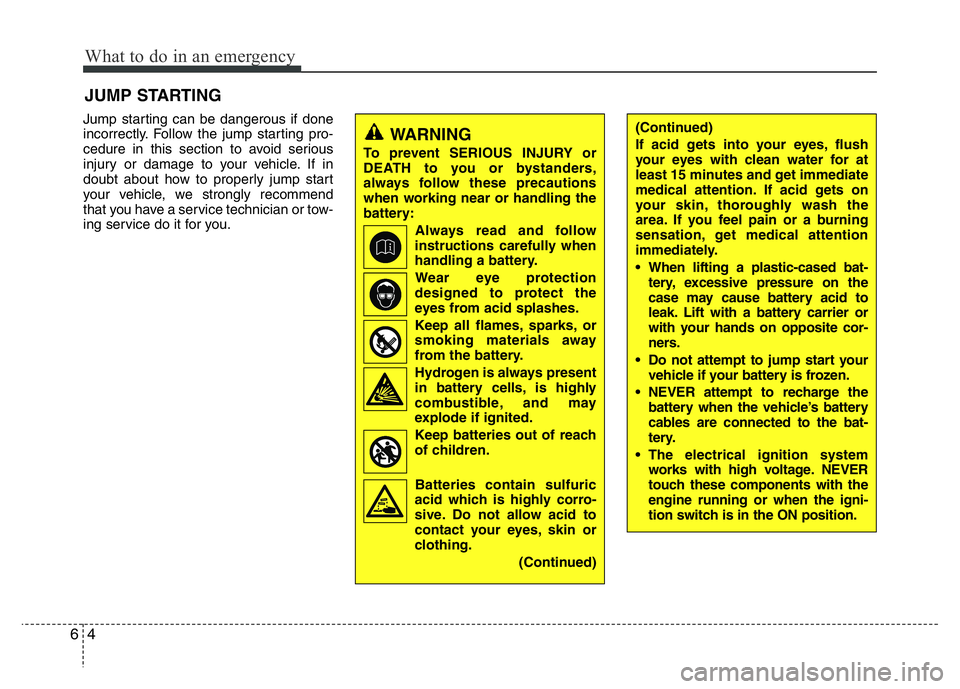
JUMP STARTING
Jump starting can be dangerous if done
incorrectly. Follow the jump starting pro-
cedure in this section to avoid serious
injury or damage to your vehicle. If in
doubt about how to properly jump start
your vehicle, we strongly recommend
that you have a service technician or tow-
ing service do it for you.
WARNING
To prevent SERIOUS INJURY or
DEATH to you or bystanders,
always follow these precautions
when working near or handling the
battery:
Always read and follow
instructions carefully when
handling a battery.
Wear eye protection
designed to protect the
eyes from acid splashes.
Keep all flames, sparks, or
smoking materials away
from the battery.
Hydrogen is always present
in battery cells, is highly
combustible, and may
explode if ignited.
Keep batteries out of reach
of children.
Batteries contain sulfuric
acid which is highly corro-
sive. Do not allow acid to
contact your eyes, skin or
clothing.
(Continued)
(Continued)
If acid gets into your eyes, flush
your eyes with clean water for at
least 15 minutes and get immediate
medical attention. If acid gets on
your skin, thoroughly wash the
area. If you feel pain or a burning
sensation, get medical attention
immediately.
• When lifting a plastic-cased bat-
tery, excessive pressure on the
case may cause battery acid to
leak. Lift with a battery carrier or
with your hands on opposite cor-
ners.
• Do not attempt to jump start your
vehicle if your battery is frozen.
• NEVER attempt to recharge the
battery when the vehicle’s battery
cables are connected to the bat-
tery.
• The electrical ignition system
works with high voltage. NEVER
touch these components with the
engine running or when the igni-
tion switch is in the ON position.
Page 238 of 343
65
What to do in an emergency
✽ NOTICE
An inappropriately disposed
battery can be harmful to the
environment and human health.
Dispose the battery according
to your local law(s) or regula-
tion.
Jump starting procedure
1. Position the vehicles close enough that
the jumper cables will reach, but do not
allow the vehicles to touch.
2. Avoid fans or any moving parts in the
engine compartment at all times, even
when the vehicles are turned off.
3. Turn off all electrical devices such as
radios, lights, air conditioning, etc. Put
the vehicles in P (Park, for automatic
transaxle vehicle) or neutral (for manu-
al transaxle vehicle), and set the park-
ing brakes. Turn both vehicles OFF.
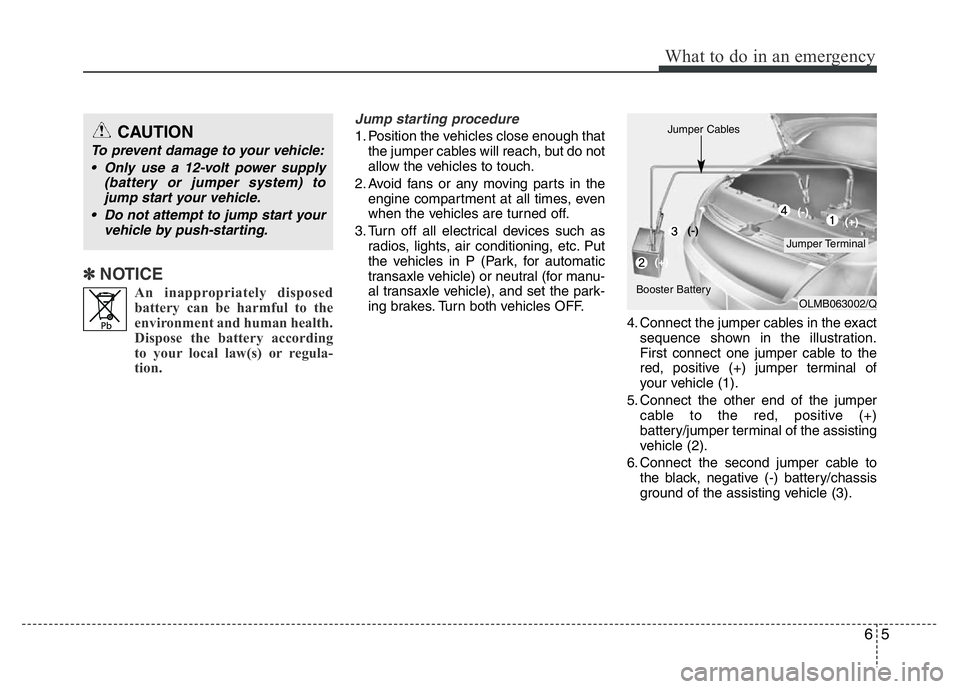
4. Connect the jumper cables in the exact
sequence shown in the illustration.
First connect one jumper cable to the
red, positive (+) jumper terminal of
your vehicle (1).
5. Connect the other end of the jumper
cable to the red, positive (+)
battery/jumper terminal of the assisting
vehicle (2).
6. Connect the second jumper cable to
the black, negative (-) battery/chassis
ground of the assisting vehicle (3).CAUTION
To prevent damage to your vehicle:
• Only use a 12-volt power supply
(battery or jumper system) to
jump start your vehicle.
• Do not attempt to jump start your
vehicle by push-starting.
OLMB063002/Q
Jumper Terminal Jumper Cables
Booster Battery(-)
(+)(+) (-)
Page 239 of 343
What to do in an emergency
6 6
7. Connect the other end of the second
jumper cable to the black, negative (-)
chassis ground of your vehicle (4).
Do not allow the jumper cables to con-
tact anything except the correct battery
or jumper terminals or the correct
ground. Do not lean over the battery
when making connections.
8. Start the engine of the assisting vehi-
cle and let it run at approximately
2,000 rpm for a few minutes. Then start
your vehicle.
If your vehicle will not start after a few
attempts, it probably requires servicing.
In this event please seek qualified assis-
tance. If the cause of your battery dis-
charging is not apparent, we recommend
that your vehicle be checked by an
authorized HYUNDAI dealer.Disconnect the jumper cables in the
exact reverse order you connected them:
1. Disconnect the jumper cable from the
black, negative (-) chassis ground of
your vehicle (4).
2. Disconnect the other end of the jumper
cable from the black, negative (-) bat-
tery/chassis ground of the assisting
vehicle (3).
3. Disconnect the second jumper cable
from the red, positive (+)
battery/jumper terminal of the assisting
vehicle (2).
4. Disconnect the other end of the jumper
cable from the red, positive (+) jumper
terminal of your vehicle (1).
Page 253 of 343
Maintenance
7
ENGINE COMPARTMENT . . . . . . . . . . . . . . . . . . 7-3
MAINTENANCE SERVICES . . . . . . . . . . . . . . . . 7-4
• Owner’s responsibility . . . . . . . . . . . . . . . . . . . . . . . . 7-4
• Owner maintenance precautions . . . . . . . . . . . . . . . . 7-4
OWNER MAINTENANCE . . . . . . . . . . . . . . . . . . . 7-6
• Owner maintenance schedule . . . . . . . . . . . . . . . . . . . 7-6
SCHEDULED MAINTENANCE SERVICE. . . . . 7-8
• Normal maintenance schedule . . . . . . . . . . . . . . . . . . . 7-9
• Maintenance under severe usage conditions. . . . . . . 7-13
EXPLANATION OF SCHEDULED
MAINTENANCE ITEMS . . . . . . . . . . . . . . . . . . . 7-19
ENGINE OIL . . . . . . . . . . . . . . . . . . . . . . . . . . . . . 7-19
• Checking the engine oil level . . . . . . . . . . . . . . . . . . 7-19
• Changing the engine oil and filter . . . . . . . . . . . . . . . 7-23
ENGINE COOLANT . . . . . . . . . . . . . . . . . . . . . . . 7-23
• Checking the engine coolant level . . . . . . . . . . . . . . . 7-23
• Changing the engine coolant . . . . . . . . . . . . . . . . . . . 7-25
BRAKE/CLUTCH FLUID . . . . . . . . . . . . . . . . . . 7-26
• Checking the brake/clutch fluid level . . . . . . . . . . . 7-26
AUTOMATIC TRANSAXLE FLUID . . . . . . . . . 7-27
• Checking the automatic transaxle fluid level . . . . . 7-27
• Changing the automatic transaxle fluid . . . . . . . . . . 7-28
WASHER FLUID . . . . . . . . . . . . . . . . . . . . . . . . . . 7-29
• Checking the washer fluid level . . . . . . . . . . . . . . . . 7-29
PARKING BRAKE . . . . . . . . . . . . . . . . . . . . . . . . 7-29
• Checking the parking brake . . . . . . . . . . . . . . . . . . 7-29
AIR CLEANER . . . . . . . . . . . . . . . . . . . . . . . . . . . 7-30
• Filter replacement . . . . . . . . . . . . . . . . . . . . . . . . . . . 7-30
CLIMATE CONTROL AIR FILTER . . . . . . . . . 7-32
• Filter inspection . . . . . . . . . . . . . . . . . . . . . . . . . . . . . . 7-32
• Filter replacement . . . . . . . . . . . . . . . . . . . . . . . . . . . . 7-32
WIPER BLADES . . . . . . . . . . . . . . . . . . . . . . . . . 7-34
• Blade inspection . . . . . . . . . . . . . . . . . . . . . . . . . . . . . . 7-34
• Blade replacement . . . . . . . . . . . . . . . . . . . . . . . . . . . 7-34
BATTERY . . . . . . . . . . . . . . . . . . . . . . . . . . . . . . . . 7-38
• For best battery service . . . . . . . . . . . . . . . . . . . . . . . 7-38
• Battery capacity label . . . . . . . . . . . . . . . . . . . . . . . . 7-39
• Battery recharging . . . . . . . . . . . . . . . . . . . . . . . . . . 7-39
• Reset items . . . . . . . . . . . . . . . . . . . . . . . . . . . . . . . . . . 7-40
TIRES AND WHEELS . . . . . . . . . . . . . . . . . . . . . 7-41
• Tire care . . . . . . . . . . . . . . . . . . . . . . . . . . . . . . . . . . . 7-41
• Recommended cold tire inflation pressures . . . . . . 7-41
• Checking tire inflation pressure. . . . . . . . . . . . . . . . . 7-43
• Tire rotation . . . . . . . . . . . . . . . . . . . . . . . . . . . . . . . . 7-44
• Wheel alignment and tire balance . . . . . . . . . . . . . . 7-45
• Tire replacement . . . . . . . . . . . . . . . . . . . . . . . . . . . . . 7-45
• Wheel replacement . . . . . . . . . . . . . . . . . . . . . . . . . . . 7-46
• Tire traction . . . . . . . . . . . . . . . . . . . . . . . . . . . . . . . . . 7-46
• Tire maintenance . . . . . . . . . . . . . . . . . . . . . . . . . . . . 7-47
Page 255 of 343
73
Maintenance
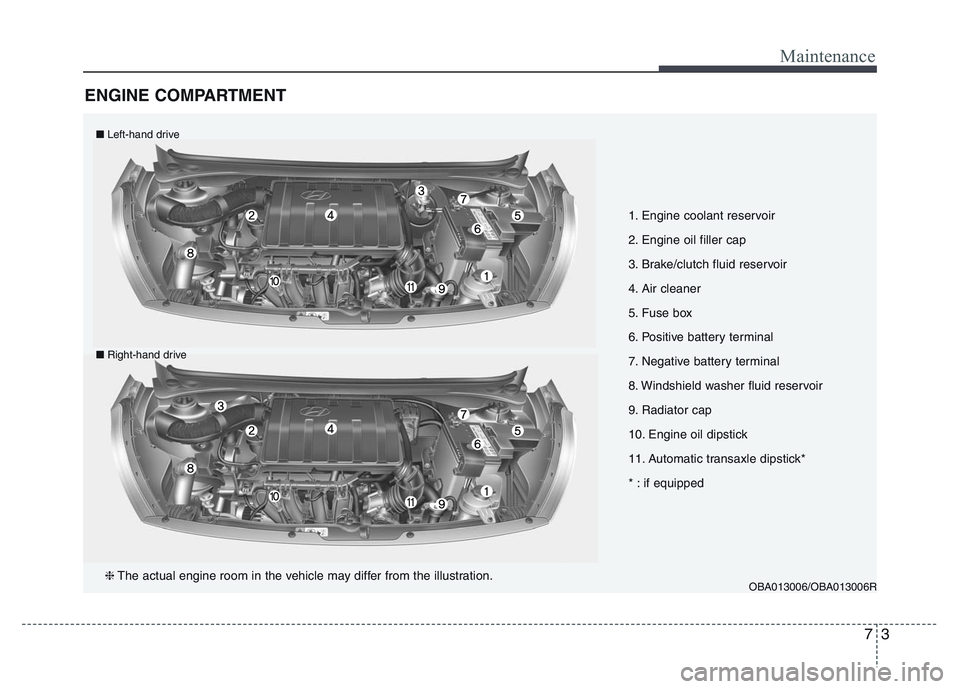
ENGINE COMPARTMENT
1. Engine coolant reservoir
2. Engine oil filler cap
3. Brake/clutch fluid reservoir
4. Air cleaner
5. Fuse box
6. Positive battery terminal
7. Negative battery terminal
8. Windshield washer fluid reservoir
9. Radiator cap
10. Engine oil dipstick
11. Automatic transaxle dipstick*
* : if equipped
OBA013006/OBA013006R❈The actual engine room in the vehicle may differ from the illustration.
■Left-hand drive
■Right-hand drive
Page 259 of 343
77
Maintenance
At least monthly:
• Check the coolant level in the engine
coolant reservoir.
• Check the operation of all exterior
lights, including the stoplights, turn sig-
nals and hazard warning flashers.
• Check the inflation pressures of all
tires including the spare.
At least twice a year
(i.e., every Spring and Fall):
• Check the radiator, heater and air con-
ditioning hoses for leaks or damage.
• Check the windshield washer spray
and wiper operation. Clean the wiper
blades with clean cloth dampened with
washer fluid.
• Check the headlight alignment.
• Check the muffler, exhaust pipes,
shields and clamps.
• Check the lap/shoulder belts for wear
and function.
• Check for worn tires and loose wheel
lug nuts.
At least once a year:
• Clean the body and door drain holes.
• Lubricate the door hinges and checks,
and hood hinges.
• Lubricate the door and hood locks and
latches.
• Lubricate the door rubber weather-
strips.
• Check the air conditioning system.
• Inspect and lubricate the automatic
transaxle linkage and controls.
• Clean the battery and terminals.
• Check the brake (and clutch) fluid
level.