wheel HYUNDAI I10 2016 Owner's Guide
[x] Cancel search | Manufacturer: HYUNDAI, Model Year: 2016, Model line: I10, Model: HYUNDAI I10 2016Pages: 343, PDF Size: 9.14 MB
Page 227 of 343
Driving your vehicle
34 5
Hazardous driving conditions
When hazardous driving conditions are
encountered such as water, snow, ice,
mud or sand:
Drive cautiously and allow extra distance
for braking.
Avoid sudden movements in braking or
steering.
If stuck in snow, mud, or sand, use sec-
ond gear. Accelerate slowly to avoid spin-
ning the drive wheels.
Use sand, rock salt, or other non-slip
material under the drive wheels to pro-
vide traction when stalled in ice, snow, or
mud.
Rocking the vehicle
If it is necessary to rock the vehicle to
free it from snow, sand, or mud, first turn
the steering wheel right and left to clear
the area around your front wheels. Then,
shift back and forth between 1st and R
(Reverse, for manual transaxle vehicle)
or R (Reverse) and a forward gear (for
automatic transaxle vehicle). Try to avoid
spinning the wheels, and do not race the
engine.
To prevent transaxle wear, wait until the
wheels stop spinning before shifting
gears. Release the accelerator pedal
while shifting, and press lightly on the
accelerator pedal while the transaxle is in
gear. Slowly spinning the wheels in for-
ward and reverse directions causes a
rocking motion that may free the vehicle.
SPECIAL DRIVING CONDITIONS
WARNING
Downshifting with an automatic
transaxle, while driving on slippery
surfaces can cause an accident.
The sudden change in tire speed
could cause the tires to skid. Be
careful when downshifting on slip-
pery surfaces.
WARNING
If the tires spin at high speed the
tires can explode, and you or oth-
ers may be injured. Do not attempt
this procedure if people or objects
are anywhere near the vehicle.
The vehicle can overheat causing
an engine compartment fire or
other damage. Spin the wheels as
little as possible and avoid spin-
ning the wheels at speeds over 56
km/h (35 mph) as indicated on the
speedometer.
CAUTION
If you are still stuck after rocking
the vehicle a few times, have the
vehicle pulled out by a tow vehicle
to avoid engine overheating, possi-
ble damage to the transaxle, and
tire damage. See “Towing” in chap-
ter 6.
To prevent damage to the transaxle,
turn OFF the ESC (if equipped) prior
to rocking the vehicle.
Page 229 of 343
Driving your vehicle
36 5
• Be sure your tires have enough tread.
If your tires do not have enough tread,
making a quick stop on wet pavement
can cause a skid and possibly lead to
an accident. See “Tire Tread” in chap-
ter 7.
• Turn on your headlights to make it eas-
ier for others to see you.
• Driving too fast through large puddles
can affect your brakes. If you must go
through puddles, try to drive through
them slowly.
• If you believe your brakes may be wet,
apply them lightly while driving until
normal braking operation returns.Hydroplaning
If the road is wet enough and you are
going fast enough, your vehicle may have
little or no contact with the road surface
and actually ride on the water. The best
advice is SLOW DOWN when the road is
wet. The risk of hydroplaning increases
as the depth of tire tread decreases, refer
to “Tire Tread” in chapter 7.
Driving in flooded areas
Avoid driving through flooded areas
unless you are sure the water is no high-
er than the bottom of the wheel hub.
Drive through any water slowly. Allow
adequate stopping distance because
brake performance may be reduced.
After driving through water, dry the
brakes by gently applying them several
times while the vehicle is moving slowly.
Page 230 of 343
537
Driving your vehicle
Snow or icy conditions
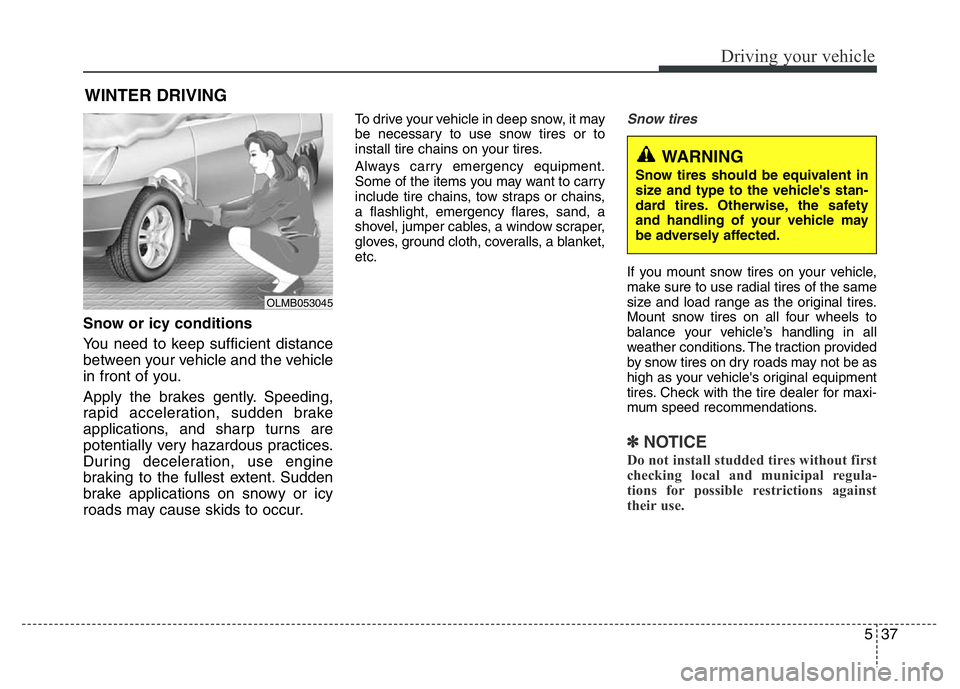
You need to keep sufficient distance
between your vehicle and the vehicle
in front of you.
Apply the brakes gently. Speeding,
rapid acceleration, sudden brake
applications, and sharp turns are
potentially very hazardous practices.
During deceleration, use engine
braking to the fullest extent. Sudden
brake applications on snowy or icy
roads may cause skids to occur.
To drive your vehicle in deep snow, it may
be necessary to use snow tires or to
install tire chains on your tires.
Always carry emergency equipment.
Some of the items you may want to carry
include tire chains, tow straps or chains,
a flashlight, emergency flares, sand, a
shovel, jumper cables, a window scraper,
gloves, ground cloth, coveralls, a blanket,
etc.Snow tires
If you mount snow tires on your vehicle,
make sure to use radial tires of the same
size and load range as the original tires.
Mount snow tires on all four wheels to
balance your vehicle’s handling in all
weather conditions. The traction provided
by snow tires on dry roads may not be as
high as your vehicle's original equipment
tires. Check with the tire dealer for maxi-
mum speed recommendations.
✽NOTICE
Do not install studded tires without first
checking local and municipal regula-
tions for possible restrictions against
their use.
WINTER DRIVING
OLMB053045
WARNING
Snow tires should be equivalent in
size and type to the vehicle's stan-
dard tires. Otherwise, the safety
and handling of your vehicle may
be adversely affected.
Page 231 of 343
Driving your vehicle
38 5
Tire chains
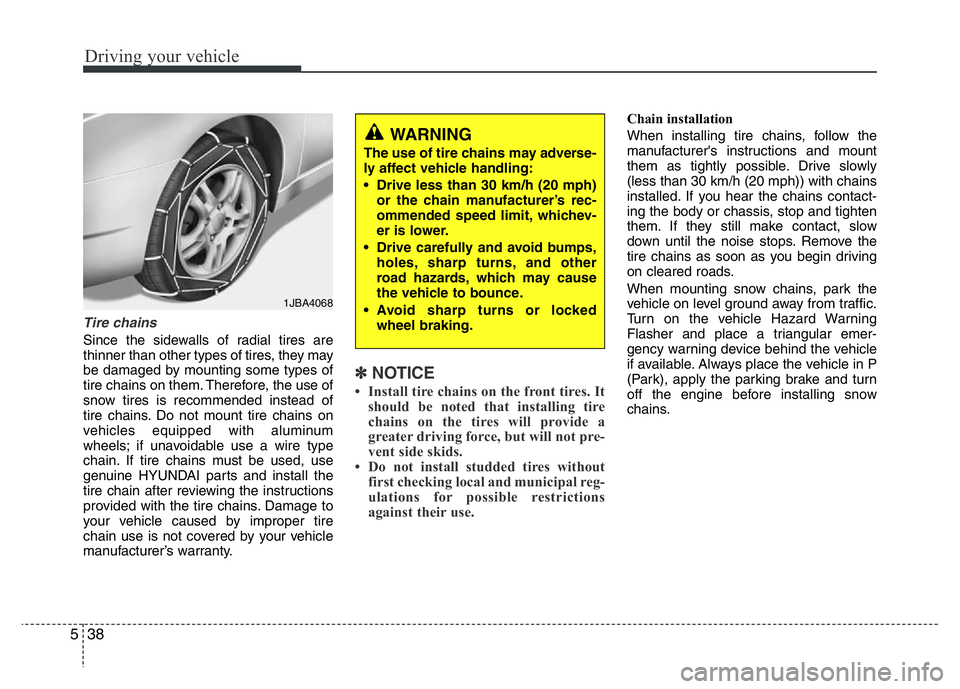
Since the sidewalls of radial tires are
thinner than other types of tires, they may
be damaged by mounting some types of
tire chains on them. Therefore, the use of
snow tires is recommended instead of
tire chains. Do not mount tire chains on
vehicles equipped with aluminum
wheels; if unavoidable use a wire type
chain. If tire chains must be used, use
genuine HYUNDAI parts and install the
tire chain after reviewing the instructions
provided with the tire chains. Damage to
your vehicle caused by improper tire
chain use is not covered by your vehicle
manufacturer’s warranty.
✽NOTICE
• Install tire chains on the front tires. It
should be noted that installing tire
chains on the tires will provide a
greater driving force, but will not pre-
vent side skids.
• Do not install studded tires without
first checking local and municipal reg-
ulations for possible restrictions
against their use.
Chain installation
When installing tire chains, follow the
manufacturer's instructions and mount
them as tightly possible. Drive slowly
(less than 30 km/h (20 mph)) with chains
installed. If you hear the chains contact-
ing the body or chassis, stop and tighten
them. If they still make contact, slow
down until the noise stops. Remove the
tire chains as soon as you begin driving
on cleared roads.
When mounting snow chains, park the
vehicle on level ground away from traffic.
Turn on the vehicle Hazard Warning
Flasher and place a triangular emer-
gency warning device behind the vehicle
if available. Always place the vehicle in P
(Park), apply the parking brake and turn
off the engine before installing snow
chains.
WARNING
The use of tire chains may adverse-
ly affect vehicle handling:
• Drive less than 30 km/h (20 mph)
or the chain manufacturer’s rec-
ommended speed limit, whichev-
er is lower.
• Drive carefully and avoid bumps,
holes, sharp turns, and other
road hazards, which may cause
the vehicle to bounce.
• Avoid sharp turns or locked
wheel braking.
1JBA4068
Page 232 of 343
539
Driving your vehicle
CAUTION
When using tire chains:
• Wrong size chains or improperly
installed chains can damage your
vehicle's brake lines, suspension,
body and wheels.
• Use SAE “S” class or wire chains.
• If you hear noise caused by
chains contacting the body,
retighten the chain to prevent
contact with the vehicle body.
• To prevent body damage, retight-
en the chains after driving 0.5~1.0
km (0.3~0.6 miles).
• Do not use tire chains on vehicles
equipped with aluminum wheels.
If unavoidable, use a wire type
chain.
• Use wire chains less than 15 mm
(0.59 in) wide to prevent damage
to the chain’s connection.
Page 241 of 343
What to do in an emergency
8 6
IF YOU HAVE A FLAT TIRE
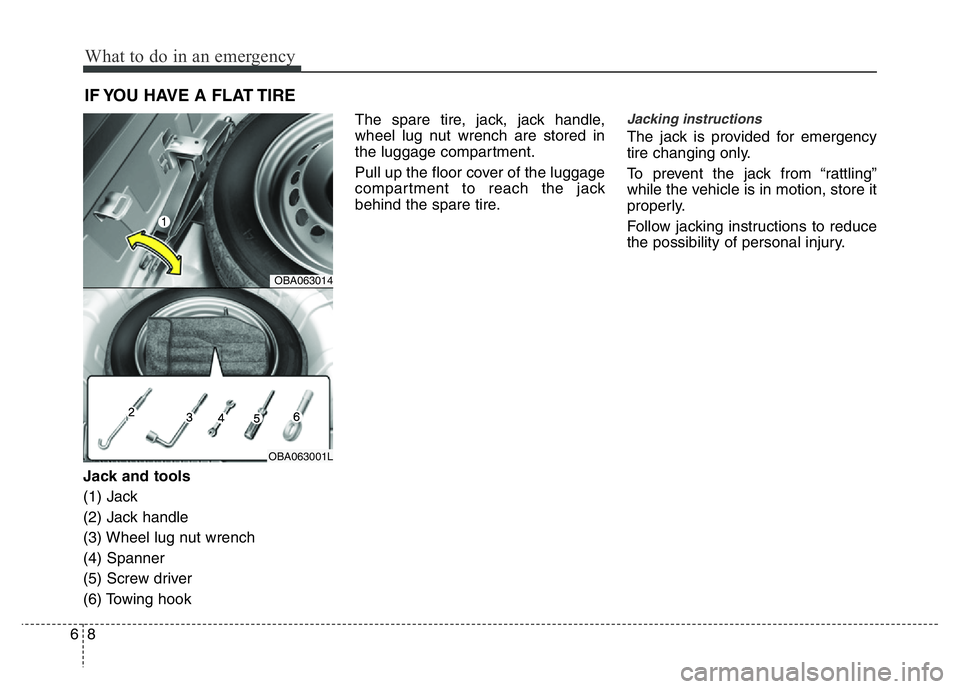
Jack and tools
(1) Jack
(2) Jack handle
(3) Wheel lug nut wrench
(4) Spanner
(5) Screw driver
(6) Towing hookThe spare tire, jack, jack handle,
wheel lug nut wrench are stored in
the luggage compartment.
Pull up the floor cover of the luggage
compartment to reach the jack
behind the spare tire.
Jacking instructions
The jack is provided for emergency
tire changing only.
To prevent the jack from “rattling”
while the vehicle is in motion, store it
properly.
Follow jacking instructions to reduce
the possibility of personal injury.
OBA063014
OBA063001L
Page 243 of 343
What to do in an emergency
10 6
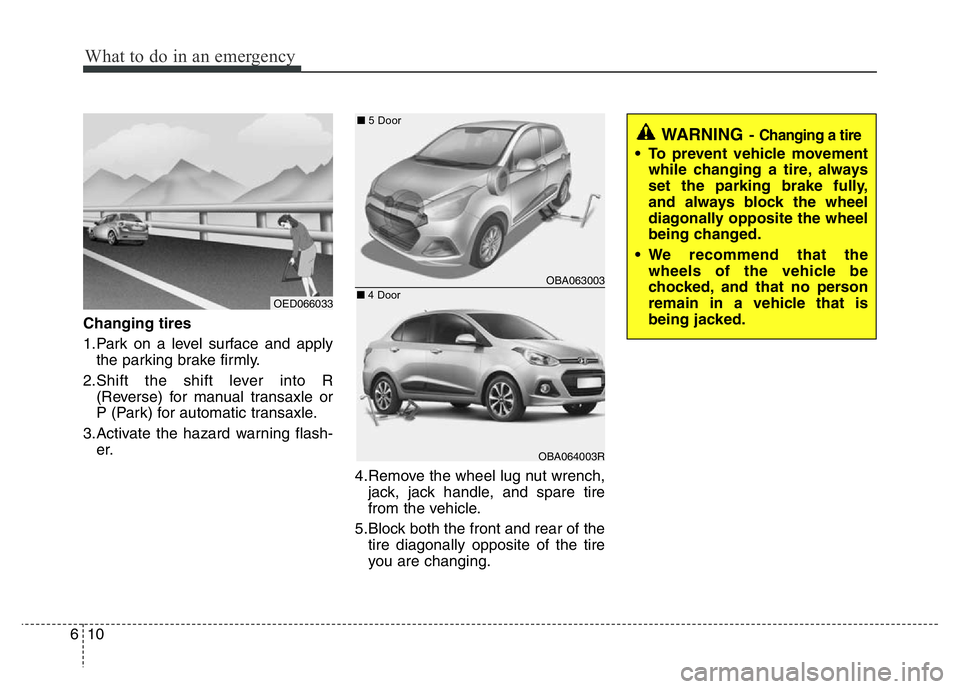
Changing tires
1.Park on a level surface and apply
the parking brake firmly.
2.Shift the shift lever into R
(Reverse) for manual transaxle or
P (Park) for automatic transaxle.
3.Activate the hazard warning flash-
er.
4.Remove the wheel lug nut wrench,
jack, jack handle, and spare tire
from the vehicle.
5.Block both the front and rear of the
tire diagonally opposite of the tire
you are changing.
OBA063003
OBA064003R
WARNING- Changing a tire
• To prevent vehicle movement
while changing a tire, always
set the parking brake fully,
and always block the wheel
diagonally opposite the wheel
being changed.
• We recommend that the
wheels of the vehicle be
chocked, and that no person
remain in a vehicle that is
being jacked.
OED066033■5 Door
■4 Door
Page 244 of 343
611
What to do in an emergency
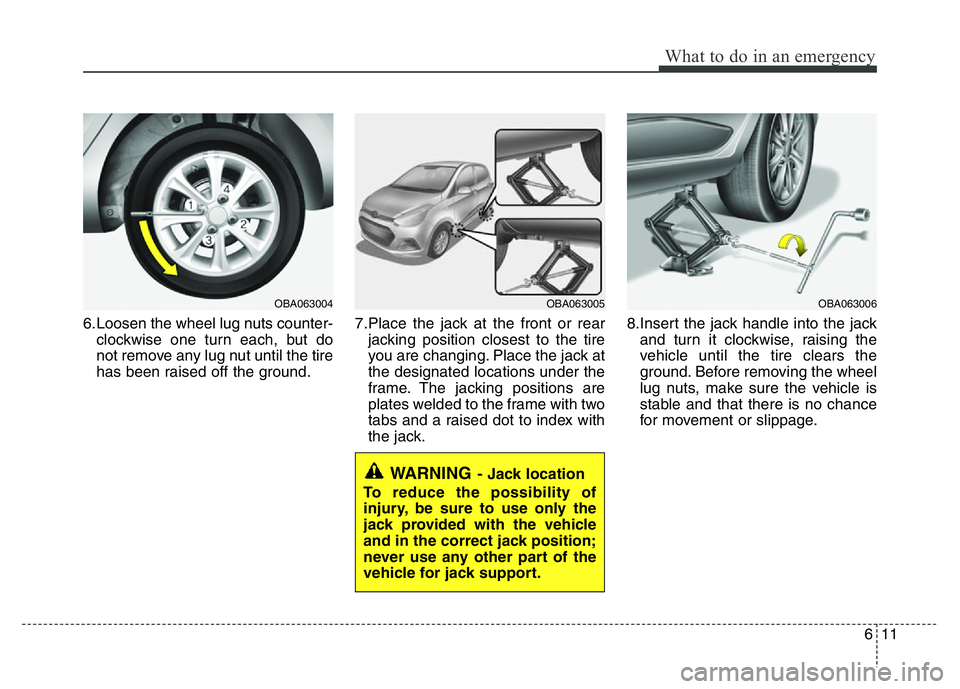
6.Loosen the wheel lug nuts counter-
clockwise one turn each, but do
not remove any lug nut until the tire
has been raised off the ground.7.Place the jack at the front or rear
jacking position closest to the tire
you are changing. Place the jack at
the designated locations under the
frame. The jacking positions are
plates welded to the frame with two
tabs and a raised dot to index with
the jack.8.Insert the jack handle into the jack
and turn it clockwise, raising the
vehicle until the tire clears the
ground. Before removing the wheel
lug nuts, make sure the vehicle is
stable and that there is no chance
for movement or slippage.
WARNING- Jack location
To reduce the possibility of
injury, be sure to use only the
jack provided with the vehicle
and in the correct jack position;
never use any other part of the
vehicle for jack support.
OBA063005OBA063006OBA063004
Page 245 of 343
What to do in an emergency
12 6
9.Loosen the wheel lug nuts and
remove them with your fingers.
Slide the wheel off the studs and
lay it flat so it cannot roll away. To
put the wheel on the hub, pick up
the spare tire, line up the holes
with the studs and slide the wheel
onto them. If this is difficult, tip the
wheel slightly and get the top hole
in the wheel lined up with the top
stud. Then jiggle the wheel back
and forth until the wheel can be slid
over the other studs.10. To install the wheel, hold it on the
studs, put the wheel nuts on the
studs and tighten them finger
tight. Jiggle the tire to be sure it is
completely seated, then tighten
the nuts as much as possible
with your fingers again.
11. Lower the vehicle to the ground
by turning the wheel nut wrench
counterclockwise.
WARNING
• Wheels and wheel covers may
have sharp edges. Handle
them carefully to avoid possi-
ble severe injury.
• Before putting the wheel into
place, be sure that there is
nothing on the hub or wheel
(such as mud, tar, gravel, etc.)
that interferes with the wheel
from fitting solidly against the
hub. If there is, remove it. If
the contact of the mounting
surface between the wheel
and hub is not good, the
wheel nuts could come loose
and cause the loss of a wheel.
Loss of a wheel may result in
loss of control of the vehicle.
This may cause serious injury
or death.
Page 246 of 343
613
What to do in an emergency
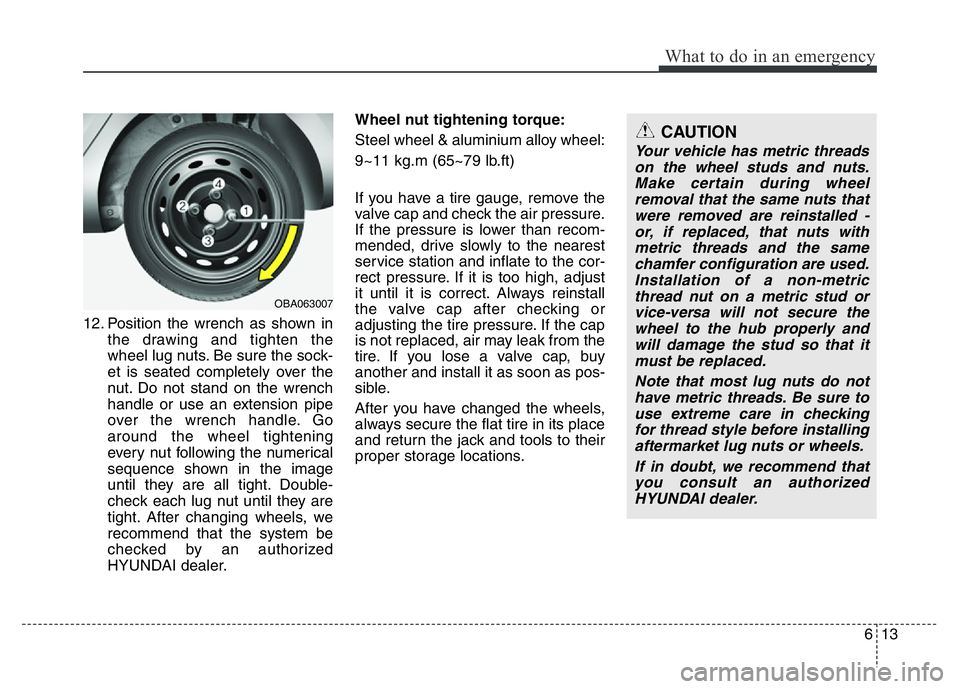
12. Position the wrench as shown in
the drawing and tighten the
wheel lug nuts. Be sure the sock-
et is seated completely over the
nut. Do not stand on the wrench
handle or use an extension pipe
over the wrench handle. Go
around the wheel tightening
every nut following the numerical
sequence shown in the image
until they are all tight. Double-
check each lug nut until they are
tight. After changing wheels, we
recommend that the system be
checked by an authorized
HYUNDAI dealer.Wheel nut tightening torque:
Steel wheel & aluminium alloy wheel:
9~11 kg.m (65~79 lb.ft)
If you have a tire gauge, remove the
valve cap and check the air pressure.
If the pressure is lower than recom-
mended, drive slowly to the nearest
service station and inflate to the cor-
rect pressure. If it is too high, adjust
it until it is correct. Always reinstall
the valve cap after checking or
adjusting the tire pressure. If the cap
is not replaced, air may leak from the
tire. If you lose a valve cap, buy
another and install it as soon as pos-
sible.
After you have changed the wheels,
always secure the flat tire in its place
and return the jack and tools to their
proper storage locations.
CAUTION
Your vehicle has metric threads
on the wheel studs and nuts.
Make certain during wheel
removal that the same nuts that
were removed are reinstalled -
or, if replaced, that nuts with
metric threads and the same
chamfer configuration are used.
Installation of a non-metric
thread nut on a metric stud or
vice-versa will not secure the
wheel to the hub properly and
will damage the stud so that it
must be replaced.
Note that most lug nuts do not
have metric threads. Be sure to
use extreme care in checking
for thread style before installing
aftermarket lug nuts or wheels.
If in doubt, we recommend that
you consult an authorized
HYUNDAI dealer.
OBA063007