door HYUNDAI I10 2016 Service Manual
[x] Cancel search | Manufacturer: HYUNDAI, Model Year: 2016, Model line: I10, Model: HYUNDAI I10 2016Pages: 343, PDF Size: 9.14 MB
Page 225 of 343
Driving your vehicle
32 5
REAR PARKING ASSIST SYSTEM (IF EQUIPPED)
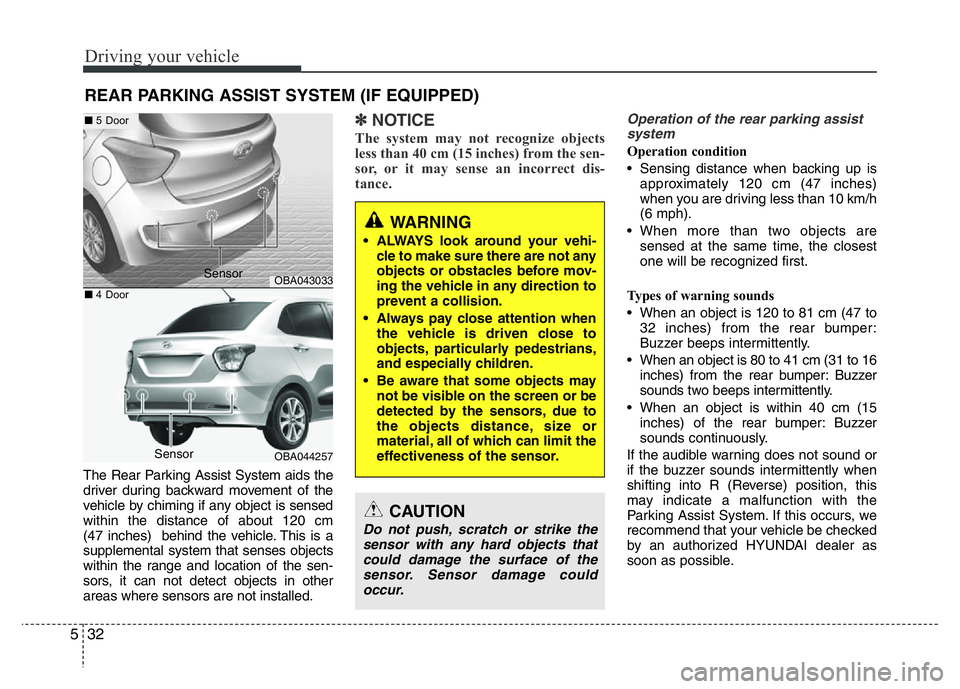
The Rear Parking Assist System aids the
driver during backward movement of the
vehicle by chiming if any object is sensed
within the distance of about 120 cm
(47 inches) behind the vehicle. This is a
supplemental system that senses objects
within the range and location of the sen-
sors, it can not detect objects in other
areas where sensors are not installed.
✽NOTICE
The system may not recognize objects
less than 40 cm (15 inches) from the sen-
sor, or it may sense an incorrect dis-
tance.
Operation of the rear parking assist
system
Operation condition
• Sensing distance when backing up is
approximately 120 cm (47 inches)
when you are driving less than 10 km/h
(6 mph).
• When more than two objects are
sensed at the same time, the closest
one will be recognized first.
Types of warning sounds
• When an object is 120 to 81 cm (47 to
32 inches) from the rear bumper:
Buzzer beeps intermittently.
• When an object is 80 to 41 cm (31 to 16
inches) from the rear bumper: Buzzer
sounds two beeps intermittently.
• When an object is within 40 cm (15
inches) of the rear bumper: Buzzer
sounds continuously.
If the audible warning does not sound or
if the buzzer sounds intermittently when
shifting into R (Reverse) position, this
may indicate a malfunction with the
Parking Assist System. If this occurs, we
recommend that your vehicle be checked
by an authorized HYUNDAI dealer as
soon as possible.
OBA043033
OBA044257
WARNING
• ALWAYS look around your vehi-
cle to make sure there are not any
objects or obstacles before mov-
ing the vehicle in any direction to
prevent a collision.
• Always pay close attention when
the vehicle is driven close to
objects, particularly pedestrians,
and especially children.
• Be aware that some objects may
not be visible on the screen or be
detected by the sensors, due to
the objects distance, size or
material, all of which can limit the
effectiveness of the sensor.
CAUTION
Do not push, scratch or strike the
sensor with any hard objects that
could damage the surface of the
sensor. Sensor damage could
occur.
■5 Door
■4 Door
Sensor
Sensor
Page 233 of 343
Driving your vehicle
40 5
Two labels on your driver’s door sill show
how much weight your vehicle was
designed to carry: the Tire and Loading
Information Label and the Certification
Label.
Before loading your vehicle, familiarize
yourself with the following terms for
determining your vehicle's weight ratings,
from the vehicle's specifications and the
Certification Label:
Base Curb Weight
This is the weight of the vehicle including
a full tank of fuel and all standard equip-
ment. It does not include passengers,
cargo, or optional equipment.
Vehicle Curb Weight
This is the weight of your new vehicle
when you picked it up from your dealer
plus any aftermarket equipment.
Cargo Weight
This figure includes all weight added to
the Base Curb Weight, including cargo
and optional equipment.GAW (Gross Axle Weight)
This is the total weight placed on each
axle (front and rear) - including vehicle
curb weight and all payload.
GAWR (Gross Axle Weight Rating)
This is the maximum allowable weight
that can be carried by a single axle (front
or rear). These numbers are shown on
the Certification Label. The total load on
each axle must never exceed its GAWR.
GVW (Gross Vehicle Weight)
This is the Base Curb Weight plus actual
Cargo Weight plus passengers weight.
GVWR (Gross Vehicle Weight Rating)
This is the maximum allowable weight of
the fully loaded vehicle (including all
options, equipment, passengers and
cargo). The GVWR is shown on the
Certification Label located on the driver’s
door sill.
Overloading
VEHICLE WEIGHT
WARNING
The Gross Axle Weight Rating
(GAWR) and the Gross Vehicle
Weight Rating (GVWR) for your
vehicle are on the Certification
Label attached to the driver's (or
front passenger’s) door. Exceeding
these ratings can cause an acci-
dent or vehicle damage. You can
calculate the weight of your load by
weighing the items (and people)
before putting them in the vehicle.
Be careful not to overload your
vehicle.
Page 243 of 343
What to do in an emergency
10 6
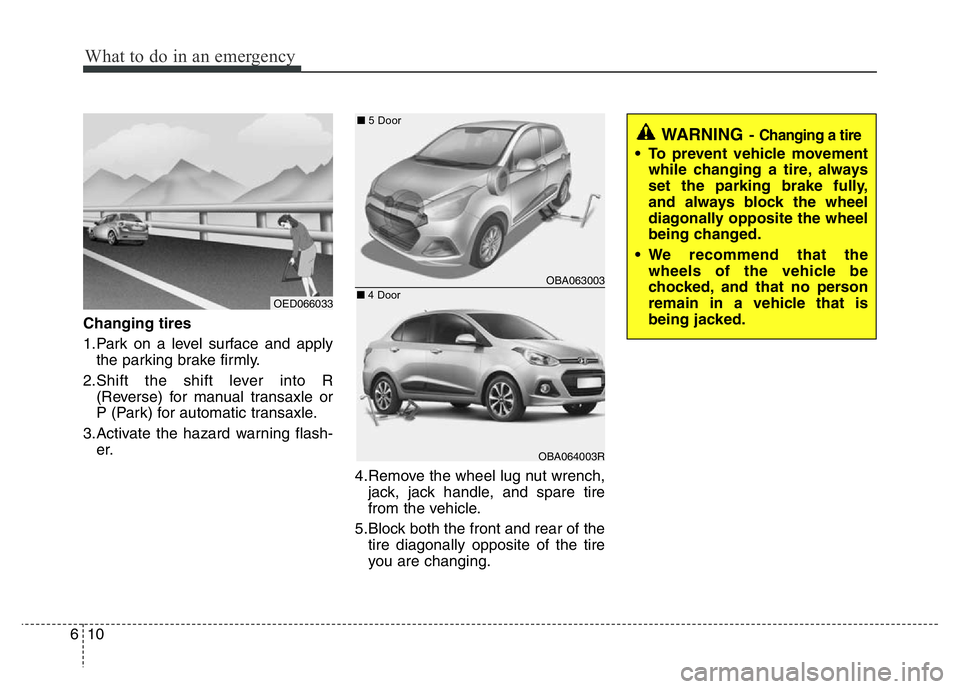
Changing tires
1.Park on a level surface and apply
the parking brake firmly.
2.Shift the shift lever into R
(Reverse) for manual transaxle or
P (Park) for automatic transaxle.
3.Activate the hazard warning flash-
er.
4.Remove the wheel lug nut wrench,
jack, jack handle, and spare tire
from the vehicle.
5.Block both the front and rear of the
tire diagonally opposite of the tire
you are changing.
OBA063003
OBA064003R
WARNING- Changing a tire
• To prevent vehicle movement
while changing a tire, always
set the parking brake fully,
and always block the wheel
diagonally opposite the wheel
being changed.
• We recommend that the
wheels of the vehicle be
chocked, and that no person
remain in a vehicle that is
being jacked.
OED066033■5 Door
■4 Door
Page 259 of 343
77
Maintenance
At least monthly:
• Check the coolant level in the engine
coolant reservoir.
• Check the operation of all exterior
lights, including the stoplights, turn sig-
nals and hazard warning flashers.
• Check the inflation pressures of all
tires including the spare.
At least twice a year
(i.e., every Spring and Fall):
• Check the radiator, heater and air con-
ditioning hoses for leaks or damage.
• Check the windshield washer spray
and wiper operation. Clean the wiper
blades with clean cloth dampened with
washer fluid.
• Check the headlight alignment.
• Check the muffler, exhaust pipes,
shields and clamps.
• Check the lap/shoulder belts for wear
and function.
• Check for worn tires and loose wheel
lug nuts.
At least once a year:
• Clean the body and door drain holes.
• Lubricate the door hinges and checks,
and hood hinges.
• Lubricate the door and hood locks and
latches.
• Lubricate the door rubber weather-
strips.
• Check the air conditioning system.
• Inspect and lubricate the automatic
transaxle linkage and controls.
• Clean the battery and terminals.
• Check the brake (and clutch) fluid
level.
Page 302 of 343
Maintenance
50 7
These grades are molded on the
side-walls of passenger vehicle tires.
The tires available as standard or
optional equipment on your vehicles
may vary with respect to grade.
Traction - AA, A, B & C
The traction grades, from highest to
lowest, are AA, A, B and C. Those
grades represent the tires ability to
stop on wet pavement as measured
under controlled conditions on spec-
ified government test surfaces of
asphalt and concrete. A tire marked
C may have poor traction perform-
ance.
Temperature -A, B & C
The temperature grades are A (the
highest), B and C representing the
tire’s resistance to the generation of
heat and its ability to dissipate heat
when tested under controlled condi-
tions on a specified indoor laboratory
test wheel.
Sustained high temperature can
cause the material of the tire to
degenerate and reduce tire life, and
excessive temperature can lead to
sudden tire failure. Grades B and A
represent higher levels of perform-
ance on the laboratory test wheel
than the minimum required by law.
WARNING
The traction grade assigned to
this tire is based on straight-
ahead braking traction tests,
and does not include accelera-
tion, cornering, hydroplaning,
or peak traction characteristics.
WARNING - Tire
temperature
The temperature grade for this
tire is established for a tire that
is properly inflated and not
overloaded. Excessive speed,
underinflation, or excessive
loading, either separately or in
combination, can cause heat
build-up and possible sudden
tire failure. This can cause loss
of vehicle control and serious
injury or death.
Page 311 of 343
759
Maintenance
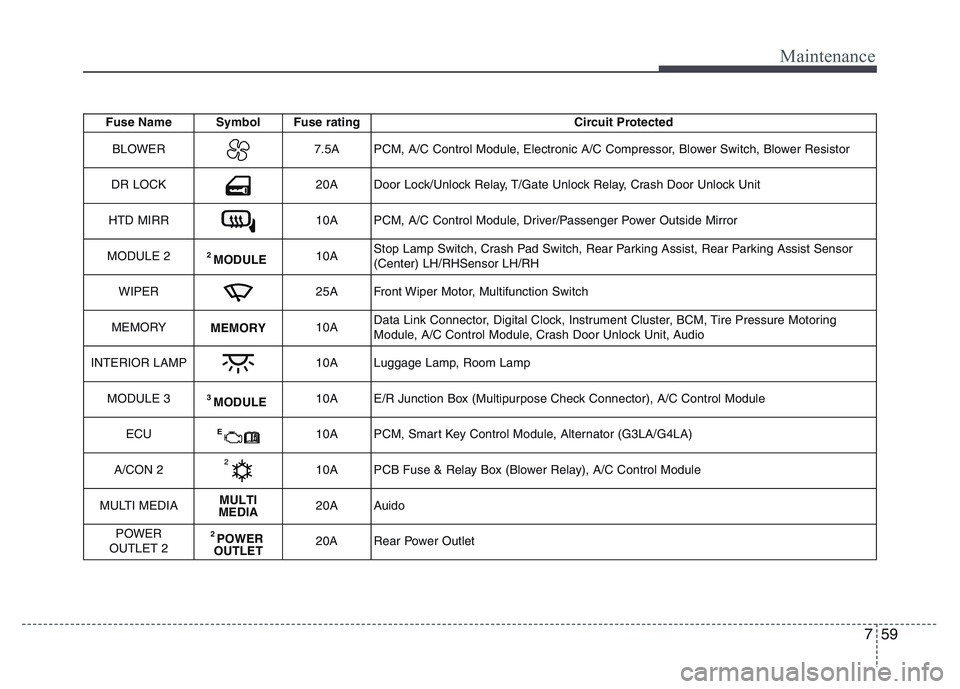
Fuse Name Symbol Fuse rating Circuit Protected
BLOWER
7.5A PCM, A/C Control Module, Electronic A/C Compressor, Blower Switch, Blower Resistor
DR LOCK
20A Door Lock/Unlock Relay, T/Gate Unlock Relay, Crash Door Unlock Unit
HTD MIRR
10A PCM, A/C Control Module, Driver/Passenger Power Outside Mirror
MODULE 2
2 MODULE10AStop Lamp Switch, Crash Pad Switch, Rear Parking Assist, Rear Parking Assist Sensor
(Center) LH/RHSensor LH/RH
WIPER
25A Front Wiper Motor, Multifunction Switch
MEMORY
MEMORY10AData Link Connector, Digital Clock, Instrument Cluster, BCM, Tire Pressure Motoring
Module, A/C Control Module, Crash Door Unlock Unit, Audio
INTERIOR LAMP
10A Luggage Lamp, Room Lamp
MODULE 3
3 MODULE10A E/R Junction Box (Multipurpose Check Connector), A/C Control Module
ECU
E10A PCM, Smart Key Control Module, Alternator (G3LA/G4LA)
A/CON 2
10A PCB Fuse & Relay Box (Blower Relay), A/C Control Module
MULTI MEDIA
MULTI
MEDIA20A Auido
POWER
OUTLET 2
2 POWER
OUTLET20A Rear Power Outlet
Page 315 of 343
763
Maintenance
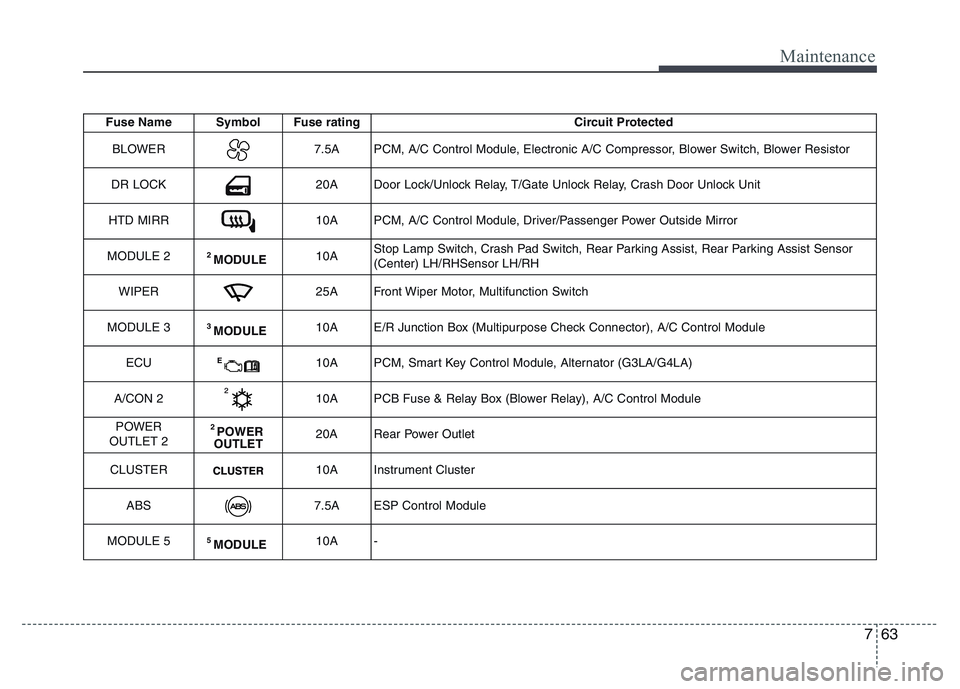
Fuse Name Symbol Fuse rating Circuit Protected
BLOWER
7.5A PCM, A/C Control Module, Electronic A/C Compressor, Blower Switch, Blower Resistor
DR LOCK
20A Door Lock/Unlock Relay, T/Gate Unlock Relay, Crash Door Unlock Unit
HTD MIRR
10A PCM, A/C Control Module, Driver/Passenger Power Outside Mirror
MODULE 2
2 MODULE10AStop Lamp Switch, Crash Pad Switch, Rear Parking Assist, Rear Parking Assist Sensor
(Center) LH/RHSensor LH/RH
WIPER
25A Front Wiper Motor, Multifunction Switch
MODULE 3
3 MODULE10A E/R Junction Box (Multipurpose Check Connector), A/C Control Module
ECU
E10A PCM, Smart Key Control Module, Alternator (G3LA/G4LA)
A/CON 2
10A PCB Fuse & Relay Box (Blower Relay), A/C Control Module
POWER
OUTLET 2
2 POWER
OUTLET20A Rear Power Outlet
CLUSTER
10A Instrument Cluster
ABS
7.5A ESP Control Module
MODULE 5
5 MODULE10A -
Page 324 of 343
Maintenance
72 7
Front fog light bulb replacement
1. Reach your hand into the back of the
front bumper.
2. Disconnect the power connector from
the socket.
3. Remove the bulb-socket from the
housing by turning the socket counter-
clockwise until the tabs on the socket
align with the slots on the housing.
4. Install the new bulb-socket into the
housing by aligning the tabs on the
socket with the slots in the housing.
Push the socket into the housing and
turn the socket clockwise.
5. Connect the power connector to the
socket.
6. Reinstall the front bumper under cover.
Side repeater light bulb replace-
ment
If the light bulb does not operate, we rec-
ommend that the vehicle be checked by
an authorized HYUNDAI dealer.
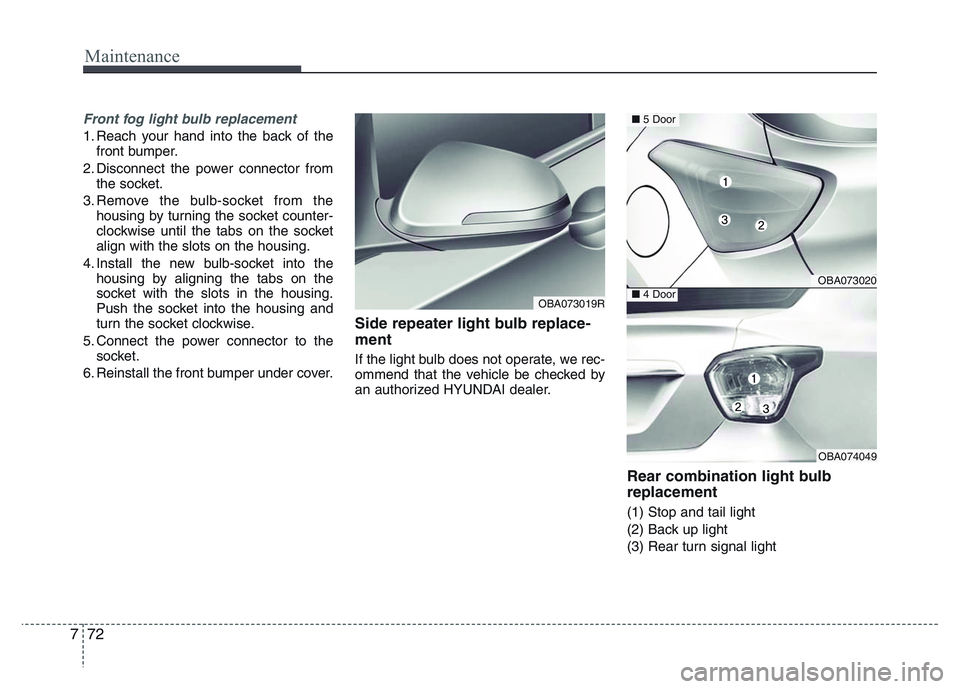
Rear combination light bulb
replacement
(1) Stop and tail light
(2) Back up light
(3) Rear turn signal light
OBA073019R
OBA073020
OBA074049
■5 Door
■4 Door
Page 325 of 343
773
Maintenance
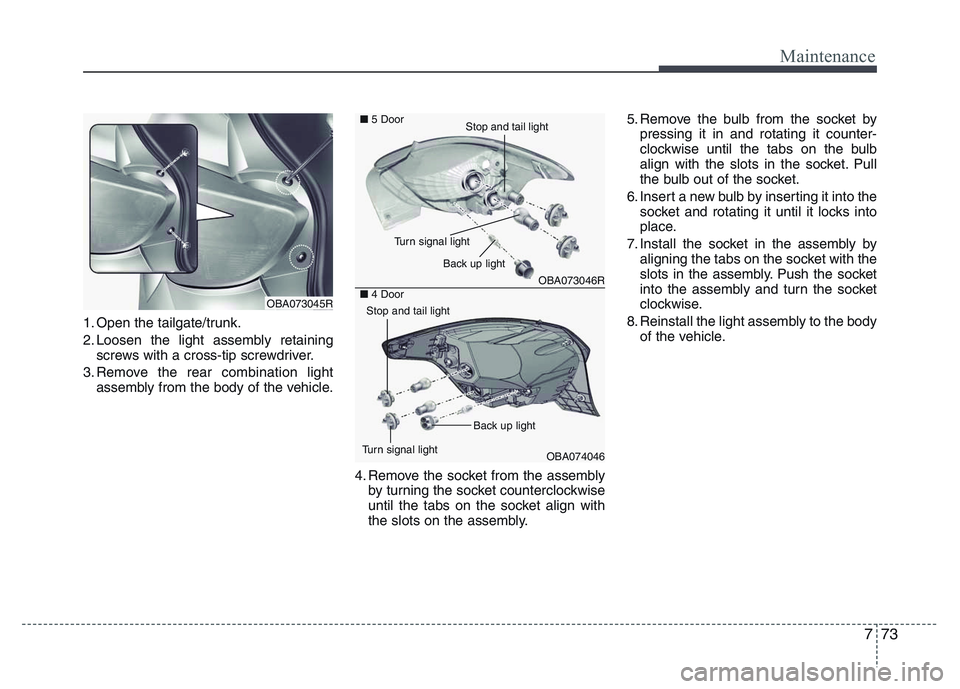
1. Open the tailgate/trunk.
2. Loosen the light assembly retaining
screws with a cross-tip screwdriver.
3. Remove the rear combination light
assembly from the body of the vehicle.
4. Remove the socket from the assembly
by turning the socket counterclockwise
until the tabs on the socket align with
the slots on the assembly.5. Remove the bulb from the socket by
pressing it in and rotating it counter-
clockwise until the tabs on the bulb
align with the slots in the socket. Pull
the bulb out of the socket.
6. Insert a new bulb by inserting it into the
socket and rotating it until it locks into
place.
7. Install the socket in the assembly by
aligning the tabs on the socket with the
slots in the assembly. Push the socket
into the assembly and turn the socket
clockwise.
8. Reinstall the light assembly to the body
of the vehicle.
OBA073045R
OBA073046R
OBA074046 ■5 Door
■4 Door
Back up light
Turn signal light
Stop and tail light
Turn signal lightBack up light
Stop and tail light
Page 326 of 343
Maintenance
74 7
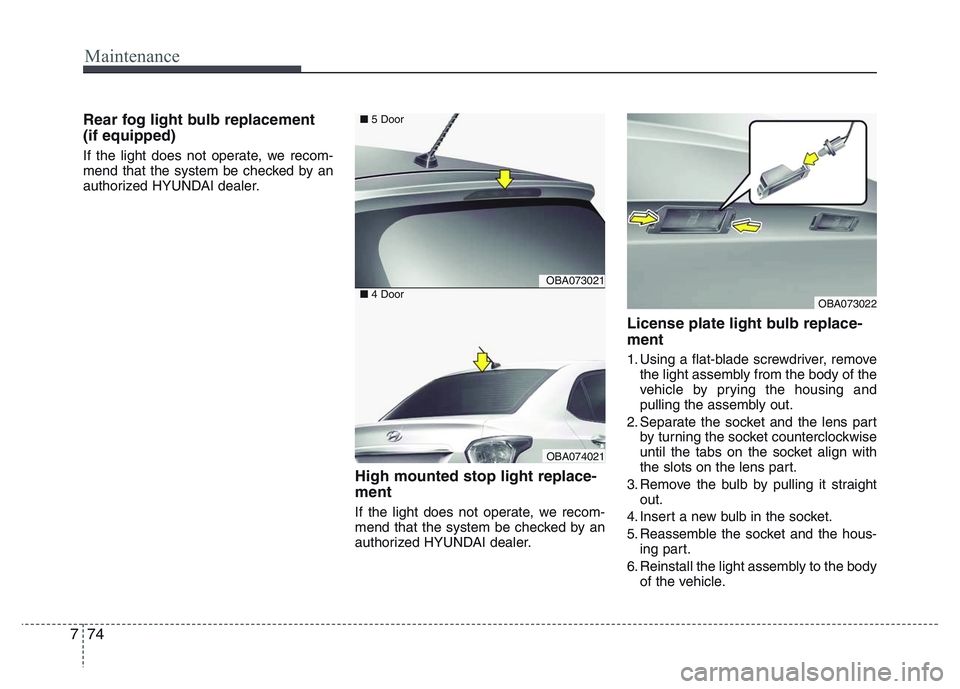
Rear fog light bulb replacement
(if equipped)
If the light does not operate, we recom-
mend that the system be checked by an
authorized HYUNDAI dealer.
High mounted stop light replace-
ment
If the light does not operate, we recom-
mend that the system be checked by an
authorized HYUNDAI dealer.
License plate light bulb replace-
ment
1. Using a flat-blade screwdriver, remove
the light assembly from the body of the
vehicle by prying the housing and
pulling the assembly out.
2. Separate the socket and the lens part
by turning the socket counterclockwise
until the tabs on the socket align with
the slots on the lens part.
3. Remove the bulb by pulling it straight
out.
4. Insert a new bulb in the socket.
5. Reassemble the socket and the hous-
ing part.
6. Reinstall the light assembly to the body
of the vehicle.
OBA073022
OBA073021
OBA074021
■5 Door
■4 Door