hill assist HYUNDAI I10 2016 Owners Manual
[x] Cancel search | Manufacturer: HYUNDAI, Model Year: 2016, Model line: I10, Model: HYUNDAI I10 2016Pages: 343, PDF Size: 9.14 MB
Page 194 of 343
Driving your vehicle
BEFORE DRIVING. . . . . . . . . . . . . . . . . . . . . . . . . 5-3
• Before entering vehicle . . . . . . . . . . . . . . . . . . . . . . . . . 5-3
• Before starting . . . . . . . . . . . . . . . . . . . . . . . . . . . . . . . 5-3
KEY IGNITION SWITCH . . . . . . . . . . . . . . . . . . . 5-4
• Ignition switch position . . . . . . . . . . . . . . . . . . . . . . . . . 5-4
• Starting the engine . . . . . . . . . . . . . . . . . . . . . . . . . . . . 5-5
ENGINE START/STOP BUTTON . . . . . . . . . . . . . 5-6
• Illuminated engine start/stop button . . . . . . . . . . . . . . 5-6
• Engine start/stop button position. . . . . . . . . . . . . . . . . 5-6
• Starting the engine . . . . . . . . . . . . . . . . . . . . . . . . . . . . 5-9
MANUAL TRANSAXLE . . . . . . . . . . . . . . . . . . . 5-11
• Manual transaxle operation . . . . . . . . . . . . . . . . . . . 5-11
• Good driving practices . . . . . . . . . . . . . . . . . . . . . . . . 5-12
AUTOMATIC TRANSAXLE . . . . . . . . . . . . . . . 5-14
• Automatic transaxle operation . . . . . . . . . . . . . . . . . 5-15
• Parking . . . . . . . . . . . . . . . . . . . . . . . . . . . . . . . . . . . . 5-18
• Good driving practices . . . . . . . . . . . . . . . . . . . . . . . . 5-18
BRAKING SYSTEM . . . . . . . . . . . . . . . . . . . . . . 5-20
• Power brakes . . . . . . . . . . . . . . . . . . . . . . . . . . . . . . . 5-20
• Disc brakes wear indicator . . . . . . . . . . . . . . . . . . . . 5-21
• Rear drum brakes . . . . . . . . . . . . . . . . . . . . . . . . . . . . 5-21
• Parking brake . . . . . . . . . . . . . . . . . . . . . . . . . . . . . . . 5-21
• Anti-lock Brake System (ABS). . . . . . . . . . . . . . . . . . 5-23
• Electronic Stability Control (ESC) . . . . . . . . . . . . . . 5-26
• Vehicle Stability Management (VSM) . . . . . . . . . . . . 5-29• Hill-Start Assist Control (HAC) . . . . . . . . . . . . . . . . 5-30
• Emergency Stop Signal (ESS) . . . . . . . . . . . . . . . . . . 5-31
• Good braking practices . . . . . . . . . . . . . . . . . . . . . . . 5-31
REAR PARKING ASSIST SYSTEM. . . . . . . . . . 5-32
SPECIAL DRIVING CONDITIONS . . . . . . . . . . 5-34
• Hazardous driving conditions . . . . . . . . . . . . . . . . . 5-34
• Rocking the vehicle . . . . . . . . . . . . . . . . . . . . . . . . . . . 5-34
• Smooth cornering . . . . . . . . . . . . . . . . . . . . . . . . . . . . 5-35
• Driving at night . . . . . . . . . . . . . . . . . . . . . . . . . . . . . . 5-35
• Driving in the rain . . . . . . . . . . . . . . . . . . . . . . . . . . . . 5-35
• Driving in flooded areas . . . . . . . . . . . . . . . . . . . . . . . 5-36
WINTER DRIVING . . . . . . . . . . . . . . . . . . . . . . . 5-37
• Snow or icy conditions . . . . . . . . . . . . . . . . . . . . . . . . 5-37
VEHICLE WEIGHT . . . . . . . . . . . . . . . . . . . . . . 5-40
• Overloading . . . . . . . . . . . . . . . . . . . . . . . . . . . . . . . . . 5-40
5
Page 213 of 343
Driving your vehicle
20 5
Power brakes
Your vehicle has power-assisted brakes
that adjust automatically through normal
usage.
If the engine is not running or is turned
off while driving, the power assist for the
brakes will not work. You can still stop
your vehicle by applying greater force to
the brake pedal than typical. The stop-
ping distance, however, will be longer
than with power brakes.
When the engine is not running, the
reserve brake power is partially depleted
each time the brake pedal is applied. Do
not pump the brake pedal when the
power assist has been interrupted.
Pump the brake pedal only when neces-
sary to maintain steering control on slip-
pery surfaces.
BRAKING SYSTEM
(Continued)
To dry the brakes, lightly tap the
brake pedal to heat up the brakes
while maintaining a safe forward
speed until brake performance
returns to normal. Avoid driving
at high speeds until the brakes
function correctly.WARNING
Take the following precautions:
• Do not drive with your foot rest-
ing on the brake pedal. This will
create abnormal high brake tem-
peratures, excessive brake lining
and pad wear, and increased
stopping distances.
• When descending a long or steep
hill, shift to a lower gear and
avoid continuous application of
the brakes. Applying the brakes
continuously will cause the
brakes to overheat and could
result in a temporary loss of brak-
ing performance.
• Wet brakes may impair the vehi-
cle’s ability to safely slow down;
the vehicle may also pull to one
side when the brakes are applied.
Applying the brakes lightly will
indicate whether they have been
affected in this way. Always test
your brakes in this fashion after
driving through deep water.
(Continued)
Page 223 of 343
Driving your vehicle
30 5
VSM OFF condition
To cancel VSM operation, press the ESC
OFF button. ESC OFF indicator light
( ) will illuminate.
To turn on VSM, press the ESC OFF but-
ton again. The ESC OFF indicator light
will go out.Hill-Start Assist Control (HAC)
(if equipped)
The Hill-Start Assist Control (HAC) pre-
vents the vehicle from rolling backwards
when starting a vehicle from a stop on a
hill. The system operates the brakes
automatically for approximately 1.5 sec-
onds and releases the brake when the
accelerator pedal is depressed or after
1.5 seconds.
✽NOTICE
• The HAC does not operate when the
shift lever is in P (Park) or N (Neutral)
(for automatic transaxle vehicle.)
• The HAC operates when:
- the shift lever is in N (Neutral) or D
(Drive) on up hill.
- the shift lever is in R (Reverses) on
down hill.
(for manual transaxle vehicle)
• The HAC activates even though the
ESC (Electronic Stability Control) is
off but does not activate when the
ESC has malfunctioned.
WARNING
If ESC indicator light ( ) or EPS
warning light ( ) stays on, your
vehicle may have a malfunction
with the VSM system. When the
warning light illuminates we recom-
mend that the vehicle be checked
by an authorized HYUNDAI dealer
as soon as possible.
WARNING
Always be ready to depress the
accelerator pedal when starting off
on a incline. The HAC activates only
for approximately 1.5 seconds.
CAUTION
Driving with varying tire or wheel
sizes may cause the ESC system to
malfunction. When replacing tires,
make sure they are the same size as
your original tires for this vehicle.
Page 251 of 343
What to do in an emergency
18 6
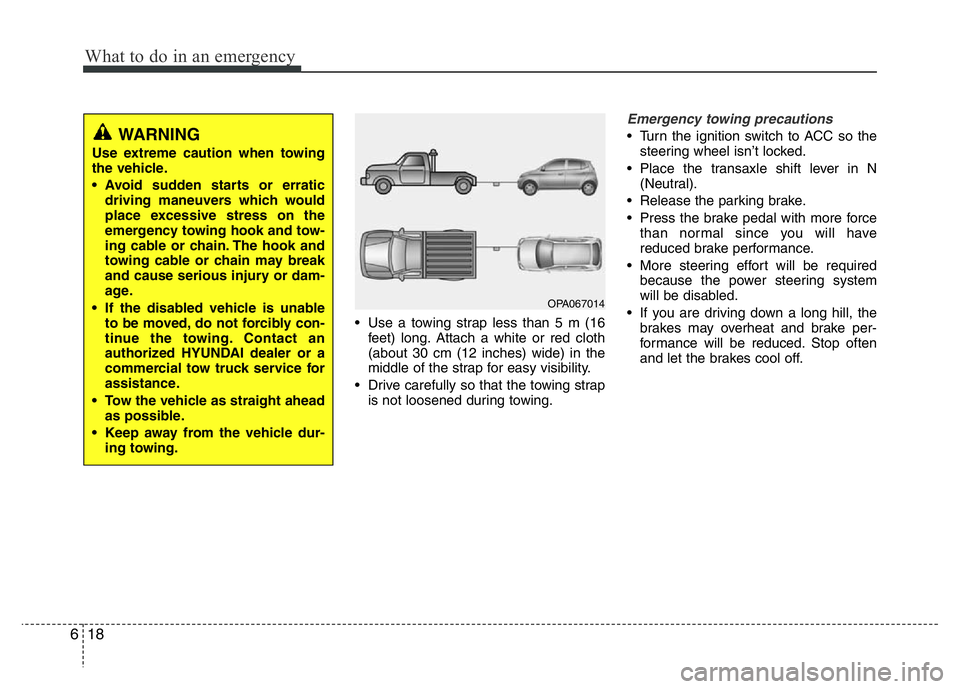
• Use a towing strap less than 5 m (16
feet) long. Attach a white or red cloth
(about 30 cm (12 inches) wide) in the
middle of the strap for easy visibility.
• Drive carefully so that the towing strap
is not loosened during towing.
Emergency towing precautions
• Turn the ignition switch to ACC so the
steering wheel isn’t locked.
• Place the transaxle shift lever in N
(Neutral).
• Release the parking brake.
• Press the brake pedal with more force
than normal since you will have
reduced brake performance.
• More steering effort will be required
because the power steering system
will be disabled.
• If you are driving down a long hill, the
brakes may overheat and brake per-
formance will be reduced. Stop often
and let the brakes cool off.WARNING
Use extreme caution when towing
the vehicle.
• Avoid sudden starts or erratic
driving maneuvers which would
place excessive stress on the
emergency towing hook and tow-
ing cable or chain. The hook and
towing cable or chain may break
and cause serious injury or dam-
age.
• If the disabled vehicle is unable
to be moved, do not forcibly con-
tinue the towing. Contact an
authorized HYUNDAI dealer or a
commercial tow truck service for
assistance.
• Tow the vehicle as straight ahead
as possible.
• Keep away from the vehicle dur-
ing towing.
OPA067014