fuel lid HYUNDAI I20 2009 Owners Manual
[x] Cancel search | Manufacturer: HYUNDAI, Model Year: 2009, Model line: I20, Model: HYUNDAI I20 2009Pages: 207, PDF Size: 2.46 MB
Page 14 of 207
Your vehicle at a glance
2 2
INTERIOR OVERVIEW
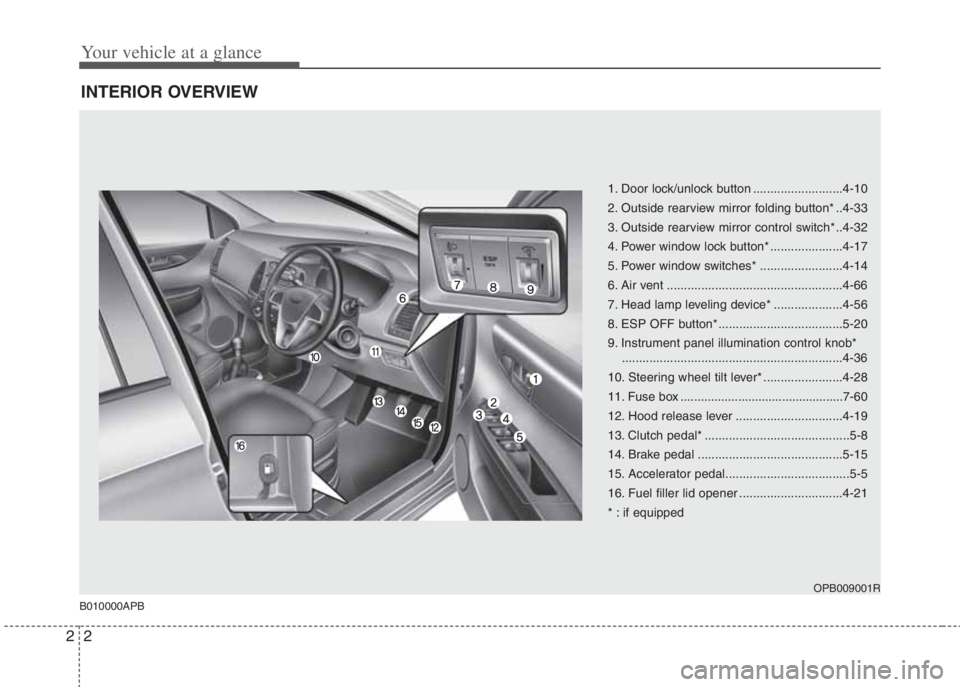
1. Door lock/unlock button ..........................4-10
2. Outside rearview mirror folding button* ..4-33
3. Outside rearview mirror control switch* ..4-32
4. Power window lock button* .....................4-17
5. Power window switches* ........................4-14
6. Air vent ...................................................4-66
7. Head lamp leveling device* ....................4-56
8. ESP OFF button* ....................................5-20
9. Instrument panel illumination control knob*
................................................................4-36
10. Steering wheel tilt lever* .......................4-28
11. Fuse box ................................................7-60
12. Hood release lever ...............................4-19
13. Clutch pedal* ..........................................5-8
14. Brake pedal ..........................................5-15
15. Accelerator pedal....................................5-5
16. Fuel filler lid opener ..............................4-21
* : if equipped
OPB009001R
B010000APB
Page 73 of 207
4
Keys / 4-2
Remote keyless entry / 4-5
Theft-alarm system / 4-7
Door locks / 4-9
Tailgate / 4-13
Windows / 4-14
Hood / 4-19
Fuel filler lid / 4-21
Sunroof / 4-24
Steering wheel / 4-28
Mirrors / 4-30
Instrument cluster / 4-34
Hazard warning flasher / 4-51
Lighting / 4-52
Wipers and washers / 4-57
Interior light / 4-60
Defroster / 4-63
Manual climate control system / 4-64
Automatic climate control system / 4-72
Windshield defrosting and defogging / 4-79
Storage compartment / 4-81
Interior features / 4-84
Audio system / 4-89
Features of your vehicle
Page 93 of 207
421
Features of your vehicle
D100100APB
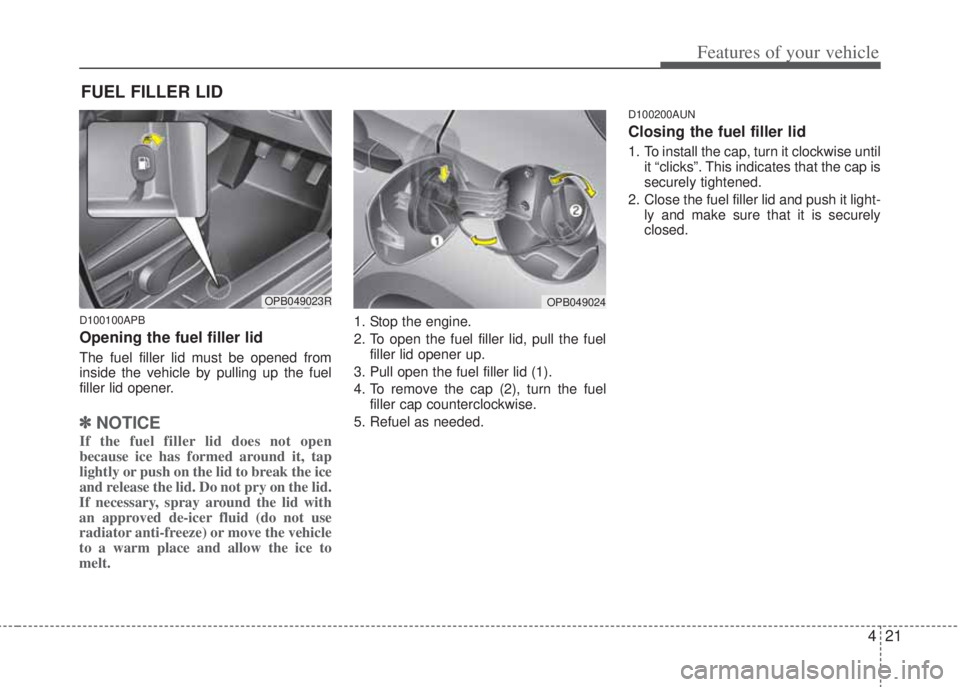
Opening the fuel filler lid
The fuel filler lid must be opened from
inside the vehicle by pulling up the fuel
filler lid opener.
✽NOTICE
If the fuel filler lid does not open
because ice has formed around it, tap
lightly or push on the lid to break the ice
and release the lid. Do not pry on the lid.
If necessary, spray around the lid with
an approved de-icer fluid (do not use
radiator anti-freeze) or move the vehicle
to a warm place and allow the ice to
melt.
1. Stop the engine.
2. To open the fuel filler lid, pull the fuel
filler lid opener up.
3. Pull open the fuel filler lid (1).
4. To remove the cap (2), turn the fuel
filler cap counterclockwise.
5. Refuel as needed.
D100200AUN
Closing the fuel filler lid
1. To install the cap, turn it clockwise until
it “clicks”. This indicates that the cap is
securely tightened.
2. Close the fuel filler lid and push it light-
ly and make sure that it is securely
closed.
FUEL FILLER LID
OPB049023ROPB049024
Page 94 of 207
Features of your vehicle
22 4
D100300APB
WARNING - Refueling dan-
gers
Automotive fuels are flammable
materials. When refueling, please
note the following guidelines care-
fully. Failure to follow these guide-
lines may result in severe personal
injury, severe burns or death by fire
or explosion.
• Read and follow all warning at the
gas station facility.
• Before refueling note the location
of the Emergency Gasoline Shut-
Off, if available, at the gas station
facility.
• Before touching the fuel nozzle,
you should eliminate potentially
dangerous static electricity dis-
charge by touching another metal
part of the vehicle, a safe dis-
tance away from the fuel filler
neck, nozzle, or other gas source.
(Continued)WARNING - Refueling
• If pressurized fuel sprays out, it
can cover your clothes or skin
and subject you to the risk of fire
and burns. Always remove the
fuel cap carefully and slowly. If
the cap is venting fuel or if you
hear a hissing sound, wait until
the condition stops before com-
pletely removing the cap.
• Do not "top off" after the nozzle
automatically shuts off when
refueling.
• Always check that the fuel cap is
installed securely to prevent fuel
spillage in the event of an acci-
dent.
(Continued)
• Do not get back into a vehicle
once you have begun refueling
since you can generate static
electricity by touching, rubbing
or sliding against any item or fab-
ric (polyester, satin, nylon, etc.)
capable of producing static elec-
tricity. Static electricity discharge
can ignite fuel vapors resulting in
rapid burning. If you must re-
enter the vehicle, you should
once again eliminate potentially
dangerous static electricity dis-
charge by touching a metal part
of the vehicle, away from the fuel
filler neck, nozzle or other gaso-
line source.
• When using an approved
portable fuel container be sure to
place the container on the ground
prior to refueling. Static electrici-
ty discharge from the container
can ignite fuel vapors causing a
fire. Once refueling has begun,
contact with the vehicle should
be maintained until the filling is
complete.
(Continued)