trip HYUNDAI I20 2009 Owners Manual
[x] Cancel search | Manufacturer: HYUNDAI, Model Year: 2009, Model line: I20, Model: HYUNDAI I20 2009Pages: 207, PDF Size: 2.46 MB
Page 15 of 207
23
Your vehicle at a glance
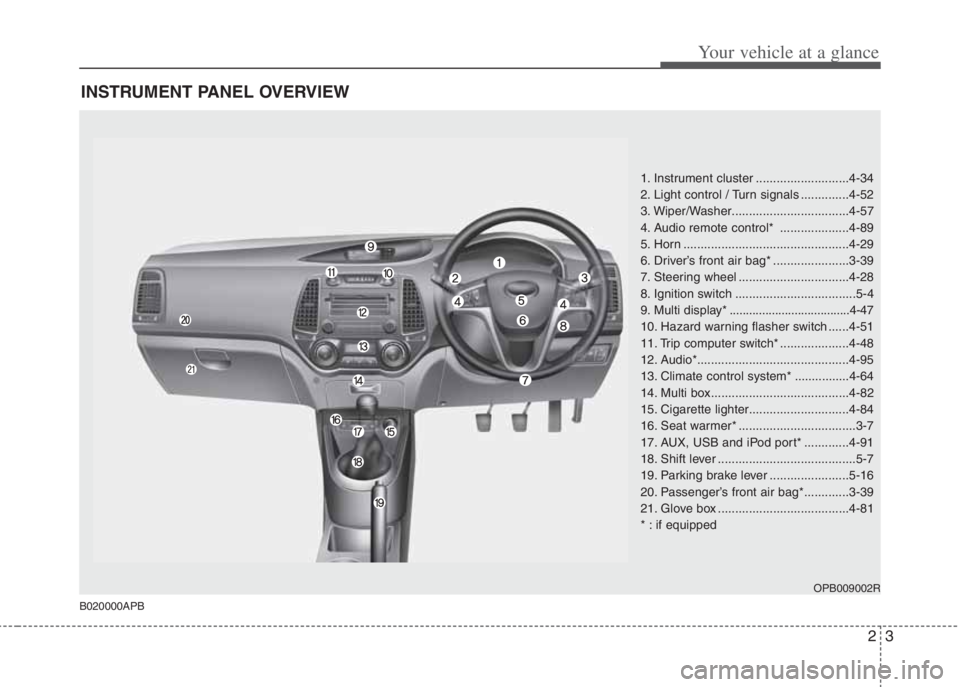
INSTRUMENT PANEL OVERVIEW
1. Instrument cluster ...........................4-34
2. Light control / Turn signals ..............4-52
3. Wiper/Washer..................................4-57
4. Audio remote control* ....................4-89
5. Horn ................................................4-29
6. Driver’s front air bag* ......................3-39
7. Steering wheel ................................4-28
8. Ignition switch ...................................5-4
9. Multi display*.....................................4-47
10. Hazard warning flasher switch ......4-51
11. Trip computer switch* ....................4-48
12. Audio*............................................4-95
13. Climate control system* ................4-64
14. Multi box........................................4-82
15. Cigarette lighter.............................4-84
16. Seat warmer* ..................................3-7
17. AUX, USB and iPod port* .............4-91
18. Shift lever ........................................5-7
19. Parking brake lever .......................5-16
20. Passenger’s front air bag*.............3-39
21. Glove box ......................................4-81
* : if equipped
OPB009002R
B020000APB
Page 57 of 207
Safety system of your vehicle
40 3
(Continued)
• Move your seat as far back as
practical from the front air bags,
while still maintaining control of
the vehicle.
• You and your passengers should
never sit or lean unnecessarily
close to the air bags. Improperly
positioned drivers and passen-
gers can be severely injured by
inflating air bags.
• Never lean against the door or
center console – always sit in an
upright position.
• Do not allow a passenger to ride
in the front seat when the pas-
senger’s front air bag OFF indica-
tor is illuminated, because the air
bag will not deploy in the event of
a moderate or severe frontal
crash. (if equipped)
(Continued)WARNING
Always use seat belts and child
restraints – every trip, every time,
everyone! Air bags inflate with
considerable force and in the blink
of an eye. Seat belts help keep
occupants in proper position to
obtain maximum benefit from the
air bag. Even with air bags,
improperly and unbelted occupants
can be severely injured when the
air bag inflates. Always follow the
precautions about seat belts, air
bags and occupant safety con-
tained in this manual.
To reduce the chance of serious or
fatal injuries and receive the maxi-
mum safety benefit from your
restraint system:
• Never place a child in any child or
booster seat in the front seat.
• ABC – Always Buckle Children in
the back seat. It is the safest
place for children of any age to
ride.
• Front and side air bags can injure
occupants improperly positioned
in the front seats.
(Continued)
(Continued)
• No objects should be placed over
or near the air bag modules on
the steering wheel, instrument
panel, and the front passenger's
panel above the glove box,
because any such object could
cause harm if the vehicle is in a
crash severe enough to cause
the air bags to deploy.
• Do not tamper with or disconnect
SRS wiring or other components
of the SRS system. Doing so
could result in injury, due to acci-
dental deployment of the air bags
or by rendering the SRS inopera-
tive.
• If the SRS air bag warning light
remains illuminated while the
vehicle is being driven, have an
authorized HYUNDAI dealer
inspect the air bag system as
soon as possible.
(Continued)
Page 119 of 207
447
Features of your vehicle
D150334APB
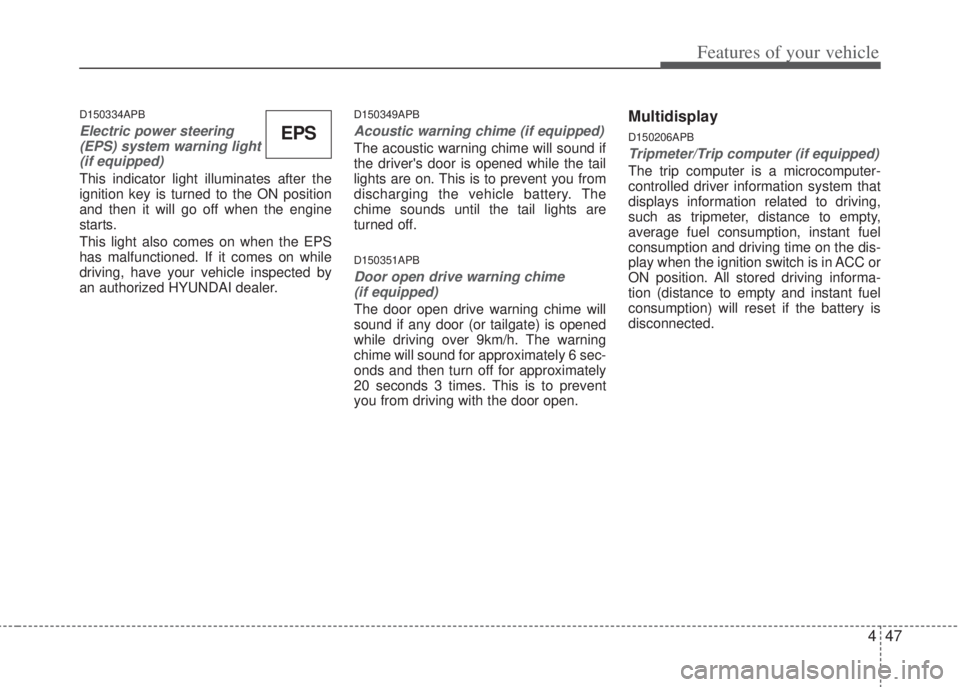
Electric power steering
(EPS) system warning light
(if equipped)
This indicator light illuminates after the
ignition key is turned to the ON position
and then it will go off when the engine
starts.
This light also comes on when the EPS
has malfunctioned. If it comes on while
driving, have your vehicle inspected by
an authorized HYUNDAI dealer.
D150349APB
Acoustic warning chime (if equipped)
The acoustic warning chime will sound if
the driver's door is opened while the tail
lights are on. This is to prevent you from
discharging the vehicle battery. The
chime sounds until the tail lights are
turned off.
D150351APB
Door open drive warning chime
(if equipped)
The door open drive warning chime will
sound if any door (or tailgate) is opened
while driving over 9km/h. The warning
chime will sound for approximately 6 sec-
onds and then turn off for approximately
20 seconds 3 times. This is to prevent
you from driving with the door open.
Multidisplay
D150206APB
Tripmeter/Trip computer (if equipped)
The trip computer is a microcomputer-
controlled driver information system that
displays information related to driving,
such as tripmeter, distance to empty,
average fuel consumption, instant fuel
consumption and driving time on the dis-
play when the ignition switch is in ACC or
ON position. All stored driving informa-
tion (distance to empty and instant fuel
consumption) will reset if the battery is
disconnected.
EPS
Page 120 of 207
Features of your vehicle
48 4
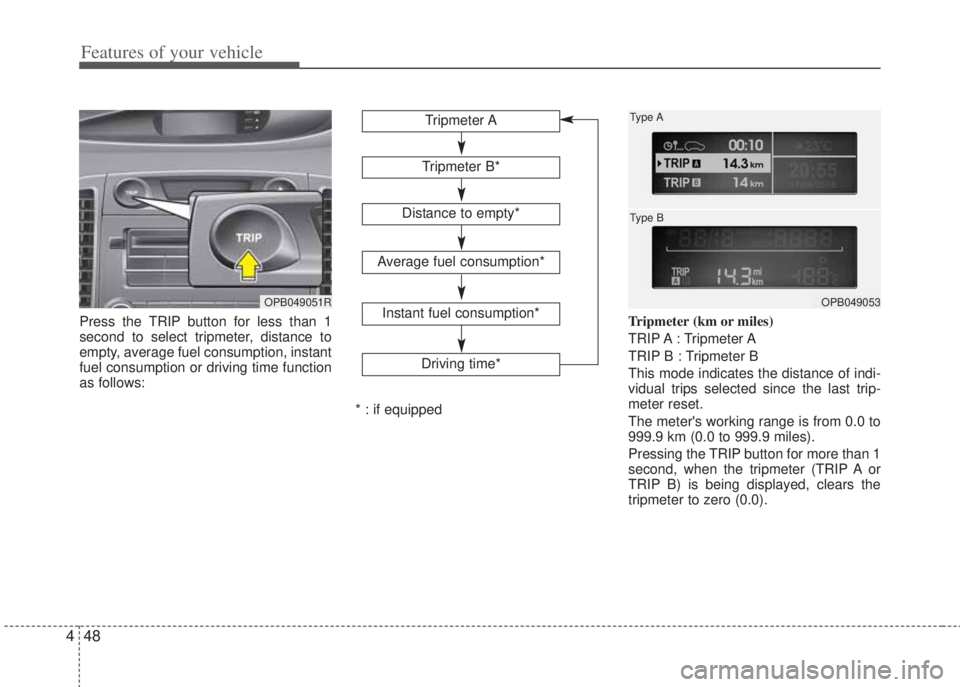
Press the TRIP button for less than 1
second to select tripmeter, distance to
empty, average fuel consumption, instant
fuel consumption or driving time function
as follows:Tripmeter (km or miles)
TRIP A : Tripmeter A
TRIP B : Tripmeter B
This mode indicates the distance of indi-
vidual trips selected since the last trip-
meter reset.
The meter's working range is from 0.0 to
999.9 km (0.0 to 999.9 miles).
Pressing the TRIP button for more than 1
second, when the tripmeter (TRIP A or
TRIP B) is being displayed, clears the
tripmeter to zero (0.0).
OPB049051R
Tripmeter B*
Average fuel consumption*
Instant fuel consumption*
Driving time*
Tripmeter A
Distance to empty*
* : if equipped
OPB049053 Type A
Type B
Page 121 of 207
449
Features of your vehicle
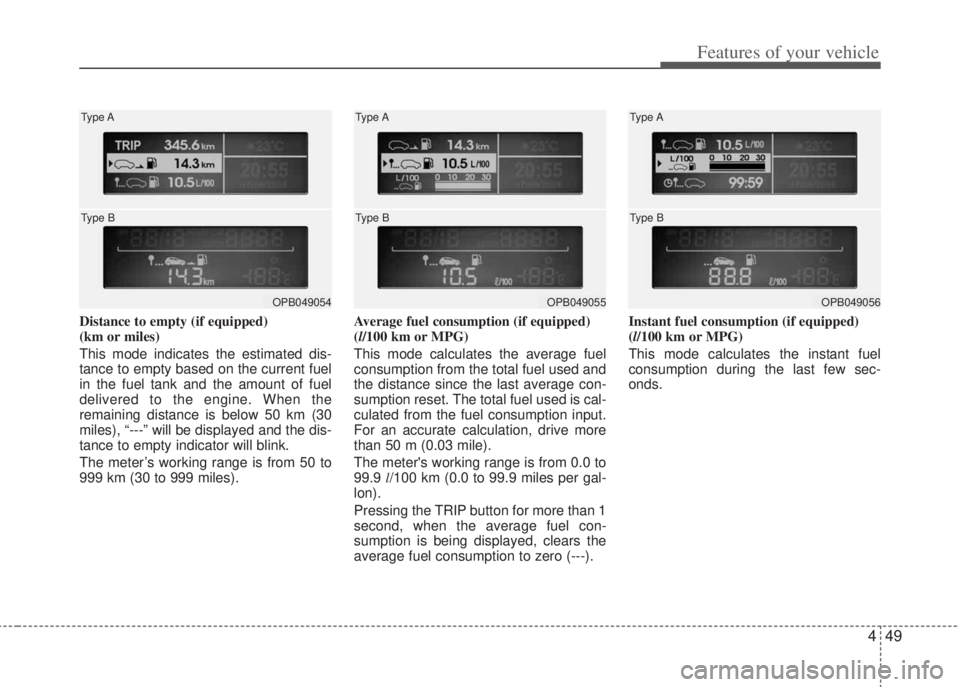
Distance to empty (if equipped)
(km or miles)
This mode indicates the estimated dis-
tance to empty based on the current fuel
in the fuel tank and the amount of fuel
delivered to the engine. When the
remaining distance is below 50 km (30
miles), “---” will be displayed and the dis-
tance to empty indicator will blink.
The meter’s working range is from 50 to
999 km (30 to 999 miles).Average fuel consumption (if equipped)
(l/100 km or MPG)
This mode calculates the average fuel
consumption from the total fuel used and
the distance since the last average con-
sumption reset. The total fuel used is cal-
culated from the fuel consumption input.
For an accurate calculation, drive more
than 50 m (0.03 mile).
The meter's working range is from 0.0 to
99.9 l/100 km (0.0 to 99.9 miles per gal-
lon).
Pressing the TRIP button for more than 1
second, when the average fuel con-
sumption is being displayed, clears the
average fuel consumption to zero (---).Instant fuel consumption (if equipped)
(l/100 km or MPG)
This mode calculates the instant fuel
consumption during the last few sec-
onds.
OPB049054 Type A
Type BOPB049055 Type A
Type BOPB049056 Type A
Type B
Page 122 of 207
Features of your vehicle
50 4
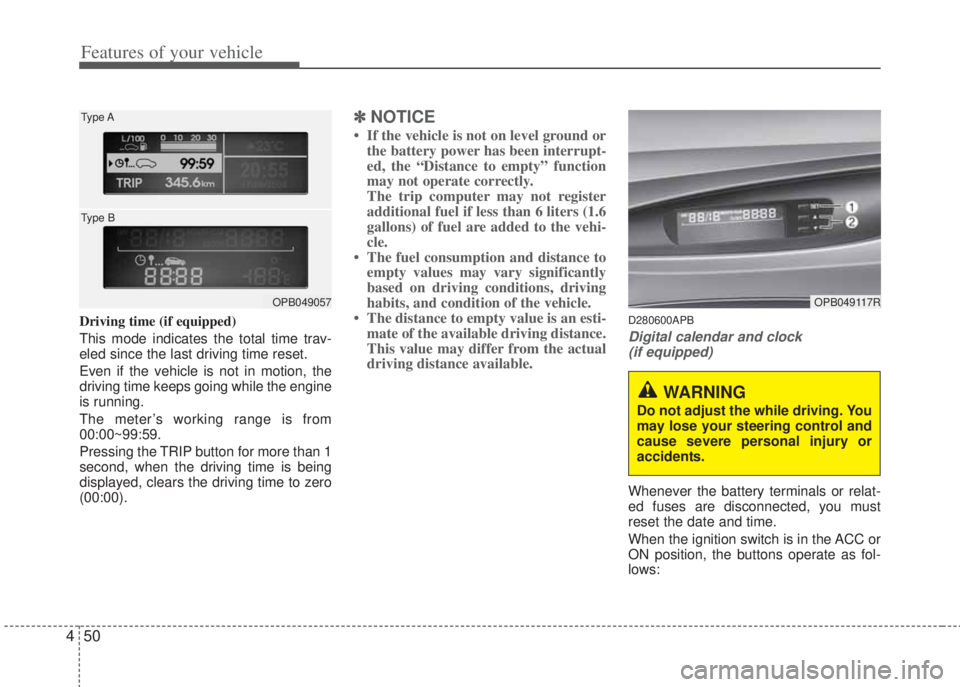
Driving time (if equipped)
This mode indicates the total time trav-
eled since the last driving time reset.
Even if the vehicle is not in motion, the
driving time keeps going while the engine
is running.
The meter’s working range is from
00:00~99:59.
Pressing the TRIP button for more than 1
second, when the driving time is being
displayed, clears the driving time to zero
(00:00).
✽NOTICE
• If the vehicle is not on level ground or
the battery power has been interrupt-
ed, the “Distance to empty” function
may not operate correctly.
The trip computer may not register
additional fuel if less than 6 liters (1.6
gallons) of fuel are added to the vehi-
cle.
• The fuel consumption and distance to
empty values may vary significantly
based on driving conditions, driving
habits, and condition of the vehicle.
• The distance to empty value is an esti-
mate of the available driving distance.
This value may differ from the actual
driving distance available.
D280600APB
Digital calendar and clock
(if equipped)
Whenever the battery terminals or relat-
ed fuses are disconnected, you must
reset the date and time.
When the ignition switch is in the ACC or
ON position, the buttons operate as fol-
lows:
OPB049057 Type A
Type BOPB049117R
WARNING
Do not adjust the while driving. You
may lose your steering control and
cause severe personal injury or
accidents.