light HYUNDAI I20 2020 Owners Manual
[x] Cancel search | Manufacturer: HYUNDAI, Model Year: 2020, Model line: I20, Model: HYUNDAI I20 2020Pages: 444, PDF Size: 8.93 MB
Page 316 of 444

9-2
Emergency situations
OAI3079001OAI3079001
The hazard warning flasher serves as
a warning to other drivers to exercise
extreme caution when approaching,
overtaking, or passing your vehicle.
It should be used whenever emergency
repairs are being made or when the
vehicle is stopped near the edge of a
roadway.
To turn the hazard warning flasher on
or off, press the hazard warning flasher
button with the ignition switch in any
position. The button is located in the
crash pad garnish panel.
All turn signal lights will flash
simultaneously.
• The hazard warning flasher operates
whether your vehicle is running or not.
• The turn signals do not work when the
hazard flasher is on.
HAZARD WARNING FLASHER IN CASE OF AN EMERGENCY
WHILE DRIVING
If the engine stalls while driving
• Reduce your speed gradually, keeping
a straight line. Move cautiously off the
road to a safe place.
• Turn on your hazard warning flasher.
• Try to start the engine again. If your
vehicle will not start, we recommend
that you contact an authorized
HYUNDAI dealer.
If the engine stalls at a
crossroad or crossing
If the engine stalls at a crossroad or
crossing, if safe to do so, move the shift
lever to the N (Neutral) position and then
push the v ehicle to a safe location.
• If your vehicle has a manual
transmission not equipped with a
ignition lock switch, the vehicle can
move forward by shifting to the
2(second) or 3(third) gear and then
turning the starter without depressing
the clutch pedal.
Page 317 of 444

9-3
09
If you have a flat tire while
driving
If a tire goes flat while you are driving:
• Take your foot off the accelerator
pedal and let the vehicle slow down
while driving straight ahead. Do not
apply the brakes immediately or
attempt to pull off the road as this
may cause loss of vehicle control
resulting in an accident. When the
vehicle has slowed to such a speed
that it is safe to do so, brake carefully
and pull off the road. Drive off the
road as far as possible and park on
firm, level ground. If you are on a
divided highway, do not park in the
median area between the two traffic
lanes.
• When the vehicle is stopped, press
the hazard warning flasher button,
move the shift lever into N (Neutral,
for Automated manual transmission)
or neutral (for manual transmission
vehicle), apply the parking brake, and
place the ignition switch in the LOCK/
OFF position.
• Have all passengers get out of the
vehicle. Be sure they all get out on the
side of the vehicle that is away from
traffic.
• When changing a flat tire, follow the
instructions provided later in this
chapter.
IF THE ENGINE WILL NOT
START
If the engine doesn’t turn over
or turns over slowly
• Be sure the for Automated manual
transmission or N (Neutral) if it is a
vehicle. The engine starts only when
the shift lever is in N (Neutral).
• Check the battery connections to be
sure they are clean and tight.
• Turn on the interior light. If the light
dims or goes out when you operate
the starter, the battery is drained.
Do not push or pull the vehicle to start
it. This could cause damage to your
vehicle.
See instructions for “Jump Starting”
provided in this chapter.
WARNING
Push or pull starting the vehicle may
cause the catalytic converter to
overload which can lead to damage to
the emission control system.
If the engine turns over normally
but doesn’t start
• Check the fuel level and add fuel if
necessary.
If the engine still does not start, we
recommend that you call an authorized
HYUNDAI dealer for assistance.
Page 319 of 444
9-5
09
CAUTION
• Improper jump starting procedure
can result in battery explosion and
acid burn hazard.
• Loosely connected battery cables
could damage the electronic control
units.
• To disconnect battery terminals
wait for at least 2 minutes to allow
discharge of high voltage or it could
lead to personal injury.
• While disconnecting, always
disconnect the -VE terminal first and
while connecting, always connect the
-VE terminal last.
NOTICE
To prevent damage to your vehicle:
• Only use a 12-volt power supply
(battery or jumper system) to jump
start your vehicle.
• Do not attempt to jump start your
vehicle by push-starting.
i Information
Pb
An inappropriately disposed
battery can be harmful to the
environment and human health.
Dispose the battery according to
your local law(s) or regulation.
Jump starting procedure
1. Position the vehicles close enough
that the jumper cables will reach, but
do not allow the vehicles to touch.
2. Avoid fans or any moving parts in the
engine compartment at all times, even
when the vehicles are turned off.
3. Turn off all electrical devices such
as radios, lights, air conditioning,
etc. Put the vehicles in N (Neutral,
for Automated manual transmission
vehicle) or neutral (for manual
transmission vehicle), and set the
parking brakes. Turn both vehicles
OFF.
OBI3090046LOBI3090046L
(-)
(+)
Booster BatteryBooster Battery
(-)
(+)
Jumper TerminalJumper Terminal
Jumper CablesJumper Cables
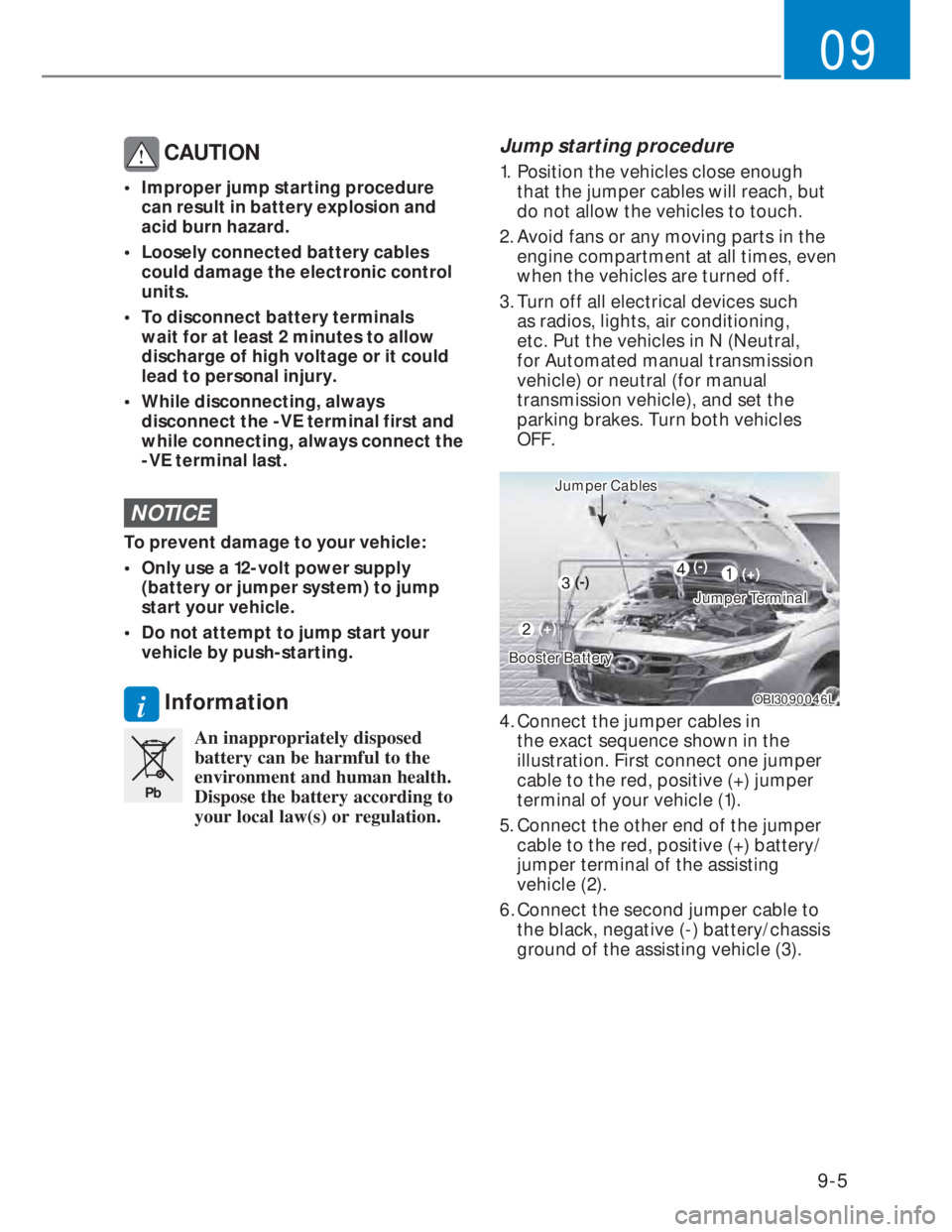
4. Connect the jumper cables in
the exact sequence shown in the
illustration. First connect one jumper
cable to the red, positive (+) jumper
terminal of your vehicle (1).
5. Connect the other end of the jumper
cable to the red, positive (+) battery/
jumper terminal of the assisting
vehicle (2).
6. Connect the second jumper cable to
the black, negative (-) battery/chassis
ground of the assisting vehicle (3).
Page 325 of 444
9-11
09
Low tire pressure
telltale
Low tire pressure position
telltale and tire pressure telltale
OSU2I049054OSU2I049054
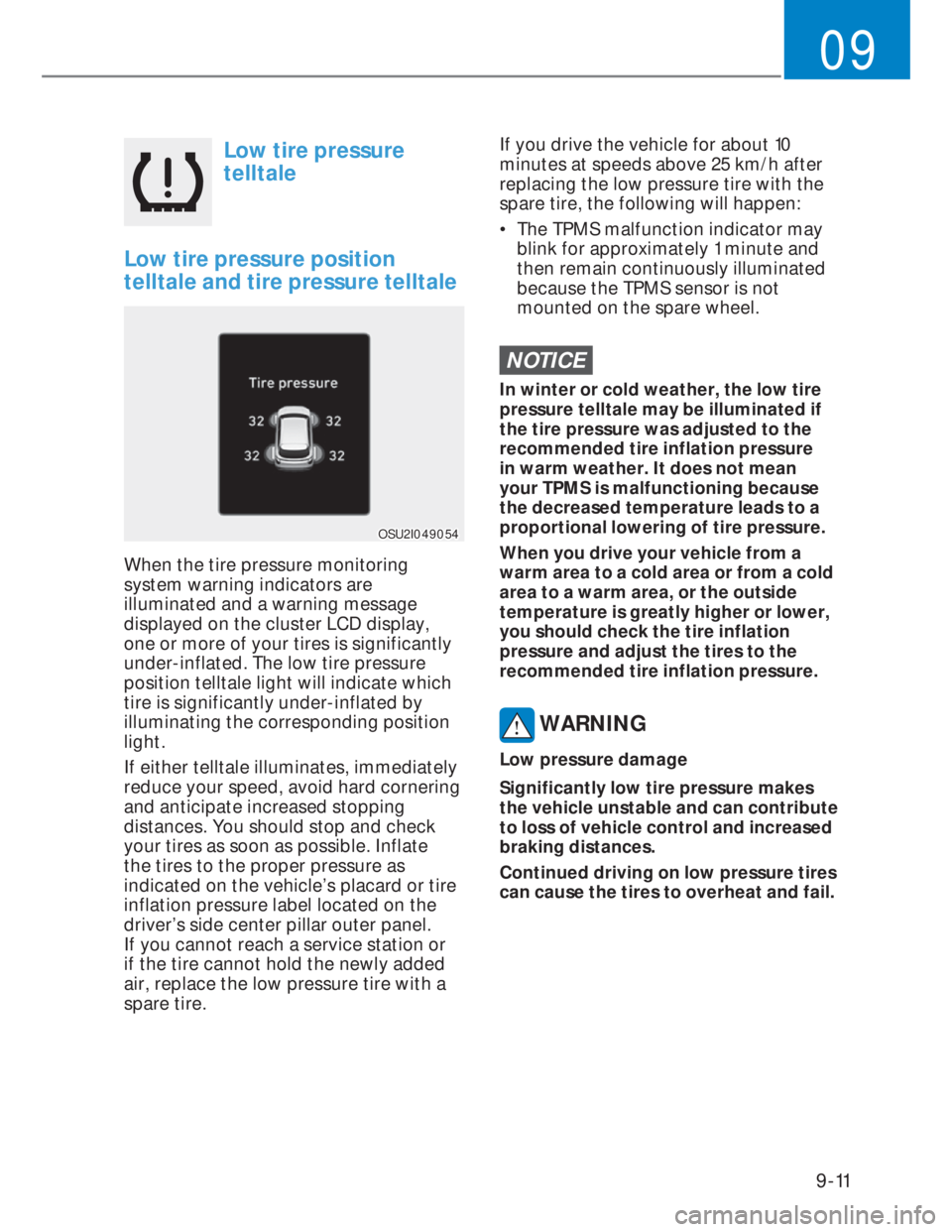
When the tire pressure monitoring
system warning indicators are
illuminated and a warning message
displayed on the cluster LCD display,
one or more of your tires is significantly
under-inflated. The low tire pressure
position telltale light will indicate which
tire is significantly under-inflated by
illuminating the corresponding position
light.
If either telltale illuminates, immediately
reduce your speed, avoid hard cornering
and anticipate increased stopping
distances. You should stop and check
your tires as soon as possible. Inflate
the tires to the proper pressure as
indicated on the vehicle’s placard or tire
inflation pressure label located on the
driver’s side center pillar outer panel.
If you cannot reach a service station or
if the tire cannot hold the newly added
air, replace the low pressure tire with a
spare tire.
If you drive the vehicle for about 10
minutes at speeds above 25 km/h after
replacing the low pressure tire with the
spare tire, the following will happen:
• The TPMS malfunction indicator may
blink for approximately 1 minute and
then remain continuously illuminated
because the TPMS sensor is not
mounted on the spare wheel.
NOTICE
In winter or cold weather, the low tire
pressure telltale may be illuminated if
the tire pressure was adjusted to the
recommended tire inflation pressure
in warm weather. It does not mean
your TPMS is malfunctioning because
the decreased temperature leads to a
proportional lowering of tire pressure.
When you drive your vehicle from a
warm area to a cold area or from a cold
area to a warm area, or the outside
temperature is greatly higher or lower,
you should check the tire inflation
pressure and adjust the tires to the
recommended tire inflation pressure.
WARNING
Low pressure damage
Significantly low tire pressure makes
the vehicle unstable and can contribute
to loss of vehicle control and increased
braking distances.
Continued driving on low pressure tires
can cause the tires to overheat and fail.
Page 327 of 444
9-13
09
NOTICE
If original mounted tire is replaced
with the spare tire, the TPMS sensor
on the replaced spare wheel should be
initiated and we recommend that the
TPMS sensor on the original mounted
wheel be deactivated by a HYUNDAI
dealer. If the TPMS sensor on the
original mounted wheel located in the
spare tire carrier still activates, the
tire pressure monitoring system may
not operate properly. We recommend
that the system be serviced by an
authorized HYUNDAI dealer.
You may not be able to identify a low
tire by simply looking at it. Always use
a good quality tire pressure gauge to
measure the tire’s inflation pressure.
Please note that a tire that is hot (from
being driven) will have a higher pressure
measurement than a tire that is cold.
A cold tire means the vehicle is in parked
position for at least 3 hours or driven
less than 1.6 km (1 mile) in that period.
Allow the tire to cool before measuring
the inflation pressure. Always be sure
the tire is cold before inflating to the
recommended pressure.
NOTICE
We recommend that you use the tire
sealant approved by HYUNDAI if your
vehicle is equipped with a Tire Pressure
Monitoring System. The liquid sealant
can damage the tire pressure sensors.
WARNING
TPMS
• The TPMS cannot alert you to severe
and sudden tire damage caused by
external factors such as nails or road
debris.
• If you feel any vehicle instability,
immediately take your foot off
the accelerator, apply the brakes
gradually and with light force, and
slowly move to a safe position off the
road.
WARNING
Protecting TPMS
Tampering with, modifying, or disabling
the Tire Pressure Monitoring System
(TPMS) components may interfere with
the system’s ability to warn the driver
of low tire pressure conditions and/
or TPMS malfunctions. Tamper-ing
with, modifying, or disabling the Tire
Pressure Monitoring System (TPMS)
components may void the war-ranty for
that portion of the vehicle.
Page 341 of 444
10
Wiper blades ............................................................................................... 10-45
Blade inspection .....................................................................................................10-45
Blade replacement .................................................................................................10-45
Battery ......................................................................................................... 10-48
For best battery service ........................................................................................ 10-48
Battery capacity label
........................................................................................... 10-50
Battery recharging ................................................................................................ 10-48
Reset items ............................................................................................................ 10-49
Battery replacement
............................................................................................. 10-49
Tires and wheels ......................................................................................... 10-50
Tire care ................................................................................................................. 10-50
Recommended cold tire inflation pressures ....................................................... 10-50
Checking tire inflation pressure
............................................................................ 10-51
Tire rotation
............................................................................................................10-52
Wheel alignment and tire balance ........................................................................10-53
Tire replacement ....................................................................................................10-54
Wheel replacement
................................................................................................10-55
Tire traction
............................................................................................................10-55
Tire maintenance .................................................................................................. 10-56
Tire sidewall labeling ............................................................................................. 10-56
Low aspect ratio tire.............................................................................................. 10-59
Fuses ............................................................................................................. 10-61
Instrument panel fuse replacement .....................................................................10-62
Engine compartment panel fuse replacement ................................................... 10-63
Fuse/relay panel description
................................................................................ 10-64
Light bulbs .................................................................................................... 10-75
Headlight, Position Light, Turn signal Light bulb replacement ........................... 10-76
Side repeater light replacement ........................................................................... 10-81
Rear combination light bulb replacement
........................................................... 10-81
High mounted stop light replacement ................................................................ 10-85
License plate light bulb replacement .................................................................. 10-85
Interior light bulb replacement ............................................................................ 10-86
Page 348 of 444
10-9
10
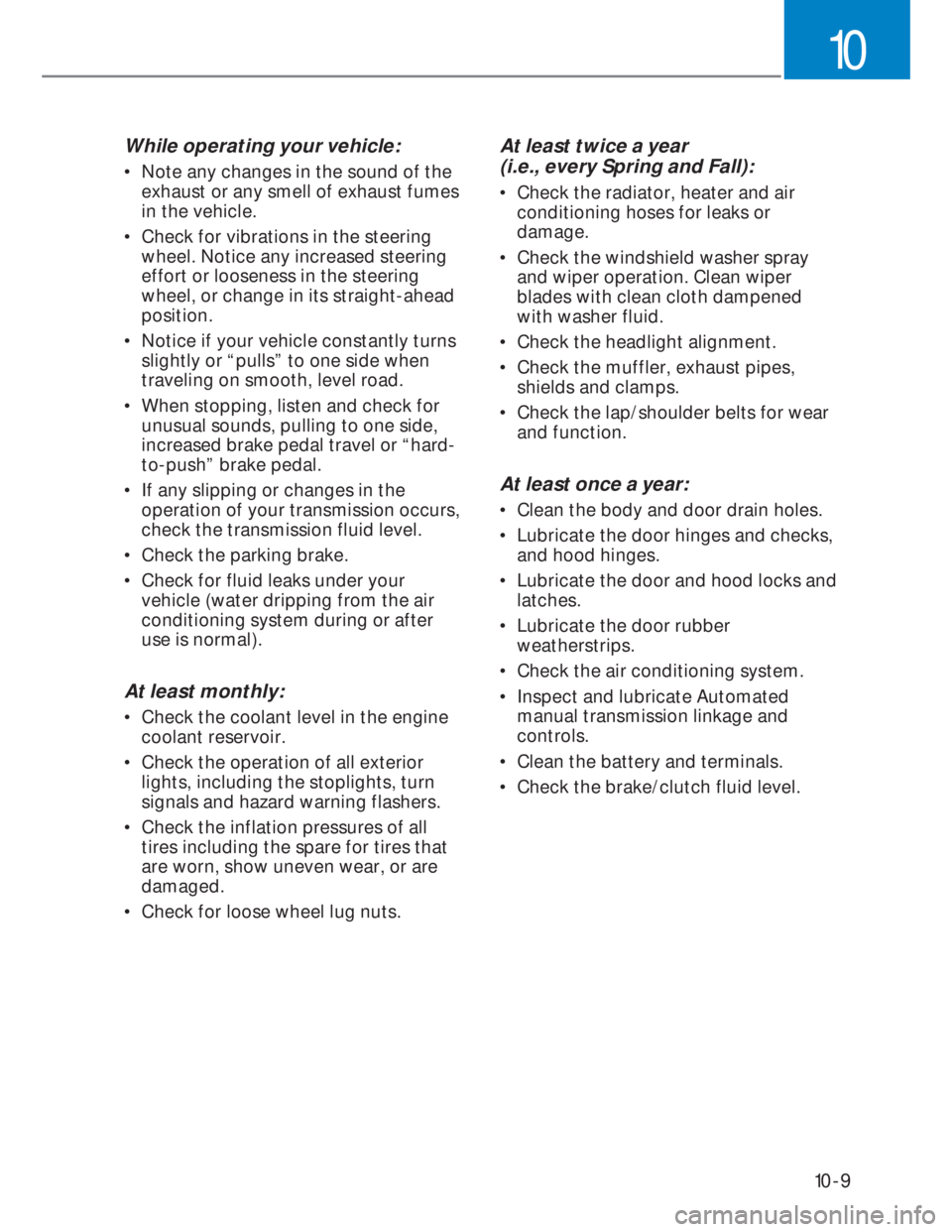
While operating your vehicle:
• Note any changes in the sound of the
exhaust or any smell of exhaust fumes
in the vehicle.
• Check for vibrations in the steering
wheel. Notice any increased steering
effort or looseness in the steering
wheel, or change in its straight-ahead
position.
• Notice if your vehicle constantly turns
slightly or “pulls” to one side when
traveling on smooth, level road.
• When stopping, listen and check for
unusual sounds, pulling to one side,
increased brake pedal travel or “hard-
to-push” brake pedal.
• If any slipping or changes in the
operation of your transmission occurs,
check the transmission fluid level.
• Check the parking brake.
• Check for fluid leaks under your
vehicle (water dripping from the air
conditioning system during or after
use is normal).
At least monthly:
• Check the coolant level in the engine
coolant reservoir.
• Check the operation of all exterior
lights, including the stoplights, turn
signals and hazard warning flashers.
• Check the inflation pressures of all
tires including the spare for tires that
are worn, show uneven wear, or are
damaged.
• Check for loose wheel lug nuts.
At least twice a year
(i.e., every Spring and Fall):
• Check the radiator, heater and air
conditioning hoses for leaks or
damage.
• Check the windshield washer spray
and wiper operation. Clean wiper
blades with clean cloth dampened
with washer fluid.
• Check the headlight alignment.
• Check the muffler, exhaust pipes,
shields and clamps.
• Check the lap/shoulder belts for wear
and function.
At least once a year:
• Clean the body and door drain holes.
• Lubricate the door hinges and checks,
and hood hinges.
• Lubricate the door and hood locks and
latches.
• Lubricate the door rubber
weatherstrips.
• Check the air conditioning system.
• Inspect and lubricate Automated
manual transmission linkage and
controls.
• Clean the battery and terminals.
• Check the brake/clutch fluid level.
Page 353 of 444
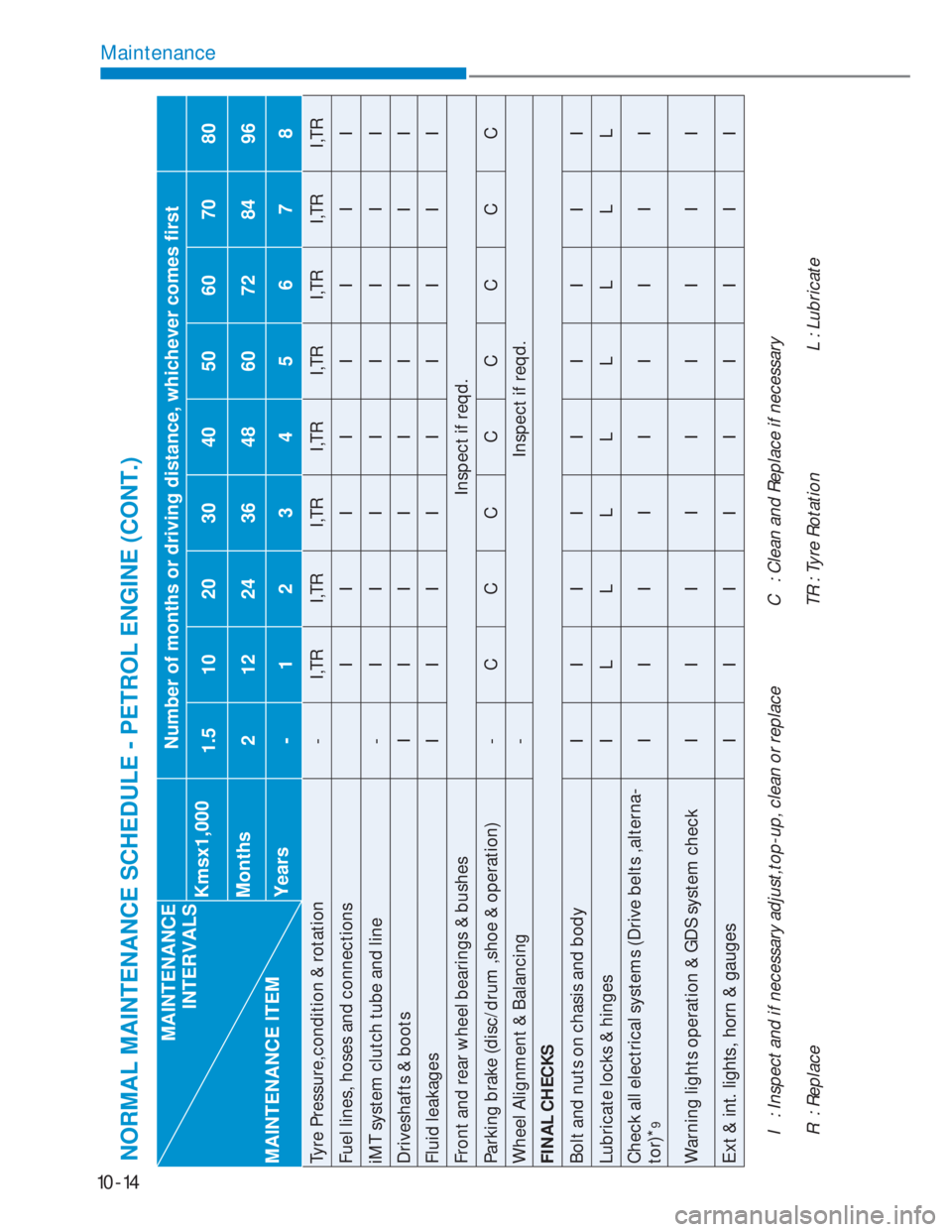
10-14
Maintenance
MAINTENANCE
INTERVALS
MAINTENANCE ITEMNumber of months or driving distance, whichever comes first
Kmsx1,000
1.51020304050607080
Months
2 1224364860728496
Years
- 12345678
Tyre Pressure,condition & rotation - I,TR I,TR I,TR I,TR I,TR I,TR I,TR I,TR
Fuel lines, hoses and connections IIIIIIII
iMT system clutch tube and line - I IIIIIII
Driveshafts & bootsIIIIIIIII
Fluid leakages IIIIIIIII
Front and rear wheel bearings & bushes Inspect if reqd.
Parking brake (disc/drum ,shoe & operation) - CCCCCCCC
Wheel Alignment & Balancing - Inspect if reqd.
FINAL CHECKS
Bolt and nuts on chasis and body I I IIIIIII
Lubricate locks & hinges ILLLLLLLL
Check all electrical systems (Drive belts ,alterna-
tor)*
9
IIIIIIIII
Warning lights operation & GDS system check I IIIIIIII
Ext & int. lights, horn & gaugesIIIIIIIII
NORMAL MAINTENANCE SCHEDULE - PETROL ENGINE (CONT.)
I : Inspect and if necessary adjust,top-up, clean or replace
R : ReplaceC : Clean and Replace if necessary
TR : Tyre Rotation L : Lubricate
Page 359 of 444
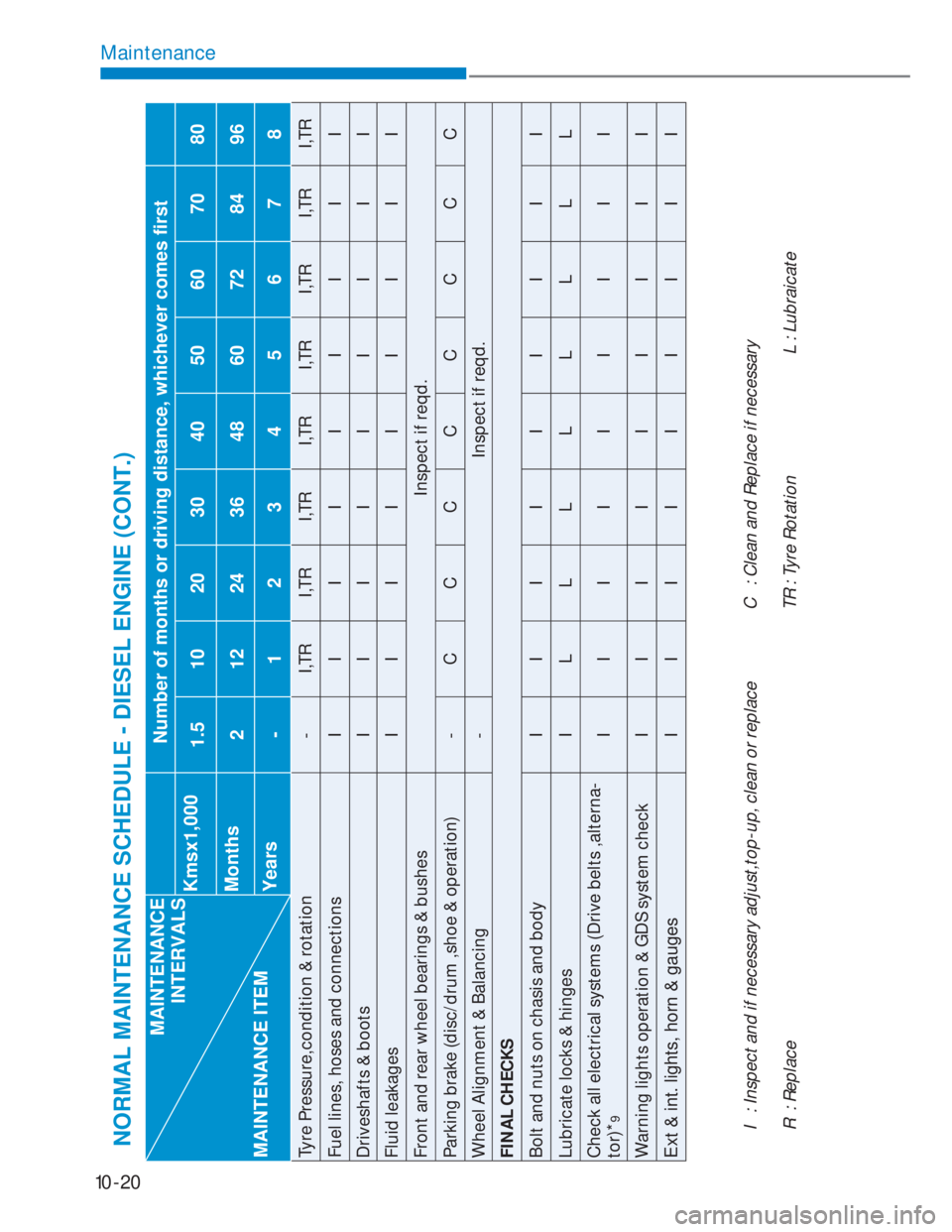
10-20
Maintenance
NORMAL MAINTENANCE SCHEDULE - DIESEL ENGINE (CONT.)
MAINTENANCE
INTERVALS
MAINTENANCE ITEMNumber of months or driving distance, whichever comes first
Kmsx1,000
1.51020304050607080
Months
2 1224364860728496
Years
- 12345678
Tyre Pressure,condition & rotation - I,TR I,TR I,TR I,TR I,TR I,TR I,TR I,TR
Fuel lines, hoses and connectionsIIIIIIIII
Driveshafts & bootsIIIIIIIII
Fluid leakages I IIIIIIII
Front and rear wheel bearings & bushes Inspect if reqd.
Parking brake (disc/drum ,shoe & operation) - C CCCCCCC
Wheel Alignment & Balancing - Inspect if reqd.
FINAL CHECKS
Bolt and nuts on chasis and body I I IIIIIII
Lubricate locks & hinges ILLLLLLLL
Check all electrical systems (Drive belts ,alterna-
tor)*
9
IIIIIIIII
Warning lights operation & GDS system check I IIIIIIII
Ext & int. lights, horn & gaugesIIIIIIIII
C : Clean and Replace if necessary
TR : Tyre Rotation L : Lubraicate I : Inspect and if necessary adjust,top-up, clean or replace
R : Replace
Page 365 of 444
10-26
Maintenance
NOTICE
The use of non-specified fluid
(even marked as compatible with
genuine) could result in shift quality
deterioration and vibrations,
eventually, the transmission failure.
Use only specified Automated
manual transmission fluid. (Refer
to “Recommended lubricants and
capacities” in chapter 2.)
Intelligent VariableTransmission
(IVT) Fluid (if equipped)
Intelligent Variable Transmission (IVT)
Fluid should not be checked under
normal usage conditions. But, the
Intel-ligent Variable Transmission (IVT)
Fluid should be changed under severe
usage conditions. We recommend that
the Intelligent Variable Transmission
(IVT) Fluid changed by an authorized
HYUNDAI dealer according to the
maintenance schedule. (Refer to
“Maintenance Under Severe Usage
Conditions” in this chapter.)
i Information
Intelligent variable transmission (IVT)
fluid color is basically light amber. As the
vehicle is driven, the intelligent variable
transmission (IVT) fluid will begin to
look darker. This is a normal condition
and you should not judge the need to
replace the fluid based upon the changed
color.
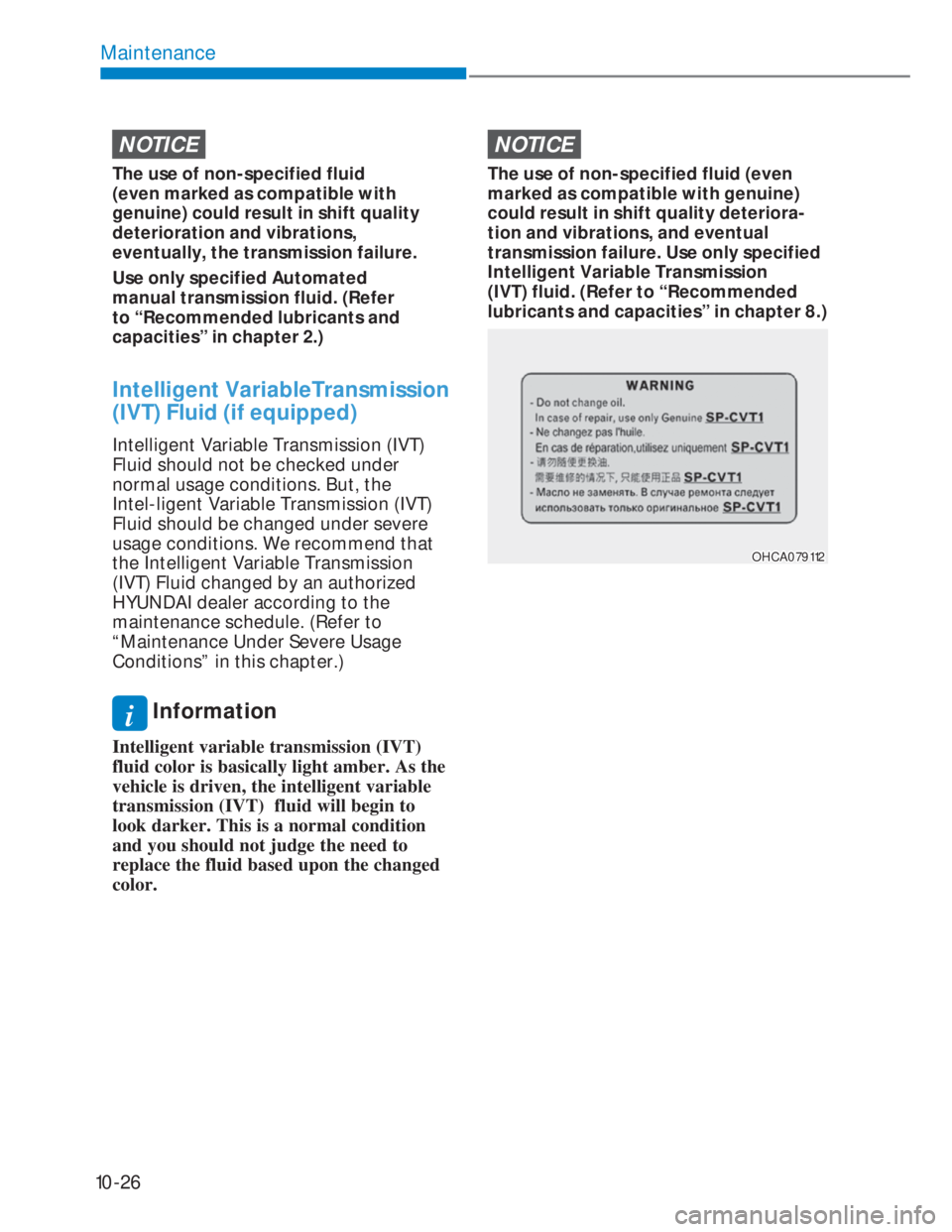
NOTICE
The use of non-specified fluid (even
marked as compatible with genuine)
could result in shift quality deteriora-
tion and vibrations, and eventual
transmission failure. Use only specified
Intelligent Variable Transmission
(IVT) fluid. (Refer to “Recommended
lubricants and capacities” in chapter 8.)
OHCA079112OHCA079112