tow HYUNDAI I20 2020 User Guide
[x] Cancel search | Manufacturer: HYUNDAI, Model Year: 2020, Model line: I20, Model: HYUNDAI I20 2020Pages: 444, PDF Size: 8.93 MB
Page 153 of 444
6-25
06
NOTICE
• The mirrors stop moving when
they reach the maximum adjusting
angles, but the motor continues to
operate while the switch is pressed.
Do not press the switch longer
than necessary, the motor may be
damaged.
• Do not attempt to adjust the outside
rearview mirror by hand or the motor
may be damaged.
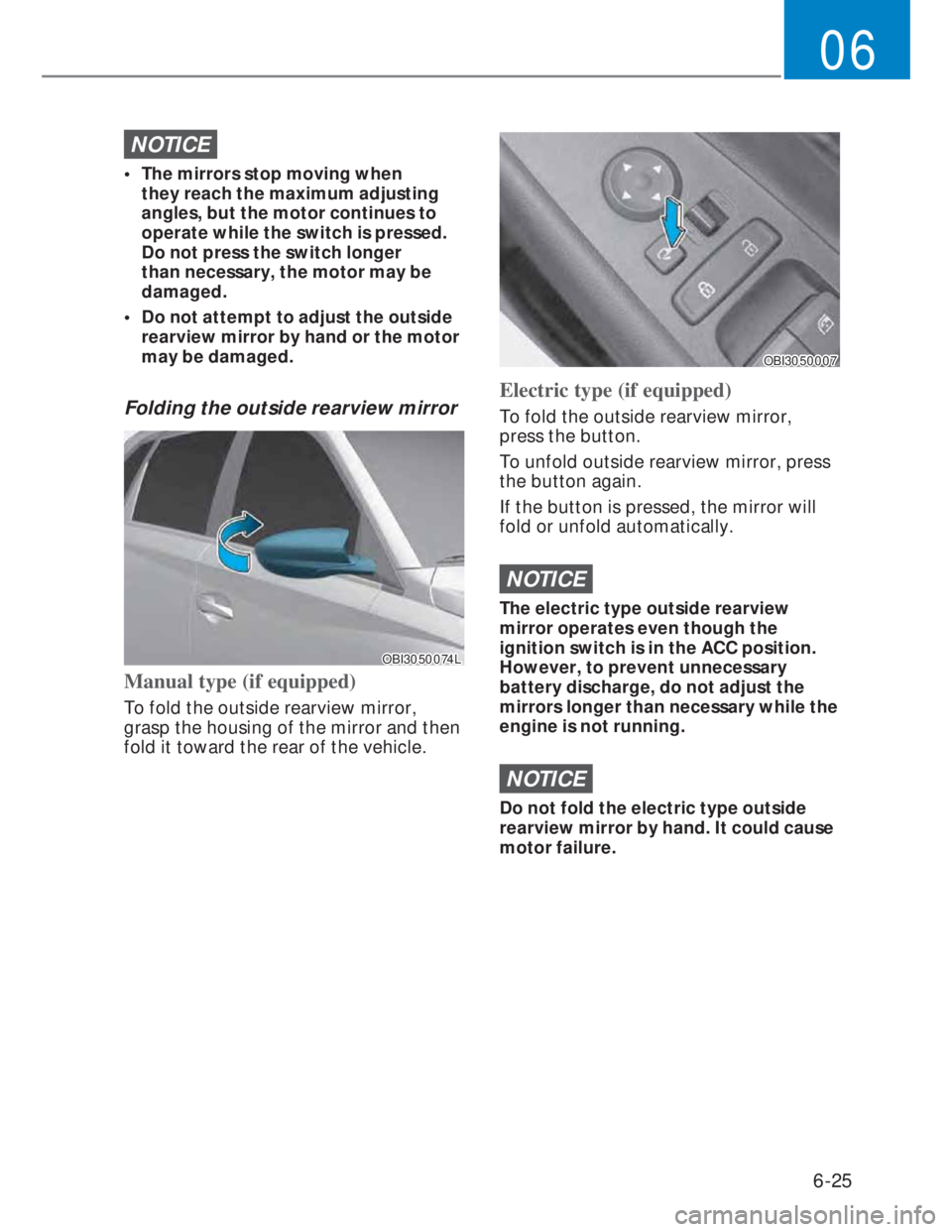
Folding the outside rearview mirror
OBI3050074LOBI3050074L
Manual type (if equipped)
To fold the outside rearview mirror,
grasp the housing of the mirror and then
fold it toward the rear of the vehicle.
OBI3050007OBI3050007
Electric type (if equipped)
To fold the outside rearview mirror,
press the button.
To unfold outside rearview mirror, press
the button again.
If the button is pressed, the mirror will
fold or unfold automatically.
NOTICE
The electric type outside rearview
mirror operates even though the
ignition switch is in the ACC position.
However, to prevent unnecessary
battery discharge, do not adjust the
mirrors longer than necessary while the
engine is not running.
NOTICE
Do not fold the electric type outside
rearview mirror by hand. It could cause
motor failure.
Page 160 of 444
6-32
Convenient features
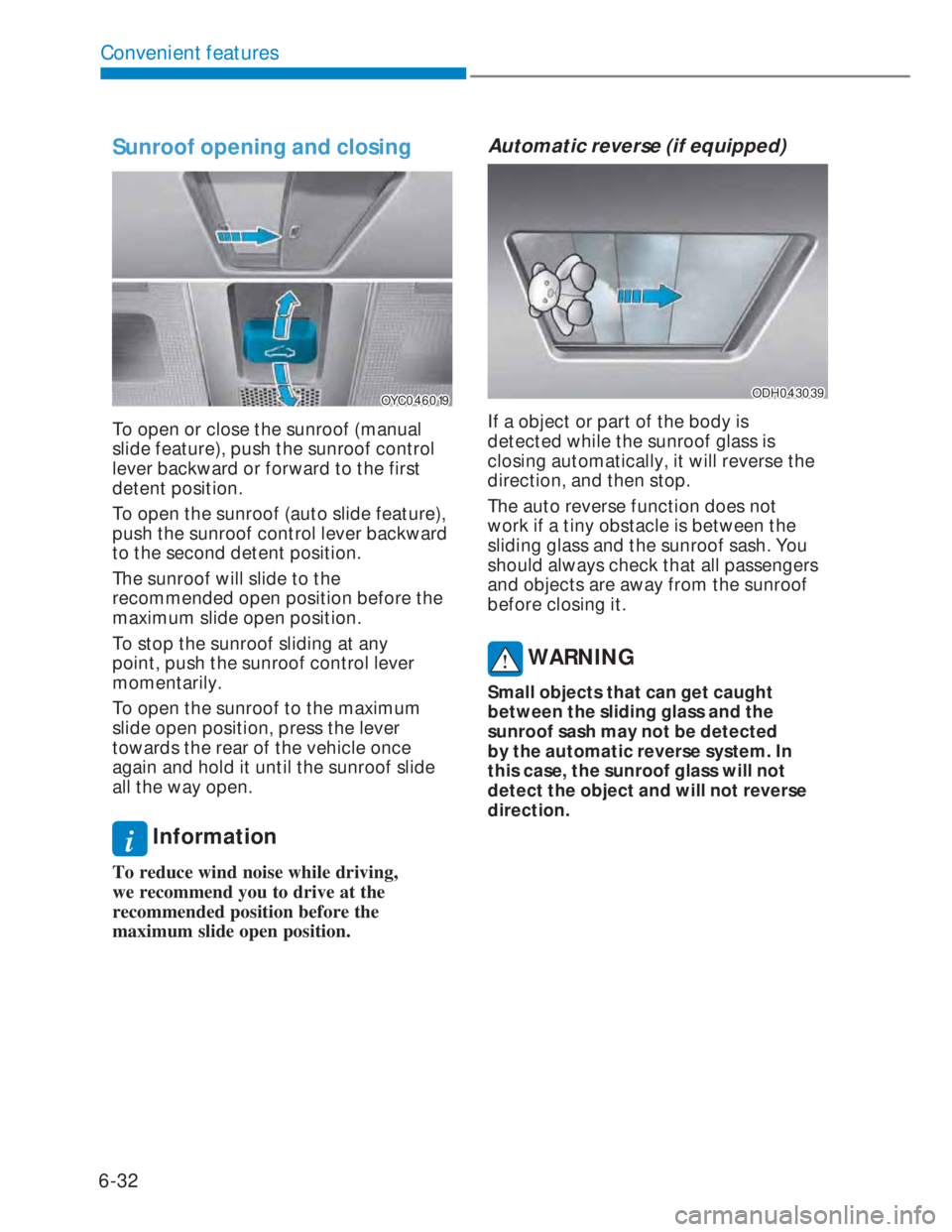
Sunroof opening and closing
OYC046019OYC046019
To open or close the sunroof (manual
slide feature), push the sunroof control
lever backward or forward to the first
detent position.
To open the sunroof (auto slide feature),
push the sunroof control lever backward
to the second detent position.
The sunroof will slide to the
recommended open position before the
maximum slide open position.
To stop the sunroof sliding at any
point, push the sunroof control lever
momentarily.
To open the sunroof to the maximum
slide open position, press the lever
towards the rear of the vehicle once
again and hold it until the sunroof slide
all the way open.
i Information
To reduce wind noise while driving,
we recommend you to drive at the
recommended position before the
maximum slide open position.
Automatic reverse (if equipped)
ODH043039ODH043039
If a object or part of the body is
detected while the sunroof glass is
closing automatically, it will reverse the
direction, and then stop.
The auto reverse function does not
work if a tiny obstacle is between the
sliding glass and the sunroof sash. You
should always check that all passengers
and objects are away from the sunroof
before closing it.
WARNING
Small objects that can get caught
between the sliding glass and the
sunroof sash may not be detected
by the automatic reverse system. In
this case, the sunroof glass will not
detect the object and will not reverse
direction.
Page 171 of 444
6-43
06
OBI3050020OBI3050020
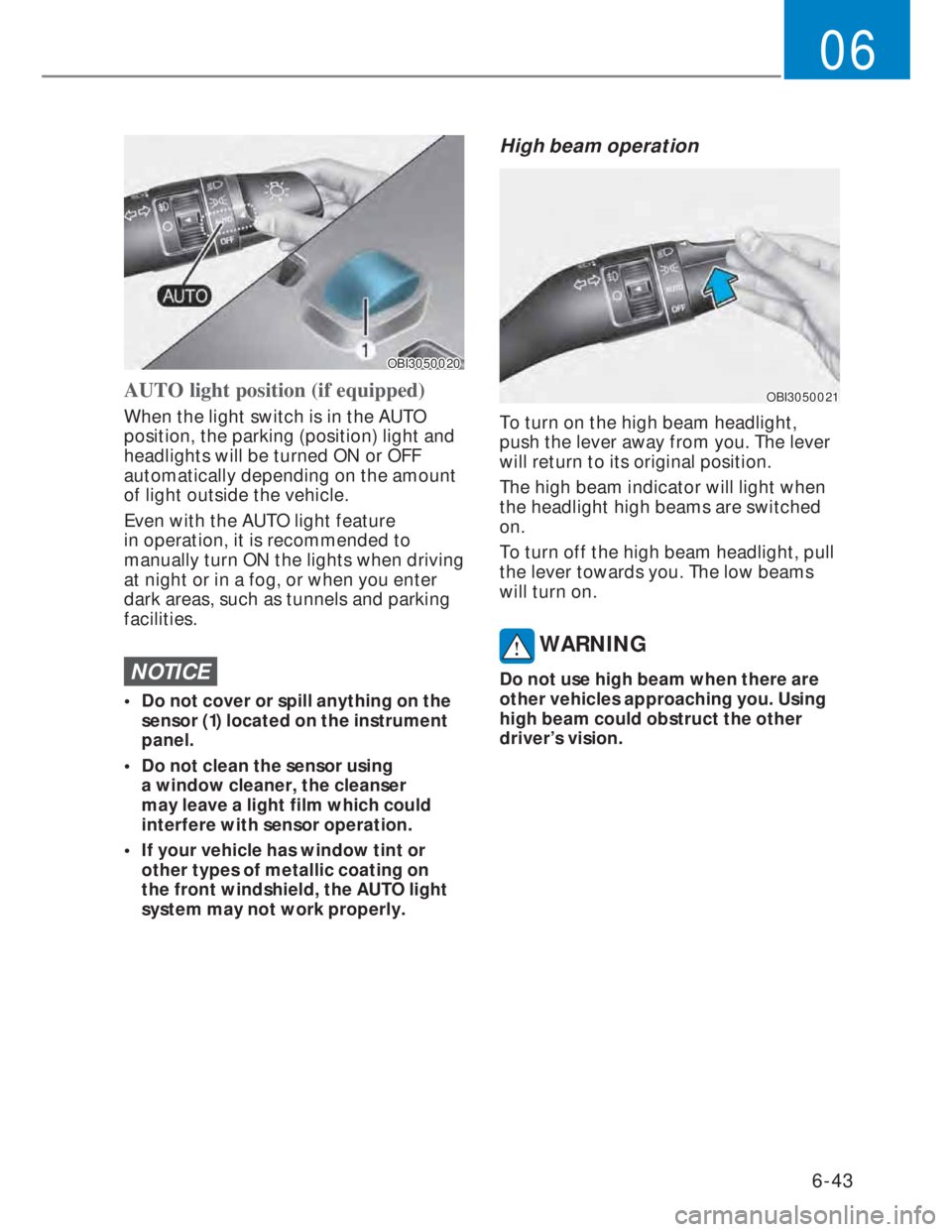
AUTO light position (if equipped)
When the light switch is in the AUTO
position, the parking (position) light and
headlights will be turned ON or OFF
automatically depending on the amount
of light outside the vehicle.
Even with the AUTO light feature
in operation, it is recommended to
manually turn ON the lights when driving
at night or in a fog, or when you enter
dark areas, such as tunnels and parking
facilities.
NOTICE
• Do not cover or spill anything on the
sensor (1) located on the instrument
panel.
• Do not clean the sensor using
a window cleaner, the cleanser
may leave a light film which could
interfere with sensor operation.
• If your vehicle has window tint or
other types of metallic coating on
the front windshield, the AUTO light
system may not work properly.
High beam operation
OBI3050021OBI3050021
To turn on the high beam headlight,
push the lever away from you. The lever
will return to its original position.
The high beam indicator will light when
the headlight high beams are switched
on.
To turn off the high beam headlight, pull
the lever towards you. The low beams
will turn on.
WARNING
Do not use high beam when there are
other vehicles approaching you. Using
high beam could obstruct the other
driver’s vision.
Page 172 of 444
6-44
Convenient features
OBI3050022OBI3050022
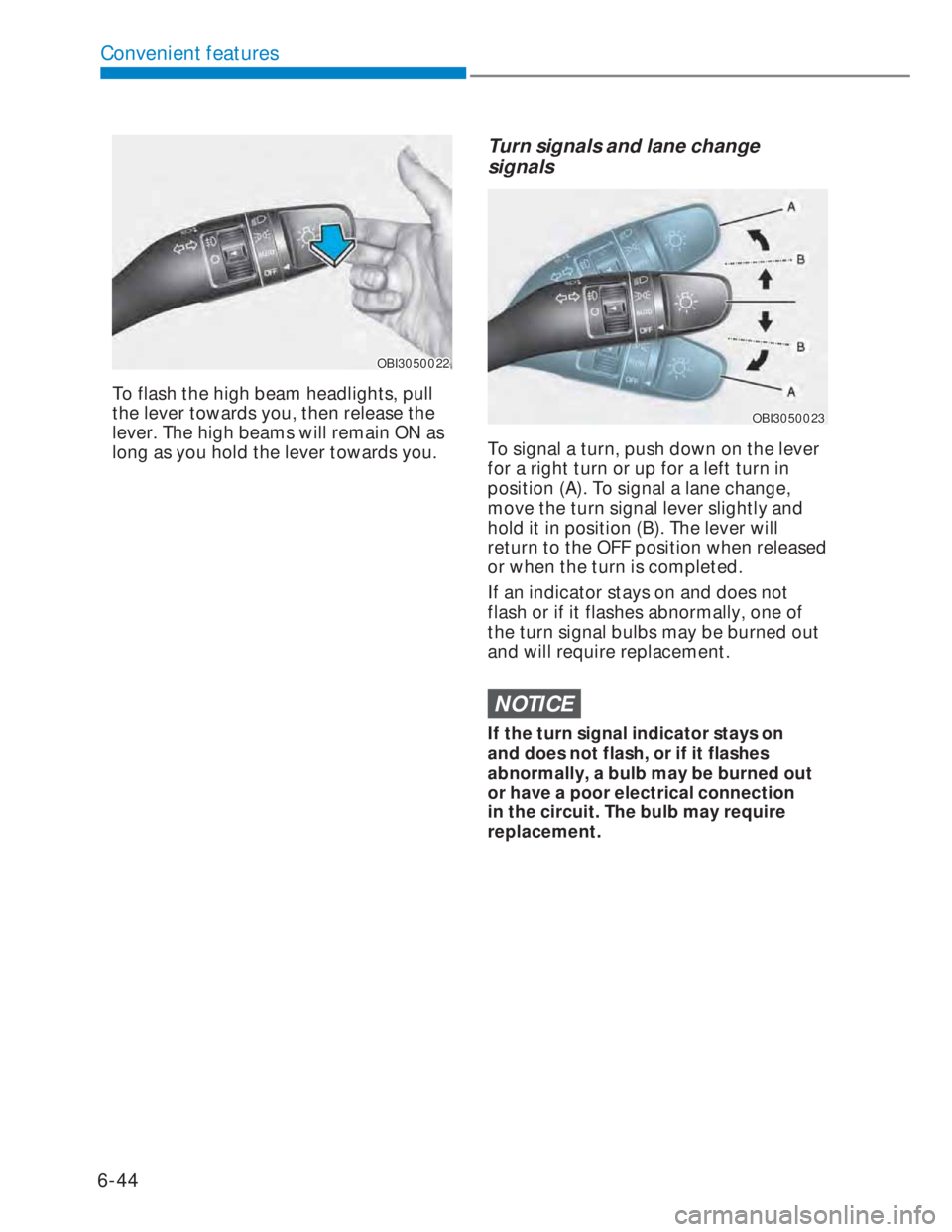
To flash the high beam headlights, pull
the lever towards you, then release the
lever. The high beams will remain ON as
long as you hold the lever towards you.
Turn signals and lane change
signals
OBI3050023OBI3050023
To signal a turn, push down on the lever
for a right turn or up for a left turn in
position (A). To signal a lane change,
move the turn signal lever slightly and
hold it in position (B). The lever will
return to the OFF position when released
or when the turn is completed.
If an indicator stays on and does not
flash or if it flashes abnormally, one of
the turn signal bulbs may be burned out
and will require replacement.
NOTICE
If the turn signal indicator stays on
and does not flash, or if it flashes
abnormally, a bulb may be burned out
or have a poor electrical connection
in the circuit. The bulb may require
replacement.
Page 179 of 444
6-51
06
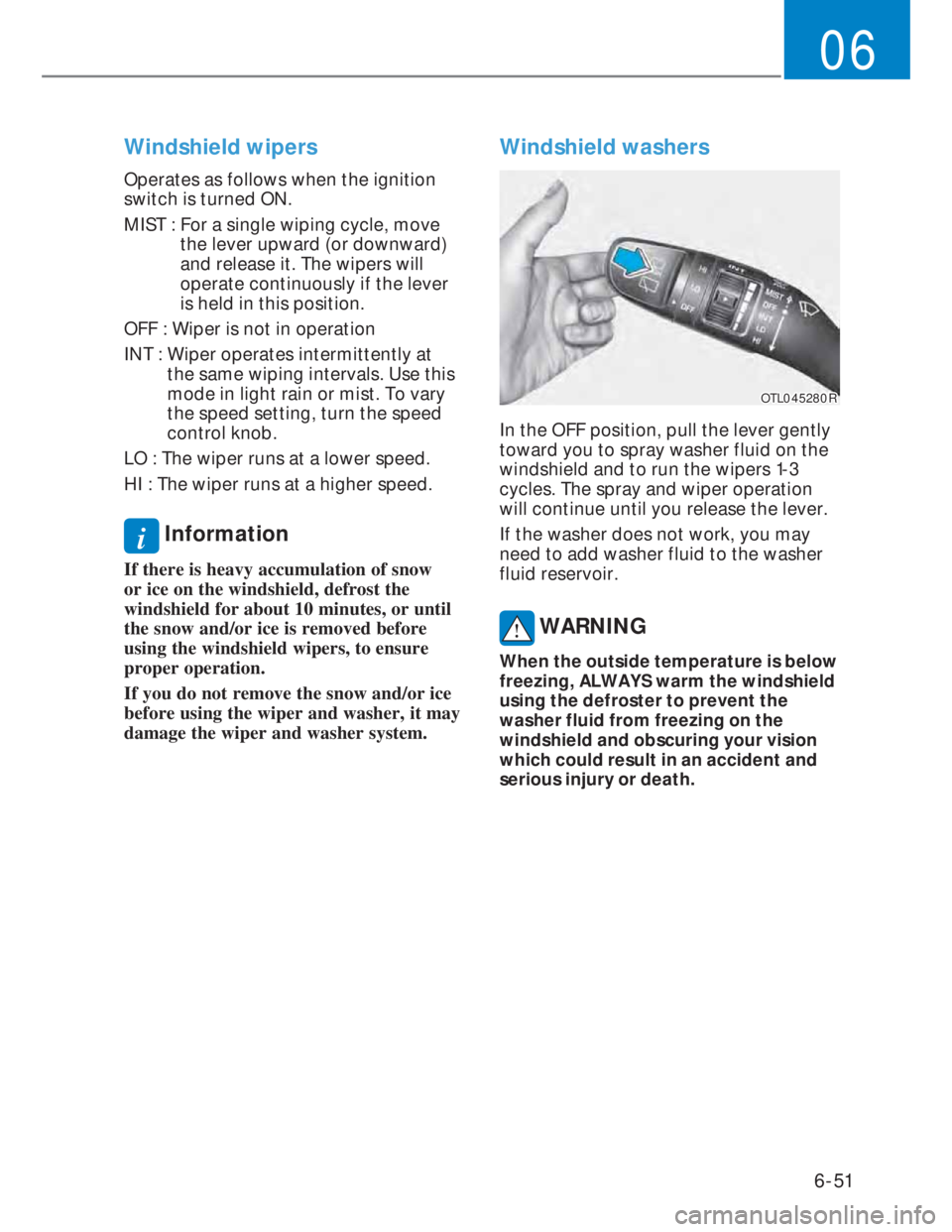
Windshield wipers
Operates as follows when the ignition
switch is turned ON.
MIST : For a single wiping cycle, move
the lever upward (or downward)
and release it. The wipers will
operate continuously if the lever
is held in this position.
OFF : Wiper is not in operation
INT : Wiper operates intermittently at
the same wiping intervals. Use this
mode in light rain or mist. To vary
the speed setting, turn the speed
control knob.
LO : The wiper runs at a lower speed.
HI : The wiper runs at a higher speed.
i Information
If there is heavy accumulation of snow
or ice on the windshield, defrost the
windshield for about 10 minutes, or until
the snow and/or ice is removed before
using the windshield wipers, to ensure
proper operation.
If you do not remove the snow and/or ice
before using the wiper and washer, it may
damage the wiper and washer system.
Windshield washers
OTL045280ROTL045280R
In the OFF position, pull the lever gently
toward you to spray washer fluid on the
windshield and to run the wipers 1-3
cycles. The spray and wiper operation
will continue until you release the lever.
If the washer does not work, you may
need to add washer fluid to the washer
fluid reservoir.
WARNING
When the outside temperature is below
freezing, ALWAYS warm the windshield
using the defroster to prevent the
washer fluid from freezing on the
windshield and obscuring your vision
which could result in an accident and
serious injury or death.
Page 183 of 444
6-55
06
OBI3050102OBI3050102
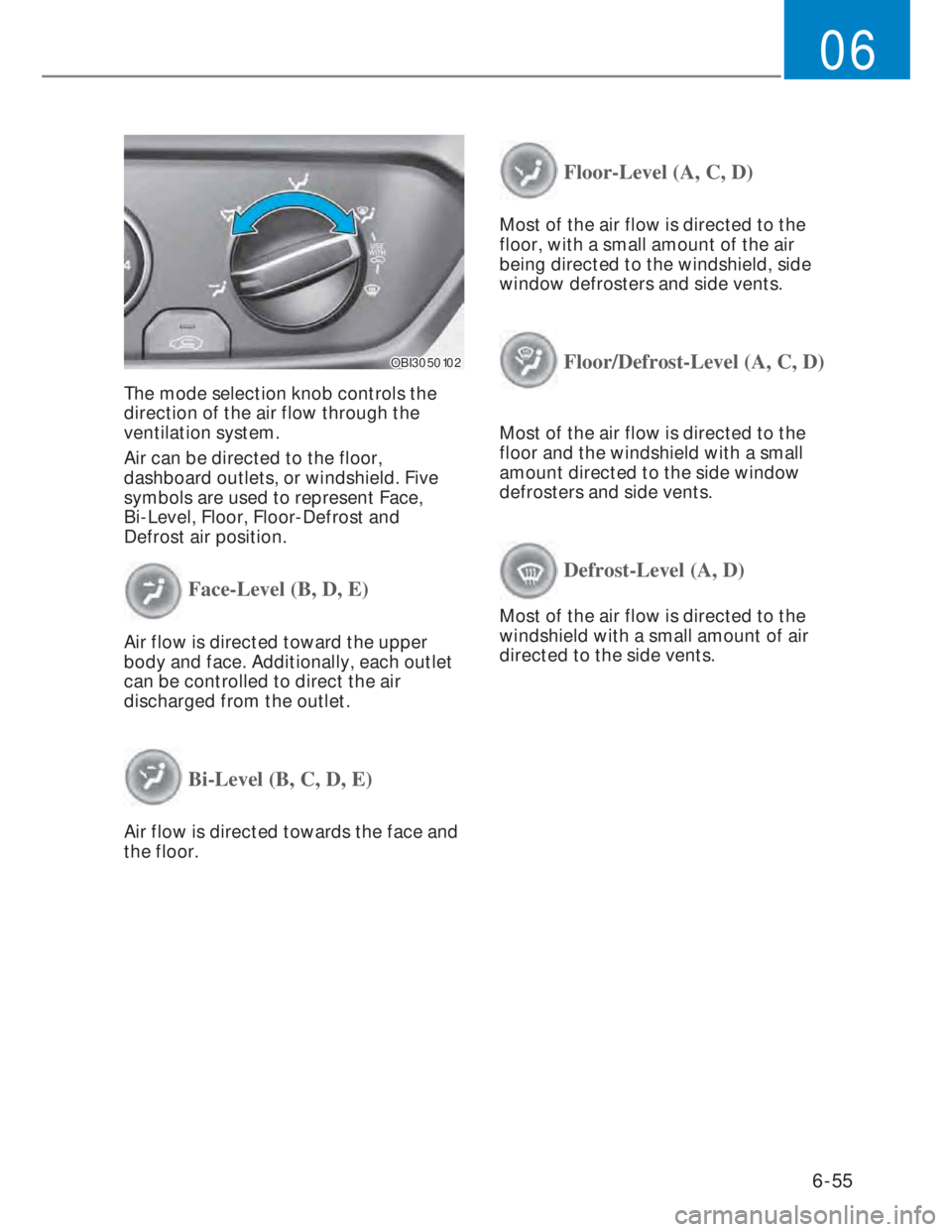
The mode selection knob controls the
direction of the air flow through the
ventilation system.
Air can be directed to the floor,
dashboard outlets, or windshield. Five
symbols are used to represent Face,
Bi-Level, Floor, Floor-Defrost and
Defrost air position.
Face-Level (B, D, E)
Air flow is directed toward the upper
body and face. Additionally, each outlet
can be controlled to direct the air
discharged from the outlet.
Bi-Level (B, C, D, E)
Air flow is directed towards the face and
the floor.
Floor-Level (A, C, D)
Most of the air flow is directed to the
floor, with a small amount of the air
being directed to the windshield, side
window defrosters and side vents.
Floor/Defrost-Level (A, C, D)
Most of the air flow is directed to the
floor and the windshield with a small
amount directed to the side window
defrosters and side vents.
Defrost-Level (A, D)
Most of the air flow is directed to the
windshield with a small amount of air
directed to the side vents.
Page 193 of 444
6-65
06
OBI3050113OBI3050113
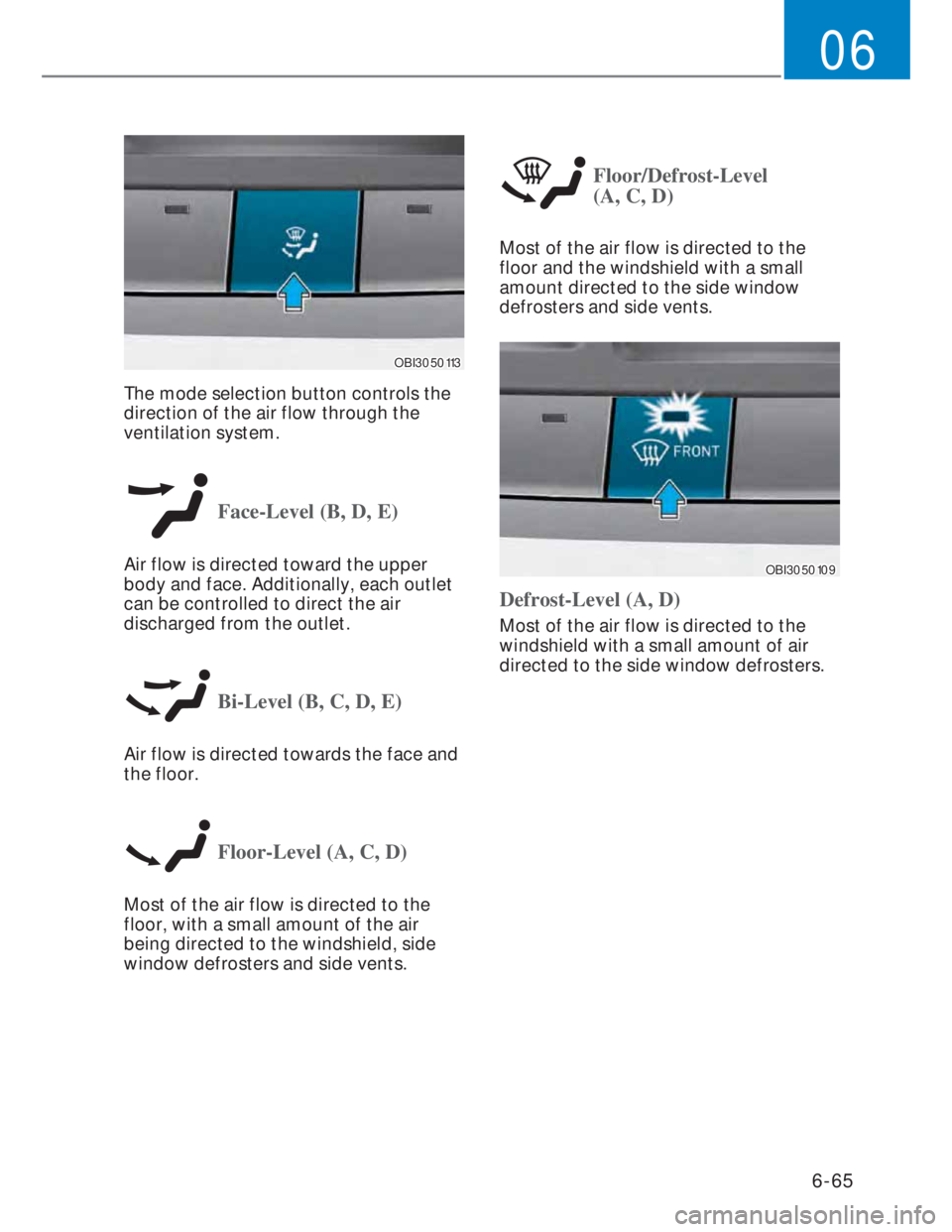
The mode selection button controls the
direction of the air flow through the
ventilation system.
Face-Level (B, D, E)
Air flow is directed toward the upper
body and face. Additionally, each outlet
can be controlled to direct the air
discharged from the outlet.
Bi-Level (B, C, D, E)
Air flow is directed towards the face and
the floor.
Floor-Level (A, C, D)
Most of the air flow is directed to the
floor, with a small amount of the air
being directed to the windshield, side
window defrosters and side vents.
Floor/Defrost-Level
(A, C, D)
Most of the air flow is directed to the
floor and the windshield with a small
amount directed to the side window
defrosters and side vents.
OBI3050109OBI3050109
Defrost-Level (A, D)
Most of the air flow is directed to the
windshield with a small amount of air
directed to the side window defrosters.
Page 219 of 444
6-91
06
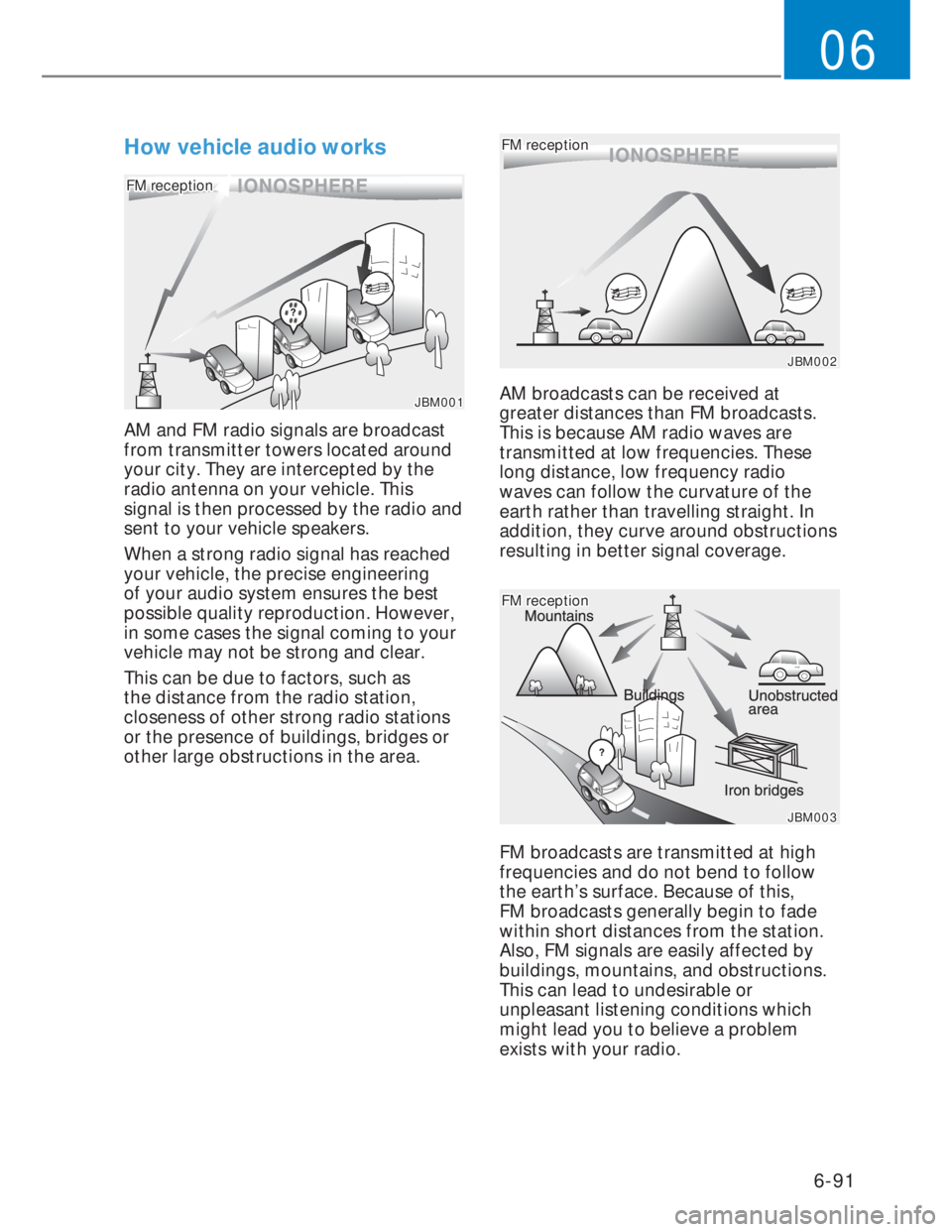
How vehicle audio works
FM receptionFM reception
JBM001JBM001
AM and FM radio signals are broadcast
from transmitter towers located around
your city. They are intercepted by the
radio antenna on your vehicle. This
signal is then processed by the radio and
sent to your vehicle speakers.
When a strong radio signal has reached
your vehicle, the precise engineering
of your audio system ensures the best
possible quality reproduction. However,
in some cases the signal coming to your
vehicle may not be strong and clear.
This can be due to factors, such as
the distance from the radio station,
closeness of other strong radio stations
or the presence of buildings, bridges or
other large obstructions in the area.
FM receptionFM reception
JBM002JBM002
AM broadcasts can be received at
greater distances than FM broadcasts.
This is because AM radio waves are
transmitted at low frequencies. These
long distance, low frequency radio
waves can follow the curvature of the
earth rather than travelling straight. In
addition, they curve around obstructions
resulting in better signal coverage.
FM receptionFM reception
JBM003JBM003
FM broadcasts are transmitted at high
frequencies and do not bend to follow
the earth’s surface. Because of this,
FM broadcasts generally begin to fade
within short distances from the station.
Also, FM signals are easily affected by
buildings, mountains, and obstructions.
This can lead to undesirable or
unpleasant listening conditions which
might lead you to believe a problem
exists with your radio.
Page 256 of 444

7-9
07
NOTICE
If the engine does not start within 10
seconds after preheating is completed,
turn the ignition switch once more
to the LOCK position and wait for 10
seconds. Then turn the ignition switch
to the ON position in order to preheat
the engine again.
Starting and stopping the engine for
turbocharger intercooler
1. Do not race or accelerate the engine
immediately after starting the engine.
If the engine is cold, idle for several
seconds before sufficient lubrication is
ensured in the turbo charger unit.
2. After high speed or extended driving
that requires heavy engine load, idle
the engine about one minute before
turning the engine off.
This idle time will allow the
turbocharger to cool prior to shutting
the engine off.
NOTICE
Do not turn off the engine immediately
after it has been subjected to a heavy
load. Doing so may cause severe
damage to the engine or turbo charger
unit.
NOTICE
To prevent damage to the vehicle:
• Do not hold the ignition key in the
START position for more than 10
seconds. Wait 5 to 10 seconds before
trying again.
• Do not turn the ignition switch to
the START position with the engine
running. It may damage the starter.
• If traffic and road conditions permit,
you may put the shift lever in the N
(Neutral) position while the vehicle
is still moving and turn the ignition
switch to the START position in an
attempt to restart the engine.
• Do not push or tow your vehicle to
start the engine.
Page 261 of 444

7-14
Driving your vehicle
Starting and stopping the engine for
turbocharger intercooler
1. Do not race or accelerate the engine
immediately after starting the engine.
If the engine is cold, idle for several
seconds before sufficient lubrication is
ensured in the turbo charger unit.
2. After high speed or extended driving
that requires heavy engine load, idle
the engine about one minute before
turning the engine off. This idle time
will allow the turbocharger to cool
prior to shutting the engine off.
NOTICE
Do not turn off the engine immediately
after it has been subjected to a heavy
load. Doing so may cause severe
damage to the engine or turbo charger
unit.
NOTICE
To prevent damage to the vehicle:
• If traffic and road conditions permit,
you may put the shift lever in the N
(Neutral) position while the vehicle
is still moving and press the Engine
Start/Stop button in an attempt to
restart the engine.
• Do not push or tow your vehicle to
start the engine.
NOTICE
To prevent damage to the vehicle:
When the stop lamp fuse is blown, you
can’t start the engine normally. Replace
the fuse with a new one. If you are not
able to replace the fuse, you can start
the engine by pressing and holding
the Engine Start/Stop button for 10
seconds with the Engine Start/Stop
button in the ACC position.
Do not press the Engine Start/Stop
button for more than 10 seconds except
when the stop lamp fuse is blown.
For your safety always depress the
brake and/or clutch pedal before
starting the engine.
OBI3060002OBI3060002
i Information
If the smart key battery is weak or the
smart key does not work correctly, you
can start the engine by pressing the
Engine Start/Stop button with the smart
key in the direction of the picture above.