fuel pressure HYUNDAI I20 2020 Owners Manual
[x] Cancel search | Manufacturer: HYUNDAI, Model Year: 2020, Model line: I20, Model: HYUNDAI I20 2020Pages: 444, PDF Size: 8.93 MB
Page 103 of 444

5-13
05
NOTICE
- Engine Oil Pressure Warning Light
• If the engine does not stop
immediately after the Engine Oil
Pressure Warning Light is illuminated,
severe damage could result.
• If the warning light stays on while the
engine is running, it indicates that
there may be serious engine damage
or malfunction. In this case,
1. Stop the vehicle as soon as it is safe
to do so.
2. Turn off the engine and check the
oil level. If the oil level is low, fill
the engine oil to the proper level.
3. Start the engine again. If the
warning light stays on after the
engine is started, turn the engine
off immediately. In this case, we
recommend that you have the
vehicle inspected by an authorized
HYUNDAI dealer.
Low Fuel Level Warning
Light
This warning light illuminates:
When the fuel tank is nearly empty.
If the fuel tank is nearly empty, add fuel
as soon as possible.
NOTICE
- Low Fuel Level
Driving with the Low Fuel Level
warning light on or with the fuel level
below “E (Empty)” can cause the
engine to misfire and damage the
catalytic converter (if equipped).
Page 104 of 444

5-14
Instrument cluster
Fuel Filter Warning Light
(for diesel engine)
This warning light illuminates:
• When water has accumulated inside
the fuel filter.
In this case, remove the water from
the fuel filter.
For more details, refer to “Fuel Filter” in
chapter 9.
NOTICE
• When the Fuel Filter Warning Light
illuminates, engine power (vehicle
speed & idle speed) may decrease.
• If you keep driving with the warning
light on, engine parts (injector,
common rail, high pressure fuel
pump) may be damaged. If this
occurs, we recommend that you
have the vehicle inspected by an
authorized HYUNDAI dealer as soon
as possible.
Exhaust System (DPF)
Warning Light (for diesel
engine, if equipped)
This warning light illuminates:
• When there is a malfunction with the
Diesel Particulate Filter (DPF) system.
When this warning light illuminates, it
may turn off after driving the vehicle:
- at more than 60 km/h (37 mph), or
- above 2nd gear with 1500 ~ 2500
engine rpm for a certain time (for
about 25 minutes).
If this warning light blinks in spite of
the procedure, we recommend that you
have the DPF system checked by an
authorized HYUNDAI dealer.
NOTICE
If you continue to drive with the DPF
warning light blinking for a long time,
the DPF system can be damaged and
fuel consumption can worsen.
Page 111 of 444

5-21
05
Wiper mode
OCN7040039LOCN7040039L
This indicator displays which wiper
speed is selected using the wiper
control.
Turn on FUSE SWITCH
This warning message is displayed if
the fuse switch located on the fuse box
under the steering wheel is OFF.
You should turn the fuse switch on.
For more details, refer to “Fuses”
Section in chapter 9.
Low pressure (if equipped)
OBI3040008OBI3040008
This warning message is displayed if the
tire pressure is low. The corresponding
tire on the vehicle will be illuminated.
For more details, refer to “Tire Pressure
Monitoring System (TPMS)” section in
chapter 8.
Heated Steering Wheel turned off
(if equipped)
This message illuminates if the heated
steering wheel will turn off automatically
approximately 30 minutes after the
heated steering wheel is turned on.
For more details, refer to “Heated
Steering Wheel” in chapter 5.
Low fuel
This warning message is displayed if the
fuel tank is almost out of fuel.
When this message is displayed, the low
fuel level warning light in the cluster will
come on.
It is recommended to look for the
nearest fueling station and refuel as
soon as possible.
Page 114 of 444

5-24
Instrument cluster
LCD display modes
Modes Symbol Explanation
Trip
ComputerThis mode displays driving information such as the tripmeter,
fuel economy, etc.
For more details, refer to "Trip Computer" in this chapter.
Turn By
Turn (TBT)
This mode displays the state of the navigation.
Driving
Assist
- Cruise Control (CC)
- Tire Pressure (TPMS)
User
Settings
In this mode, you can change settings of the doors, lamps,
etc.
Warning
- This mode displays warning messages related to the
lamp malfunction, etc.
- Tire pressure information
The information provided may differ depending on which functions are applicable
to your vehicle.
Page 115 of 444

5-25
05
Trip computer mode
OIK047124LOIK047124L
The trip computer mode displays
information related to vehicle driving
parameters including fuel economy,
tripmeter information and vehicle speed.
For more details, refer to "Trip
Computer" in this chapter.
Turn By Turn (TBT) group
OCN7060149OCN7060149
This group displays the state of the
navigation.
Driving Assist mode
OSU2I049039OSU2I049039
CC
This mode displays the state of Cruise
Control (CC).
For more details, refer to “Cruise
Control” in chapter 7.
OBI3040009OBI3040009
Tire Pressure
This mode displays information related
to Tire Pressure.
For more details, refer to “Tire Pressure
Monitoring System (TPMS)” in chapter
8.
Page 119 of 444

5-29
05
Other features
ItemsExplanation
Fuel Economy
Auto Reset• Off : The average fuel economy will not reset automatically whenever
refueling.
• After Ignition : The average fuel economy will reset automatically
whenever it has passed 4 hours after turning OFF the engine.
• After Refueling : The average fuel economy will reset automatically
when refueling.
For more details, refer to “Trip Computer” in this chapter.
Fuel Economy
UnitChoose the fuel economy unit. (Km/L, L/100km)
Temperature
UnitChoose the temperature unit. (°C,°F)
Tyre pressure
unitTo select the tire pressure unit. (psi, kPa, bar)
Language
ItemsExplanation
LanguageChoose the language.
Reset
ItemsExplanation
ResetYou can reset the menus in the User Settings Mode. All menus in the
User Settings Mode are reset to factory settings, except language and
service interval.
Page 167 of 444
6-39
06
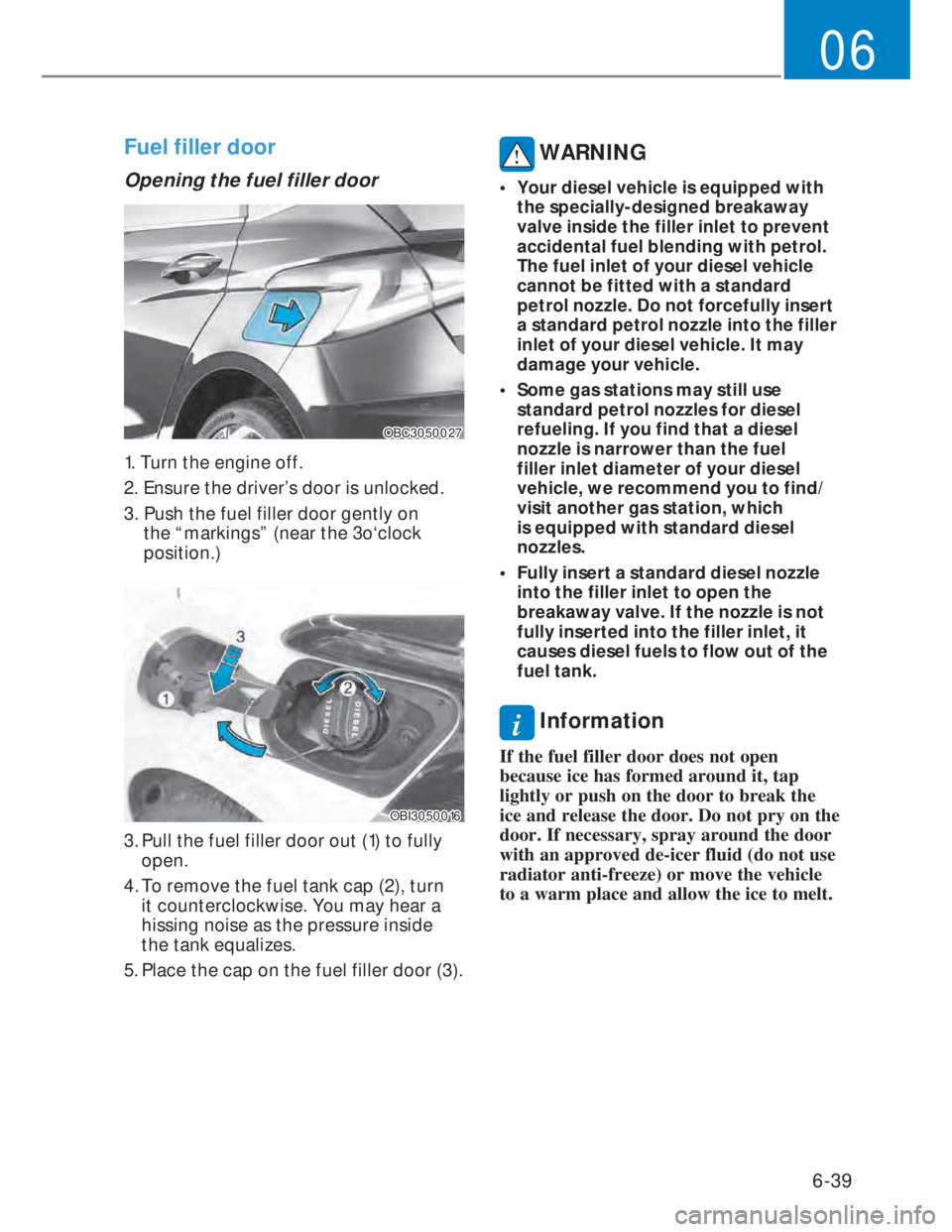
Fuel filler door
Opening the fuel filler door
OBC3050027OBC3050027
1. Turn the engine off.
2. Ensure the driver’s door is unlocked.
3. Push the fuel filler door gently on
the “markings” (near the 3o‘clock
position.)
OBI3050016OBI3050016
3. Pull the fuel filler door out (1) to fully
open.
4. To remove the fuel tank cap (2), turn
it counterclockwise. You may hear a
hissing noise as the pressure inside
the tank equalizes.
5. Place the cap on the fuel filler door (3).
WARNING
• Your diesel vehicle is equipped with
the specially-designed breakaway
valve inside the filler inlet to prevent
accidental fuel blending with petrol.
The fuel inlet of your diesel vehicle
cannot be fitted with a standard
petrol nozzle. Do not forcefully insert
a standard petrol nozzle into the filler
inlet of your diesel vehicle. It may
damage your vehicle.
• Some gas stations may still use
standard petrol nozzles for diesel
refueling. If you find that a diesel
nozzle is narrower than the fuel
filler inlet diameter of your diesel
vehicle, we recommend you to find/
visit another gas station, which
is equipped with standard diesel
nozzles.
• Fully insert a standard diesel nozzle
into the filler inlet to open the
breakaway valve. If the nozzle is not
fully inserted into the filler inlet, it
causes diesel fuels to flow out of the
fuel tank.
i Information
If the fuel filler door does not open
because ice has formed around it, tap
lightly or push on the door to break the
ice and release the door. Do not pry on the
door. If necessary, spray around the door
with an approved de-icer fluid (do not use
radiator anti-freeze) or move the vehicle
to a warm place and allow the ice to melt.
Page 324 of 444

9-10
Emergency situations
Tire pressure monitoring system
WARNING
Over-inflation or under-inflation can
reduce tire life, adversely affect vehicle
handling, and lead to sudden tire
failure that may cause loss of vehicle
control resulting in an accident.
Each tire, including the spare (if
provided), should be checked monthly
when cold and inflated to the inflation
pressure recommended by the vehicle
manufacturer on the vehicle placard
or tire inflation pressure label. (If your
vehicle has tires of a different size
than the size indicated on the vehicle
placard or tire inflation pressure label,
you should determine the proper tire
inflation pressure for those tires.)
As an added safety feature, your
vehicle has been equipped with a tire
pressure monitoring system (TPMS)
that illuminates a low tire pressure
telltale when one or more of your tires is
significantly under-inflated.
Accordingly, when the low tire pressure
telltale illuminates, you should stop and
check your tires as soon as possible,
and inflate them to the proper pressure.
Driving on a significantly under-inflated
tire causes the tire to overheat and can
lead to tire failure. Under-inflation also
reduces fuel efficiency and tire tread life,
and may affect the vehicle’s handling
and stopping ability.
Please note that the TPMS is not a
substitute for proper tire maintenance,
and it is the driver’s responsibility to
maintain correct tire pressure, even if
under-inflation has not reached the level
to trigger illumination of the TPMS low
tire pressure telltale.Your vehicle has also been equipped
with a TPMS malfunction indicator
to indicate when the system is
not operating properly. The TPMS
malfunction indicator is combined with
the low tire pressure telltale. When
the system detects a malfunction, the
telltale will flash for approximately one
minute and then remain continuously
illuminated. This sequence will continue
upon subsequent vehicle start-ups as
long as the malfunction exists. When
the malfunction indicator is illuminated,
the system may not be able to detect
or signal low tire pressure as intended.
TPMS malfunctions may occur for
a variety of reasons, including the
installation of replacement or alternate
tires or wheels on the vehicle that
prevent the TPMS from functioning
properly. Always check the TPMS
malfunction telltale after replacing
one or more tires or wheels on your
vehicle to ensure that the replacement
or alternate tires and wheels allow the
TPMS to continue to function properly.
i Information
If the TPMS indicator does not illuminate
for 3 seconds when the ignition switch
is turned to the ON position or engine
is running, or if it comes on after
blinking for approximately one minute,
we recommend that you contact an
authorized HYUNDAI dealer.
Page 347 of 444

10-8
Maintenance
The following lists are vehicle checks
and inspections that should be
performed at the frequencies indicated
to help ensure safe, dependable
operation of your vehicle.
Any adverse conditions should be
brought to the attention of your dealer
as soon as possible.
These Owner Maintenance Checks are
generally not covered by warranties and
you may be charged for labor, parts and
lubricants used.
WARNING
Diesel Engine
Never manipulate or modify the
injection system while running the
diesel engine or within 30 seconds
after turning OFF the diesel engine. The
high-pressure pump, high-pressure
pipes, rail, and injectors are still subject
to high pressure immediately after
stopping the diesel engine.
When the fuel leakage vents out, it
may cause serious body injury. Any
people, who are implanted with the
artificial cardiac pacemaker, should
remain away from the ECU or the
wiring harness by at least 30 cm,
while running the diesel engine. The
high currents of the electronic engine
control system produce a considerable
amount of magnetic fields.
Owner maintenance schedule
When you stop for fuel:
• Check the engine oil level.
• Check the coolant level in coolant
reservoir.
• Check the windshield washer fluid
level.
• Look for low or under-inflated tires.
• Check the radiator and condenser.
Check if the front of the radiator and
condenser are clean and not blocked
with leaves, dirt or insects etc.
If any of the above parts are extremely
dirty or you are not sure of their
condition, we recommend that you
contact an authorized HYUNDAI
dealer.
WARNING
Be careful when checking your engine
coolant level when the engine is hot.
Scalding hot coolant and steam may
blow out under pressure. This could
cause burns or other serious injury.
OWNER MAINTENANCE
Page 353 of 444
10-14
Maintenance
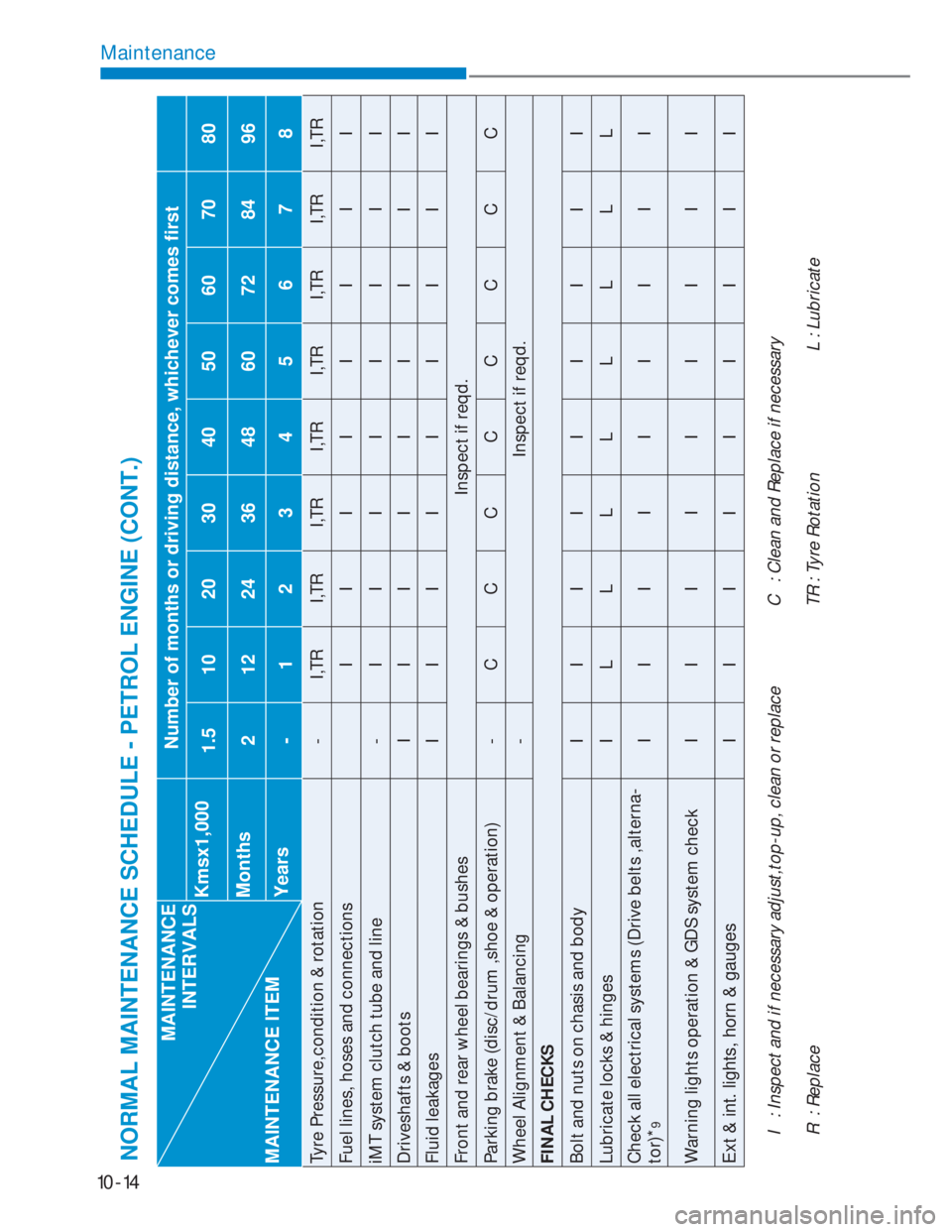
MAINTENANCE
INTERVALS
MAINTENANCE ITEMNumber of months or driving distance, whichever comes first
Kmsx1,000
1.51020304050607080
Months
2 1224364860728496
Years
- 12345678
Tyre Pressure,condition & rotation - I,TR I,TR I,TR I,TR I,TR I,TR I,TR I,TR
Fuel lines, hoses and connections IIIIIIII
iMT system clutch tube and line - I IIIIIII
Driveshafts & bootsIIIIIIIII
Fluid leakages IIIIIIIII
Front and rear wheel bearings & bushes Inspect if reqd.
Parking brake (disc/drum ,shoe & operation) - CCCCCCCC
Wheel Alignment & Balancing - Inspect if reqd.
FINAL CHECKS
Bolt and nuts on chasis and body I I IIIIIII
Lubricate locks & hinges ILLLLLLLL
Check all electrical systems (Drive belts ,alterna-
tor)*
9
IIIIIIIII
Warning lights operation & GDS system check I IIIIIIII
Ext & int. lights, horn & gaugesIIIIIIIII
NORMAL MAINTENANCE SCHEDULE - PETROL ENGINE (CONT.)
I : Inspect and if necessary adjust,top-up, clean or replace
R : ReplaceC : Clean and Replace if necessary
TR : Tyre Rotation L : Lubricate