fuel type HYUNDAI I20 2021 User Guide
[x] Cancel search | Manufacturer: HYUNDAI, Model Year: 2021, Model line: I20, Model: HYUNDAI I20 2021Pages: 444, PDF Size: 8.93 MB
Page 169 of 444

6-41
06
• When refueling, always move the
shift lever to the P (Park) position (for
Intelligent Manual Transmission) or
first gear or R (Reverse, for manual
transmission), set the parking brake,
and place the ignition switch to the
LOCK/OFF position. Sparks produced
by electrical components related
to the engine can ignite fuel vapors
causing a fire.
• Do not use matches or a lighter and
do not smoke or leave a lit cigarette
in your vehicle while at a gas station,
especially during refueling.
• Do not over-fill or top-off your
vehicle tank, which can cause petrol
spillage.
• If a fire breaks out during refueling,
leave the vicinity of the vehicle, and
immediately contact the manager
of the gas station and then contact
the local fire department. Follow any
safety instructions they provide.
• If pressurized fuel sprays out, it can
cover your clothes or skin and thus
subject you to the risk of fire and
burns. Always remove the fuel cap
carefully and slowly. If the cap is
venting fuel or if you hear a hissing
sound, wait until the condition stops
before completely removing the cap.
• Always check that the fuel cap is
installed securely to prevent fuel
spillage in the event of an accident.i Information
• Make sure to refuel your vehicle
according to the “Fuel Requirements”
suggested in the 1 chapter.
• Do not spill fuel on the exterior surfaces
of the vehicle. Any type of fuel spilled
on painted surfaces may damage the
paint.
NOTICE
If the fuel filler cap requires
replacement, use only a genuine
HYUNDAI cap or the equivalent
specified for your vehicle. An incorrect
fuel filler cap can result in a serious
malfunction of the fuel system or
emission control system.
Page 269 of 444
7-22
Driving your vehicle
• The dual clutch transmission
incorporates a dry-type dual clutch
mechanism, which allows for better
acceleration performance and
increased fuel efficiency while driving.
But it differs from a conventional
automatic transmission because
it does not incorporate a torque
converter. Instead, the transition from
one gear to the next is managed by
clutch slip, especially at lower speeds.
As a result, shifts are sometimes more
noticeable, and a light vibration can be
felt as the transmission shaft speed is
matched with the engine shaft speed.
This is a normal condition of the dual
clutch transmission.
• The dry-type clutch transfers torque
more directly and provides a direct-
drive feeling which may feel different
from a conventional automatic
transmission. This may be more
noticeable when launching the vehicle
from a stop or when traveling at low,
stop-and-go vehicle speeds.
• When rapidly accelerating from a
lower vehicle speed, the engine
rpm may increase dramatically as a
result of clutch slip as the dual clutch
transmission selects the correct gear.
This is a normal condition.
• When accelerating from a stop on an
incline, press the accelerator smoothly
and gradually to avoid any shudder
feeling or jerkiness.
• When traveling at a lower vehicle
speed, if you release the accelerator
pedal quickly, you may feel engine
braking before the transmission
changes gears. This engine braking
feeling is similar to operating a manual
transmission at low speed.
• When driving downhill, you may
wish to move the gear shift lever to
Manual Shift mode and downshift to
a lower gear in order to control your
speed without using the brake pedal
excessively.• When you turn the engine on and off,
you may hear clicking sounds as the
system goes through a self-test. This
is a normal sound for the dual clutch
transmission.
• During the first 1,500 km (1000 miles),
you may feel that the vehicle may not
be smooth when accelerating at low
speed. During this break-in period, the
shift quality and performance of your
new vehicle is continuously optimized.
WARNING
To reduce the risk of serious injury or
death:
• ALWAYS check the surrounding
areas near your vehicle for people,
especially children, before shifting a
vehicle into D (Drive) or R (Reverse).
• Before leaving the driver’s seat,
always make sure the shift lever
is in the P (Park) position, then set
the parking brake, and place the
ignition switch in the LOCK/OFF
position. Unexpected and sudden
vehicle movement can occur if these
precautions are not followed.
• Do not use aggressive engine braking
(shifting from a higher gear to a lower
gear) on slippery roads. This could
cause the tires to slip and may result
in an accident.
Page 441 of 444
10-102
Maintenance
4. Self Regeneration Mode
LCD Type
If the warning message “Self
Regeneration” is stored in inspection
message tap, it is operable in LCD
warning message page.
WARNING
• Make sure the vehicle parked on
safety zone (to avoid the flammables
like grass and traffic accident)
• Check remained fuel above 1/5 of
full level fuel gauge to prevent fuel
overheat
• Open the hood to prevent engine
room overheat
• Self regeneration should be done
only when DPF indicator illuminates
OSU2I089042OSU2I089042
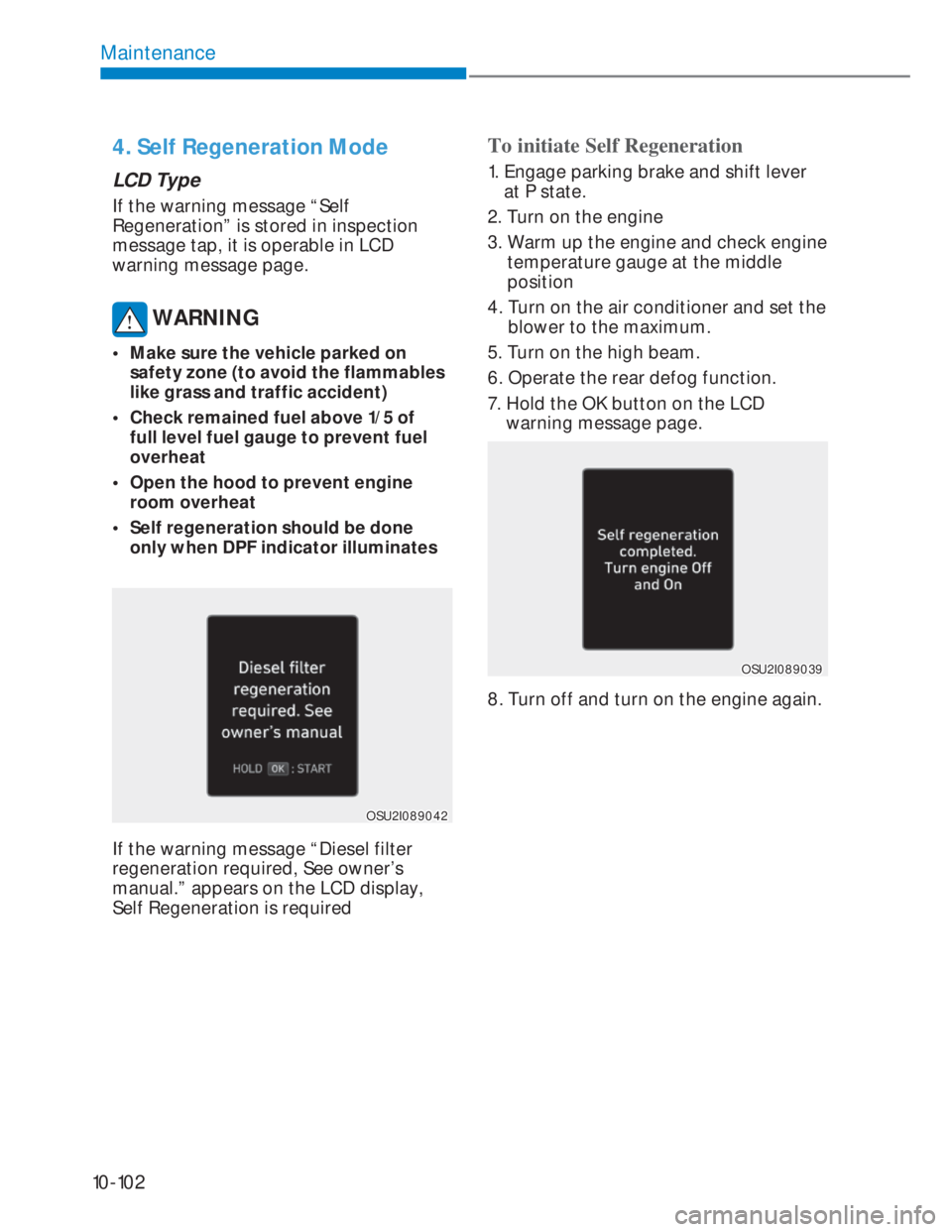
If the warning message “Diesel filter
regeneration required, See owner’s
manual.” appears on the LCD display,
Self Regeneration is required
To initiate Self Regeneration
1. Engage parking brake and shift lever
at P state.
2. Turn on the engine
3. Warm up the engine and check engine
temperature gauge at the middle
position
4. Turn on the air conditioner and set the
blower to the maximum.
5. Turn on the high beam.
6. Operate the rear defog function.
7. Hold the OK button on the LCD
warning message page.
OSU2I089039OSU2I089039
8. Turn off and turn on the engine again.