height HYUNDAI I20 2022 User Guide
[x] Cancel search | Manufacturer: HYUNDAI, Model Year: 2022, Model line: I20, Model: HYUNDAI I20 2022Pages: 444, PDF Size: 8.93 MB
Page 89 of 444
4-56
Safety system
• Do not attach or place objects on or
near the air bag covers. Any object
attached to or placed on the front air
bag covers could interfere with the
proper operation of the air bags.
• Do not modify the front seats.
Modification of the front seats could
interfere with the operation of the
supplemental restraint system sensing
components air bags.
• Do not place items under the
front seats. Placing items under
the front seats could interfere with
the operation of the supplemental
restraint system sensing components
and wiring harnesses.
• Never hold an infant or child on
your lap. The infant or child could be
seriously injured or killed in the event
of a crash. All infants and children
should be properly restrained in
appropriate child safety seats or seat
belts in the rear seat.
WARNING
• Sitting improperly or out of position
can cause occupants to be shifted
too close to a deploying air bag,
strike the interior structure or be
thrown from the vehicle resulting in
serious injury or death.
• Always sit upright with the seatback
in an upright position, centered on
the seat cushion with your seat belt
on, legs comfortably extended and
your feet on the floor.
Adding equipment to or modifying
your air bag-equipped vehicle
If you modify your vehicle by changing
your vehicle’s frame, bumper system,
front end or side sheet metal or ride
height, this may affect the operation of
your vehicle’s air bag system.
Page 149 of 444
6-21
06
Tilt steering / Telescope
steering (if equipped)
WARNING
Never adjust the steering wheel while
driving. You may lose steering control
and cause severe personal injury, death
or accidents.
i Information
After adjustment, sometimes the lock-
release lever may not lock the steering
wheel.
It is not a malfunction. This occurs when
two gears are not engaged correctly. In
this case, adjust the steering wheel again
and then lock the steering wheel.
OBI3050005OBI3050005
To change the steering wheel angle and
height:
1. Pull down the lock-release lever (1).
2. Adjust the steering wheel to the
desired angle (2) and height (3, if
equipped). Move the steering wheel,
so it points toward your chest, not
toward your face. Make sure you can
see the instrument panel warning
lights and gauges.
3. Pull up the lock-release lever to lock
the steering wheel in place.
Push the steering wheel both up and
down to be certain it is locked in
position.
CAUTION
While adjusting the steering wheel
height, please do not push or pull it
hard since the fixture can be damaged.
Page 216 of 444
6-88
Convenient features
NOTICE
• Before entering a place with a low
height clearance, be sure that the
antenna is removed.
• Be sure to remove the antenna before
washing the vehicle in an automatic
car wash or it may be damaged.
• When reinstalling your antenna, it is
important that it is fully tightened
and adjusted to the upright position
to ensure proper reception. But it
could be removed when parking the
vehicle.
NOTICE
Installation of aftermarket antenna may
result in water leakage, wind noise,
rattling & improper radio operation.
We recommend to use the antenna
available with an authorized Hyundai
dealer.
i Information
Some models do not have audio (plastic
blanking cover) system, and will not
supply radio main cable. Thus if you want
to insert Aftermarket audio or OEM
audio to listen radio broadcasting service,
we recommend to use the feeder cable
available with an authorized HYUNDAI
dealer.
Steering wheel audio control
(if equipped)
OBI3050053OBI3050053
The steering wheel audio control
switches are installed for your
convenience.
NOTICE
Do not operate audio remote control
buttons simultaneously.
Page 287 of 444
7-40
Driving your vehicle
Anti-lock Brake System (ABS)
WARNING
An Anti-Lock Braking System (ABS) or
an Electronic Stability Control (ESC)
system will not prevent accidents
due to improper or dangerous driving
maneuvers. Even though vehicle
control is improved during emergency
braking, always maintain a safe
distance between you and objects
ahead of you. Vehicle speeds should
always be reduced during extreme
road conditions. The braking distance
for vehicles equipped with ABS or ESC
may be longer than for those without
these systems in the following road
conditions.
Drive your vehicle at reduced speeds
during the following conditions:
• Rough, gravel or snow-covered
roads.
• On roads where the road surface is
pitted or has different surface height.
• Tire chains are installed on your
vehicle.
The safety features of an ABS or ESC
equipped vehicle should not be tested
by high speed driving or cornering. This
could endanger the safety of yourself
or others.
ABS is an electronic braking system that
helps prevent a braking skid. ABS allows
the driver to steer and brake at the same
time.
Using ABS
To obtain the maximum benefit from
your ABS in an emergency situation,
do not attempt to modulate your brake
pressure and do not try to pump your
brakes. Depress your brake pedal as
hard as possible.
When you apply your brakes under
conditions which may lock the wheels,
you may hear sounds from the brakes,
or feel a corresponding sensation in the
brake pedal. This is normal and it means
your ABS is active.
ABS does not reduce the time or
distance it takes to stop the vehicle.
Always maintain a safe distance from the
vehicle in front of you.
ABS will not prevent a skid that results
from sudden changes in direction, such
as trying to take a corner too fast or
making a sudden lane change. Always
drive at a safe speed for the road and
weather conditions.
ABS cannot prevent a loss of stability.
Always steer moderately when braking
hard. Severe or sharp steering wheel
movement can still cause your vehicle
to veer into oncoming traffic or off the
road.
On loose or uneven road surfaces,
operation of the anti-lock brake system
may result in a longer stopping distance
than for vehicles equipped with a
conventional brake system.
The ABS warning light (
) will stay
on for several seconds after the ignition
switch is in the ON position. During
that time, the ABS will go through self-
diagnosis and the light will go off if
everything is normal. If the light stays
on, you may have a problem with your
ABS. We recommend that you contact
an authorized HYUNDAI dealer as soon
as possible.
Page 314 of 444
Driver assistance system
8-12
• Reverse Parking Distance Warning
may malfunction when:
- Heavy rain or water spray is present
- Water flows on the surface of the
sensor
- Affected by another vehicle’s sensors
- The sensor is covered with snow
- Driving on uneven road, gravel roads
or bushes
- Objects that generates ultrasonic
waves are near the sensor
- Installing the license plate differently
from the original location
- The vehicle bumper height or
ultrasonic sensor installation has
been modified
- Attaching equipments or accessories
around the ultrasonic sensors
• The following objects may not be
detected:
- Sharp or slim objects, such as ropes,
chains or small poles.
- Objects, which tend to absorb sensor
frequency, such as clothes, spongy
material or snow.
- Objects smaller than 100 cm (40 in.)
in length and narrower than 14 cm (6
in.) in diameter.
- Pedestrians, animals or objects
that are very close to the ultrasonic
sensors
• Parking Distance Warning Indicators
may be displayed differently from
the actual detected location when
the obstacle is located between the
sensors.
• Parking Distance Warning indicator
may not occur sequentially depending
on vehicle speed or obstacle shape.
• If Reverse Parking Distance Warning
needs repair, we recommend that the
system be inspected by an authorized
HYUNDAI dealer.
Page 396 of 444
10-57
10
Compact spare tire replacement
(if equipped)
A compact spare tire has a shorter tread
life than a regular size tire. Replace
it when you can see the tread wear
indicator bars on the tire. The replaced
compact spare tire should be the same
size and design tire as the one provided
with your new vehicle and should be
mounted on the same compact spare
tire wheel. The compact spare tire is not
designed to be mounted on a regular
size wheel, and the compact spare tire
wheel is not designed to mount a regular
size tire.
Wheel replacement
When replacing the metal wheels for any
reason, make sure the new wheels are
equivalent to the original factory units in
diameter, rim width and offset.
WARNING
A wheel that is not the correct size may
adversely affect wheel and bearing life,
braking and stopping abilities, handling
characteristics, ground clearance,
body-to-tire clearance, snow chain
clearance, speedometer and odometer
calibration, headlight aim and bumper
height.
Tire traction
Tire traction can be reduced if you drive
on worn tires, tires that are improperly
inflated or on slippery road surfaces.
Tires should be replaced when tread
wear indicators appear. Slow down
whenever there is rain, snow or ice on
the road, to reduce the possibility of
losing control of the vehicle.
Page 397 of 444
10-58
Maintenance
Tire maintenance
In addition to proper inflation, correct
wheel alignment helps decrease tire
wear. If you find a tire worn unevenly,
have your dealer check the wheel
alignment.
When you have new tires installed,
make sure they are balanced. This will
increase vehicle ride comfort and tire
life. Additionally, a tire should always
be rebalanced if it is removed from the
wheel.
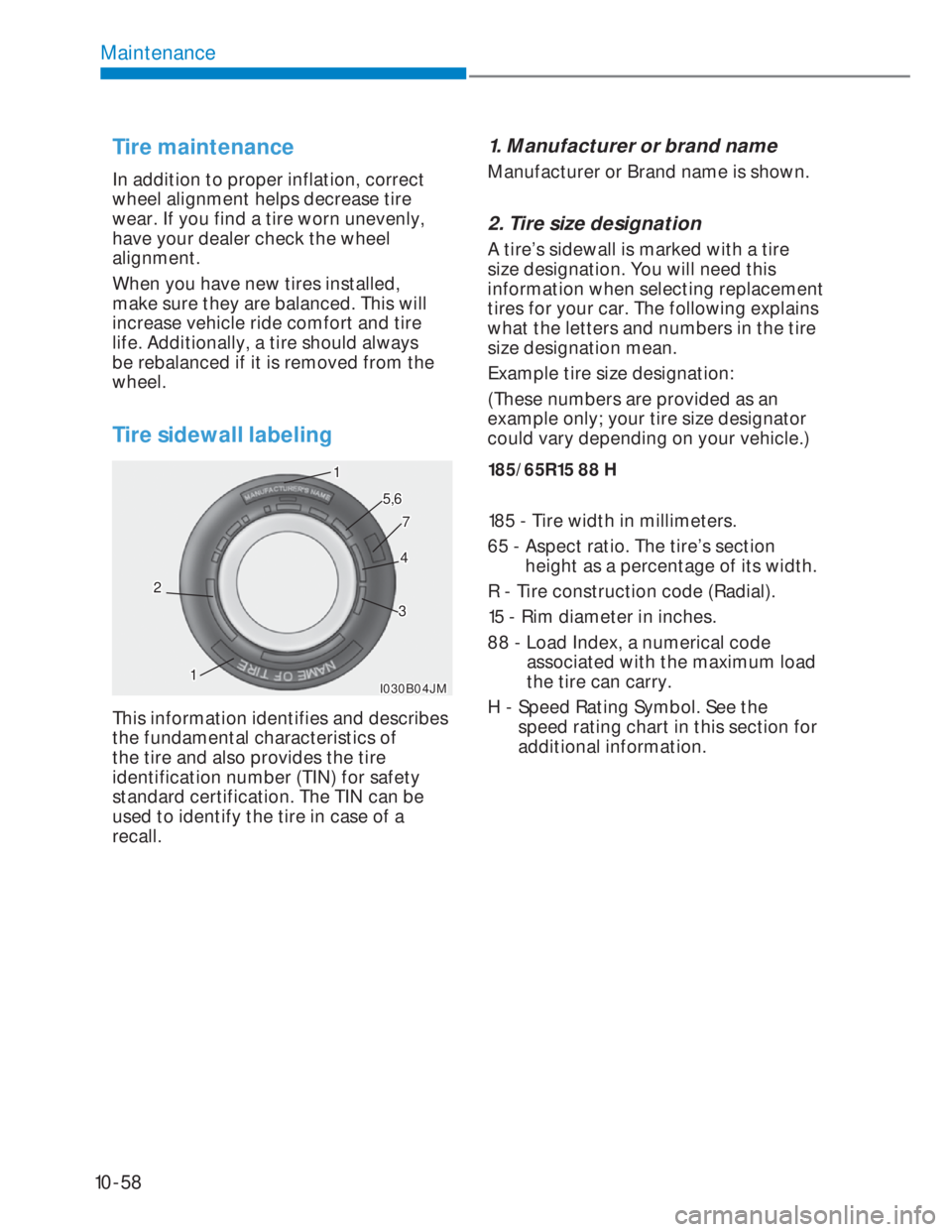
Tire sidewall labeling
I030B04JMI030B04JM
22
11
77
5,65,6
33
44
11
This information identifies and describes
the fundamental characteristics of
the tire and also provides the tire
identification number (TIN) for safety
standard certification. The TIN can be
used to identify the tire in case of a
recall.
1. Manufacturer or brand name
Manufacturer or Brand name is shown.
2. Tire size designation
A tire’s sidewall is marked with a tire
size designation. You will need this
information when selecting replacement
tires for your car. The following explains
what the letters and numbers in the tire
size designation mean.
Example tire size designation:
(These numbers are provided as an
example only; your tire size designator
could vary depending on your vehicle.)
185/65R15 88 H
185 - Tire width in millimeters.
65 - Aspect ratio. The tire’s section
height as a percentage of its width.
R - Tire construction code (Radial).
15 - Rim diameter in inches.
88 - Load Index, a numerical code
associated with the maximum load
the tire can carry.
H - Speed Rating Symbol. See the
speed rating chart in this section for
additional information.