cooling HYUNDAI I30 2011 User Guide
[x] Cancel search | Manufacturer: HYUNDAI, Model Year: 2011, Model line: I30, Model: HYUNDAI I30 2011Pages: 635, PDF Size: 40.66 MB
Page 327 of 635
Maintenance
10
7
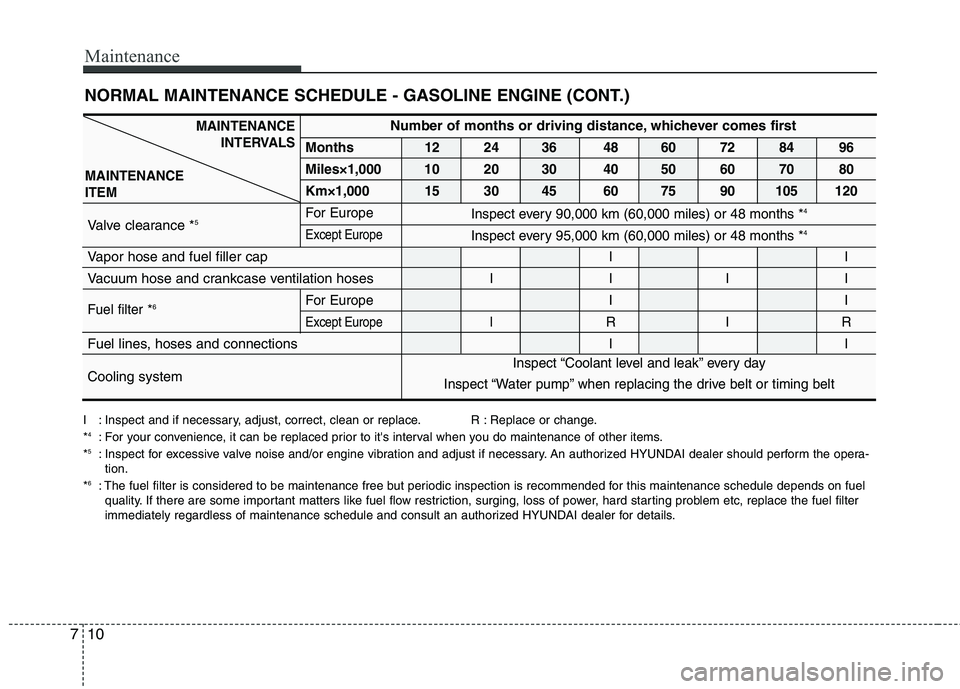
NORMAL MAINTENANCE SCHEDULE - GASOLINE ENGINE (CONT.)
Number of months or driving distance, whichever comes first
Months 12 24 36 48 60 72 84 96
Miles×1,000 10 20 30 40 50 60 70 80
Km×1,000 15 30 45 60 75 90 105 120
Valve clearance * 5For Europe
Except Europe
Vapor hose and fuel filler cap
II
Vacuum hose and crankcase ventilation hoses I I I I
Fuel filter * 6For Europe
II
Except Europe IRI R
Fuel lines, hoses and connections II
Cooling system
Inspect “Coolant level and leak” every day
Inspect “Water pump” when replacing the drive belt or timing belt
I : Inspect and if necessary, adjust, correct, clean or replace. R : Replace or change. * 4
: For your convenience, it can be replaced prior to it's interval when you do maintenance of other items.
* 5
: Inspect for excessive valve noise and/or engine vibration and adjust if necessary. An authorized HYUNDAI dealer should perform the opera-
tion.
* 6
: The fuel filter is considered to be maintenance free but periodic inspection is recommended for this maintenance schedule depends on fuel
quality. If there are some important matters like fuel flow restriction, surging, loss of power, hard starting problem etc, replace the fuel filter
immediately regardless of maintenance schedule and consult an authorized HYUNDAI dealer for details.
MAINTENANCE
INTERVALS
MAINTENANCE ITEM
Inspect every 90,000 km (60,000 miles) or 48 months * 4
Inspect every 95,000 km (60,000 miles) or 48 months * 4
Page 333 of 635
Maintenance
16
7
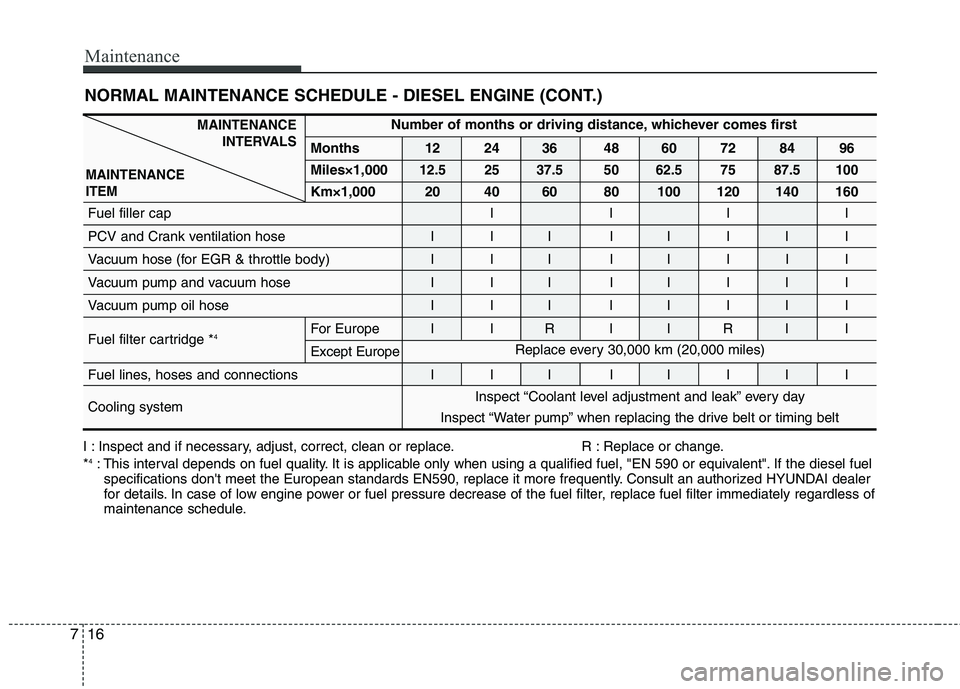
NORMAL MAINTENANCE SCHEDULE - DIESEL ENGINE (CONT.)
MAINTENANCE
INTERVALS
MAINTENANCE ITEMNumber of months or driving distance, whichever comes first
Months 12 24 36 48 60 72 84 96 Miles×1,000
12.5 25 37.5 50 62.5 75 87.5 100
Km×1,000 20 40 60 80 100 120 140 160
Fuel filler cap I I I I
PCV and Crank ventilation hose I I I I I I I I
Vacuum hose (for EGR & throttle body) I I I I I I I I
Vacuum pump and vacuum hose I I I I I I I I
Vacuum pump oil hose I I I I I I I I
Fuel filter cartridge * 4For Europe I I R I I R I I Except Europe
Fuel lines, hoses and connections I I I I I I I I Cooling system Inspect “Coolant level adjustment and leak” every dayReplace every 30,000 km (20,000 miles)
Inspect “Water pump” when replacing the drive belt or timing belt
I : Inspect and if necessary, adjust, correct, clean or replace. R : Replace or change. * 4
: This interval depends on fuel quality. It is applicable only when using a qualified fuel, "EN 590 or equivalent". If the diesel fuel
specifications don't meet the European standards EN590, replace it more frequently. Consult an authorized HYUNDAI dealer
for details. In case of low engine power or fuel pressure decrease of the fuel filter, replace fuel filter immediately regardless of
maintenance schedule.
Page 339 of 635
Maintenance
22
7
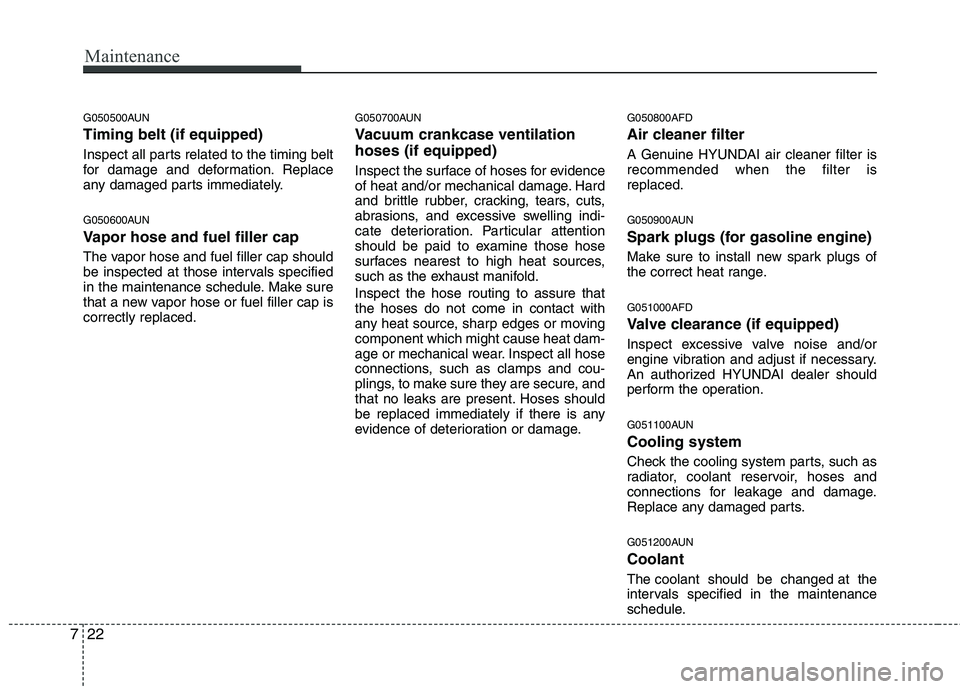
G050500AUN Timing belt (if equipped)
Inspect all parts related to the timing belt
for damage and deformation. Replace
any damaged parts immediately.
G050600AUN
Vapor hose and fuel filler cap
The vapor hose and fuel filler cap should
be inspected at those intervals specified
in the maintenance schedule. Make sure
that a new vapor hose or fuel filler cap iscorrectly replaced. G050700AUN
Vacuum crankcase ventilation hoses (if equipped)
Inspect the surface of hoses for evidence
of heat and/or mechanical damage. Hard
and brittle rubber, cracking, tears, cuts,
abrasions, and excessive swelling indi-
cate deterioration. Particular attention
should be paid to examine those hose
surfaces nearest to high heat sources,
such as the exhaust manifold. Inspect the hose routing to assure that the hoses do not come in contact with
any heat source, sharp edges or movingcomponent which might cause heat dam-
age or mechanical wear. Inspect all hose
connections, such as clamps and cou-
plings, to make sure they are secure, and
that no leaks are present. Hoses should
be replaced immediately if there is any
evidence of deterioration or damage.G050800AFD
Air cleaner filter
A Genuine HYUNDAI air cleaner filter is recommended when the filter isreplaced.
G050900AUN
Spark plugs (for gasoline engine)
Make sure to install new spark plugs of
the correct heat range. G051000AFD
Valve clearance (if equipped)
Inspect excessive valve noise and/or
engine vibration and adjust if necessary.
An authorized HYUNDAI dealer should
perform the operation.
G051100AUN Cooling system
Check the cooling system parts, such as
radiator, coolant reservoir, hoses and
connections for leakage and damage.
Replace any damaged parts.
G051200AUN Coolant The coolant should be changed at the
intervals specified in the maintenance
schedule.
Page 342 of 635
725
Maintenance
ENGINE COOLANT
G060200AFD Changing the engine oil and filter
Have engine oil and filter changed by an
authorized HYUNDAI dealer according tothe Maintenance Schedule at the begin-ning of this section. G070000AFD The high-pressure cooling system has a
reservoir filled with year-round antifreeze
coolant. The reservoir is filled at the fac-
tory.
Check the antifreeze protection and
coolant concentration level at least once
a year, at the beginning of the winter sea-
son, and before traveling to a colder cli-
mate. G070100AFD
Checking the coolant level
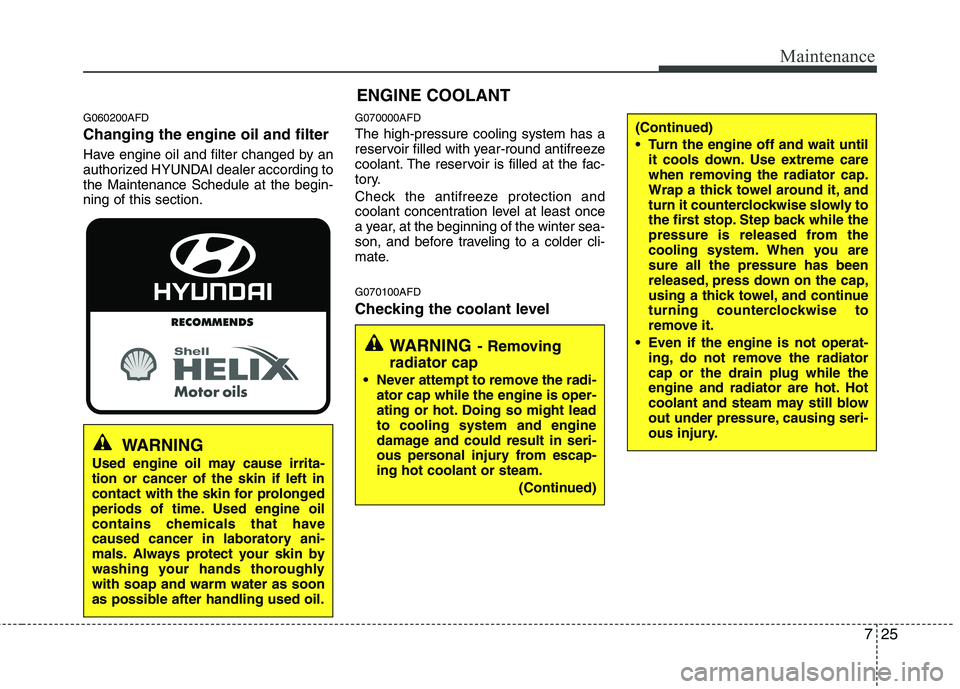
WARNING
- Removing
radiator cap
Never attempt to remove the radi- ator cap while the engine is oper-
ating or hot. Doing so might leadto cooling system and engine
damage and could result in seri-
ous personal injury from escap-ing hot coolant or steam.
(Continued)
WARNING
Used engine oil may cause irrita- tion or cancer of the skin if left in
contact with the skin for prolonged
periods of time. Used engine oil
contains chemicals that have
caused cancer in laboratory ani-
mals. Always protect your skin by
washing your hands thoroughlywith soap and warm water as soon
as possible after handling used oil.
(Continued)
Turn the engine off and wait until it cools down. Use extreme care
when removing the radiator cap.
Wrap a thick towel around it, and
turn it counterclockwise slowly to
the first stop. Step back while the
pressure is released from the
cooling system. When you aresure all the pressure has been
released, press down on the cap,
using a thick towel, and continue
turning counterclockwise to
remove it.
Even if the engine is not operat- ing, do not remove the radiatorcap or the drain plug while the
engine and radiator are hot. Hot
coolant and steam may still blow
out under pressure, causing seri-
ous injury.
Page 343 of 635
Maintenance
26
7
-15°C (5°F) 35 65
-25°C (-13°F) 40 60
-35°C (-31°F) 50 50
-45°C (-49°F) 60 40
Ambient
Temperature Mixture Percentage (volume)
Antifreeze Water
Check the condition and connections of all cooling system hoses and heater
hoses. Replace any swollen or deterio-
rated hoses.
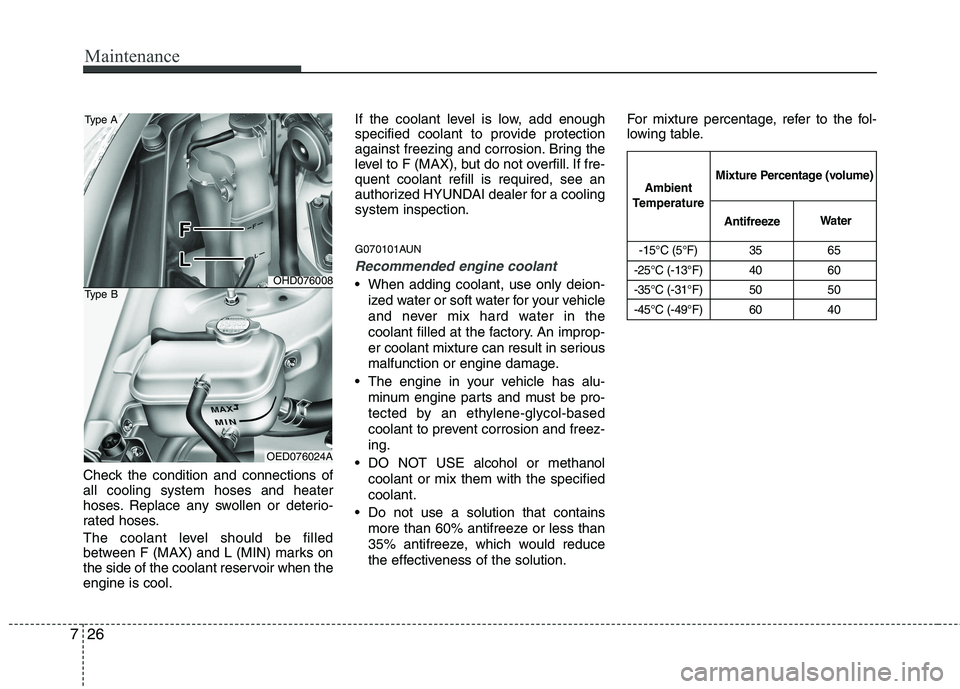
The coolant level should be filled
between F (MAX) and L (MIN) marks on
the side of the coolant reservoir when theengine is cool. If the coolant level is low, add enough
specified coolant to provide protection
against freezing and corrosion. Bring the
level to F (MAX), but do not overfill. If fre-quent coolant refill is required, see an
authorized HYUNDAI dealer for a coolingsystem inspection.
G070101AUN
Recommended engine coolant
When adding coolant, use only deion-
ized water or soft water for your vehicle
and never mix hard water in the
coolant filled at the factory. An improp-
er coolant mixture can result in serious
malfunction or engine damage.
The engine in your vehicle has alu- minum engine parts and must be pro-
tected by an ethylene-glycol-based
coolant to prevent corrosion and freez-ing.
DO NOT USE alcohol or methanol coolant or mix them with the specifiedcoolant.
Do not use a solution that contains more than 60% antifreeze or less than
35% antifreeze, which would reduce
the effectiveness of the solution. For mixture percentage, refer to the fol-
lowing table.OHD076008
Type A
OED076024A
Type B
Page 406 of 635
I3
Index
Capacities (Lubricants) ·····················································9-4 Care
Exterior care ······························································7-68
Interior care ·······························································7-73
Tire care·····································································7-43
Cargo security screen ····················································4-100
Cargo weight ···································································5-49
Center console storage ····················································4-88
Central door lock switch ···················································4-9
Changing tires ·································································6-13Chains Tire chains ·································································5-38
Checking tire inflation pressure ······································7-45
Child restraint system ·····················································3-28 ISOFIX system ·························································3-34
Tether anchor system·················································3-32
Child-protector rear door lock ·······································4-11
Climate control system (Automatic)·······························4-76 Air conditioning ·······················································4-83Automatic heating and air conditioning ···················4-78
Manual heating and air conditioning ·······················4-79
Climate control system (Manual) ··································4-68 Air conditioning ························································4-73
Climate control air filter············································4-75
Heating and air conditioning ·····································4-69
Cigarette lighter ······························································4-92 Climate control air filter ········································4-75, 7-34
Clock (Digital) ·········································4-94, 4-114, 4-127
Clothes hanger ································································4-96
Combined instrument, see instrument cluster ················4-35
Compact spare tire ··························································6-18
Compact spare tire replacement ·····································7-48
Coolant ············································································7-25
Cooling fluid, see engine coolant ···································7-25
Crankcase emission control system ·······························7-74
Cruise control system ····················································5-27
Cup holder·······································································4-93
Curtain air bag ································································3-48
Dashboard, see instrument cluster ··································4-35
Dashboard illumination, see instrument
panel illumination ························································4-36
Deadlocks········································································4-10
Defogging (Windshield) ·················································4-84
Defogging logic (Windshield) ········································4-86
Defroster ·········································································4-66 Front windshield deicer·············································4-67
Rear window defroster ··············································4-67
Defrosting (Windshield) ·················································4-84
Digital clock ·············································4-94, 4-114, 4-127
Dimensions ·······································································9-2
Displays, see instrument cluster ·····································4-35
C
D
Page 545 of 635
473
Features of your vehicle
D230105AUN
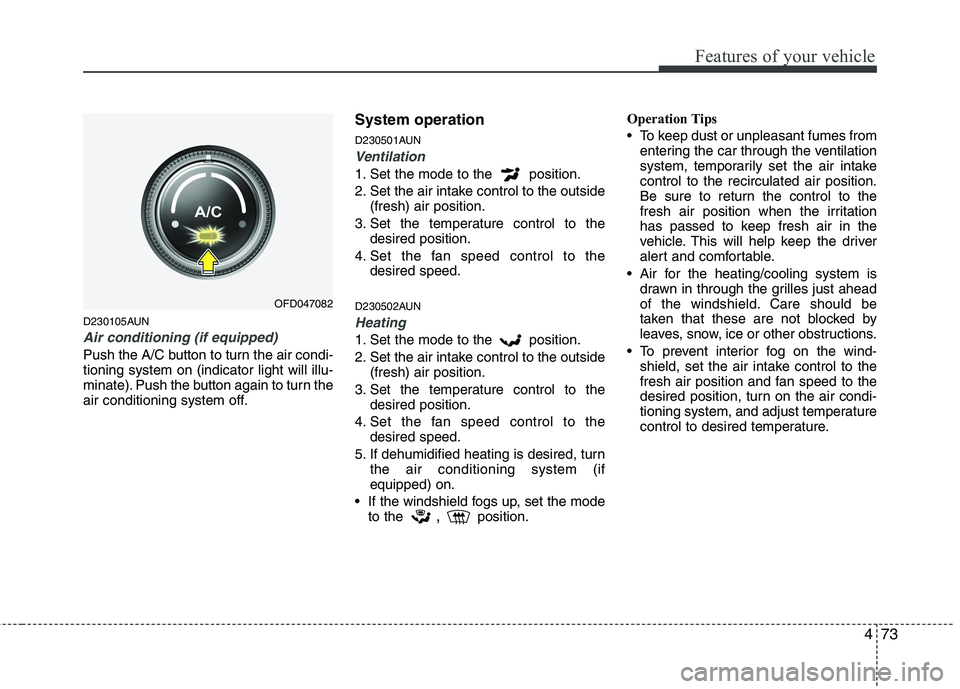
Air conditioning (if equipped)
Push the A/C button to turn the air condi- tioning system on (indicator light will illu-
minate). Push the button again to turn the
air conditioning system off.System operation
D230501AUN
Ventilation
1. Set the mode to the position.
2. Set the air intake control to the outside
(fresh) air position.
3. Set the temperature control to the desired position.
4. Set the fan speed control to the desired speed.
D230502AUN
Heating
1. Set the mode to the position.
2. Set the air intake control to the outside (fresh) air position.
3. Set the temperature control to the desired position.
4. Set the fan speed control to the desired speed.
5. If dehumidified heating is desired, turn the air conditioning system (if equipped) on.
If the windshield fogs up, set the mode to the ,
position. Operation Tips
To keep dust or unpleasant fumes from
entering the car through the ventilation
system, temporarily set the air intakecontrol to the recirculated air position.
Be sure to return the control to the
fresh air position when the irritation
has passed to keep fresh air in the
vehicle. This will help keep the driver
alert and comfortable.
Air for the heating/cooling system is drawn in through the grilles just ahead
of the windshield. Care should be
taken that these are not blocked by
leaves, snow, ice or other obstructions.
To prevent interior fog on the wind- shield, set the air intake control to the
fresh air position and fan speed to the
desired position, turn on the air condi-
tioning system, and adjust temperature
control to desired temperature.
OFD047082
Page 546 of 635
Features of your vehicle
74
4
D230503AFD
Air conditioning (if equipped)
All HYUNDAI Air Conditioning Systems
are filled with environmentally friendly
R-134a refrigerant which does not dam-
age to the ozone layer.
1. Start the engine. Push the air condi-
tioning button.
2. Set the mode to the position.
3. Set the air intake control to the outside air or recirculated air position.
4. Adjust the fan speed control and tem- perature control to maintain maximum
comfort.
When maximum cooling is desired, set the temperature control to the extreme
left position then set the fan speedcontrol to the highest speed.
✽✽ NOTICE
When using the air conditioning sys- tem, monitor the temperature gauge
closely while driving up hills or in
heavy traffic when outside tempera-
tures are high. Air conditioning sys-
tem operation may cause engine over-
heating. Continue to use the blower
fan but turn the air conditioning sys-
tem off if the temperature gauge indi-
cates engine overheating.
When opening the windows in humid weather air conditioning may create
water droplets inside the vehicle.
Since excessive water droplets may
cause damage to electrical equipment,
air conditioning should only be run
with the windows closed.Air conditioning system operation tips
If the vehicle has been parked in directsunlight during hot weather, open the
windows for a short time to let the hot
air inside the vehicle escape.
To help reduce moisture inside of win- dows on rainy or humid days, decrease
the humidity inside the vehicle by oper-ating the air conditioning system.
During air conditioning system opera- tion, you may occasionally notice aslight change in engine speed as the
air conditioning compressor cycles.
This is a normal system operation
characteristic.
Use the air conditioning system every month if only for a few minutes to
ensure maximum system performance.
When using the air conditioning sys- tem, you may notice clear water drip-
ping (or even puddling) on the ground
under the passenger side of the vehi-
cle. This is a normal system operation
characteristic.
Operating the air conditioning system in the recirculated air position provides
maximum cooling, however, continual
operation in this mode may cause the
air inside the vehicle to become stale.
During cooling operation, you may occasionally notice a misty air flow
because of rapid cooling and humid air
intake. This is a normal system opera-
tion characteristics.
Page 550 of 635
Features of your vehicle
78
4
D240100AFD
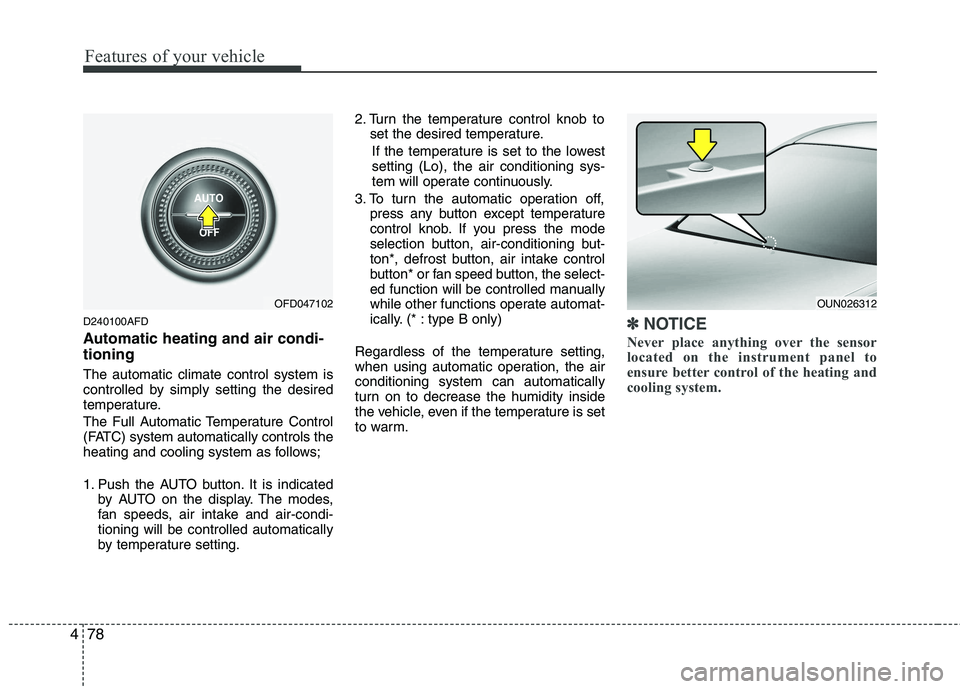
Automatic heating and air condi- tioning The automatic climate control system is
controlled by simply setting the desired
temperature.
The Full Automatic Temperature Control
(FATC) system automatically controls the
heating and cooling system as follows;
1. Push the AUTO button. It is indicated
by AUTO on the display. The modes,
fan speeds, air intake and air-condi-tioning will be controlled automatically
by temperature setting. 2. Turn the temperature control knob to
set the desired temperature.
If the temperature is set to the lowestsetting (Lo), the air conditioning sys-
tem will operate continuously.
3. To turn the automatic operation off, press any button except temperature
control knob. If you press the mode
selection button, air-conditioning but-
ton*, defrost button, air intake control
button* or fan speed button, the select-
ed function will be controlled manually
while other functions operate automat-
ically. (* : type B only)
Regardless of the temperature setting,
when using automatic operation, the airconditioning system can automatically
turn on to decrease the humidity inside
the vehicle, even if the temperature is set
to warm.✽✽ NOTICE
Never place anything over the sensor
located on the instrument panel to
ensure better control of the heating and
cooling system.
OUN026312OFD047102
Page 551 of 635
479
Features of your vehicle
D240200AUN
Manual heating and air condition- ing The heating and cooling system can be
controlled manually by pushing buttons
other than the AUTO button. In this case,
the system works sequentially according
to the order of buttons selected.
When pressing any button (or turning
any knob) except AUTO button while
automatic operation, the functions not
selected will be controlled automatically.
1. Start the engine.
2. Set the mode to the desired position.
3. Set the temperature control to thedesired position.
4. Set the air intake control to the outside (fresh) air position.
5. Set the fan speed control to the desired speed.
6. If air conditioning is desired, turn the air conditioning system on.
Press the AUTO button in order to con-
vert to full automatic control of the sys-tem. D240201AFD
Mode selection
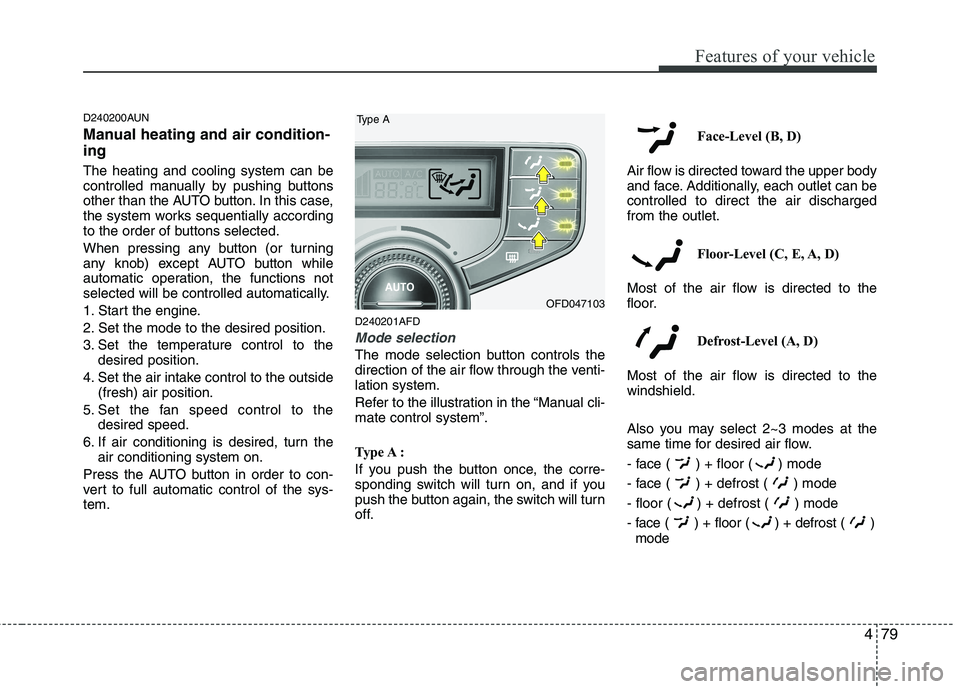
The mode selection button controls the
direction of the air flow through the venti-lation system.
Refer to the illustration in the “Manual cli- mate control system”.
Type A :
If you push the button once, the corre-
sponding switch will turn on, and if you
push the button again, the switch will turn
off. Face-Level (B, D)
Air flow is directed toward the upper body
and face. Additionally, each outlet can becontrolled to direct the air dischargedfrom the outlet.
Floor-Level (C, E, A, D)
Most of the air flow is directed to the
floor.
Defrost-Level (A, D)
Most of the air flow is directed to thewindshield.
Also you may select 2~3 modes at the
same time for desired air flow.
- face ( ) + floor ( ) mode
- face ( ) + defrost ( ) mode
- floor ( ) + defrost ( ) mode
- face ( ) + floor ( ) + defrost ( ) mode
OFD047103
Type A