sunroof HYUNDAI I30 2011 User Guide
[x] Cancel search | Manufacturer: HYUNDAI, Model Year: 2011, Model line: I30, Model: HYUNDAI I30 2011Pages: 635, PDF Size: 40.66 MB
Page 410 of 635
I7
Index
Main fuse ········································································7-56 Maintenance
Explanation of scheduled maintenance items ···········7-21Maintenance services ················································· 7-4
Maintenance under severe usage conditions(Diesel) ····················································7-19
Maintenance under severe usage conditions(Gasoline) ················································7-13 Normal maintenance schedule(Diesel) ·····················7-15
Normal maintenance schedule(Gasoline) ··················7-9
Owner maintenance ····················································7-6
Scheduled maintenance service ·································7-8
Tire maintenance ······················································7-49
Maintenance services ·······················································7-4
Manual climate control system ······································4-68 Air conditioning ·······················································4-73
Climate control air filter ···········································4-75
Heating and air conditioning ····································4-69
Manual heating and air conditioning ·····························4-79
Manual transaxle ······························································5-8
Memory fuse ··································································7-55Mirrors ···········································································4-31 Day/night rearview mirror ·······································4-31
Electric chromic mirror (ECM) ·······························4-31
Inside rearview mirror ··············································4-31
Outside rearview mirror ···········································4-32 Moonroof, see sunroof ···················································4-24
Mounting bracket for roof carrier ·································4-101
Multibox··········································································4-90
Neck restraints, see headrest ·····································3-5, 3-9
Odometer/Tripmeter························································4-38
Oil (Engine) ····································································7-24
Outside rearview mirror ··················································4-32
Overheats ··········································································6-6
Owner maintenance ··························································7-6
Parking brake inspect ·····················································7-31
Parking brake ·································································5-18
Passenger's front air bag ················································3-40
Position light bulb replacement ·····································7-64
Power brakes ··································································5-17
Power outlet ···································································4-94
Power window lock button ············································4-17
Pre-tensioner seat belt ····················································3-22
Push starting ·····································································6-5
O
P
M
N
Page 412 of 635
I9
Index
Smooth cornering ·····················································5-34
Speedometer ···································································4-36
Starting difficulties, see engine will not start ··················6-3
Starting the engine ···························································5-5
Steering wheel ·······························································4-28 Electric power steering ·············································4-28Horn ··········································································4-29
Tilt steering ······························································4-28
Steering wheel audio control ·······································4-104
Storage compartment ·····················································4-88 Center console storage ·············································4-88
Glove box ·································································4-88
Luggage box ······························································4-90
Multibox ····································································4-90
Sunglass holder ························································4-89
Sunroof············································································4-24
Sunvisor ··········································································4-93 Tachometer ·····································································4-37
Tailgate ···········································································4-12
Emergency tailgate safety release ····························4-13
Tether anchor system ·····················································3-32
Theft-alarm system ··························································4-6
Tie-down hook ·······························································6-24
Tilt steering ····································································4-28
Tire specification and pressure label ·······························8-3
Tire Pressure Monitoring System (TPMS) ·······················6-7
Tires and wheels ·····················································7-43, 9-3 Checking tire inflation pressure ·······························7-45
Compact spare tire replacement ·······························7-48
Recommended cold tire inflation pressures ·············7-43
Tire care ···································································7-43
Tire maintenance ······················································7-49
Tire replacement ·······················································7-47
Tire rotation ······························································7-46
Tire sidewall labeling ···············································7-49
Tire traction ······························································7-49
Wheel alignment and tire balance ····························7-47
Wheel replacement ···················································7-48
Towing ···········································································6-20 Emergency towing ····················································6-22
Removable towing hook ···········································6-21
Tie-down hook (for flatbed towing) ·························6-24T
Page 473 of 635
4
Keys / 4-2
Remote keyless entry / 4-4
Theft-alarm system / 4-6
Door locks / 4-8
Tailgate / 4-12
Windows / 4-14
Hood / 4-19
Fuel filler lid / 4-21
Sunroof / 4-24
Steering wheel / 4-28
Mirrors / 4-31
Instrument cluster / 4-35
Rear parking assist system / 4-51
Hazard warning flasher / 4-53
Lighting / 4-54
Wipers and washers / 4-60
Interior light / 4-64
Defroster / 4-66
Manual climate control system / 4-68
Automatic climate control system / 4-76
Windshield defrosting and defogging / 4-84
Storage compartment / 4-88
Interior features / 4-92
Exterior features / 4-101
Audio system / 4-103
Features of your vehicle
Page 487 of 635
415
Features of your vehicle
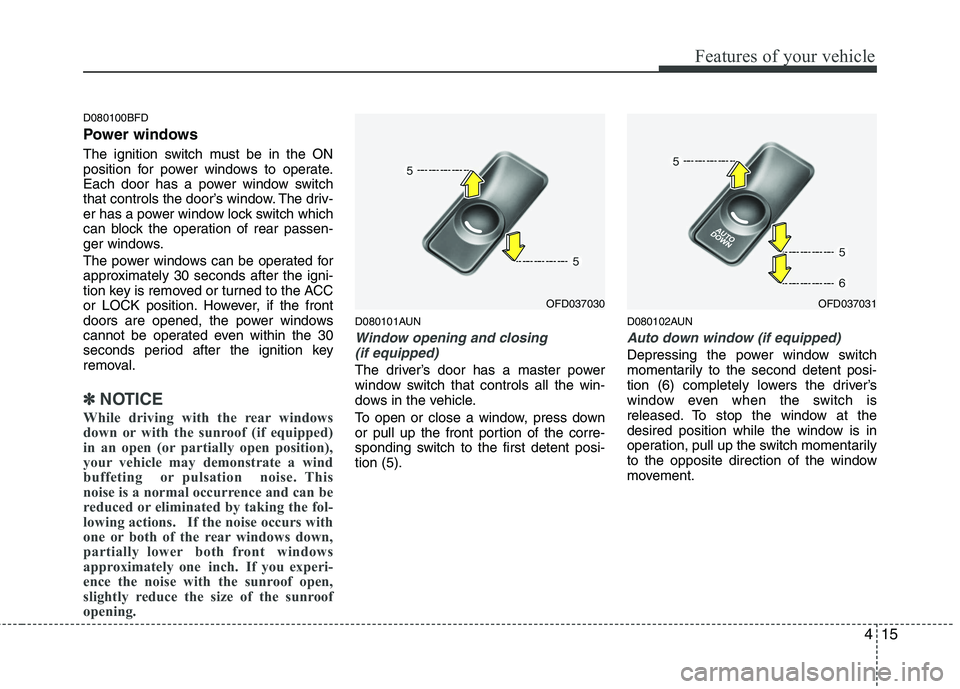
D080100BFD
Power windows
The ignition switch must be in the ON
position for power windows to operate.
Each door has a power window switch
that controls the door’s window. The driv-
er has a power window lock switch which
can block the operation of rear passen-
ger windows.
The power windows can be operated for
approximately 30 seconds after the igni-
tion key is removed or turned to the ACC
or LOCK position. However, if the front
doors are opened, the power windows
cannot be operated even within the 30
seconds period after the ignition key
removal.
✽✽NOTICE
While driving with the rear windows
down or with the sunroof (if equipped)
in an open (or partially open position),
your vehicle may demonstrate a wind
buffeting or pulsation noise. This
noise is a normal occurrence and can be
reduced or eliminated by taking the fol-
lowing actions. If the noise occurs with
one or both of the rear windows down,
partially lower both front windows
approximately one inch. If you experi-
ence the noise with the sunroof open,
slightly reduce the size of the sunroof
opening.
D080101AUN
Window opening and closing (if equipped)
The driver’s door has a master power
window switch that controls all the win-
dows in the vehicle.
To open or close a window, press down
or pull up the front portion of the corre-
sponding switch to the first detent posi-tion (5). D080102AUN
Auto down window (if equipped)
Depressing the power window switch
momentarily to the second detent posi-
tion (6) completely lowers the driver’s
window even when the switch is
released. To stop the window at the
desired position while the window is in
operation, pull up the switch momentarily
to the opposite direction of the window
movement.
OFD037031OFD037030
Page 496 of 635
Features of your vehicle
24
4
D110000AUN
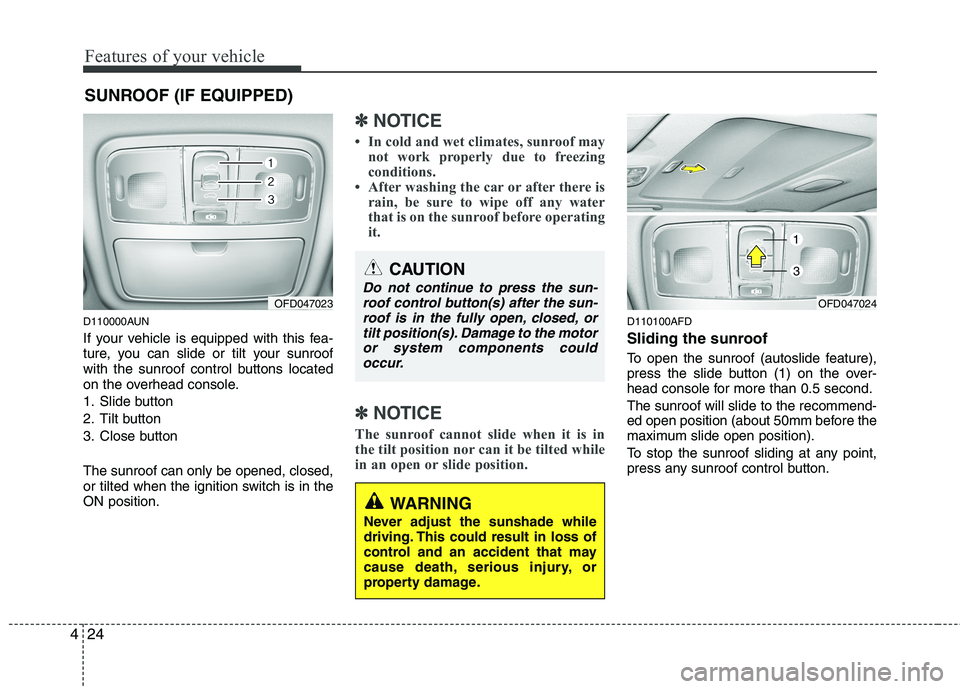
If your vehicle is equipped with this fea-
ture, you can slide or tilt your sunroof
with the sunroof control buttons located
on the overhead console.
1. Slide button
2. Tilt button
3. Close button The sunroof can only be opened, closed,
or tilted when the ignition switch is in theON position.
✽✽
NOTICE
In cold and wet climates, sunroof may not work properly due to freezing
conditions.
After washing the car or after there is
rain, be sure to wipe off any water
that is on the sunroof before operating
it.
✽
✽ NOTICE
The sunroof cannot slide when it is in
the tilt position nor can it be tilted while
in an open or slide position.
D110100AFD
Sliding the sunroof
To open the sunroof (autoslide feature),
press the slide button (1) on the over-
head console for more than 0.5 second. The sunroof will slide to the recommend-
ed open position (about 50mm before the
maximum slide open position).
To stop the sunroof sliding at any point,
press any sunroof control button.
SUNROOF (IF EQUIPPED)
OFD047023
CAUTION
Do not continue to press the sun-
roof control button(s) after the sun-
roof is in the fully open, closed, or tilt position(s). Damage to the motoror system components couldoccur.
WARNING
Never adjust the sunshade while
driving. This could result in loss of
control and an accident that may
cause death, serious injury, or
property damage.
OFD047024
1
3
Page 497 of 635
425
Features of your vehicle
To open the sunroof to the maximum
slide open position, press the slide but-ton (1) once again and hold it until the
sunroof slide all the way open.
✽✽NOTICE
To reduce wind noise while driving, we
recommend you to drive at the recom-
mended postion (about 50mm before the
maximum slide open positon).
To close the sunroof (autoslide feature),
press the close button (3) on the over-
head console for more than 0.5 second.
The sunroof will slide all the way close. To
stop the sunroof sliding at any point,
press any sunroof control button. D110101AUN
Automatic reversal
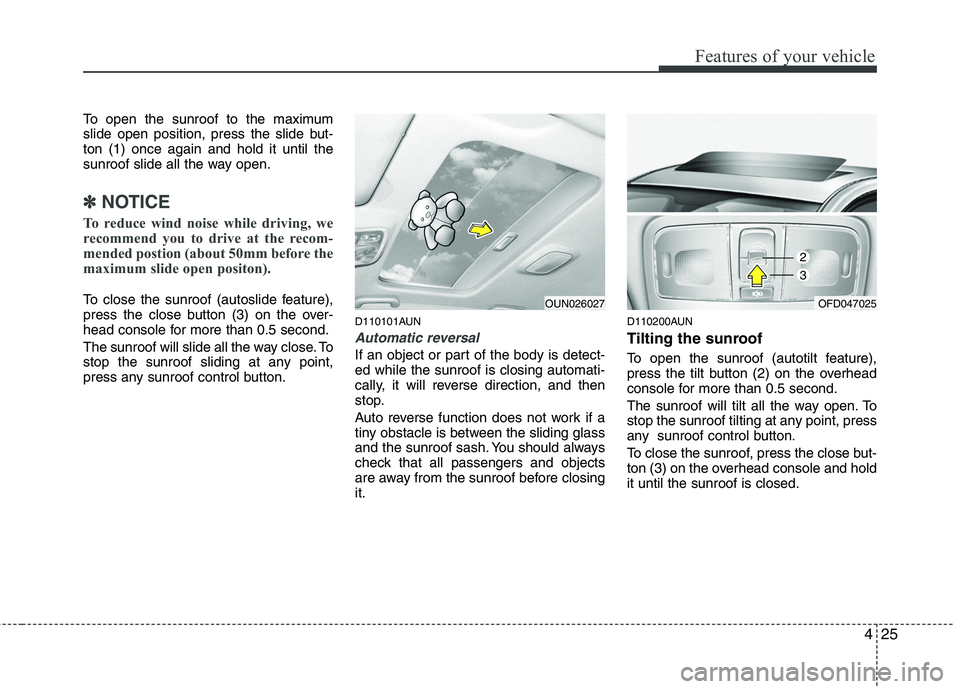
If an object or part of the body is detect- ed while the sunroof is closing automati-
cally, it will reverse direction, and then
stop.
Auto reverse function does not work if a
tiny obstacle is between the sliding glass
and the sunroof sash. You should always
check that all passengers and objects
are away from the sunroof before closingit.D110200AUN
Tilting the sunroof
To open the sunroof (autotilt feature),
press the tilt button (2) on the overhead
console for more than 0.5 second.
The sunroof will tilt all the way open. To
stop the sunroof tilting at any point, press
any sunroof control button.
To close the sunroof, press the close but-
ton (3) on the overhead console and holdit until the sunroof is closed.
OFD047025OUN026027
2
3
Page 498 of 635
Features of your vehicle
26
4
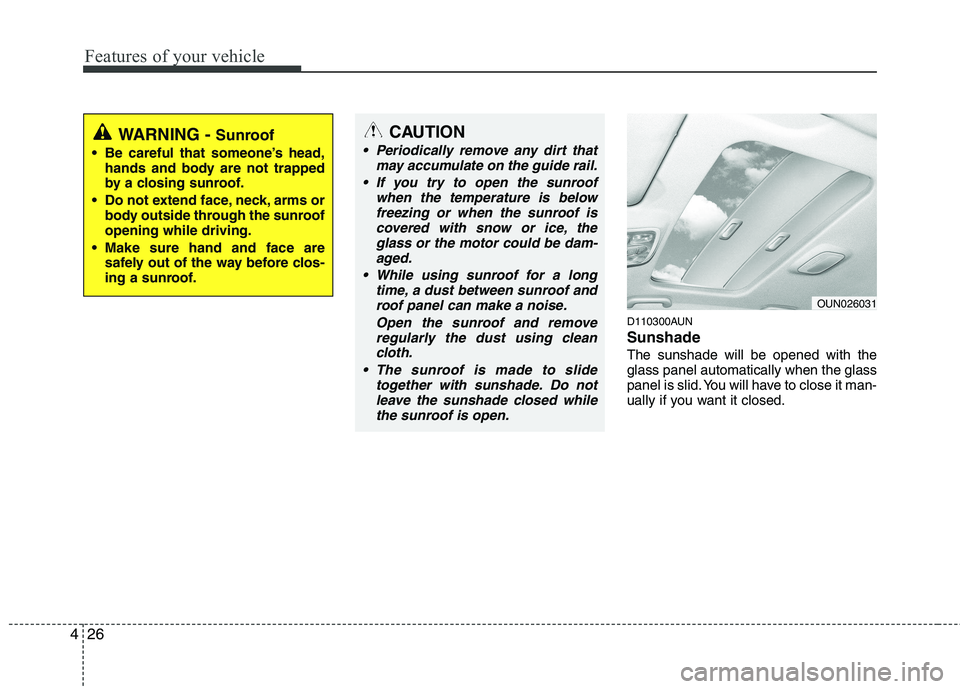
D110300AUN Sunshade The sunshade will be opened with the glass panel automatically when the glass
panel is slid. You will have to close it man-
ually if you want it closed.
OUN026031
WARNING - Sunroof
Be careful that someone’s head, hands and body are not trapped
by a closing sunroof.
Do not extend face, neck, arms or body outside through the sunroofopening while driving.
Make sure hand and face are safely out of the way before clos-
ing a sunroof.CAUTION
Periodically remove any dirt that
may accumulate on the guide rail.
If you try to open the sunroof when the temperature is belowfreezing or when the sunroof iscovered with snow or ice, the
glass or the motor could be dam- aged.
While using sunroof for a long time, a dust between sunroof androof panel can make a noise.
Open the sunroof and removeregularly the dust using cleancloth.
The sunroof is made to slide together with sunshade. Do notleave the sunshade closed while
the sunroof is open.
Page 499 of 635
427
Features of your vehicle
D110500AFD
Resetting the sunroof
Whenever the vehicle battery is discon- nected or discharged, or related fuse is
blown, you must reset your sunroof sys-
tem as follows:
1. Turn the ignition switch to the ONposition and close the sunroof com-
pletely.
2. Release the control button.
3. Press and hold the close button until the sunroof tilts and slightly moves up
and down. Then, release the button.
4. Press and hold the close button until the sunroof is operated as follows;
TILT DOWN SLIDE OPEN
SLIDE CLOSE
Then, release the control button.
When this is complete, the sunroof sys- tem is reset. ❈
For more detailed information, contact
an authorized HYUNDAI dealer.
CAUTION
If the sunroof is not reset when the
vehicle battery is disconnected ordischarged, or related fuse isblown, the sunroof may operate improperly.
Page 574 of 635

Features of your vehicle
102
4
D290100AFD
Roof rack (if equipped)
If the vehicle has a roof rack, you can
load cargo on top of your vehicle.
✽✽
NOTICE
If the vehicle is equipped with a sunroof,
be sure not to position cargo onto the
roof rack in such a way that it could
interfere with sunroof operation.
CAUTION
When carrying cargo on the roof rack, take the necessary precau-
tions to make sure the cargo does not damage the roof of the vehicle.
When carrying large objects on the roof rack, make sure they donot exceed the overall roof length
or width.
WARNING
The following specification is the maximum weight that can be
loaded onto the roof rack.
Distribute the load as evenly as
possible onto the roof rack and
secure the load firmly.
(Continued)
(Continued)Loading cargo or luggage in
excess of the specified weight
limit on the roof rack may dam-
age your vehicle.
The vehicle center of gravity will be higher when items are loaded
onto the roof rack. Avoid sudden
starts, braking, sharp turns,
abrupt maneuvers or high speeds
that may result in loss of vehicle
control or rollover resulting in anaccident.
Always drive slowly and turn cor- ners carefully when carrying
items on the roof rack. Severe
wind updrafts, caused by passing
vehicles or natural causes, can
cause sudden upward pressure
on items loaded on the roof rack.
This is especially true when car-
rying large, flat items such as
wood panels or mattresses. Thiscould cause the items to fall off
the roof rack and cause damage
to your vehicle or others around
you.
To prevent damage or loss of cargo while driving, check fre-
quently before or while driving to
make sure the items on the roof
rack are securely fastened.
ROOF 75 kg (165 lbs.)
RACK EVENLY DISTRIBUTED
OED037106