Back door HYUNDAI I30 2013 Owners Manual
[x] Cancel search | Manufacturer: HYUNDAI, Model Year: 2013, Model line: I30, Model: HYUNDAI I30 2013Pages: 635, PDF Size: 40.66 MB
Page 30 of 635
311
Safety system of your vehicle
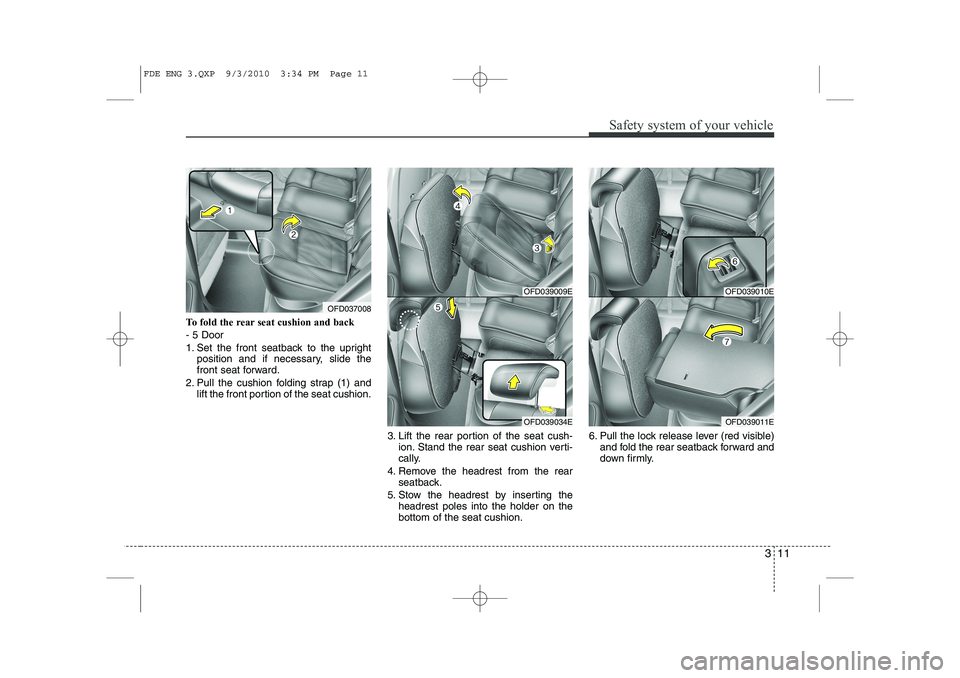
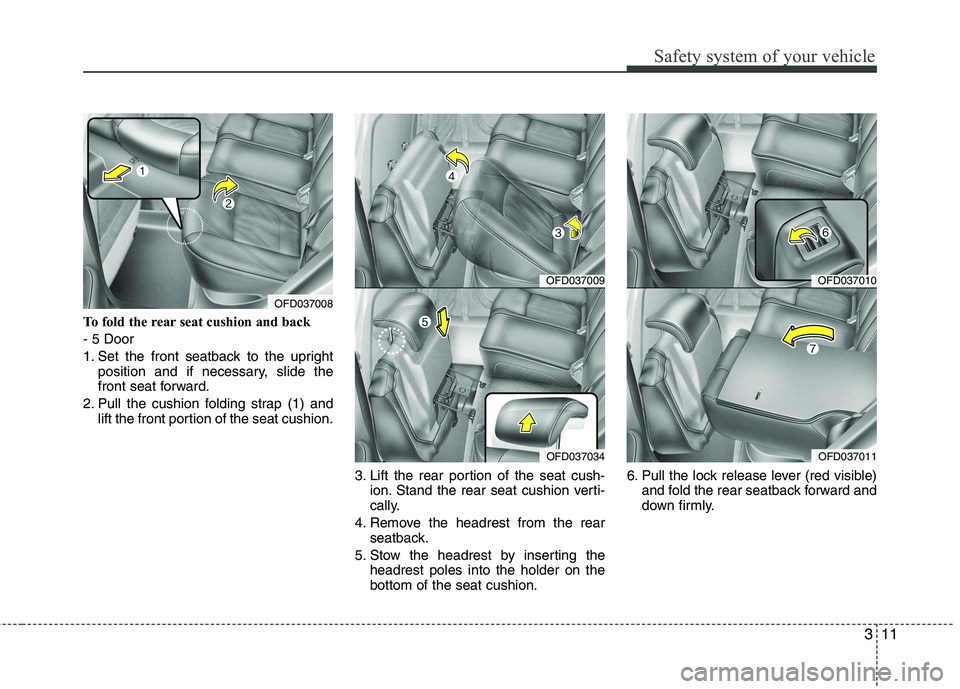
To fold the rear seat cushion and back - 5 Door
1. Set the front seatback to the uprightposition and if necessary, slide the
front seat forward.
2. Pull the cushion folding strap (1) and lift the front portion of the seat cushion.
3. Lift the rear portion of the seat cush-ion. Stand the rear seat cushion verti-
cally.
4. Remove the headrest from the rear seatback.
5. Stow the headrest by inserting the headrest poles into the holder on thebottom of the seat cushion. 6. Pull the lock release lever (red visible)
and fold the rear seatback forward and
down firmly.
OFD039010E
OFD039011E
OFD039009E
OFD039034E
OFD037008
FDE ENG 3.QXP 9/3/2010 3:34 PM Page 11
Page 37 of 635

Safety system of your vehicle
18
3
To release the seat belt:
The seat belt is released by pressing the
release button (1) in the locking buckle.When it is released, the belt should auto-
matically draw back into the retractor.
If this does not happen, check the belt to
be sure it is not twisted, then try again. C020103AUN
Lap belt (if equipped)
To fasten your seat belt:
To fasten a 2-point static type belt, insert
the metal tab into the locking buckle.
There will be an audible "click" when the
tab locks into the buckle. Check to make
sure the belt is properly locked and thatthe belt is not twisted.
B220A04NFB210A01NF1B200A01NF
WARNING
You should place the lap belt por-
tion as low as possible and snugly
across your hips, not on your waist.If the lap belt is located too high on
your waist, it may increase the
chance of injury in the event of a
collision. Both arms should not be
under or over the belt. Rather, one
should be over and the other under,
as shown in the illustration.
Never wear the seat belt under the
arm nearest the door.
FDE ENG 3.QXP 9/3/2010 3:34 PM Page 18
Page 46 of 635
327
Safety system of your vehicle
C020305AFD
Do not lie down
To reduce the chance of injuries in the
event of an accident and to achieve max-
imum effectiveness of the restraint sys-tem, all passengers should be sitting upand the front seats should be in an
upright position when the car is moving. A
seat belt cannot provide proper protection
if the person is lying down in the rear seator if the front seat is in a reclined position.C020400AUN Care of seat belts
Seat belt systems should never be disas-
sembled or modified. In addition, care
should be taken to assure that seat belts
and belt hardware are not damaged by
seat hinges, doors or other abuse.
C020401AUN
Periodic inspection
It is recommended that all seat belts be
inspected periodically for wear or dam-
age of any kind. Any damaged parts
should be replaced as soon as possible.
C020402AUN
Keep belts clean and dry
Seat belts should be kept clean and dry.
If belts become dirty, they can be
cleaned by using a mild soap solution
and warm water. Bleach, dye, strong
detergents or abrasives should not be
used because they may damage and
weaken the fabric. C020403AFD
When to replace seat belts
Entire in-use seat belt assembly or
assemblies should be replaced if the
vehicle has been involved in an accident.
This should be done even if no damage
is visible. Additional questions concern-
ing seat belt operation should be directed
to an authorized HYUNDAI dealer.
WARNING
Riding with a reclined seatback
increases your chance of serious
or fatal injuries in the event of a col-
lision or sudden stop. The protec-
tion of your restraint system (seat
belts and air bags) is greatly
reduced by reclining your seat.
Seat belts must be snug against
your hips and chest to work proper-
ly. The more the seatback is
reclined, the greater the chancethat an occupant's hips will slideunder the lap belt causing seriousinternal injuries or the occupant's
neck could strike the shoulder belt.
Drivers and passengers should
always sit well back in their seats,
properly belted, and with the seat-
backs upright.
WARNING
When you return the rear seatback to its upright position after the rear
seatback was folded down, be care-
ful not to damage the seat belt web-
bing or buckle. Be sure that the
webbing or buckle does not get
caught or pinched in the rear seat.
A seat belt with damaged webbing
or buckle will not be as strong and
could possibly fail during a colli-
sion or sudden stop, resulting in
serious injury.
FDE ENG 3.QXP 9/3/2010 3:35 PM Page 27
Page 60 of 635
341
Safety system of your vehicle
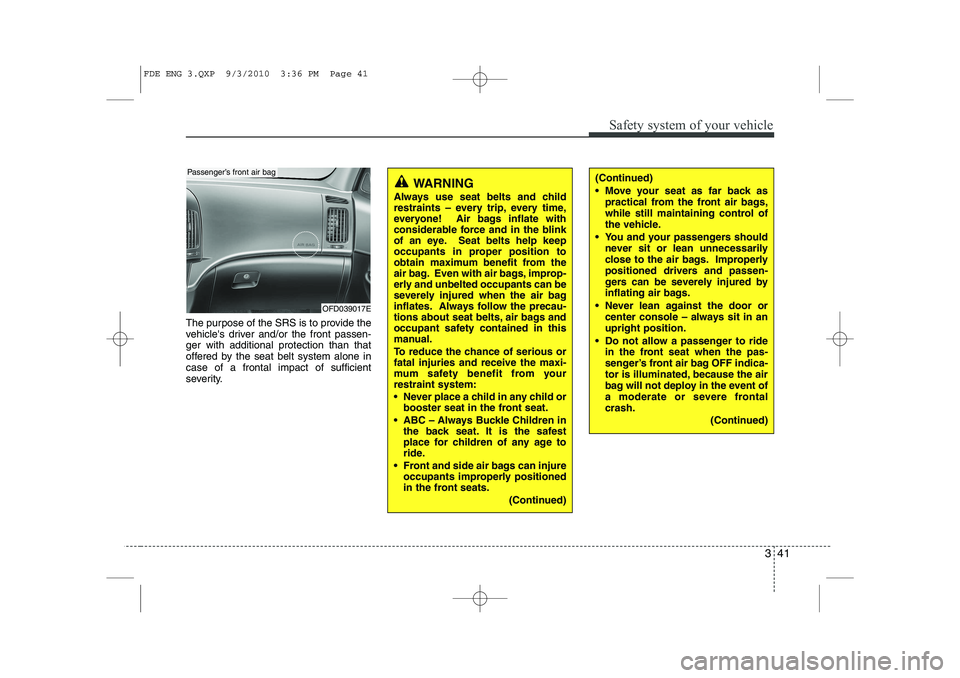
The purpose of the SRS is to provide the
vehicle's driver and/or the front passen-ger with additional protection than that
offered by the seat belt system alone incase of a frontal impact of sufficient
severity.
(Continued)
Move your seat as far back aspractical from the front air bags,
while still maintaining control of
the vehicle.
You and your passengers should never sit or lean unnecessarily
close to the air bags. Improperly
positioned drivers and passen-
gers can be severely injured by
inflating air bags.
Never lean against the door or center console – always sit in anupright position.
Do not allow a passenger to ride in the front seat when the pas-
senger’s front air bag OFF indica-
tor is illuminated, because the air
bag will not deploy in the event of
a moderate or severe frontalcrash.
(Continued)WARNING
Always use seat belts and child
restraints – every trip, every time,
everyone! Air bags inflate with
considerable force and in the blink
of an eye. Seat belts help keep
occupants in proper position to
obtain maximum benefit from the
air bag. Even with air bags, improp-
erly and unbelted occupants can be
severely injured when the air bag
inflates. Always follow the precau-
tions about seat belts, air bags and
occupant safety contained in this
manual.
To reduce the chance of serious or fatal injuries and receive the maxi-
mum safety benefit from yourrestraint system:
Never place a child in any child or booster seat in the front seat.
ABC – Always Buckle Children in the back seat. It is the safest
place for children of any age to
ride.
Front and side air bags can injure occupants improperly positioned
in the front seats.
(Continued)
OFD039017E
Passenger’s front air bag
FDE ENG 3.QXP 9/3/2010 3:36 PM Page 41
Page 133 of 635
455
Features of your vehicle
LCD display warnings and indica-
tors (if equipped)
Door open
The monitor will display the correspon- ding door or tailgate that is not closed
securely.
Low Tire Pressure (if equipped)
The monitor will display the correspon-
ding tire that is low with pressure.
For details, see Tire Pressure Monitoring System on chapter 6. ❈The actual indicator in LCD display may dif-
fer from the illustration. D170000AEN
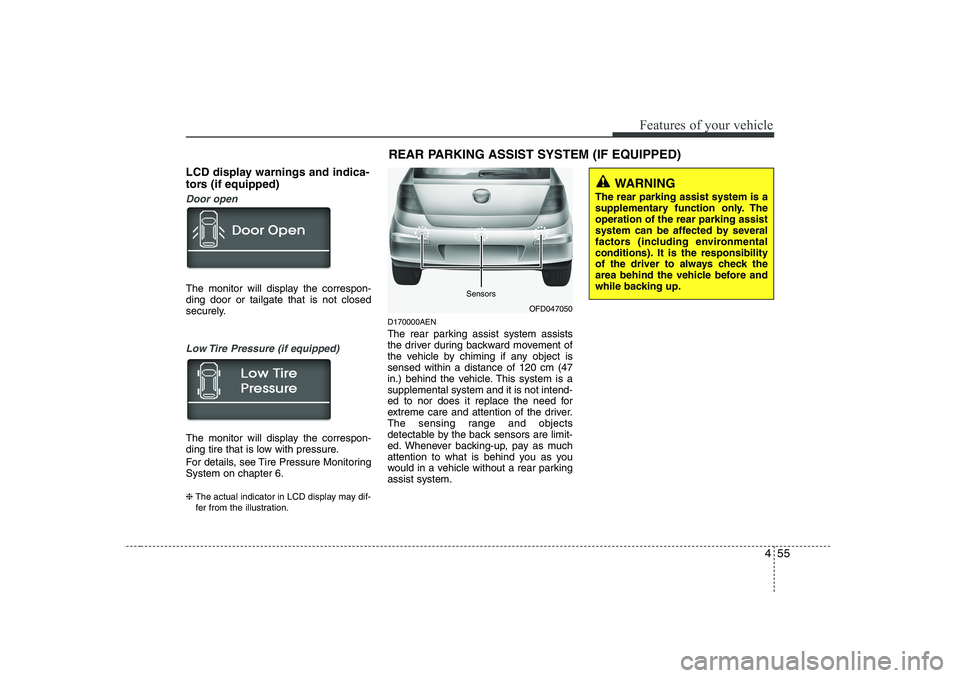
The rear parking assist system assists
the driver during backward movement of
the vehicle by chiming if any object issensed within a distance of 120 cm (47
in.) behind the vehicle. This system is asupplemental system and it is not intend-
ed to nor does it replace the need for
extreme care and attention of the driver.
The sensing range and objects
detectable by the back sensors are limit-
ed. Whenever backing-up, pay as much
attention to what is behind you as you
would in a vehicle without a rear parkingassist system.REAR PARKING ASSIST SYSTEM (IF EQUIPPED)
OFD047050
WARNING
The rear parking assist system is a
supplementary function only. Theoperation of the rear parking assist
system can be affected by several
factors (including environmental
conditions). It is the responsibility
of the driver to always check the
area behind the vehicle before and
while backing up.
Sensors
Page 245 of 635
Driving your vehicle
2
5
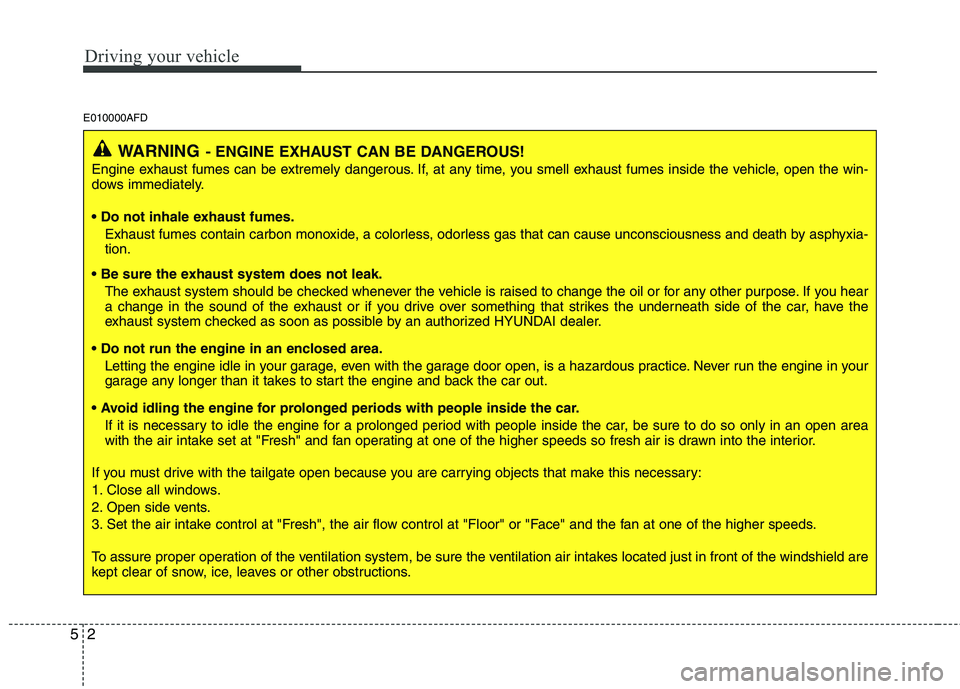
E010000AFD
WARNING - ENGINE EXHAUST CAN BE DANGEROUS!
Engine exhaust fumes can be extremely dangerous. If, at any time, you smell exhaust fumes inside the vehicle, open the win-
dows immediately.
• Do not inhale exhaust fumes.
Exhaust fumes contain carbon monoxide, a colorless, odorless gas that can cause unconsciousness and death by asphyxia- tion.
The exhaust system should be checked whenever the vehicle is raised to change the oil or for any other purpose. If you hear
a change in the sound of the exhaust or if you drive over something that strikes the underneath side of the car, have the
exhaust system checked as soon as possible by an authorized HYUNDAI dealer.
Letting the engine idle in your garage, even with the garage door open, is a hazardous practice. Never run the engine in your
garage any longer than it takes to start the engine and back the car out.
If it is necessary to idle the engine for a prolonged period with people inside the car, be sure to do so only in an open area
with the air intake set at "Fresh" and fan operating at one of the higher speeds so fresh air is drawn into the interior.
If you must drive with the tailgate open because you are carrying objects that make this necessary:
1. Close all windows.
2. Open side vents.
3. Set the air intake control at "Fresh", the air flow control at "Floor" or "Face" and the fan at one of the higher speeds.
To assure proper operation of the ventilation system, be sure the ventilation air intakes located just in front of the windshie ld are
kept clear of snow, ice, leaves or other obstructions.
Page 246 of 635
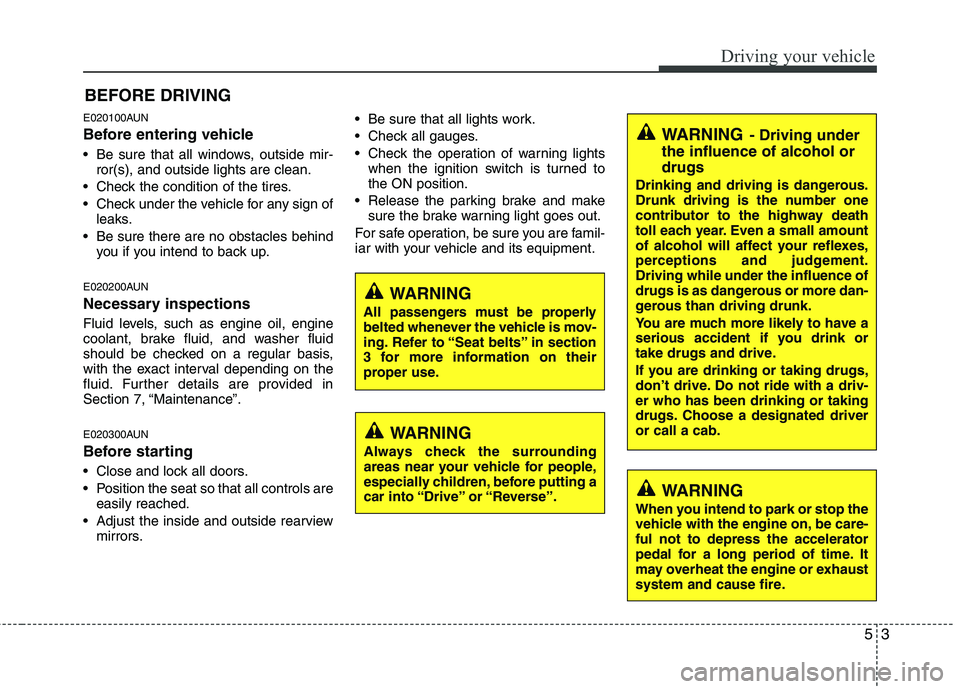
E020100AUN
Before entering vehicle
• Be sure that all windows, outside mir-ror(s), and outside lights are clean.
Check the condition of the tires.
Check under the vehicle for any sign of leaks.
Be sure there are no obstacles behind you if you intend to back up.
E020200AUN
Necessary inspections
Fluid levels, such as engine oil, engine
coolant, brake fluid, and washer fluid
should be checked on a regular basis,
with the exact interval depending on the
fluid. Further details are provided in
Section 7, “Maintenance”.
E020300AUN
Before starting
Close and lock all doors.
Position the seat so that all controls are easily reached.
Adjust the inside and outside rearview mirrors. Be sure that all lights work.
Check all gauges.
Check the operation of warning lights
when the ignition switch is turned to the ON position.
Release the parking brake and make sure the brake warning light goes out.
For safe operation, be sure you are famil-
iar with your vehicle and its equipment.
53
Driving your vehicle
BEFORE DRIVING
WARNING
All passengers must be properly
belted whenever the vehicle is mov-
ing. Refer to “Seat belts” in section
3 for more information on their
proper use.
WARNING
Always check the surrounding
areas near your vehicle for people,
especially children, before putting a
car into “Drive” or “Reverse”.
WARNING
When you intend to park or stop the
vehicle with the engine on, be care-ful not to depress the accelerator
pedal for a long period of time. It
may overheat the engine or exhaust
system and cause fire.
WARNING - Driving under
the influence of alcohol or drugs
Drinking and driving is dangerous.
Drunk driving is the number one
contributor to the highway death
toll each year. Even a small amount
of alcohol will affect your reflexes,
perceptions and judgement.Driving while under the influence of
drugs is as dangerous or more dan-
gerous than driving drunk.
You are much more likely to have a
serious accident if you drink or
take drugs and drive.
If you are drinking or taking drugs,
don’t drive. Do not ride with a driv-er who has been drinking or taking
drugs. Choose a designated driveror call a cab.
Page 382 of 635
765
Maintenance
4. Remove the bulb by pulling it straightout.
5. Insert a new bulb in the socket.
6. Reassemble the socket and the lens part.
7. Connect the bulb electrical connector.
8. Reinstall the light assembly to the body of the vehicle.
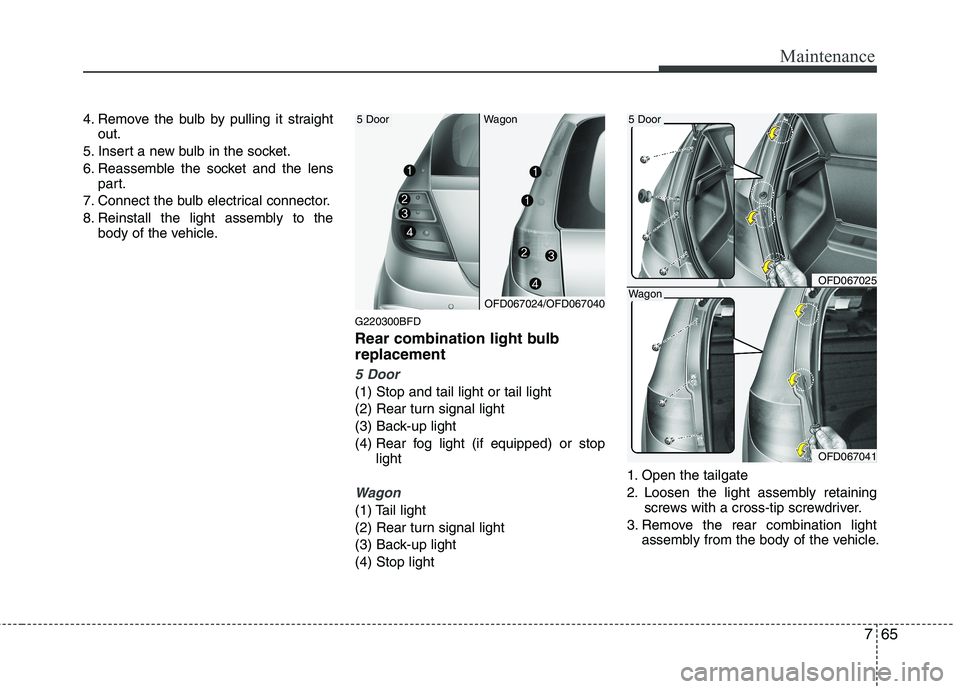
G220300BFD
Rear combination light bulb replacement
5 Door
(1) Stop and tail light or tail light
(2) Rear turn signal light
(3) Back-up light
(4) Rear fog light (if equipped) or stoplight
Wagon
(1) Tail light
(2) Rear turn signal light
(3) Back-up light(4) Stop light 1. Open the tailgate
2. Loosen the light assembly retaining
screws with a cross-tip screwdriver.
3. Remove the rear combination light assembly from the body of the vehicle.
OFD067024/OFD067040
OFD067025
OFD067041
5 Door5 Door
Wagon
Wagon
Page 399 of 635
Specifications
2
9
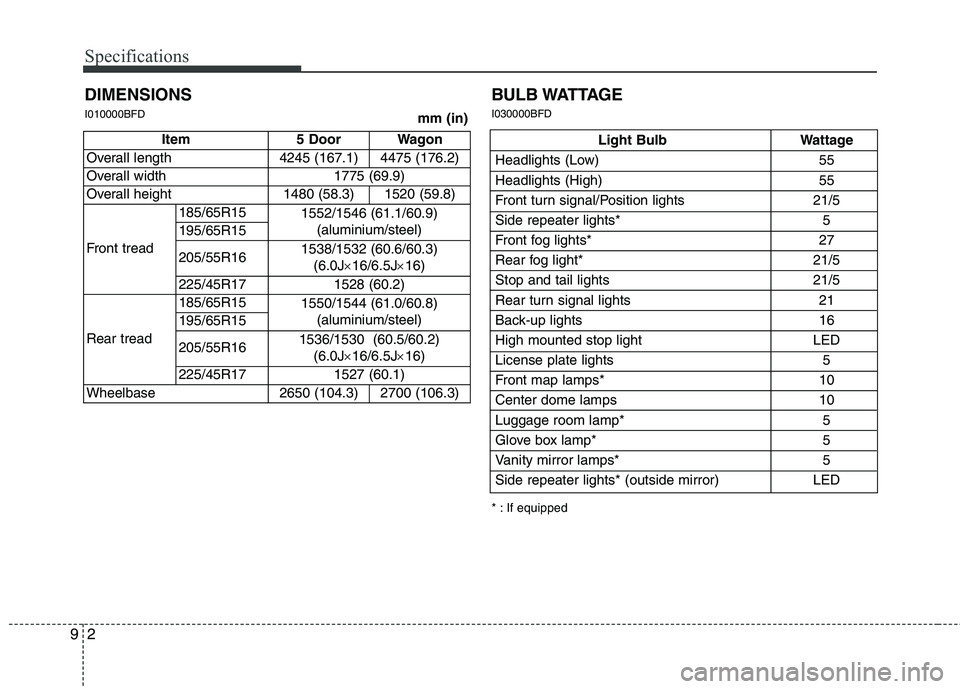
DIMENSIONS I010000BFD
Light Bulb Wattage
Headlights (Low) 55
Headlights (High) 55
Front turn signal/Position lights 21/5
Side repeater lights* 5
Front fog lights* 27
Rear fog light* 21/5
Stop and tail lights 21/5
Rear turn signal lights 21
Back-up lights 16
High mounted stop light LED
License plate lights 5
Front map lamps* 10
Center dome lamps 10
Luggage room lamp* 5
Glove box lamp* 5
Vanity mirror lamps* 5
Side repeater lights* (outside mirror) LED
BULB WATTAGE I030000BFD
* : If equipped
mm (in)
Item 5 Door Wagon
Overall length 4245 (167.1) 4475 (176.2)
Overall width 1775 (69.9)
Overall height 1480 (58.3) 1520 (59.8)
Front tread 185/65R15
1552/1546 (61.1/60.9)
(aluminium/steel)
195/65R15 205/55R16 1538/1532 (60.6/60.3)
(6.0J ×16/6.5J ×16)
225/45R17 1528 (60.2)
Rear tread 185/65R15
1550/1544 (61.0/60.8)
(aluminium/steel)
195/65R15205/55R16 1536/1530 (60.5/60.2)
(6.0J ×16/6.5J ×16)
225/45R17 1527 (60.1)
Wheelbase 2650 (104.3) 2700 (106.3)
Page 424 of 635
311
Safety system of your vehicle
To fold the rear seat cushion and back - 5 Door
1. Set the front seatback to the uprightposition and if necessary, slide the
front seat forward.
2. Pull the cushion folding strap (1) and lift the front portion of the seat cushion.
3. Lift the rear portion of the seat cush-ion. Stand the rear seat cushion verti-
cally.
4. Remove the headrest from the rear seatback.
5. Stow the headrest by inserting the headrest poles into the holder on thebottom of the seat cushion. 6. Pull the lock release lever (red visible)
and fold the rear seatback forward and
down firmly.
OFD037010
OFD037011
OFD037009
OFD037034
OFD037008