Heat HYUNDAI I30 2016 Manual PDF
[x] Cancel search | Manufacturer: HYUNDAI, Model Year: 2016, Model line: I30, Model: HYUNDAI I30 2016Pages: 659, PDF Size: 17.14 MB
Page 586 of 659
7-73
7
Maintenance
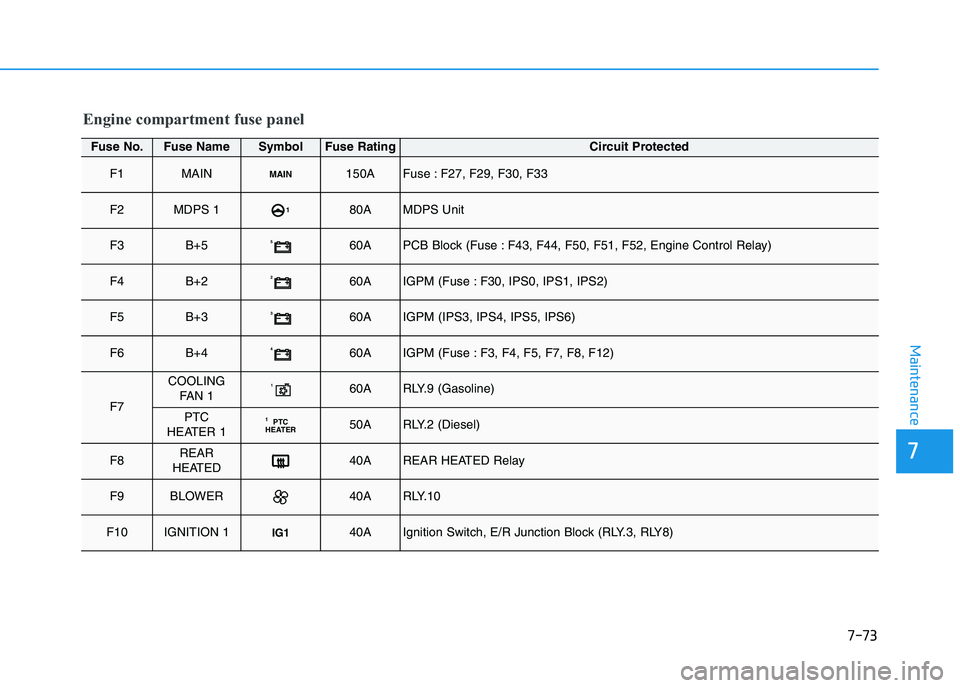
Engine compartment fuse panel
Fuse No.Fuse NameSymbolFuse RatingCircuit Protected
F1MAINMAIN150AFuse : F27, F29, F30, F33
F2MDPS 1180AMDPS Unit
F3B+5560APCB Block (Fuse : F43, F44, F50, F51, F52, Engine Control Relay)
F4B+2260AIGPM (Fuse : F30, IPS0, IPS1, IPS2)
F5B+3360AIGPM (IPS3, IPS4, IPS5, IPS6)
F6B+4460AIGPM (Fuse : F3, F4, F5, F7, F8, F12)
F7
COOLINGFAN 1160ARLY.9 (Gasoline)
PTC
HEATER 1PTC
HEATER150ARLY.2 (Diesel)
F8REAR
HEATED40AREAR HEATED Relay
F9BLOWER40ARLY.10
F10IGNITION 1IG140AIgnition Switch, E/R Junction Block (RLY.3, RLY8)
Page 587 of 659
7-74
Maintenance
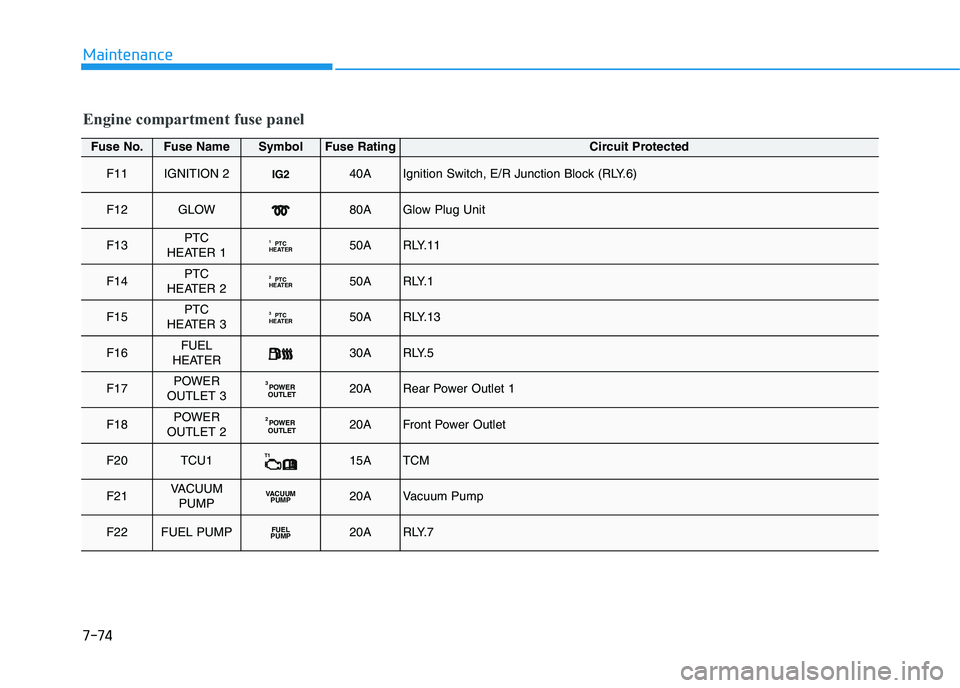
Engine compartment fuse panel
Fuse No.Fuse NameSymbolFuse RatingCircuit Protected
F11IGNITION 2IG240AIgnition Switch, E/R Junction Block (RLY.6)
F12GLOW80AGlow Plug Unit
F13PTC
HEATER 1PTC
HEATER150ARLY.11
F14PTC
HEATER 2PTC
HEATER250AR LY. 1
F15PTC
HEATER 3PTC
HEATER350ARLY.13
F16FUEL
HEATER30AR LY. 5
F17POWER
OUTLET 3POWER
OUTLET320ARear Power Outlet 1
F18POWER
OUTLET 2POWER
OUTLET220AFront Power Outlet
F20TCU1T115ATCM
F21VACUUM
PUMPVACUUM PUMP20AVacuum Pump
F22FUEL PUMPFUEL
PUMP20AR LY. 7
Page 595 of 659
7-82
Maintenance
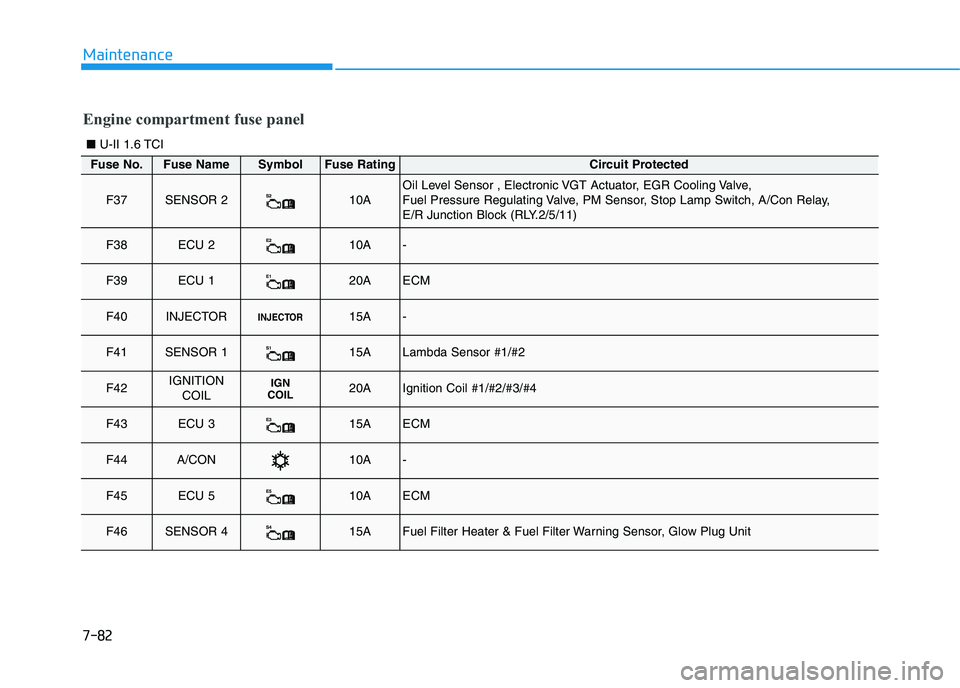
Fuse No.Fuse NameSymbolFuse RatingCircuit Protected
F37SENSOR 2S210AOil Level Sensor , Electronic VGT Actuator, EGR Cooling Valve,
Fuel Pressure Regulating Valve, PM Sensor, Stop Lamp Switch, A/Con Relay,
E/R Junction Block (RLY.2/5/11)
F38ECU 2E210A-
F39ECU 1E120AECM
F40INJECTORINJECTOR15A-
F41SENSOR 1S115ALambda Sensor #1/#2
F42IGNITION
COILIGN
COIL20AIgnition Coil #1/#2/#3/#4
F43ECU 3E 315AECM
F44A/CON10A-
F45ECU 5E510AECM
F46SENSOR 4S415AFuel Filter Heater & Fuel Filter Warning Sensor, Glow Plug Unit
■ U-II 1.6 TCI
Engine compartment fuse panel
Page 599 of 659
7-86
Maintenance
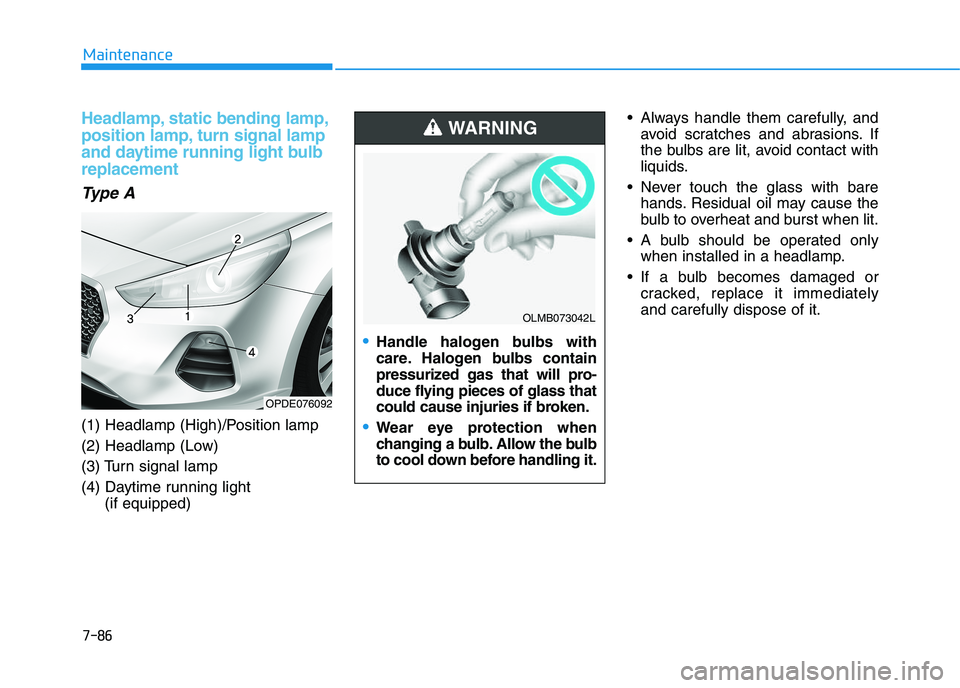
Headlamp, static bending lamp,
position lamp, turn signal lamp
and daytime running light bulb
replacement
Ty p e A
(1) Headlamp (High)/Position lamp
(2) Headlamp (Low)
(3) Turn signal lamp
(4) Daytime running light (if equipped) Always handle them carefully, and
avoid scratches and abrasions. If
the bulbs are lit, avoid contact with
liquids.
Never touch the glass with bare hands. Residual oil may cause the
bulb to overheat and burst when lit.
A bulb should be operated only when installed in a headlamp.
If a bulb becomes damaged or cracked, replace it immediately
and carefully dispose of it.
OPDE076092
Handle halogen bulbs with
care. Halogen bulbs contain
pressurized gas that will pro-
duce flying pieces of glass that
could cause injuries if broken.
Wear eye protection when
changing a bulb. Allow the bulb
to cool down before handling it.
WARNING
OLMB073042L
Page 602 of 659
7-89
7
Maintenance
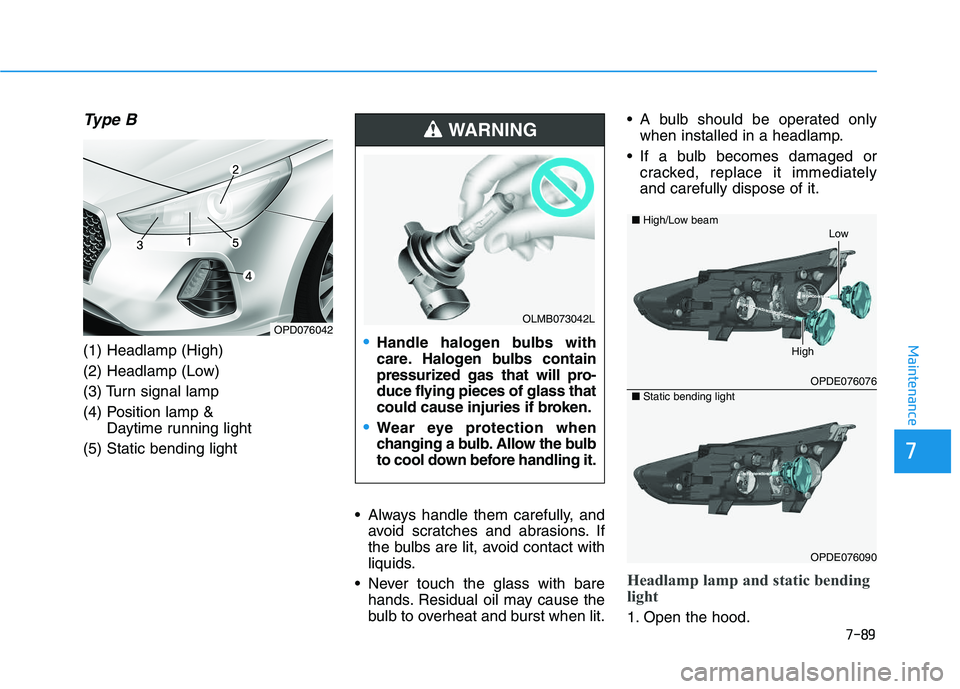
Type B
(1) Headlamp (High)
(2) Headlamp (Low)
(3) Turn signal lamp
(4) Position lamp & Daytime running light
(5) Static bending light
• Always handle them carefully, andavoid scratches and abrasions. If
the bulbs are lit, avoid contact with
liquids.
Never touch the glass with bare hands. Residual oil may cause the
bulb to overheat and burst when lit. A bulb should be operated only
when installed in a headlamp.
If a bulb becomes damaged or cracked, replace it immediately
and carefully dispose of it.
Headlamp lamp and static bending
light
1. Open the hood.
OPDE076076
■
High/Low beam
High
Low
OPDE076090
■
Static bending light
OPD076042Handle halogen bulbs with
care. Halogen bulbs contain
pressurized gas that will pro-
duce flying pieces of glass that
could cause injuries if broken.
Wear eye protection when
changing a bulb. Allow the bulb
to cool down before handling it.
WARNING
OLMB073042L
Page 622 of 659
7-109
7
Maintenance
Keep your car clean
The best way to prevent corrosion is
to keep your car clean and free of
corrosive materials. Attention to the
underside of the car is particularly
important.
If you live in a high-corrosion area— where road salts are used, near
the ocean, areas with industrial
pollution, acid rain, etc.—, you
should take extra care to prevent
corrosion. In winter, hose off the
underside of your car at least once
a month and be sure to clean the
underside thoroughly when winter
is over.
When cleaning underneath the car, give particular attention to the
components under the fenders and
other areas that are hidden from
view. Do a thorough job; just damp-
ening the accumulated mud rather
than washing it away will acceler-
ate corrosion rather than prevent
it. Water under high pressure and
steam are particularly effective in
removing accumulated mud and
corrosive materials. When cleaning lower door panels,
rocker panels and frame members,
be sure that drain holes are kept
open so that moisture can escape
and not be trapped inside to accel-
erate corrosion.
Keep your garage dry
Don't park your car in a damp, poor-
ly ventilated garage. This creates a
favorable environment for corrosion.
This is particularly true if you wash
your car in the garage or drive it into
the garage when it is still wet or cov-
ered with snow, ice or mud. Even a
heated garage can contribute to cor-
rosion unless it is well ventilated so
moisture is dispersed.
Keep paint and trim in good condition
Scratches or chips in the finish
should be covered with "touch-up"
paint as soon as possible to reduce
the possibility of corrosion. If bare
metal is showing through, the atten-
tion of a qualified body and paint
shop is recommended.
Bird droppings : Bird droppings are
highly corrosive and may damage
painted surfaces in just a few hours.
Always remove bird droppings as
soon as possible.
Don't neglect the interior
Moisture can collect under the floor
mats and carpeting to cause corro-
sion. Check under the mats periodi-
cally to be sure the carpeting is dry.
Use particular care if you carry fertil-
izers, cleaning materials or chemi-
cals in the car.
These should be carried only in
proper containers and any spills or
leaks should be cleaned up, flushed
with clean water and thoroughly
dried.
Page 626 of 659
7-113
7
Maintenance
Do not operate the engine in con-fined or closed areas (such as
garages) any more than what is
necessary to move the vehicle in or
out of the area.
When the vehicle is stopped in an open area for more than a short
time with the engine running,
adjust the ventilation system (as
needed) to draw outside air into the
vehicle.
Never sit in a parked or stopped vehicle for any extended time with
the engine running.
When the engine stalls or fails to start, excessive attempts to restart
the engine may cause damage to
the emission control system.Operating precautions for cat-alytic converters (if equipped)Your vehicle is equipped with a cat-
alytic converter emission control
device.
Therefore, the following precautions
must be observed:
Use only UNLEADED FUEL for
gasoline engine.
Do not operate the vehicle when there are signs of engine malfunc-
tion, such as misfire or a noticeable
loss of performance.
Do not misuse or abuse the engine. Examples of misuse are
coasting with the engine off and
descending steep grades in gear
with the engine off.
Do not operate the engine at high idle speed for extended periods (5
minutes or more).
A hot exhaust system can
ignite flammable items under
your vehicle. Do not park, idle,
or drive the vehicle over or
near flammable objects, such
as dry grass, paper, leaves, etc.
The exhaust system and cat-
alytic system are very hot while
the engine is running or imme-
diately after the engine is
turned off. Keep away from the
exhaust system and catalytic,
you may get burned.
Also, do not remove the heat
sink around the exhaust sys-
tem, do not seal the bottom of
the vehicle or do not coat the
vehicle for corrosion control. It
may present a fire risk under
certain conditions.
WARNING