air filter HYUNDAI I30 2017 Owner's Manual
[x] Cancel search | Manufacturer: HYUNDAI, Model Year: 2017, Model line: I30, Model: HYUNDAI I30 2017Pages: 659, PDF Size: 17.14 MB
Page 543 of 659
Maintenance
7-30
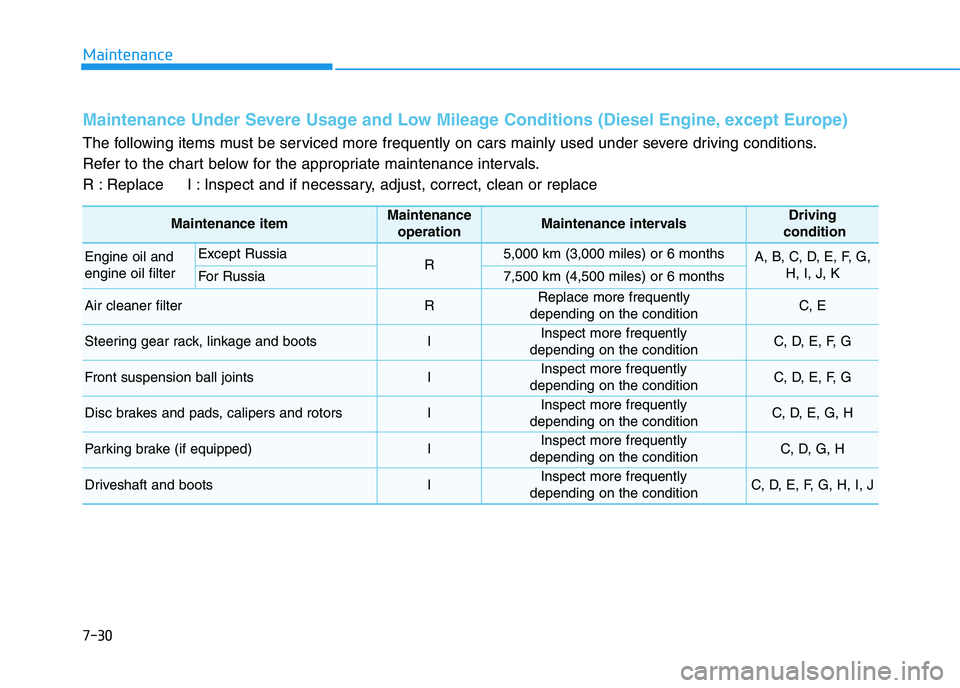
Maintenance Under Severe Usage and Low Mileage Conditions (Diesel Engine, except Europe)
The following items must be serviced more frequently on cars mainly used under severe driving conditions.
Refer to the chart below for the appropriate maintenance intervals.
R : Replace I : Inspect and if necessary, adjust, correct, clean or replace
Maintenance itemMaintenance operationMaintenance intervalsDriving
condition
Engine oil and
engine oil filterExcept RussiaR5,000 km (3,000 miles) or 6 monthsA, B, C, D, E, F, G, H, I, J, K
For Russia7,500 km (4,500 miles) or 6 months
Air cleaner filterRReplace more frequently
depending on the conditionC, E
Steering gear rack, linkage and bootsIInspect more frequently
depending on the conditionC, D, E, F, G
Front suspension ball jointsIInspect more frequently
depending on the conditionC, D, E, F, G
Disc brakes and pads, calipers and rotorsIInspect more frequently
depending on the conditionC, D, E, G, H
Parking brake (if equipped)IInspect more frequently
depending on the conditionC, D, G, H
Driveshaft and bootsIInspect more frequently
depending on the conditionC, D, E, F, G, H, I, J
Page 544 of 659
7-31
7
Maintenance
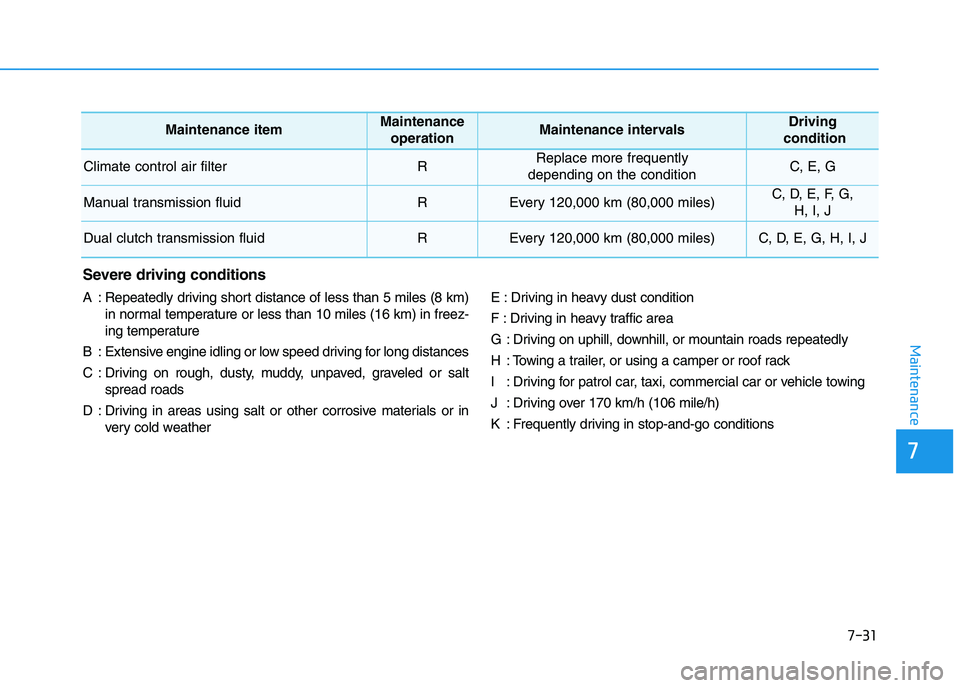
Maintenance itemMaintenance operationMaintenance intervalsDriving
condition
Climate control air filter RReplace more frequently
depending on the conditionC, E, G
Manual transmission fluidREvery 120,000 km (80,000 miles)C, D, E, F, G, H, I, J
Dual clutch transmission fluidREvery 120,000 km (80,000 miles)C, D, E, G, H, I, J
Severe driving conditions
A : Repeatedly driving short distance of less than 5 miles (8 km)in normal temperature or less than 10 miles (16 km) in freez-
ing temperature
B : Extensive engine idling or low speed driving for long distances
C : Driving on rough, dusty, muddy, unpaved, graveled or salt spread roads
D : Driving in areas using salt or other corrosive materials or in very cold weather E : Driving in heavy dust condition
F : Driving in heavy traffic area
G : Driving on uphill, downhill, or mountain roads repeatedly
H : Towing a trailer, or using a camper or roof rack
I : Driving for patrol car, taxi, commercial car or vehicle towing
J : Driving over 170 km/h (106 mile/h)
K : Frequently driving in stop-and-go conditions
Page 546 of 659

7-33
7
Maintenance
Air cleaner filter
We recommend that the air cleaner
filter be replaced by an authorized
HYUNDAI dealer.
Spark plugs
(for Gasoline Engine)
Make sure to install new spark plugs
of the correct heat range.
Valve clearance
(for Gasoline Engine)
Inspect excessive valve noise and/or
engine vibration and adjust if neces-
sary. We recommend that the system
be serviced by an authorized HYUNDAI
dealer.
Cooling system
Check the cooling system parts,
such as radiator, coolant reservoir,
hoses and connections for leakage
and damage. Replace any damaged
parts.
Engine coolant
The coolant should be changed at
the intervals specified in the mainte-
nance schedule.
Automatic transmission fluid
(if equipped)
Automatic transmission fluid should
not be checked under normal usage
conditions.
We recommend that the automatic
transmission fluid changed by an
authorized HYUNDAI dealer accord-
ing to the maintenance schedule.
Information
Automatic transmission fluid color is
basically red.
As the vehicle is driven, the automatic
transmission fluid will begin to look
darker.
It is normal condition and you should
not judge the need to replace the fluid
based upon the changed color.
The use of a non-specified fluid
could result in transmission mal-
function and failure.
Use only specified automatic
transmission fluid.
(Refer to “Recommended lubri-
cants and capacities” in chapter 8.)
Manual transmission fluid
(if equipped)
Inspect the manual transmission
fluid according to the maintenance
schedule.
NOTICE
i
Do not disconnect and inspect
spark plugs when the engine is
hot. You may burn yourself.
WARNING
Page 555 of 659
7-42
Maintenance
A
A I
I R
R
C
C L
L E
E A
A N
N E
E R
R
F
F U
U E
E L
L
F
F I
I L
L T
T E
E R
R
(
( F
F O
O R
R
D
D I
I E
E S
S E
E L
L )
)
Draining water from fuel filter
The fuel filter in the diesel engine
operates the critical function of sepa-
rating water from the fuels and accu-
mulating the water in its bottom.
When enough water is accumulated
inside the fuel filter, the warning light
( ) illuminates with the ignition
switch in the ON position.
In this case, we recommend you to
have the system checked by an
authorized HYUNDAI dealer.
When the accumulated water is not
drained at a proper timing, water
may permeate in the fuel filter,
damaging the major vehicle com-
ponents, such as the fuel system.
Fuel filter cartridge replace-
ment
We recommend the fuel filter car-
tridge be replaced by an authorized
HYUNDAI dealer according to the
Maintenance Schedule at the begin-
ning of this chapter.
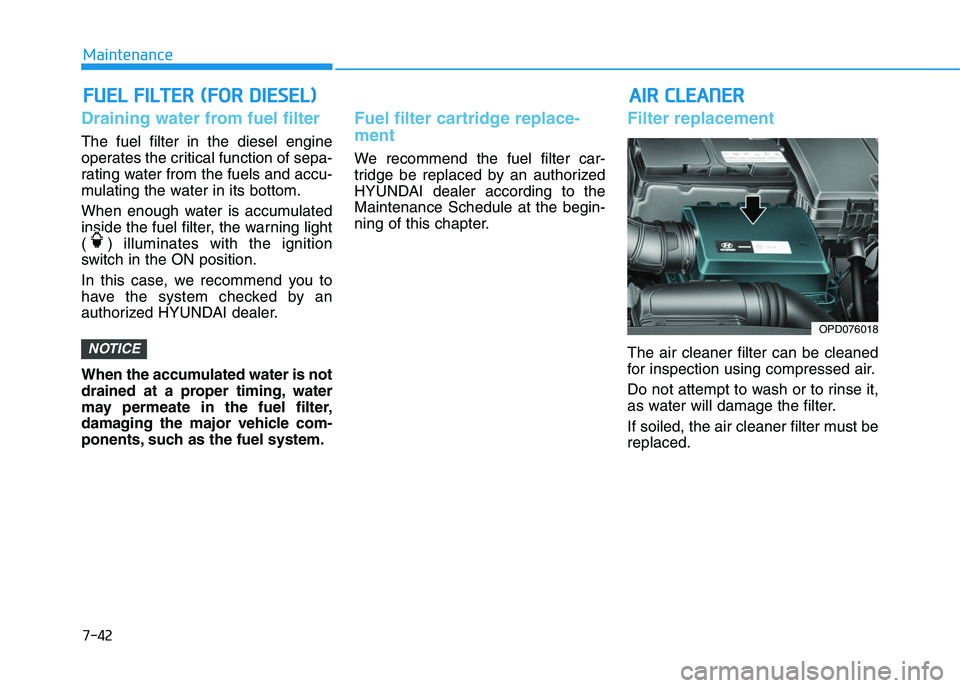
Filter replacement
The air cleaner filter can be cleaned
for inspection using compressed air.
Do not attempt to wash or to rinse it,
as water will damage the filter.
If soiled, the air cleaner filter must be
replaced.NOTICE
OPD076018
Page 556 of 659
7-43
7
Maintenance
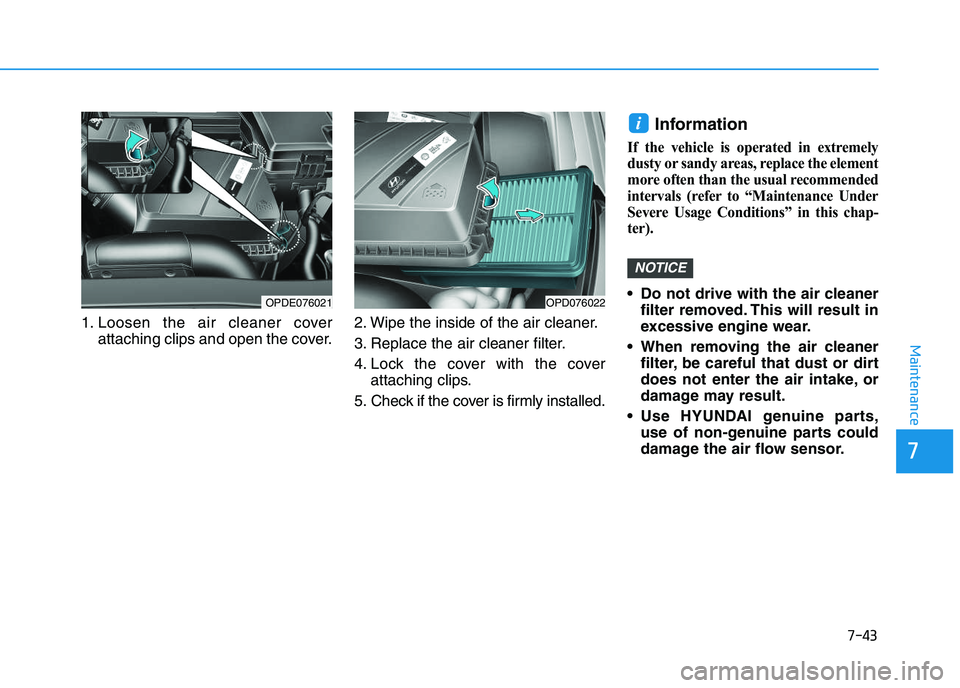
1. Loosen the air cleaner coverattaching clips and open the cover. 2. Wipe the inside of the air cleaner.
3. Replace the air cleaner filter.
4. Lock the cover with the cover
attaching clips.
5. Check if the cover is firmly installed.
Information
If the vehicle is operated in extremely
dusty or sandy areas, replace the element
more often than the usual recommended
intervals (refer to “Maintenance Under
Severe Usage Conditions” in this chap-
ter).
Do not drive with the air cleaner filter removed. This will result in
excessive engine wear.
When removing the air cleaner filter, be careful that dust or dirt
does not enter the air intake, or
damage may result.
Use HYUNDAI genuine parts, use of non-genuine parts could
damage the air flow sensor.
NOTICE
i
OPDE076021OPD076022
Page 557 of 659
7-44
Maintenance
C
C L
L I
I M
M A
A T
T E
E
C
C O
O N
N T
T R
R O
O L
L
A
A I
I R
R
F
F I
I L
L T
T E
E R
R
Filter inspection
If the vehicle is operated in the
severely air-polluted cities or on
dusty rough roads for a long period,
it should be inspected more fre-
quently and replaced earlier. When
you, the owner, replace the climate
control air filter, replace it performing
the following procedure, and be care-
ful to avoid damaging other compo-
nents.
Replace the filter according to the
Maintenance Schedule.
Filter replacement
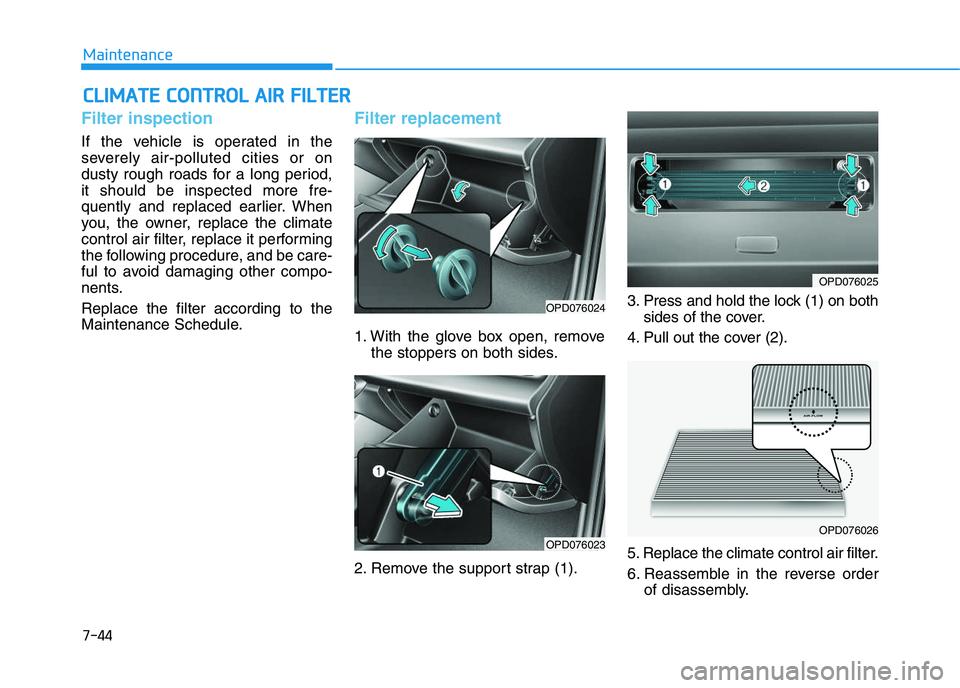
1. With the glove box open, remove
the stoppers on both sides.
2. Remove the support strap (1). 3. Press and hold the lock (1) on both
sides of the cover.
4. Pull out the cover (2).
5. Replace the climate control air filter.
6. Reassemble in the reverse order of disassembly.
OPD076024
OPD076023
OPD076025
OPD076026
Page 558 of 659
7-45
7
Maintenance
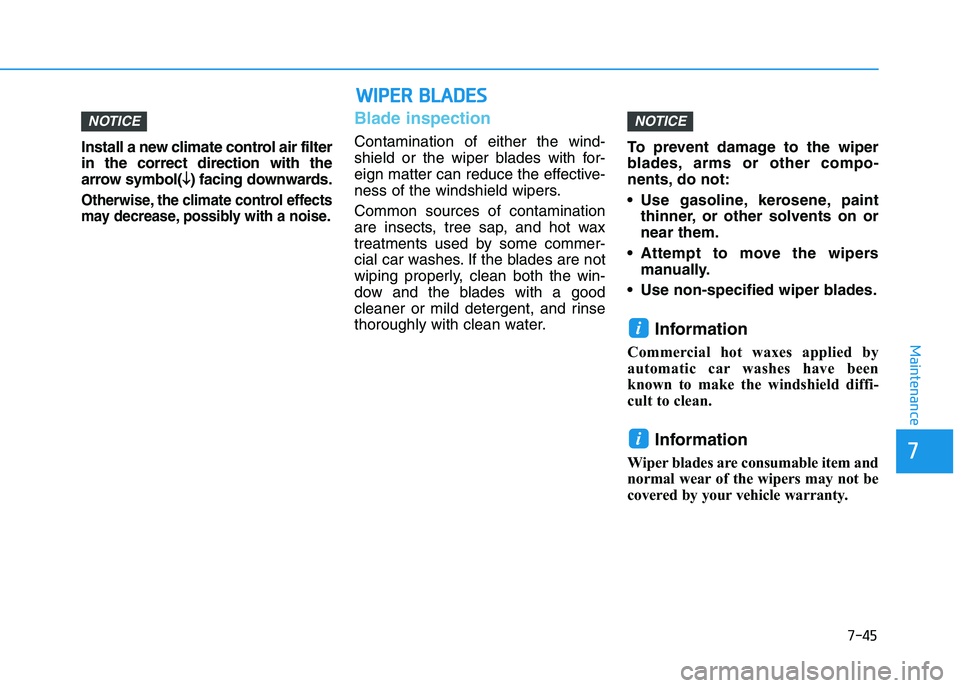
Install a new climate control air filter
in the correct direction with the
arrow symbol(
↓
↓) facing downwards.
Otherwise, the climate control effects
may decrease, possibly with a noise.
Blade inspection
Contamination of either the wind-
shield or the wiper blades with for-
eign matter can reduce the effective-
ness of the windshield wipers.
Common sources of contamination
are insects, tree sap, and hot wax
treatments used by some commer-
cial car washes. If the blades are not
wiping properly, clean both the win-
dow and the blades with a good
cleaner or mild detergent, and rinse
thoroughly with clean water. To prevent damage to the wiper
blades, arms or other compo-
nents, do not:
Use gasoline, kerosene, paint
thinner, or other solvents on or
near them.
Attempt to move the wipers manually.
Use non-specified wiper blades.
Information
Commercial hot waxes applied by
automatic car washes have been
known to make the windshield diffi-
cult to clean.
Information
Wiper blades are consumable item and
normal wear of the wipers may not be
covered by your vehicle warranty.
i
i
NOTICENOTICE
W
W I
I P
P E
E R
R
B
B L
L A
A D
D E
E S
S
Page 624 of 659
7-111
7
Maintenance
E
E M
M I
I S
S S
S I
I O
O N
N
C
C O
O N
N T
T R
R O
O L
L
S
S Y
Y S
S T
T E
E M
M
The emission control system of your
vehicle is covered by a written limited
warranty. Please see the warranty
information contained in the Service
Passport in your vehicle.
Your vehicle is equipped with an
emission control system to meet all
emission regulations.
There are three emission control
systems which are as follows.
(1) Crankcase emission control sys-
tem
(2) Evaporative emission control sys- tem
(3) Exhaust emission control system
In order to assure the proper function
of the emission control systems, it is
recommended that you have your car
inspected and maintained by an
authorized HYUNDAI dealer in accor-
dance with the maintenance schedule
in this manual.1. Crankcase emission control system
The positive crankcase ventilation
system is employed to prevent air
pollution caused by blow-by gases
being emitted from the crankcase.
This system supplies fresh filtered air
to the crankcase through the air
intake hose. Inside the crankcase,
the fresh air mixes with blow-by
gases, which then pass through the
PCV valve into the induction system.
2. Evaporative emission con-trol system
The Evaporative Emission Control
System is designed to prevent fuel
vapors from escaping into the atmos-
phere.
For the Inspection and Maintenance
Test (With Electronic Stability Control
(ESC) system)
To prevent the vehicle from
misfiring during dynamome-
ter testing, turn the Electronic
Stability Control (ESC) sys-
tem off by pressing the ESC
switch.
After dynamometer testing is
completed, turn the ESC sys-
tem back on by pressing the
ESC switch again.
CAUTION
Page 627 of 659
7-114
Maintenance
Do not modify or tamper with any part of the engine or emission con-
trol system. All inspections and
adjustments must be made by an
authorized HYUNDAI dealer.
Avoid driving with a very low fuel level. If you run out of gasoline, it
could cause the engine to misfire
and result in excessive loading of
the catalytic converter.
Failure to observe these precautions
could result in damage to the catalytic
converter and to your vehicle.
Additionally, such actions could void
your warranties.
Diesel particulate filter (DPF) (if equipped)
The Diesel Particulate Filter (DPF)
system removes the soot in the
exhaust gas.
The DPF system automatically burns
(or oxidizes) the accumulated soot in
accordance with the driving situa-
tions, unlike a disposable air filter.
In other words, the accumulated soot
is automatically purged out by the
engine control system and by the high
exhaust-gas temperature at normal/
high driving speeds.
However, when the vehicle is continu-
ally driven at repeated short distance
or driven at low speed for a long time,
the accumulated soot may not be
automatically removed because of low
exhaust gas temperature. In this case,
the accumulated soot is out of the
detection range, the soot oxidization
process does not occur, and the
Malfunction Indicator Lamp ( )
Illuminates. The Malfunction Indicator Lamp (MIL)
stops illuminating, when the driving
speed exceeds 60 km/h (37mph), or
when the engine rpm is between
1,500 and 2,500 with the gear in the
2nd position or above for approxi-
mately 25 minutes.
When the MIL continuously blinks or
the warning message “Check exhaust
system” illuminates in the above
cases, we recommend you to have the
DPF system checked by an author-
ized HYUNDAI dealer.
When the vehicle is continuously driv-
en with the MIL flashing for an extend-
ed period of time, it may damage the
DPF system and lower the fuel econ-
omy.