fuel filter HYUNDAI I30 2020 User Guide
[x] Cancel search | Manufacturer: HYUNDAI, Model Year: 2020, Model line: I30, Model: HYUNDAI I30 2020Pages: 659, PDF Size: 17.14 MB
Page 595 of 659
7-82
Maintenance
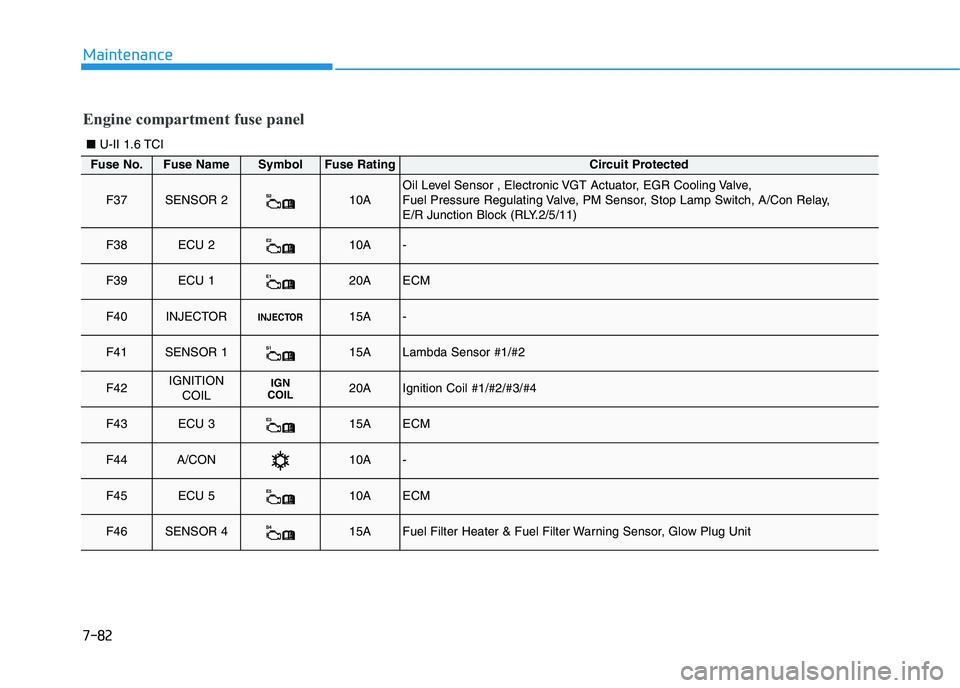
Fuse No.Fuse NameSymbolFuse RatingCircuit Protected
F37SENSOR 2S210AOil Level Sensor , Electronic VGT Actuator, EGR Cooling Valve,
Fuel Pressure Regulating Valve, PM Sensor, Stop Lamp Switch, A/Con Relay,
E/R Junction Block (RLY.2/5/11)
F38ECU 2E210A-
F39ECU 1E120AECM
F40INJECTORINJECTOR15A-
F41SENSOR 1S115ALambda Sensor #1/#2
F42IGNITION
COILIGN
COIL20AIgnition Coil #1/#2/#3/#4
F43ECU 3E 315AECM
F44A/CON10A-
F45ECU 5E510AECM
F46SENSOR 4S415AFuel Filter Heater & Fuel Filter Warning Sensor, Glow Plug Unit
■ U-II 1.6 TCI
Engine compartment fuse panel
Page 624 of 659
7-111
7
Maintenance
E
E M
M I
I S
S S
S I
I O
O N
N
C
C O
O N
N T
T R
R O
O L
L
S
S Y
Y S
S T
T E
E M
M
The emission control system of your
vehicle is covered by a written limited
warranty. Please see the warranty
information contained in the Service
Passport in your vehicle.
Your vehicle is equipped with an
emission control system to meet all
emission regulations.
There are three emission control
systems which are as follows.
(1) Crankcase emission control sys-
tem
(2) Evaporative emission control sys- tem
(3) Exhaust emission control system
In order to assure the proper function
of the emission control systems, it is
recommended that you have your car
inspected and maintained by an
authorized HYUNDAI dealer in accor-
dance with the maintenance schedule
in this manual.1. Crankcase emission control system
The positive crankcase ventilation
system is employed to prevent air
pollution caused by blow-by gases
being emitted from the crankcase.
This system supplies fresh filtered air
to the crankcase through the air
intake hose. Inside the crankcase,
the fresh air mixes with blow-by
gases, which then pass through the
PCV valve into the induction system.
2. Evaporative emission con-trol system
The Evaporative Emission Control
System is designed to prevent fuel
vapors from escaping into the atmos-
phere.
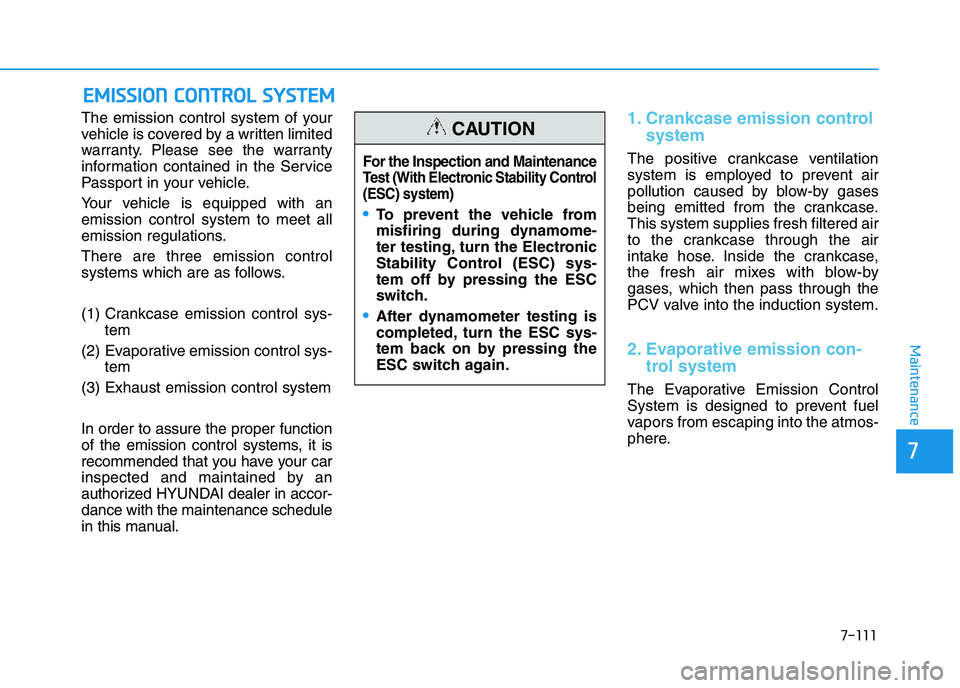
For the Inspection and Maintenance
Test (With Electronic Stability Control
(ESC) system)
To prevent the vehicle from
misfiring during dynamome-
ter testing, turn the Electronic
Stability Control (ESC) sys-
tem off by pressing the ESC
switch.
After dynamometer testing is
completed, turn the ESC sys-
tem back on by pressing the
ESC switch again.
CAUTION
Page 627 of 659
7-114
Maintenance
Do not modify or tamper with any part of the engine or emission con-
trol system. All inspections and
adjustments must be made by an
authorized HYUNDAI dealer.
Avoid driving with a very low fuel level. If you run out of gasoline, it
could cause the engine to misfire
and result in excessive loading of
the catalytic converter.
Failure to observe these precautions
could result in damage to the catalytic
converter and to your vehicle.
Additionally, such actions could void
your warranties.
Diesel particulate filter (DPF) (if equipped)
The Diesel Particulate Filter (DPF)
system removes the soot in the
exhaust gas.
The DPF system automatically burns
(or oxidizes) the accumulated soot in
accordance with the driving situa-
tions, unlike a disposable air filter.
In other words, the accumulated soot
is automatically purged out by the
engine control system and by the high
exhaust-gas temperature at normal/
high driving speeds.
However, when the vehicle is continu-
ally driven at repeated short distance
or driven at low speed for a long time,
the accumulated soot may not be
automatically removed because of low
exhaust gas temperature. In this case,
the accumulated soot is out of the
detection range, the soot oxidization
process does not occur, and the
Malfunction Indicator Lamp ( )
Illuminates. The Malfunction Indicator Lamp (MIL)
stops illuminating, when the driving
speed exceeds 60 km/h (37mph), or
when the engine rpm is between
1,500 and 2,500 with the gear in the
2nd position or above for approxi-
mately 25 minutes.
When the MIL continuously blinks or
the warning message “Check exhaust
system” illuminates in the above
cases, we recommend you to have the
DPF system checked by an author-
ized HYUNDAI dealer.
When the vehicle is continuously driv-
en with the MIL flashing for an extend-
ed period of time, it may damage the
DPF system and lower the fuel econ-
omy.
Page 635 of 659
8-7
Specifications & Consumer information
R
R E
E C
C O
O M
M M
M E
E N
N D
D E
E D
D
L
L U
U B
B R
R I
I C
C A
A N
N T
T S
S
A
A N
N D
D
C
C A
A P
P A
A C
C I
I T
T I
I E
E S
S
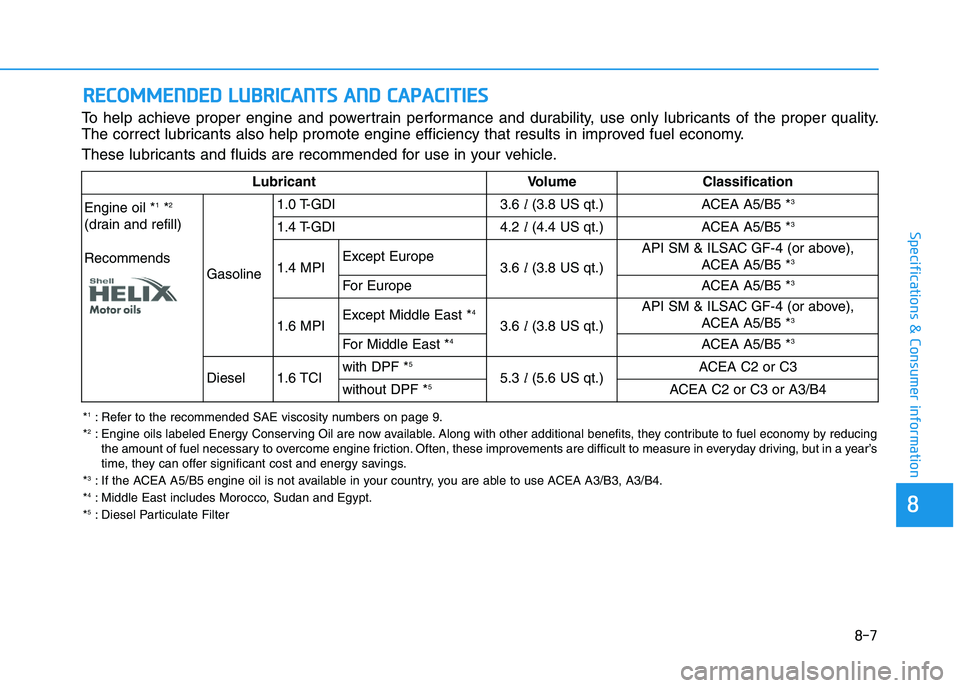
To help achieve proper engine and powertrain performance and durability, use only lubricants of the proper quality.
The correct lubricants also help promote engine efficiency that results in improved fuel economy.
These lubricants and fluids are recommended for use in your vehicle.
Lubricant Volume Classification
Engine oil *
1*2
(drain and refill)
Recommends Gasoline1.0 T-GDI
3.6
l(3.8 US qt.)
ACEA A5/B5 *
3
1.4 T-GDI 4.2
l(4.4 US qt.)
ACEA A5/B5 *3
1.4 MPIExcept Europe
3.6 l(3.8 US qt.) API SM & ILSAC GF-4 (or above),
ACEA A5/B5 *3
For Europe ACEA A5/B5 *3
1.6 MPI Except Middle East *
4
3.6
l(3.8 US qt.) API SM & ILSAC GF-4 (or above),
ACEA A5/B5 *3
For Middle East *4ACEA A5/B5 *3
Diesel 1.6 TCI with DPF *
5
5.3
l(5.6 US qt.) ACEA C2 or C3
without DPF *5ACEA C2 or C3 or A3/B4
8
*1: Refer to the recommended SAE viscosity numbers on page 9.
*2: Engine oils labeled Energy Conserving Oil are now available. Along with other additional benefits, they contribute to fuel econ omy by reducing
the amount of fuel necessary to overcome engine friction. Often, these improvements are difficult to measure in everyday driving , but in a year’s
time, they can offer significant cost and energy savings.
*
3: If the ACEA A5/B5 engine oil is not available in your country, you are able to use ACEA A3/B3, A3/B4.
*4: Middle East includes Morocco, Sudan and Egypt.
*5: Diesel Particulate Filter