belt HYUNDAI I30 2020 Repair Manual
[x] Cancel search | Manufacturer: HYUNDAI, Model Year: 2020, Model line: I30, Model: HYUNDAI I30 2020Pages: 659, PDF Size: 17.14 MB
Page 524 of 659
7-11
7
Maintenance
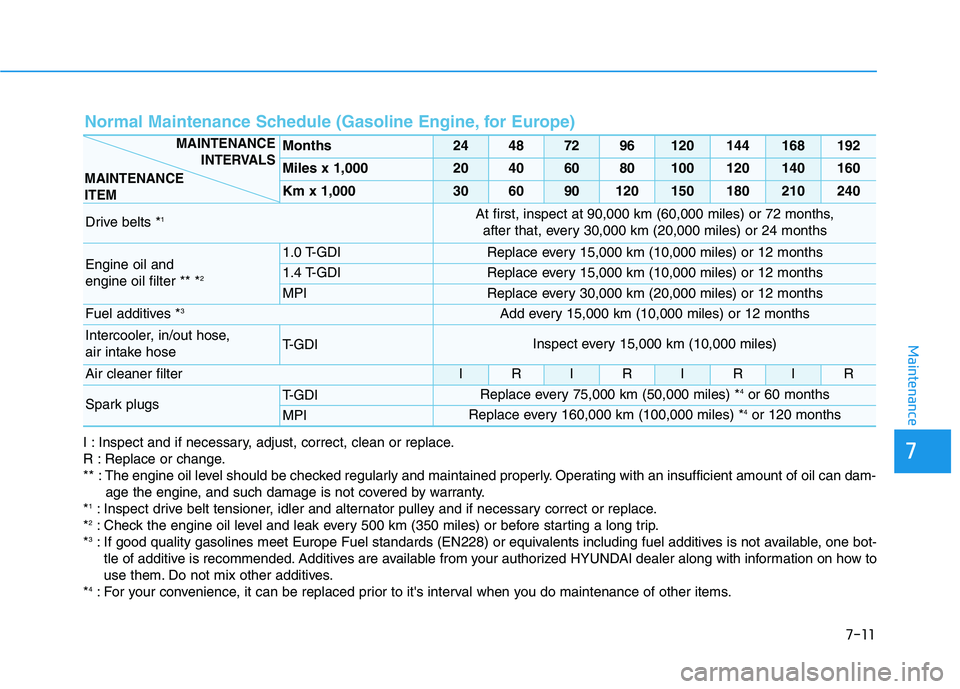
I : Inspect and if necessary, adjust, correct, clean or replace.
R : Replace or change.
** : The engine oil level should be checked regularly and maintained properly. Operating with an insufficient amount of oil can dam-
age the engine, and such damage is not covered by warranty.
*
1: Inspect drive belt tensioner, idler and alternator pulley and if necessary correct or replace.
*2: Check the engine oil level and leak every 500 km (350 miles) or before starting a long trip.
*3: If good quality gasolines meet Europe Fuel standards (EN228) or equivalents including fuel additives is not available, one bot -
tle of additive is recommended. Additives are available from your authorized HYUNDAI dealer along with information on how to
use them. Do not mix other additives.
*
4: For your convenience, it can be replaced prior to it's interval when you do maintenance of other items.
Normal Maintenance Schedule (Gasoline Engine, for Europe)
Months24487296120144168192
Miles x 1,00020406080100120140160
Km x 1,000306090120150180210240
Drive belts *1At first, inspect at 90,000 km (60,000 miles) or 72 months, after that, every 30,000 km (20,000 miles) or 24 months
Engine oil and
engine oil filter ** *2
1.0 T-GDI Replace every 15,000 km (10,000 miles) or 12 months
1.4 T-GDI Replace every 15,000 km (10,000 miles) or 12 months
MPI Replace every 30,000 km (20,000 miles) or 12 months
Fuel additives *3Add every 15,000 km (10,000 miles) or 12 months
Intercooler, in/out hose,
air intake hose T-GDIInspect every 15,000 km (10,000 miles)
Air cleaner filterIRIRIRIR
Spark plugsT-GDIReplace every 75,000 km (50,000 miles) *4or 60 months
MPIReplace every 160,000 km (100,000 miles) *4or 120 months
MAINTENANCE INTERVALS
MAINTENANCE
ITEM
Page 529 of 659
Maintenance
7-16
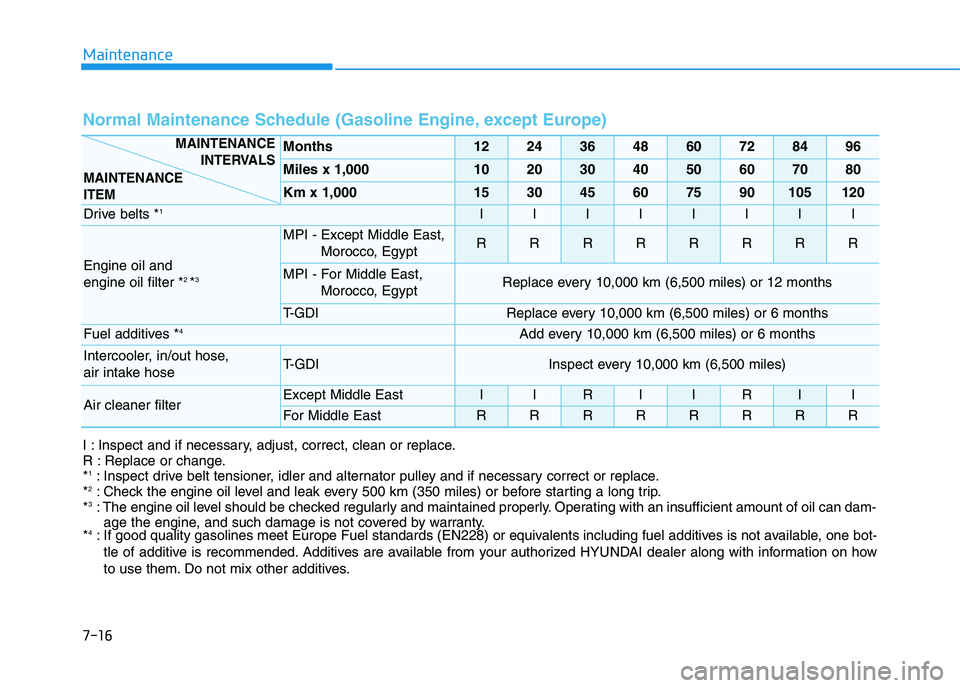
Normal Maintenance Schedule (Gasoline Engine, except Europe)
Months1224364860728496
Miles x 1,0001020304050607080
Km x 1,000153045607590105120
Drive belts *1IIIIIIII
Engine oil and
engine oil filter *2 *3
MPI - Except Middle East,Morocco, Egypt RRRRRRRR
MPI - For Middle East,Morocco, Egypt Replace every 10,000 km (6,500 miles) or 12 months
T-GDIReplace every 10,000 km (6,500 miles) or 6 months
Fuel additives *4Add every 10,000 km (6,500 miles) or 6 months
Intercooler, in/out hose,
air intake hoseT-GDIInspect every 10,000 km (6,500 miles)
Air cleaner filter Except Middle EastIIRIIRII
For Middle EastRRRRRRRR
I : Inspect and if necessary, adjust, correct, clean or replace.
R : Replace or change.
*
1: Inspect drive belt tensioner, idler and alternator pulley and if necessary correct or replace.
*2: Check the engine oil level and leak every 500 km (350 miles) or before starting a long trip.
*3 : The engine oil level should be checked regularly and maintained properly. Operating with an insufficient amount of oil can dam- age the engine, and such damage is not covered by warranty.
*
4: If good quality gasolines meet Europe Fuel standards (EN228) or equivalents including fuel additives is not available, one bot -
tle of additive is recommended. Additives are available from your authorized HYUNDAI dealer along with information on how
to use them. Do not mix other additives.
MAINTENANCE INTERVALS
MAINTENANCE
ITEM
Page 535 of 659
Maintenance
7-22
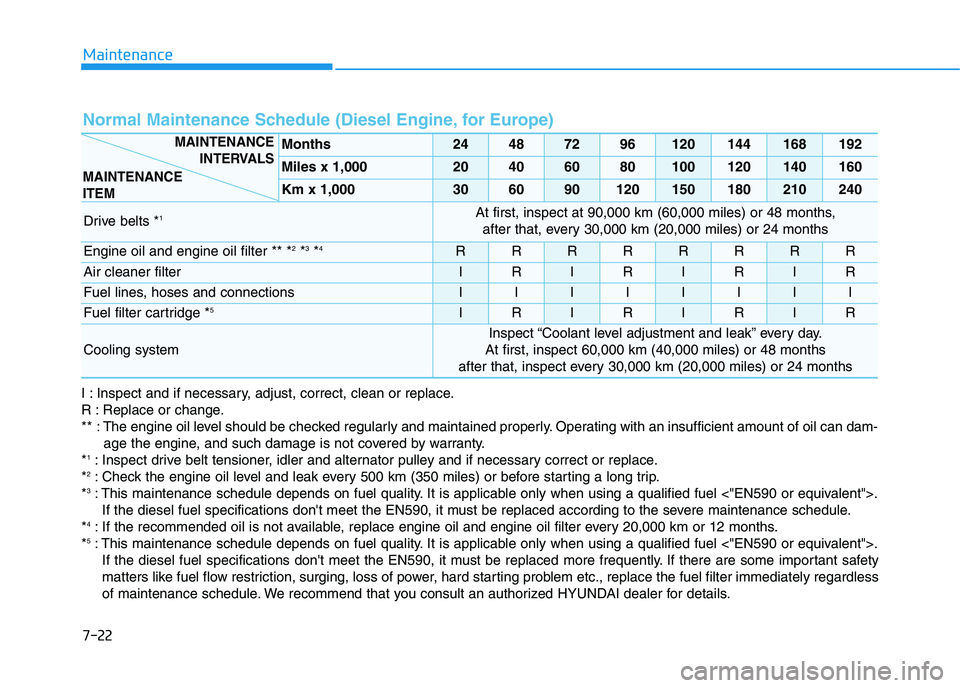
I : Inspect and if necessary, adjust, correct, clean or replace.
R : Replace or change.
** : The engine oil level should be checked regularly and maintained properly. Operating with an insufficient amount of oil can d
am-
age the engine, and such damage is not covered by warranty.
*
1: Inspect drive belt tensioner, idler and alternator pulley and if necessary correct or replace.
*2: Check the engine oil level and leak every 500 km (350 miles) or before starting a long trip.
*3: This maintenance schedule depends on fuel quality. It is applicable only when using a qualified fuel <"EN590 or equivalent">. If the diesel fuel specifications don't meet the EN590, it must be replaced according to the severe maintenance schedule.
*
4: If the recommended oil is not available, replace engine oil and engine oil filter every 20,000 km or 12 months.
*5: This maintenance schedule depends on fuel quality. It is applicable only when using a qualified fuel <"EN590 or equivalent">. If the diesel fuel specifications don't meet the EN590, it must be replaced more frequently. If there are some important safety
matters like fuel flow restriction, surging, loss of power, hard starting problem etc., replace the fuel filter immediately reg ardless
of maintenance schedule. We recommend that you consult an authorized HYUNDAI dealer for details.
Normal Maintenance Schedule (Diesel Engine, for Europe)
Months24487296120144168192
Miles x 1,00020406080100120140160
Km x 1,000306090120150180210240
Drive belts *1At first, inspect at 90,000 km (60,000 miles) or 48 months, after that, every 30,000 km (20,000 miles) or 24 months
Engine oil and engine oil filter ** *2*3*4RRRRRRRR
Air cleaner filterIRIRIRIR
Fuel lines, hoses and connectionsIIIIIIII
Fuel filter cartridge *5IRIRIRIR
Cooling system
Inspect “Coolant level adjustment and leak” every day.
At first, inspect 60,000 km (40,000 miles) or 48 months
after that, inspect every 30,000 km (20,000 miles) or 24 months
MAINTENANCE INTERVALS
MAINTENANCE
ITEM
Page 540 of 659
7-27
7
Maintenance
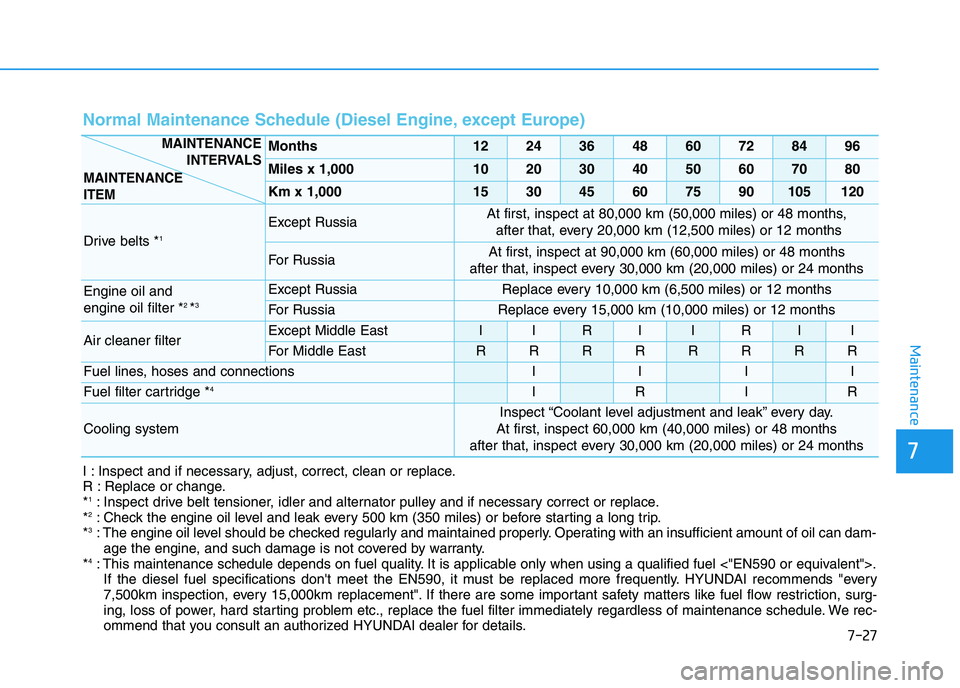
Normal Maintenance Schedule (Diesel Engine, except Europe)
Months1224364860728496
Miles x 1,0001020304050607080
Km x 1,000153045607590105120
Drive belts *1Except RussiaAt first, inspect at 80,000 km (50,000 miles) or 48 months, after that, every 20,000 km (12,500 miles) or 12 months
For RussiaAt first, inspect at 90,000 km (60,000 miles) or 48 months
after that, inspect every 30,000 km (20,000 miles) or 24 months
Engine oil and
engine oil filter *2 *3Except RussiaReplace every 10,000 km (6,500 miles) or 12 months
For RussiaReplace every 15,000 km (10,000 miles) or 12 months
Air cleaner filter Except Middle EastIIRIIRII
For Middle EastRRRRRRRR
Fuel lines, hoses and connectionsIIII
Fuel filter cartridge *4IRIR
Cooling system
Inspect “Coolant level adjustment and leak” every day.
At first, inspect 60,000 km (40,000 miles) or 48 months
after that, inspect every 30,000 km (20,000 miles) or 24 months
I : Inspect and if necessary, adjust, correct, clean or replace.
R : Replace or change.
*
1: Inspect drive belt tensioner, idler and alternator pulley and if necessary correct or replace.
*2: Check the engine oil level and leak every 500 km (350 miles) or before starting a long trip.
*3 : The engine oil level should be checked regularly and maintained properly. Operating with an insufficient amount of oil can dam- age the engine, and such damage is not covered by warranty.
*
4: This maintenance schedule depends on fuel quality. It is applicable only when using a qualified fuel <"EN590 or equivalent">. If the diesel fuel specifications don't meet the EN590, it must be replaced more frequently. HYUNDAI recommends "every
7,500km inspection, every 15,000km replacement". If there are some important safety matters like fuel flow restriction, surg-
ing, loss of power, hard starting problem etc., replace the fuel filter immediately regardless of maintenance schedule. We rec-
ommend that you consult an authorized HYUNDAI dealer for details.
MAINTENANCE
INTERVALS
MAINTENANCE
ITEM
Page 545 of 659
7-32
Maintenance
E
E X
X P
P L
L A
A N
N A
A T
T I
I O
O N
N
O
O F
F
S
S C
C H
H E
E D
D U
U L
L E
E D
D
M
M A
A I
I N
N T
T E
E N
N A
A N
N C
C E
E
I
I T
T E
E M
M S
S
Engine oil and filter
The engine oil and filter should be
changed at the intervals specified in
the maintenance schedule. If the car
is being driven in severe conditions,
more frequent oil and filter changes
are required.
Drive belts
Inspect all drive belts for evidence of
cuts, cracks, excessive wear or oil
saturation and replace if necessary.
Drive belts should be checked peri-
odically for proper tension and
adjusted as necessary.
Fuel filter (cartridge)
A clogged-up fuel filter may limit the
vehicle driving speed, damage the
emission system, and cause the
hard starting. When a considerable
amount of foreign substances are
accumulated in the fuel tank, the fuel
filter should be replaced.
Upon installing a new fuel filter, oper-
ate the diesel engine for several min-
utes, and check the connections for
any leakages. We recommend you to
have the fuel filter replaced by an
authorized HYUNDAI dealer.
Fuel lines, fuel hoses and con-
nections
Check the fuel lines, fuel hoses and
connections for leakage and dam-
age. We recommend that the fuel
lines, fuel hoses and connections be
replaced by an authorized HYUNDAI
dealer.
Vapor hose and fuel filler cap
The vapor hose and fuel filler cap
should be inspected at those inter-
vals specified in the maintenance
schedule. Make sure that a new
vapor hose or fuel filler cap is cor-
rectly replaced.
Vacuum crankcase ventilation
hoses (if equipped)
Inspect the surface of hoses for evi-
dence of heat and/or mechanical
damage. Hard and brittle rubber,
cracking, tears, cuts, abrasions, and
excessive swelling indicate deterio-
ration. Particular attention should be
paid to examine those hose surfaces
nearest to high heat sources, such
as the exhaust manifold.
Inspect the hose routing to assure
that the hoses do not come in con-
tact with any heat source, sharp
edges or moving component which
might cause heat damage or
mechanical wear. Inspect all hose
connections, such as clamps and
couplings, to make sure they are
secure, and that no leaks are pres-
ent. Hoses should be replaced
immediately if there is any evidence
of deterioration or damage.
When you are inspecting the belt,
place the ignition switch to the
LOCK/OFF or ACC position.
CAUTION
Page 572 of 659
7-59
7
Maintenance
Tire speed ratings
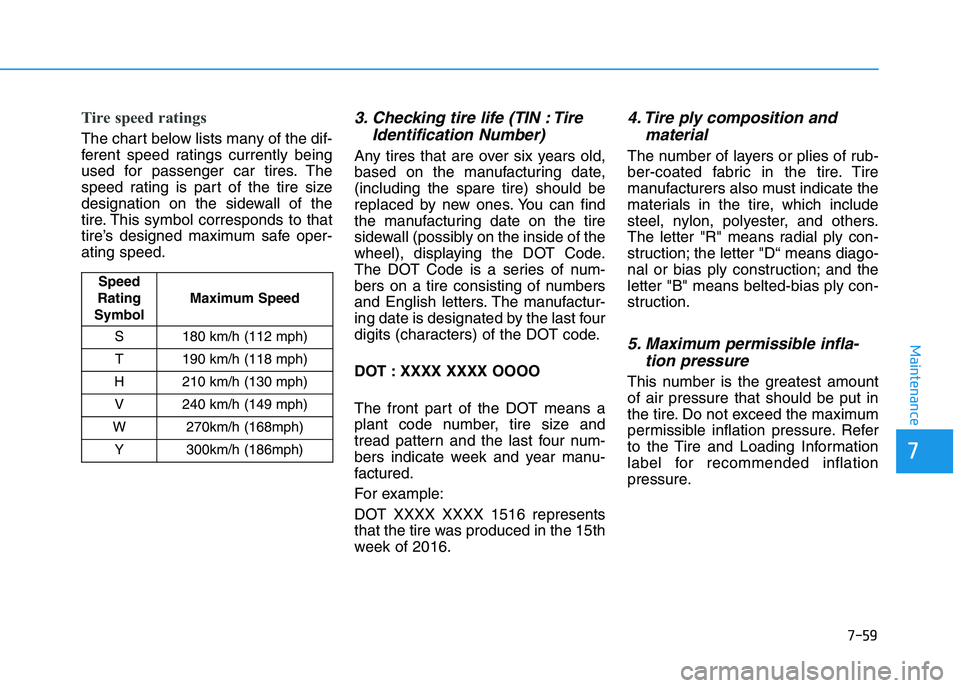
The chart below lists many of the dif-
ferent speed ratings currently being
used for passenger car tires. The
speed rating is part of the tire size
designation on the sidewall of the
tire. This symbol corresponds to that
tire’s designed maximum safe oper-
ating speed.
3. Checking tire life (TIN : TireIdentification Number)
Any tires that are over six years old,
based on the manufacturing date,
(including the spare tire) should be
replaced by new ones. You can find
the manufacturing date on the tire
sidewall (possibly on the inside of the
wheel), displaying the DOT Code.
The DOT Code is a series of num-
bers on a tire consisting of numbers
and English letters. The manufactur-
ing date is designated by the last four
digits (characters) of the DOT code.
DOT : XXXX XXXX OOOO
The front part of the DOT means a
plant code number, tire size and
tread pattern and the last four num-
bers indicate week and year manu-
factured.
For example:
DOT XXXX XXXX 1516 represents
that the tire was produced in the 15th
week of 2016.
4. Tire ply composition andmaterial
The number of layers or plies of rub-
ber-coated fabric in the tire. Tire
manufacturers also must indicate the
materials in the tire, which include
steel, nylon, polyester, and others.
The letter "R" means radial ply con-
struction; the letter "D“ means diago-
nal or bias ply construction; and the
letter "B" means belted-bias ply con-
struction.
5. Maximum permissible infla-tion pressure
This number is the greatest amount
of air pressure that should be put in
the tire. Do not exceed the maximum
permissible inflation pressure. Refer
to the Tire and Loading Information
label for recommended inflation
pressure.
Speed
Rating
Symbol Maximum Speed
S 180 km/h (112 mph) T 190 km/h (118 mph)
H 210 km/h (130 mph) V 240 km/h (149 mph)
W 270km/h (168mph) Y 300km/h (186mph)
Page 623 of 659
7-110
Maintenance
Interior care
Interior general precautions
Prevent chemicals such as perfume,
cosmetic oil, sun cream, hand cleaner
and air freshener from contacting the
interior parts because they may
cause damage or discoloration. If they
do contact the interior parts, wipe them
off immediately.
See the instructions that follow for
the proper way to clean vinyl.
Never allow water or other liquids to
come in contact with electrical/elec-
tronic components inside the vehi-
cle as this may damage them.
When cleaning leather products
(steering wheel, seats etc.), use
neutral detergents or low alcohol
content solutions. If you use high
alcohol content solutions or acid/
alkaline detergents, the color of
the leather may fade or the sur-
face may get stripped off.
Cleaning the upholstery andinterior trim
Vinyl
Remove dust and loose dirt from
vinyl with a whisk broom or vacuum
cleaner. Clean vinyl surfaces with a
vinyl cleaner.
Fabric
Remove dust and loose dirt from fabric
with a whisk broom or vacuum cleaner.
Clean with a mild soap solution recom-
mended for upholstery or carpets.
Remove fresh spots immediately with
a fabric spot cleaner. If fresh spots do
not receive immediate attention, the
fabric can be stained and its color can
be affected. Also, its fire-resistant prop-
erties can be reduced if the material is
not properly maintained.
Using anything but recommended
cleaners and procedures may affect
the fabric’s appearance and fire-
resistant properties.
Cleaning the lap/shoulder beltwebbing
Clean the belt webbing with any mild
soap solution recommended for clean-
ing upholstery or carpet. Follow the
instructions provided with the soap. Do
not bleach or re-dye the webbing
because this may weaken it.
Cleaning the interior windowglass
If the interior glass surfaces of the
vehicle become fogged (that is, cov-
ered with an oily, greasy or waxy film),
they should be cleaned with glass
cleaner. Follow the directions on the
glass cleaner container.
Do not scrape or scratch the inside
of the rear window. This may result
in damage to the rear window
defroster grid.
NOTICE
NOTICE
NOTICE
NOTICE
Page 649 of 659
Téli gumiabroncs
Ha téli gumiabroncsot akar használni,
először győződjön meg arról, hogy
ezek megfelelő méretű és
terhelhetőségű radiál abroncsok.
Kifejezetten javasoljuk, hogy mind a
négy kerékre szereltessen téli
gumiabroncsot, hogy biztosítsa
gépkocsija jó vezethetőségét. Ne
feledje, hogy a téli gumiabroncsok
tapadása száraz úton nem olyan jó,
mint a gépkocsira eredetileg felszerelt
gumiabroncsoké. Még tiszta úton is
óvatosan kell vezetnie. Tájékozódjon a
gumiszerelőnél a megengedett
legnagyobb sebességgel
kapcsolatban.
Ne szereltessen fel szögesgumiabroncsot, mielőtt tájékozódnaa használatukra, illetve esetlegestiltásukra vonatkozó helyi előírásokról.Hólánc
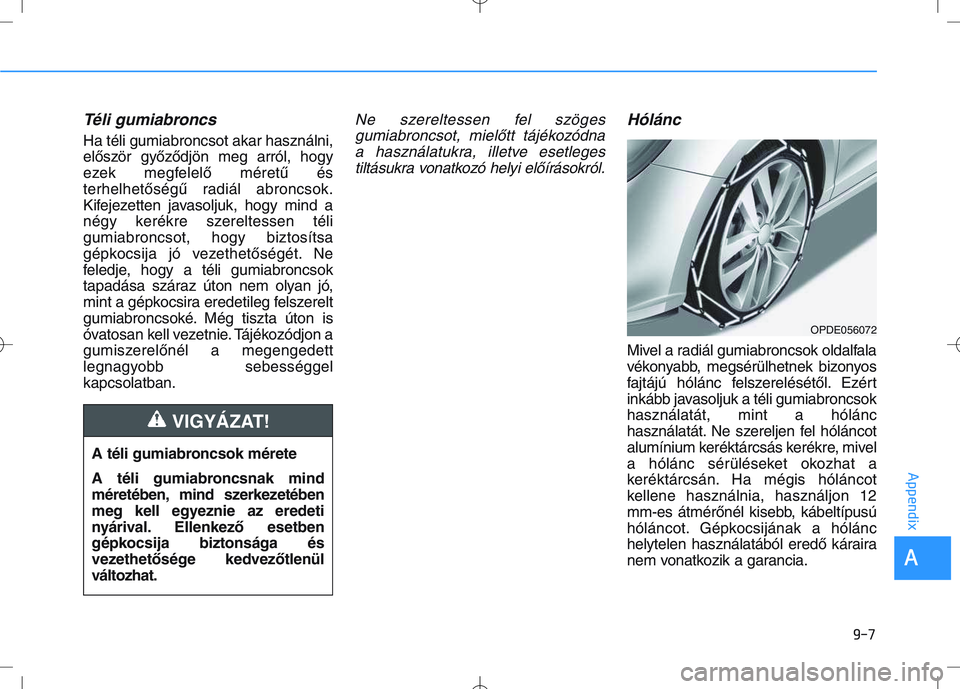
Mivel a radiál gumiabroncsok oldalfala
vékonyabb, megsérülhetnek bizonyos
fajtájú hólánc felszerelésétől. Ezért
inkább javasoljuk a téli gumiabroncsok
használatát, mint a hólánc
használatát. Ne szereljen fel hóláncot
alumínium keréktárcsás kerékre, mivel
a hólánc sérüléseket okozhat a
keréktárcsán. Ha mégis hóláncot
kellene használnia, használjon 12
mm-es átmérőnél kisebb, kábeltípusú
hóláncot. Gépkocsijának a hólánc
helytelen használatából eredő káraira
nem vonatkozik a garancia.
9-7
A
AppendixA téli gumiabroncsok mérete
A téli gumiabroncsnak mind
méretében, mind szerkezetében
meg kell egyeznie az eredeti
nyárival. Ellenkező esetben
gépkocsija biztonsága és
vezethetősége kedvezőtlenül
változhat.
VIGYÁZAT!
OPDE056072