egr HYUNDAI I30 2021 Owners Manual
[x] Cancel search | Manufacturer: HYUNDAI, Model Year: 2021, Model line: I30, Model: HYUNDAI I30 2021Pages: 659, PDF Size: 17.14 MB
Page 94 of 659
3-92
Automatic type
It automatically adjusts the headlight
beam level according to the number
of passengers and loading weight in
the luggage area.
And it offers proper headlight beam
under various conditions.
Static bending light
(if equipped)
While driving a corner, for greater
visibility and safety, either the left or
right side static bending light will turn
on automatically. The static bending
light will turn on when one of the fol-
lowing conditions occur.
Vehicle speed is less than 10 km/h(6 mph) and steering wheel angle
is turned approximately 80 degrees
with the low beam on.
Vehicle speed is between 10 km/h (6 mph) to 90 km/h (56 mph) and
steering wheel angle is turned
approximately 35 degrees with the
low beam on.
When the vehicle is in reverse with one of the conditions above satis-
fied, the light opposite to the direc-
tion the steering wheel is steered
will turn on.
Welcome system (if equipped)
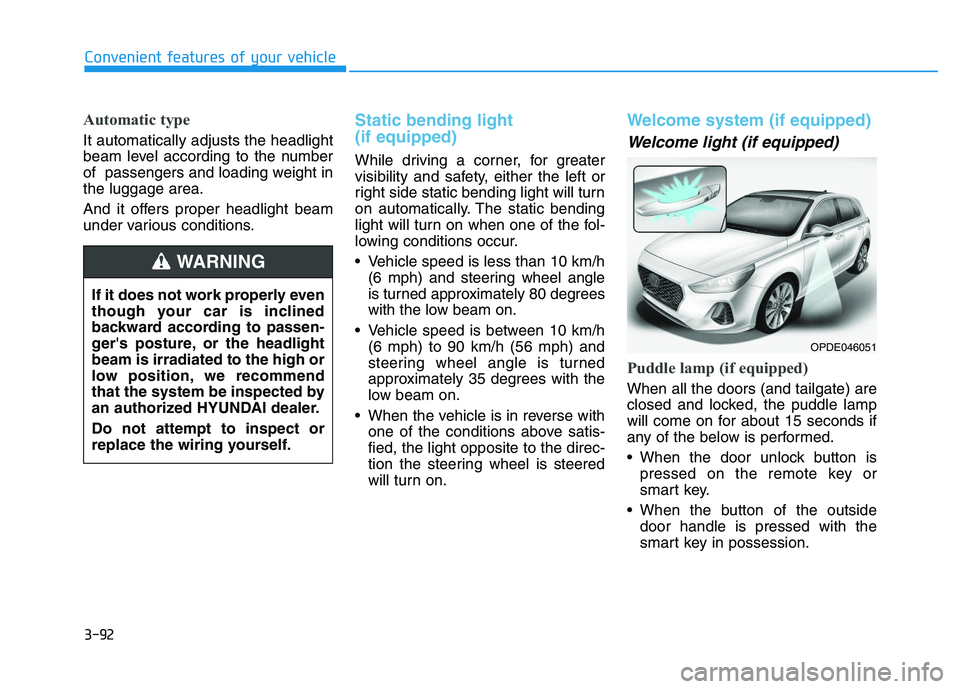
Welcome light (if equipped)
Puddle lamp (if equipped)
When all the doors (and tailgate) are
closed and locked, the puddle lamp
will come on for about 15 seconds if
any of the below is performed.
When the door unlock button ispressed on the remote key or
smart key.
When the button of the outside door handle is pressed with the
smart key in possession.
Convenient features of your vehicle
If it does not work properly even
though your car is inclined
backward according to passen-
ger's posture, or the headlight
beam is irradiated to the high or
low position, we recommend
that the system be inspected by
an authorized HYUNDAI dealer.
Do not attempt to inspect or
replace the wiring yourself.
WARNING
OPDE046051
Page 150 of 659
3-148
Convenient features of your vehicle
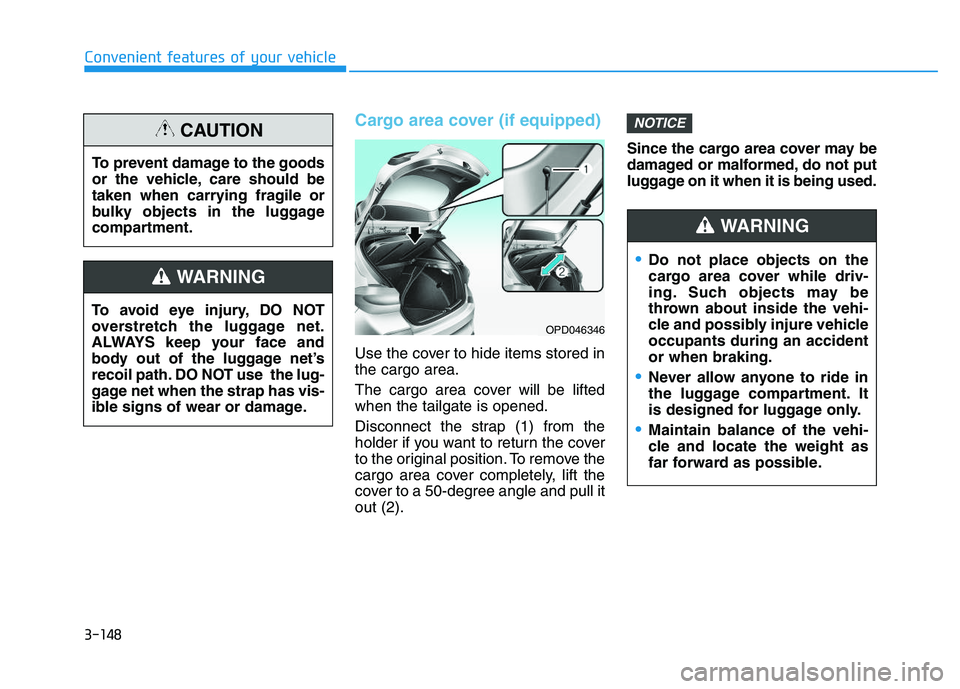
Cargo area cover (if equipped)
Use the cover to hide items stored in
the cargo area.
The cargo area cover will be lifted
when the tailgate is opened.
Disconnect the strap (1) from the
holder if you want to return the cover
to the original position. To remove the
cargo area cover completely, lift the
cover to a 50-degree angle and pull it
out (2).Since the cargo area cover may be
damaged or malformed, do not put
luggage on it when it is being used.
NOTICE
To avoid eye injury, DO NOT
overstretch the luggage net.
ALWAYS keep your face and
body out of the luggage net’s
recoil path. DO NOT use the lug-
gage net when the strap has vis-
ible signs of wear or damage.
WARNING
To prevent damage to the goods
or the vehicle, care should be
taken when carrying fragile or
bulky objects in the luggage
compartment.
CAUTION
OPD046346
Do not place objects on the
cargo area cover while driv-
ing. Such objects may be
thrown about inside the vehi-
cle and possibly injure vehicle
occupants during an accident
or when braking.
Never allow anyone to ride in
the luggage compartment. It
is designed for luggage only.
Maintain balance of the vehi-
cle and locate the weight as
far forward as possible.
WARNING
Page 213 of 659
3-63
Convenient features of your vehicle
3
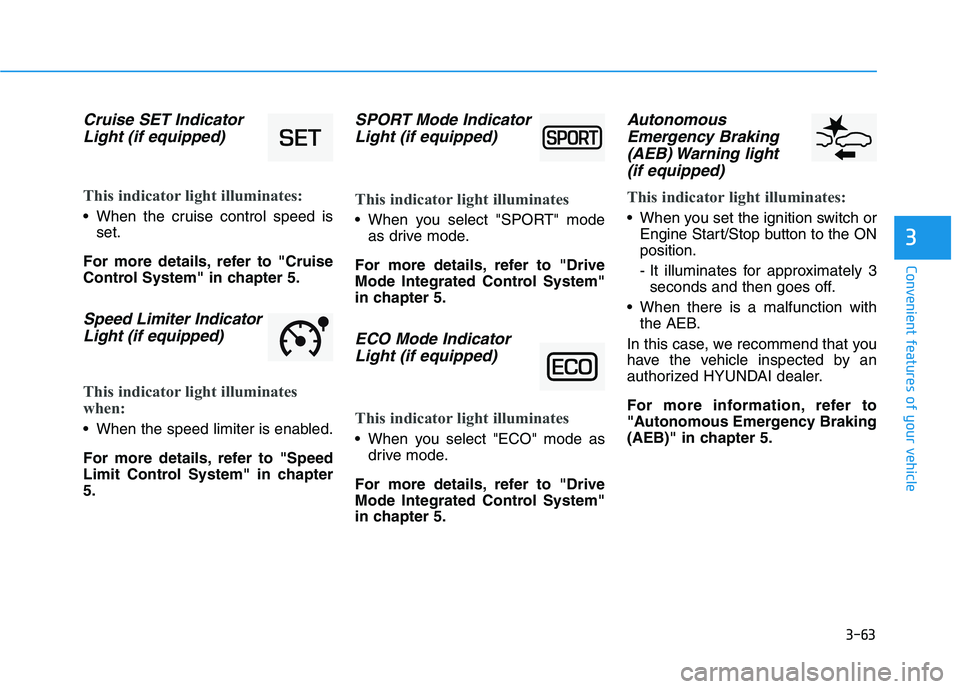
Cruise SET IndicatorLight (if equipped)
This indicator light illuminates:
When the cruise control speed is
set.
For more details, refer to "Cruise
Control System" in chapter 5.
Speed Limiter Indicator Light (if equipped)
This indicator light illuminates
when:
When the speed limiter is enabled.
For more details, refer to "Speed
Limit Control System" in chapter
5.
SPORT Mode IndicatorLight (if equipped)
This indicator light illuminates
When you select "SPORT" mode
as drive mode.
For more details, refer to "Drive
Mode Integrated Control System"
in chapter 5.
ECO Mode Indicator Light (if equipped)
This indicator light illuminates
When you select "ECO" mode as
drive mode.
For more details, refer to "Drive
Mode Integrated Control System"
in chapter 5.
Autonomous Emergency Braking(AEB) Warning light (if equipped)
This indicator light illuminates:
When you set the ignition switch or
Engine Start/Stop button to the ON
position.
- It illuminates for approximately 3seconds and then goes off.
When there is a malfunction with the AEB.
In this case, we recommend that you
have the vehicle inspected by an
authorized HYUNDAI dealer.
For more information, refer to
"Autonomous Emergency Braking
(AEB)" in chapter 5.
Page 235 of 659
4-3
Multimedia System
4
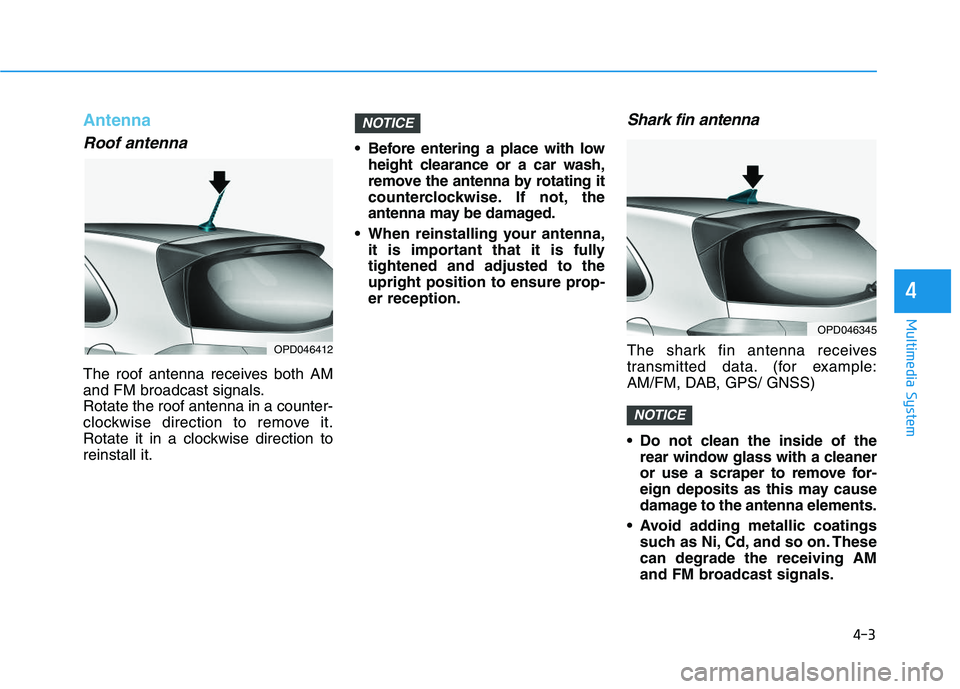
Antenna
Roof antenna
The roof antenna receives both AM
and FM broadcast signals.
Rotate the roof antenna in a counter-
clockwise direction to remove it.
Rotate it in a clockwise direction to
reinstall it. Before entering a place with low
height clearance or a car wash,
remove the antenna by rotating it
counterclockwise. If not, the
antenna may be damaged.
When reinstalling your antenna, it is important that it is fully
tightened and adjusted to the
upright position to ensure prop-
er reception.
Shark fin antenna
The shark fin antenna receives
transmitted data. (for example:
AM/FM, DAB, GPS/ GNSS)
Do not clean the inside of therear window glass with a cleaner
or use a scraper to remove for-
eign deposits as this may cause
damage to the antenna elements.
Avoid adding metallic coatings such as Ni, Cd, and so on. These
can degrade the receiving AM
and FM broadcast signals.
NOTICE
NOTICE
OPD046412
OPD046345
Page 305 of 659
Driving your vehicle
Before driving.........................................................5-5
Before entering the vehicle ...........................................5-5
Before starting...................................................................5-5
Ignition switch ........................................................5-7
Key ignition switch ............................................................5-7
Engine Start/Stop button ..............................................5-11
Manual transmission............................................5-20
Manual transmission operation ...................................5-20
Good driving practices ...................................................5-22
Automatic transmission .......................................5-24
Automatic transmission operation ..............................5-24
Parking ...............................................................................5-29
Good driving practices ...................................................5-29
Dual clutch transmission .....................................5-31
Dual clutch transmission operation ............................5-31
Parking ...............................................................................5-39
Good driving practices ...................................................5-39
Braking system.....................................................5-41
Power brakes ...................................................................5-41
Disc brakes wear indicator ...........................................5-42
Parking brake (Hand type) ...........................................5-42
Electronic Parking Brake (EPB)...................................5-44
AUTO HOLD ......................................................................5-49
Anti-lock Brake System (ABS) ....................................5-53Electronic Stability Control (ESC)................................5-55
Vehicle Stability Management......................................5-58
Hill-Start Assist Control (HAC) ....................................5-60
Emergency Stop Signal (ESS) ......................................5-60
Good braking practices..................................................5-61
ISG (Idle Stop and Go) system ...........................5-62
To activate the ISG system ...........................................5-62
To deactivate the ISG system ......................................5-66
ISG system malfunction .................................................5-66
The battery sensor deactivation .................................5-67
Drive mode integrated control system .............5-68
Blind Spot Detection System (BSD) ..................5-70
BSD (Blind Spot Detection) /
LCA (Lane Change Assist) .............................................5-71
RCTA (Rear Cross Traffic Alert) ..................................5-74
Limitations of the system .............................................5-77
Autonomous Emergency Braking (AEB)
- Sensor fusion type ...........................................5-78
System setting and activation......................................5-78
AEB warning message and system control ..............5-80
AEB sensor .......................................................................5-82
System malfunction ........................................................5-84
Limitations of the system .............................................5-85
5
Page 569 of 659
7-56
Maintenance
Tire replacement
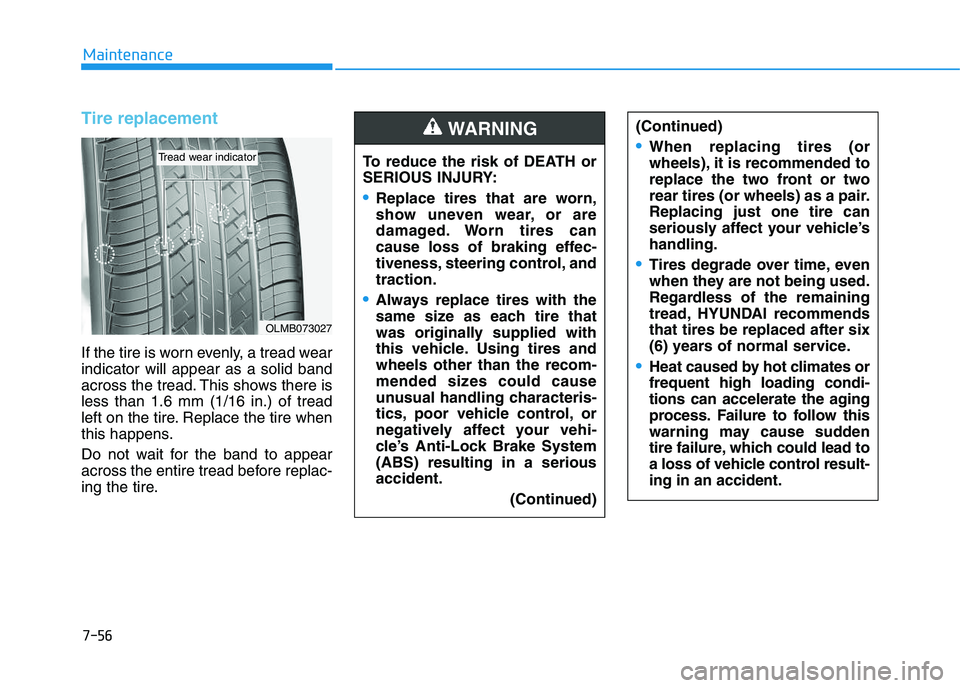
If the tire is worn evenly, a tread wear
indicator will appear as a solid band
across the tread. This shows there is
less than 1.6 mm (1/16 in.) of tread
left on the tire. Replace the tire when
this happens.
Do not wait for the band to appear
across the entire tread before replac-
ing the tire.
OLMB073027
Tread wear indicatorTo reduce the risk of DEATH or
SERIOUS INJURY:
Replace tires that are worn,
show uneven wear, or are
damaged. Worn tires can
cause loss of braking effec-
tiveness, steering control, and
traction.
Always replace tires with the
same size as each tire that
was originally supplied with
this vehicle. Using tires and
wheels other than the recom-
mended sizes could cause
unusual handling characteris-
tics, poor vehicle control, or
negatively affect your vehi-
cle’s Anti-Lock Brake System
(ABS) resulting in a serious
accident.(Continued)
WARNING (Continued)
When replacing tires (or
wheels), it is recommended to
replace the two front or two
rear tires (or wheels) as a pair.
Replacing just one tire can
seriously affect your vehicle’s
handling.
Tires degrade over time, even
when they are not being used.
Regardless of the remaining
tread, HYUNDAI recommends
that tires be replaced after six
(6) years of normal service.
Heat caused by hot climates or
frequent high loading condi-
tions can accelerate the aging
process. Failure to follow this
warning may cause sudden
tire failure, which could lead to
a loss of vehicle control result-
ing in an accident.
Page 595 of 659
7-82
Maintenance
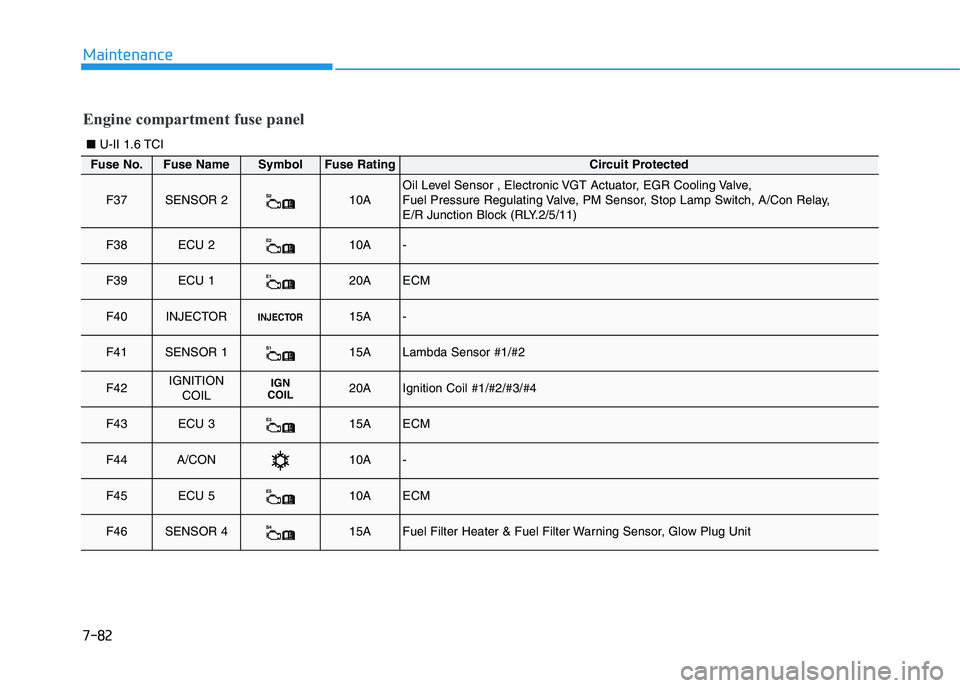
Fuse No.Fuse NameSymbolFuse RatingCircuit Protected
F37SENSOR 2S210AOil Level Sensor , Electronic VGT Actuator, EGR Cooling Valve,
Fuel Pressure Regulating Valve, PM Sensor, Stop Lamp Switch, A/Con Relay,
E/R Junction Block (RLY.2/5/11)
F38ECU 2E210A-
F39ECU 1E120AECM
F40INJECTORINJECTOR15A-
F41SENSOR 1S115ALambda Sensor #1/#2
F42IGNITION
COILIGN
COIL20AIgnition Coil #1/#2/#3/#4
F43ECU 3E 315AECM
F44A/CON10A-
F45ECU 5E510AECM
F46SENSOR 4S415AFuel Filter Heater & Fuel Filter Warning Sensor, Glow Plug Unit
■ U-II 1.6 TCI
Engine compartment fuse panel
Page 628 of 659
7-115
7
Maintenance
Lean NOx Trap (if equipped)
The Lean NOx Trap (LNT) system
removes the nitrogen oxide in the
exhaust gas. The smell can occur in
the exhaust gas depending on the
quality of the fuel and it can degrade
NOx reduction performance, please
use the regulated automotive diesel
fuel.
Diesel Fuel
(if equipped with DPF)
We recommend you to use only
the regulated diesel fuels, when
your vehicle is equipped with
the DPF system.
When you use other diesel fuels,
which is high in sulfurs (above
50 ppm) or contains unspecified
additives, it may damage the
DPF system and cause the white
smoke emission.CAUTION
Page 650 of 659
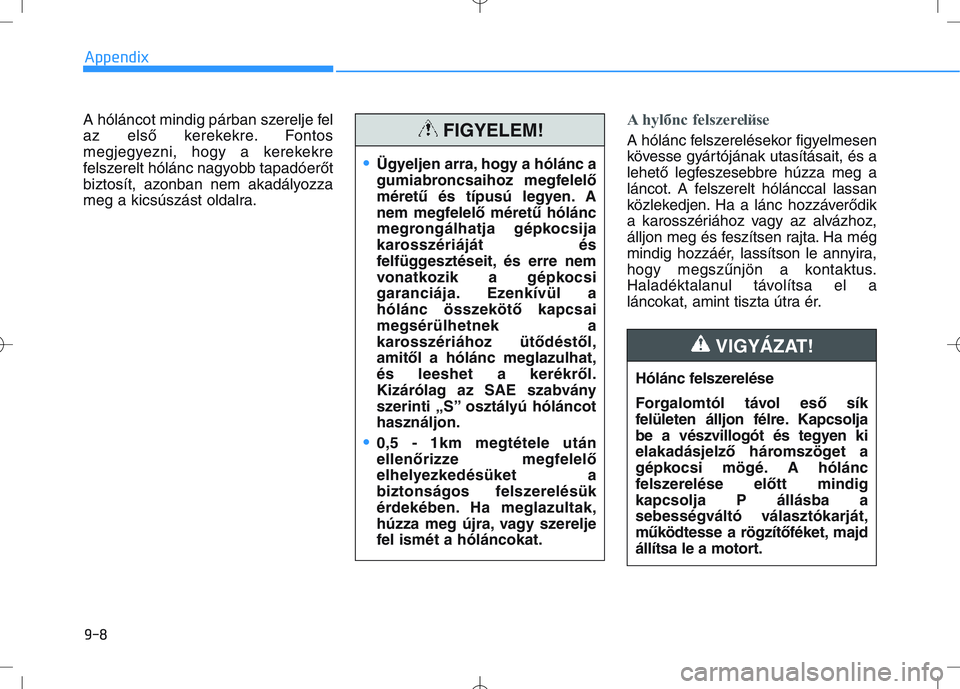
A hóláncot mindig párban szerelje fel
az első kerekekre. Fontos
megjegyezni, hogy a kerekekre
felszerelt hólánc nagyobb tapadóerőt
biztosít, azonban nem akadályozza
meg a kicsúszást oldalra.A h\flбnc felszerelйse
A hólánc felszerelésekor figyelmesen
kövesse gyártójának utasításait, és a
lehető legfeszesebbre húzza meg a
láncot. A felszerelt hólánccal lassan
közlekedjen. Ha a lánc hozzáverődik
a karosszériához vagy az alvázhoz,
álljon meg és feszítsen rajta. Ha még
mindig hozzáér, lassítson le annyira,
hogy megszűnjön a kontaktus.
Haladéktalanul távolítsa el a
láncokat, amint tiszta útra ér.
9-8
Appendix
•Ügyeljen arra, hogy a hólánc a
gumiabroncsaihoz megfelelő
méretű és típusú legyen. A
nem megfelelő méretű hólánc
megrongálhatja gépkocsija
karosszériáját és
felfüggesztéseit, és erre nem
vonatkozik a gépkocsi
garanciája. Ezenkívül a
hólánc összekötő kapcsai
megsérülhetnek a
karosszériához ütődéstől,
amitől a hólánc meglazulhat,
és leeshet a kerékről.
Kizárólag az SAE szabvány
szerinti „S” osztályú hóláncot
használjon.
•0,5 - 1km megtétele után
ellenőrizze megfelelő
elhelyezkedésüket a
biztonságos felszerelésük
érdekében. Ha meglazultak,
húzza meg újra, vagy szerelje
fel ismét a hóláncokat.
FIGYELEM!
Hólánc felszerelése
Forgalomtól távol eső sík
felületen álljon félre. Kapcsolja
be a vészvillogót és tegyen ki
elakadásjelző háromszöget a
gépkocsi mögé. A hólánc
felszerelése előtt mindig
kapcsolja P állásba a
sebességváltó választókarját,
működtesse a rögzítőféket, majd
állítsa le a motort.
VIGYÁZAT!
Page 651 of 659
9-9
A
Appendix
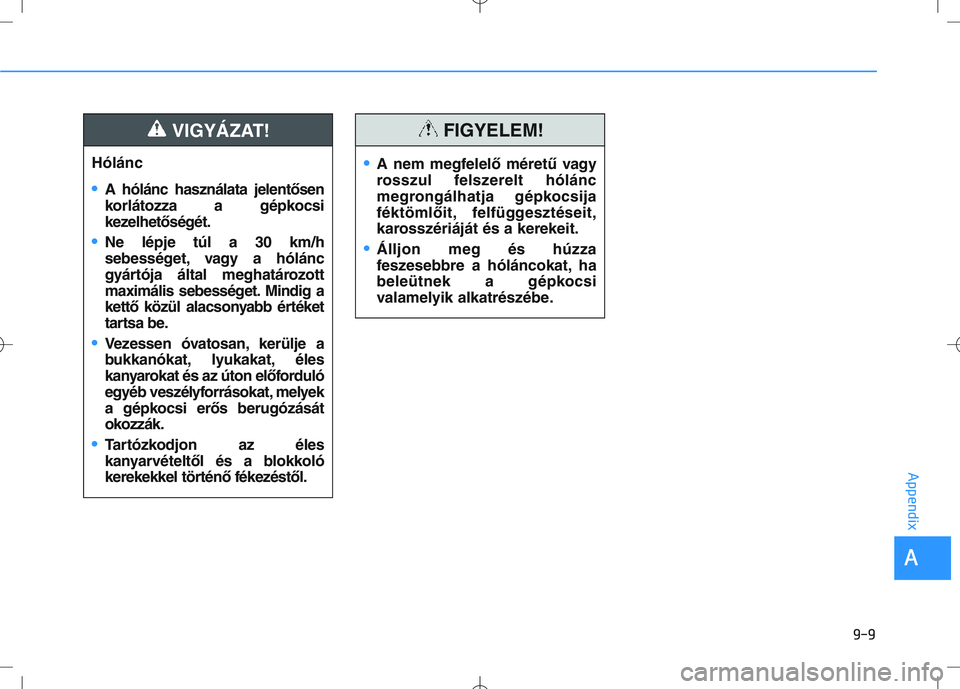
Hólánc
•A hólánc használata jelentősen
korlátozza a gépkocsi
kezelhetőségét.
•Ne lépje túl a 30 km/h
sebességet, vagy a hólánc
gyártója által meghatározott
maximális sebességet. Mindig a
kettő közül alacsonyabb értéket
tartsa be.
•Vezessen óvatosan, kerülje a
bukkanókat, lyukakat, éles
kanyarokat és az úton előforduló
egyéb veszélyforrásokat, melyek
a gépkocsi erős berugózását
okozzák.
•Tartózkodjon az éles
kanyarvételtől és a blokkoló
kerekekkel történő fékezéstől.
•A nem megfelelő méretű vagy
rosszul felszerelt hólánc
megrongálhatja gépkocsija
féktömlőit, felfüggesztéseit,
karosszériáját és a kerekeit.
•Álljon meg és húzza
feszesebbre a hóláncokat, ha
beleütnek a gépkocsi
valamelyik alkatrészébe.
FIGYELEM!