Front safety HYUNDAI I30 2022 Owner's Manual
[x] Cancel search | Manufacturer: HYUNDAI, Model Year: 2022, Model line: I30, Model: HYUNDAI I30 2022Pages: 659, PDF Size: 17.14 MB
Page 48 of 659
2-28
Safety system of your vehicle
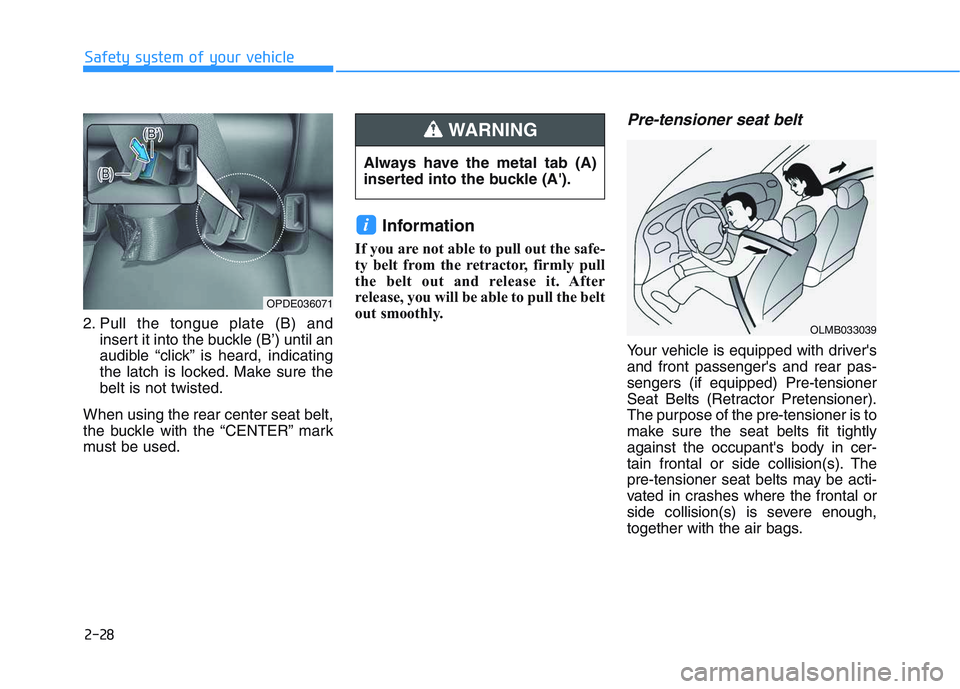
2. Pull the tongue plate (B) and insert it into the buckle (B’) until an
audible “click” is heard, indicating
the latch is locked. Make sure the
belt is not twisted.
When using the rear center seat belt,
the buckle with the “CENTER” mark
must be used.
Information
If you are not able to pull out the safe-
ty belt from the retractor, firmly pull
the belt out and release it. After
release, you will be able to pull the belt
out smoothly.
Pre-tensioner seat belt
Your vehicle is equipped with driver's
and front passenger's and rear pas-
sengers (if equipped) Pre-tensioner
Seat Belts (Retractor Pretensioner).
The purpose of the pre-tensioner is to
make sure the seat belts fit tightly
against the occupant's body in cer-
tain frontal or side collision(s). The
pre-tensioner seat belts may be acti-
vated in crashes where the frontal or
side collision(s) is severe enough,
together with the air bags.
i
OLMB033039
OPDE036071
Always have the metal tab (A)
inserted into the buckle (A').
WARNING
Page 49 of 659
2-29
Safety system of your vehicle
2
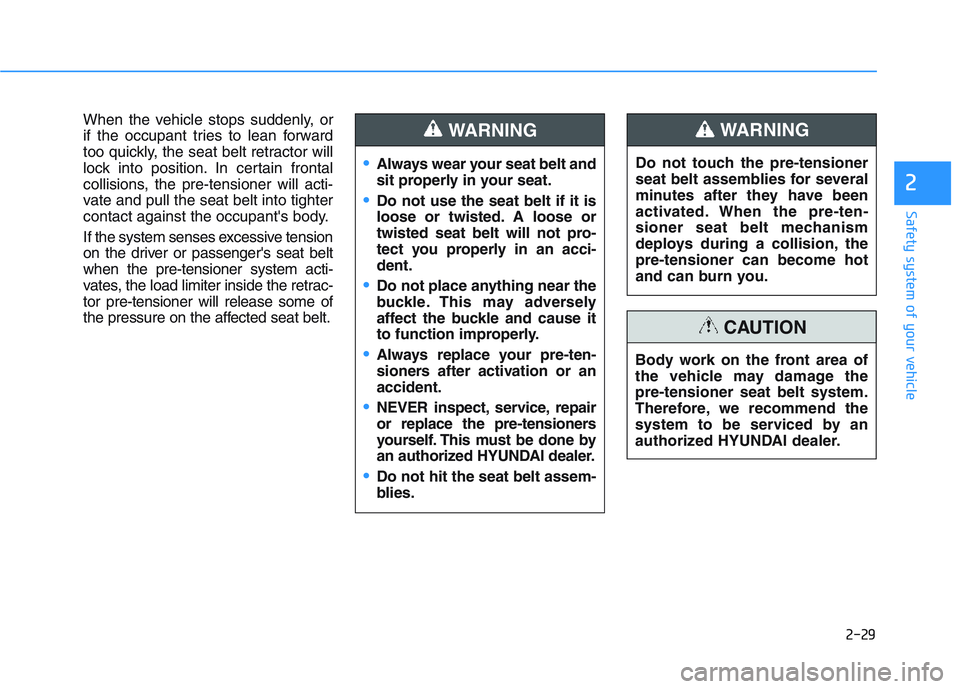
When the vehicle stops suddenly, or
if the occupant tries to lean forward
too quickly, the seat belt retractor will
lock into position. In certain frontal
collisions, the pre-tensioner will acti-
vate and pull the seat belt into tighter
contact against the occupant's body.
If the system senses excessive tension
on the driver or passenger's seat belt
when the pre-tensioner system acti-
vates, the load limiter inside the retrac-
tor pre-tensioner will release some of
the pressure on the affected seat belt.Do not touch the pre-tensioner
seat belt assemblies for several
minutes after they have been
activated. When the pre-ten-
sioner seat belt mechanism
deploys during a collision, the
pre-tensioner can become hot
and can burn you.WARNING
Body work on the front area of
the vehicle may damage the
pre-tensioner seat belt system.
Therefore, we recommend the
system to be serviced by an
authorized HYUNDAI dealer.
CAUTION
Always wear your seat belt and
sit properly in your seat.
Do not use the seat belt if it is
loose or twisted. A loose or
twisted seat belt will not pro-
tect you properly in an acci-
dent.
Do not place anything near the
buckle. This may adversely
affect the buckle and cause it
to function improperly.
Always replace your pre-ten-
sioners after activation or an
accident.
NEVER inspect, service, repair
or replace the pre-tensioners
yourself. This must be done by
an authorized HYUNDAI dealer.
Do not hit the seat belt assem-
blies.
WARNING
Page 50 of 659
2-30
Safety system of your vehicle
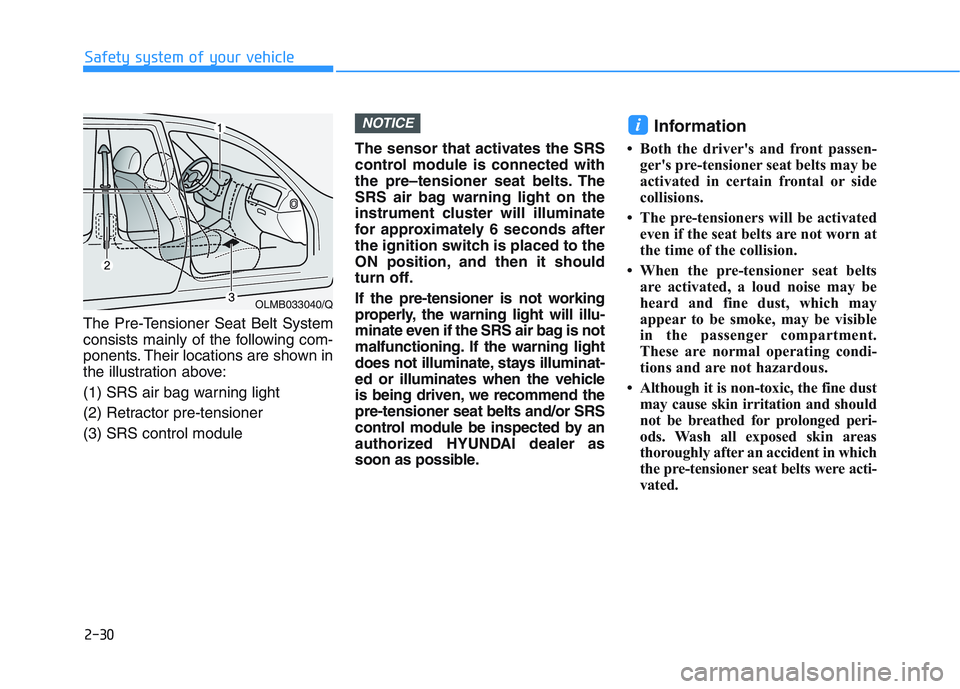
The Pre-Tensioner Seat Belt System
consists mainly of the following com-
ponents. Their locations are shown in
the illustration above:
(1) SRS air bag warning light
(2) Retractor pre-tensioner
(3) SRS control module The sensor that activates the SRS
control module is connected with
the pre–tensioner seat belts. The
SRS air bag warning light on the
instrument cluster will illuminate
for approximately 6 seconds after
the ignition switch is placed to the
ON position, and then it should
turn off.
If the pre-tensioner is not working
properly, the warning light will illu-
minate even if the SRS air bag is not
malfunctioning. If the warning light
does not illuminate, stays illuminat-
ed or illuminates when the vehicle
is being driven, we recommend the
pre-tensioner seat belts and/or SRS
control module be inspected by an
authorized HYUNDAI dealer as
soon as possible.
Information
• Both the driver's and front passen-
ger's pre-tensioner seat belts may be
activated in certain frontal or side
collisions.
• The pre-tensioners will be activated even if the seat belts are not worn at
the time of the collision.
• When the pre-tensioner seat belts are activated, a loud noise may be
heard and fine dust, which may
appear to be smoke, may be visible
in the passenger compartment.
These are normal operating condi-
tions and are not hazardous.
• Although it is non-toxic, the fine dust may cause skin irritation and should
not be breathed for prolonged peri-
ods. Wash all exposed skin areas
thoroughly after an accident in which
the pre-tensioner seat belts were acti-
vated.
iNOTICE
OLMB033040/Q
Page 52 of 659
2-32
Safety system of your vehicle
Small children are best protected
from injury in an accident when prop-
erly restrained in the rear seat by a
Child Restraint System that meets
the requirements of the Safety
Standards of your country. Before
buying any Child Restraint System,
make sure that it has a label certify-
ing that it meets Safety Standard of
your country. The Child Restraint
System must be appropriate for your
child's height and weight. Check the
label on the Child Restraint System
for this information. Refer to “Child
Restraint Systems” in this chapter.
Larger children
Children under age 13 and who are
too large for a booster seat should
always occupy the rear seat and use
the available lap/shoulder belts. A
seat belt should lie across the upper
thighs and be snug across the shoul-
der and chest to restrain the child
safely. Check belt fit periodically. A
child's squirming could put the belt
out of position. In the event of an acci-
dent, children are afforded the best
safety restrained by a proper Child
Restraint System in the rear seats.
If a larger child over age 13 must be
seated in the front seat, the child
must be securely restrained by the
available lap/shoulder belt and the
seat should be placed in the rear-
most position.
If the shoulder belt portion slightly
touches the child’s neck or face, try
placing the child closer to the center
of the vehicle. If the shoulder belt still
touches their face or neck, they need
to be returned to an appropriate
booster seat in the rear seat.
Always make sure larger chil-
dren’s seat belts are worn and
properly adjusted.
NEVER allow the shoulder
belt to contact the child’s
neck or face.
Do not allow more than one
child to use a single seat belt.
WARNING
Page 54 of 659
2-34
When to replace seat belts
The entire seat belt assembly or
assemblies should be replaced if the
vehicle has been involved in an acci-
dent. This should be done even if no
damage is visible. We recommend that
you consult an authorized HYUNDAI
dealer.Our recommendation:
Children always in the rear
Children under age 13 should always
ride in the rear seats and must
always be properly restrained to min-
imize the risk of injury in an accident,
sudden stop or sudden maneuver.
According to accident statistics, chil-
dren are safer when properly
restrained in the rear seats than in
the front seat. Children too large for a
Child Restraint System must use the
seat belts provided.Most countries have regulations
which require children to travel in
approved Child Restraint Systems.
The laws governing the age or
height/weight restrictions at which
seat belts can be used instead of
Child Restraint System differs
among countries, so you should be
aware of the specific requirements in
your country, and where you are trav-
elling.
Child Restraint Systems must be
properly installed in the vehicle seat.
Always use a commercially available
Child Restraint System that meets
the requirements of your country.
Safety system of your vehicle
C
C H
H I
I L
L D
D
R
R E
E S
S T
T R
R A
A I
I N
N T
T
S
S Y
Y S
S T
T E
E M
M
(
( C
C R
R S
S )
)
Always properly restrain children
in the vehicle. Children of all ages
are safer when riding in the rear
seats. Never place a rearward-
facing Child Restraint System on
the front passenger seat, unless
the air bag is deactivated.
WARNING
Page 61 of 659
2-41
Safety system of your vehicle
2
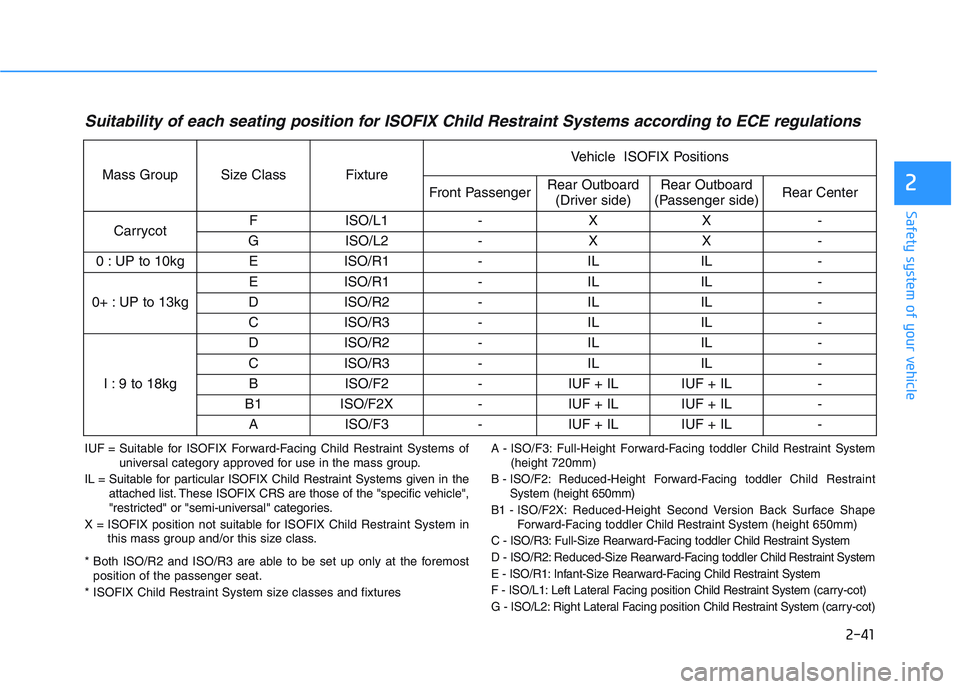
Suitability of each seating position for ISOFIX Child Restraint Systems according to ECE regulations
IUF = Suitable for ISOFIX Forward-Facing Child Restraint Systems ofuniversal category approved for use in the mass group.
IL = Suitable for particular ISOFIX Child Restraint Systems given in the attached list. These ISOFIX CRS are those of the "specific vehicle",
"restricted" or "semi-universal" categories.
X = ISOFIX position not suitable for ISOFIX Child Restraint System in this mass group and/or this size class.
* Both ISO/R2 and ISO/R3 are able to be set up only at the foremost position of the passenger seat.
* ISOFIX Child Restraint System size classes and fixturesA - ISO/F3: Full-Height Forward-Facing toddler Child Restraint System
(height 720mm)
B - ISO/F2: Reduced-Height Forward-Facing toddler Child Restraint
System (height 650mm)
B1 - ISO/F2X: Reduced-Height Second Version Back Surface Shape Forward-Facing toddler Child Restraint System(height 650mm)
C - ISO/R3: Full-Size Rearward-Facing toddler Child Restraint System
D - ISO/R2: Reduced-Size Rearward-Facing toddler Child Restraint System
E - ISO/R1: Infant-Size Rearward-Facing Child Restraint System
F - ISO/L1: Left Lateral Facing position Child Restraint System(carry-cot)
G - ISO/L2: Right Lateral Facing position Child Restraint System (carry-cot)
Mass Group Size Class Fixture Vehicle ISOFIX Positions
Front Passenger Rear Outboard
(Driver side) Rear Outboard
(Passenger side) Rear Center
Carrycot F ISO/L1 - X X -
G ISO/L2 - X X -
0 : UP to 10kg E ISO/R1 - IL IL -
0+ : UP to 13kg E ISO/R1 - IL IL -
D ISO/R2 - IL IL -
C ISO/R3 - IL IL -
I : 9 to 18kg D ISO/R2 - IL IL -
C ISO/R3 - IL IL -
B ISO/F2 - IUF + IL IUF + IL -
B1 ISO/F2X - IUF + IL IUF + IL - A ISO/F3 - IUF + IL IUF + IL -
Page 63 of 659
2-43
Safety system of your vehicle
2
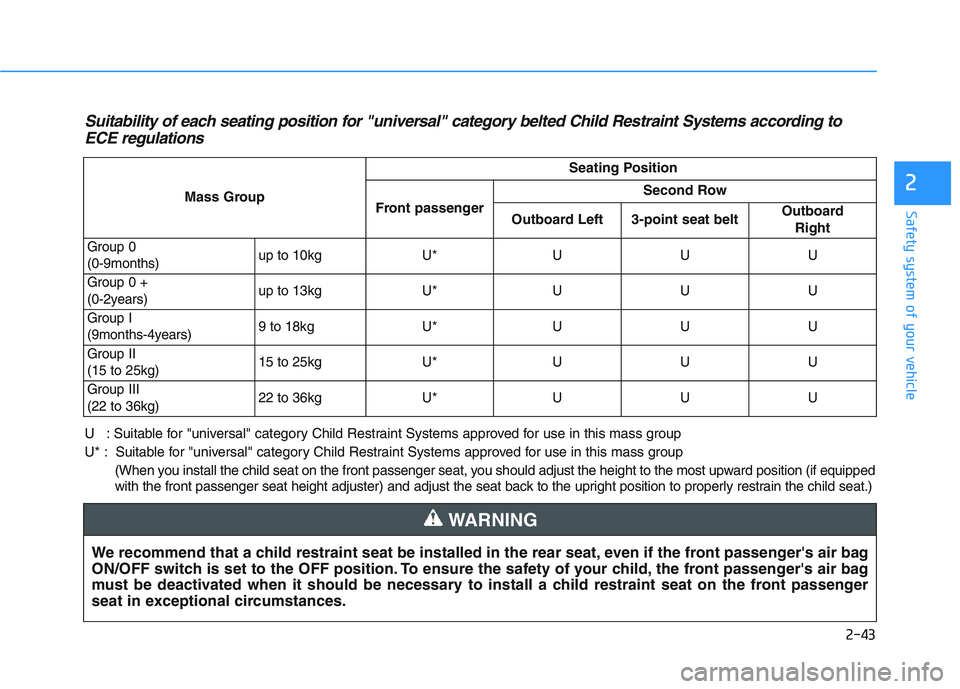
Suitability of each seating position for "universal" category belted Child Restraint Systems according toECE regulations
U : Suitable for "universal" category Child Restraint Systems approved for use in this mass group
U* : Suitable for "universal" category Child Restraint Systems approved for use in this mass group
(When you install the child seat on the front passenger seat, you should adjust the height to the most upward position (if equi pped
with the front passenger seat height adjuster) and adjust the seat back to the upright position to properly restrain the child seat.)
Mass Group
Seating Position
Front passenger
Second Row
Outboard Left3-point seat beltOutboard
Right
Group 0
(0-9months)up to 10kgU*UUU
Group 0 +
(0-2years)up to 13kgU*UUU
Group I
(9months-4years)9 to 18kgU*UUU
Group II
(15 to 25kg)15 to 25kgU*UUU
Group III
(22 to 36kg)22 to 36kgU*UUU
We recommend that a child restraint seat be installed in the rear seat, even if the front passenger's air bag
ON/OFF switch is set to the OFF position. To ensure the safety of your child, the front passenger's air bag
must be deactivated when it should be necessary to install a child restraint seat on the front passenger
seat in exceptional circumstances.
WARNING
Page 64 of 659
2-44
Safety system of your vehicle
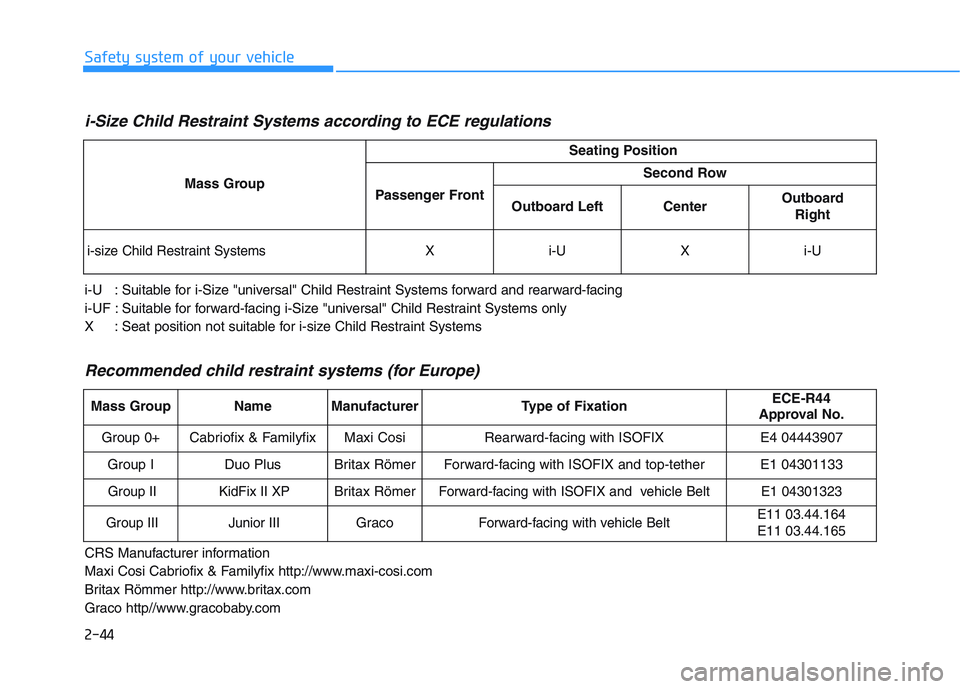
i-Size Child Restraint Systems according to ECE regulations
i-U : Suitable for i-Size "universal" Child Restraint Systems forward and rearward-facing
i-UF : Suitable for forward-facing i-Size "universal" Child Restraint Systems only
X : Seat position not suitable for i-size Child Restraint Systems
Mass Group
Seating Position
Passenger Front
Second Row
Outboard LeftCenter Outboard Right
i-size Child Restraint SystemsXi-UXi-U
Recommended child restraint systems (for Europe)
CRS Manufacturer information
Maxi Cosi Cabriofix & Familyfix http://www.maxi-cosi.com
Britax Römmer http://www.britax.com
Graco http//www.gracobaby.com
Mass GroupNameManufacturerType of FixationECE-R44
Approval No.
Group 0+Cabriofix & FamilyfixMaxi CosiRearward-facing with ISOFIXE4 04443907
Group IDuo PlusBritax RömerForward-facing with ISOFIX and top-tetherE1 04301133
Group IIKidFix II XPBritax RömerForward-facing with ISOFIX and vehicle BeltE1 04301323
Group IIIJunior IIIGracoForward-facing with vehicle BeltE11 03.44.164
E11 03.44.165
Page 65 of 659
2-45
Safety system of your vehicle
2
A
A I
I R
R
B
B A
A G
G
-
-
S
S U
U P
P P
P L
L E
E M
M E
E N
N T
T A
A L
L
R
R E
E S
S T
T R
R A
A I
I N
N T
T
S
S Y
Y S
S T
T E
E M
M
OPDE036032/OPDE036066The actual air bags in the vehicle may differ from the illustration.
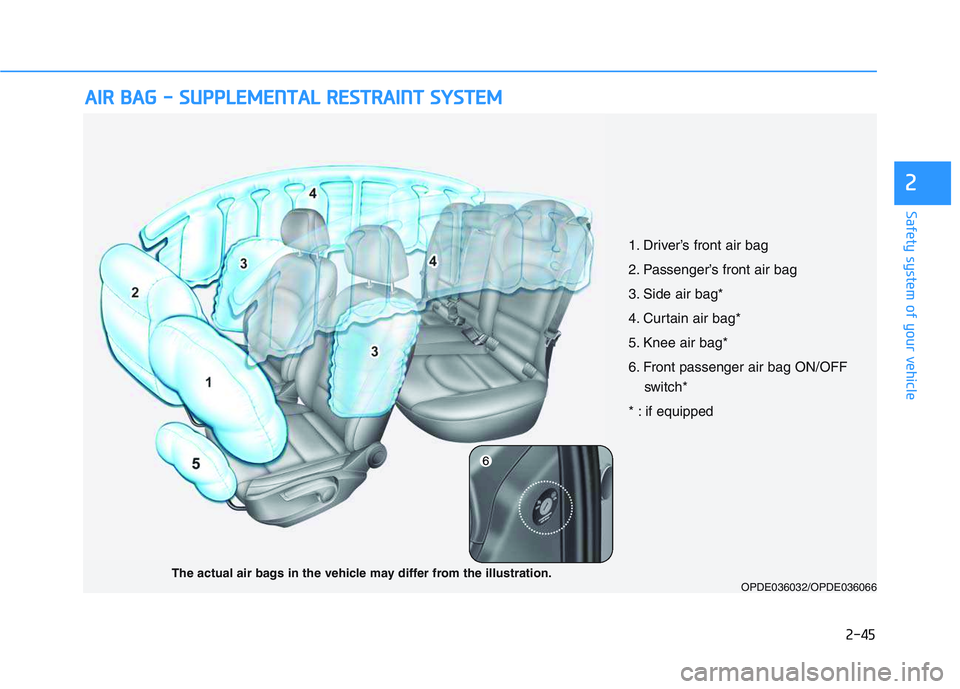
1. Driver’s front air bag
2. Passenger’s front air bag
3. Side air bag*
4. Curtain air bag*
5. Knee air bag*
6. Front passenger air bag ON/OFF
switch*
* : if equipped
Page 66 of 659
2-46
Safety system of your vehicle
The vehicles are equipped with a
Supplemental Air Bag System for the
driver’s seat and front passenger’s
seats.
The front air bags are designed to
supplement the three-point seat
belts. For these air bags to provide
protection, the seat belts must be
worn at all times when driving.
You can be severely injured or killed
in an accident if you are not wearing
a seat belt. Air bags are designed to
supplement seat belts, but do not
replace them. Also, air bags are not
designed to deploy in every collision.
In some accidents, the seat belts are
the only restraint protecting you. AIR BAG SAFETY PRECAUTIONS
ALWAYS use seat belts Child Restraint Systems - every trip, every
time, everyone! Even with air bags, you can be seriously injured or
killed in a collision if you are improperly belted or not wearing your
seat belt when the air bag inflates.
NEVER place a child in any Child Restraint System or booster seat in
the front passenger seat, unless the air bag is deactivated.
An inflating air bag could forcefully strike the infant or child causing
serious or fatal injuries.
ABC - Always Buckle Children under age 13 in the back seat. It is the
safest place for children of any age to ride. If a child age 13 or older
must be seated in the front seat, he or she must be properly belted
and the seat should be moved as far back as possible.
All occupants should sit upright with the seatback in an upright posi-
tion, centered on the seat cushion with their seat belt on, legs com-
fortably extended and their feet on the floor until the vehicle is parked
and the engine is turned off. If an occupant is out of position during
an accident, the rapidly deploying air bag may forcefully contact the
occupant causing serious or fatal injuries.
You and your passengers should never sit or lean unnecessarily
close to the air bags or lean against the door or center console.
Move your seat as far back as possible from front air bags, while still
maintaining control of the vehicle.
WARNING