Front right HYUNDAI I40 2012 Owners Manual
[x] Cancel search | Manufacturer: HYUNDAI, Model Year: 2012, Model line: I40, Model: HYUNDAI I40 2012Pages: 534, PDF Size: 11.05 MB
Page 27 of 534
Downloaded from www.Manualslib.com manuals search engine 33
Safety system of your vehicle
WARNING- Driver’s seat Never attempt to adjust seatwhile the vehicle is moving. This
could result in loss of control,
and an accident causing death,
serious injury, or property dam-
age.
Do not allow anything to interfere with the normal position of the
seatback. Storing items against a
seatback or in any other way
interfering with proper locking of
a seatback could result in serious
or fatal injury in a sudden stop or
collision.
seatback upright and the lap por-
tion of the seat belt snug and low
across the hips. This is the best
position to protect you in case of
an accident.
In order to avoid unnecessary and perhaps severe air bag
injuries, always sit as far back as
possible from the steering wheel
while maintaining comfortable
control of the vehicle. It is recom-
mended that your chest is at least
250 mm (10 inches) away from
the steering wheel.
WARNING - Uprighting
seat
When you return the seatback to its
upright position, hold the seatback
and return it slowly and be sure
there are no other occupants
around the seat. If the seatback is
returned without being held and
controlled, the back of the seat
could spring forward resulting in
accidental injury to a person struck
by the seatback.
WARNING- Loose objects
Loose objects in the driver’s foot
area could interfere with the opera-
tion of the foot pedals, possibly
causing an accident. Do not place
anything under the front seats.
WARNING- Driver respon-
sibility for front seat pas-
senger
Riding in a vehicle with a front seat-
back reclined could lead to serious
or fatal injury in an accident. If a
front seat is reclined during an
accident, the occupant’s hips may
slide under the lap portion of the
seat belt applying great force to the
unprotected abdomen. Serious or
fatal internal injuries could result.
The driver must advise the front
passenger to keep the seatback in
an upright position whenever the
vehicle is in motion.
WARNING
Do not use a sitting cushion that
reduces friction between the seat
and passenger. The passenger's
hips may slide under the lap por-
tion of the seat belt during an acci-
dent or a sudden stop. Serious or
fatal internal injuries could result
because the seat belt can't operate
normally.
Page 40 of 534
Downloaded from www.Manualslib.com manuals search engine Safety system of your vehicle
16
3
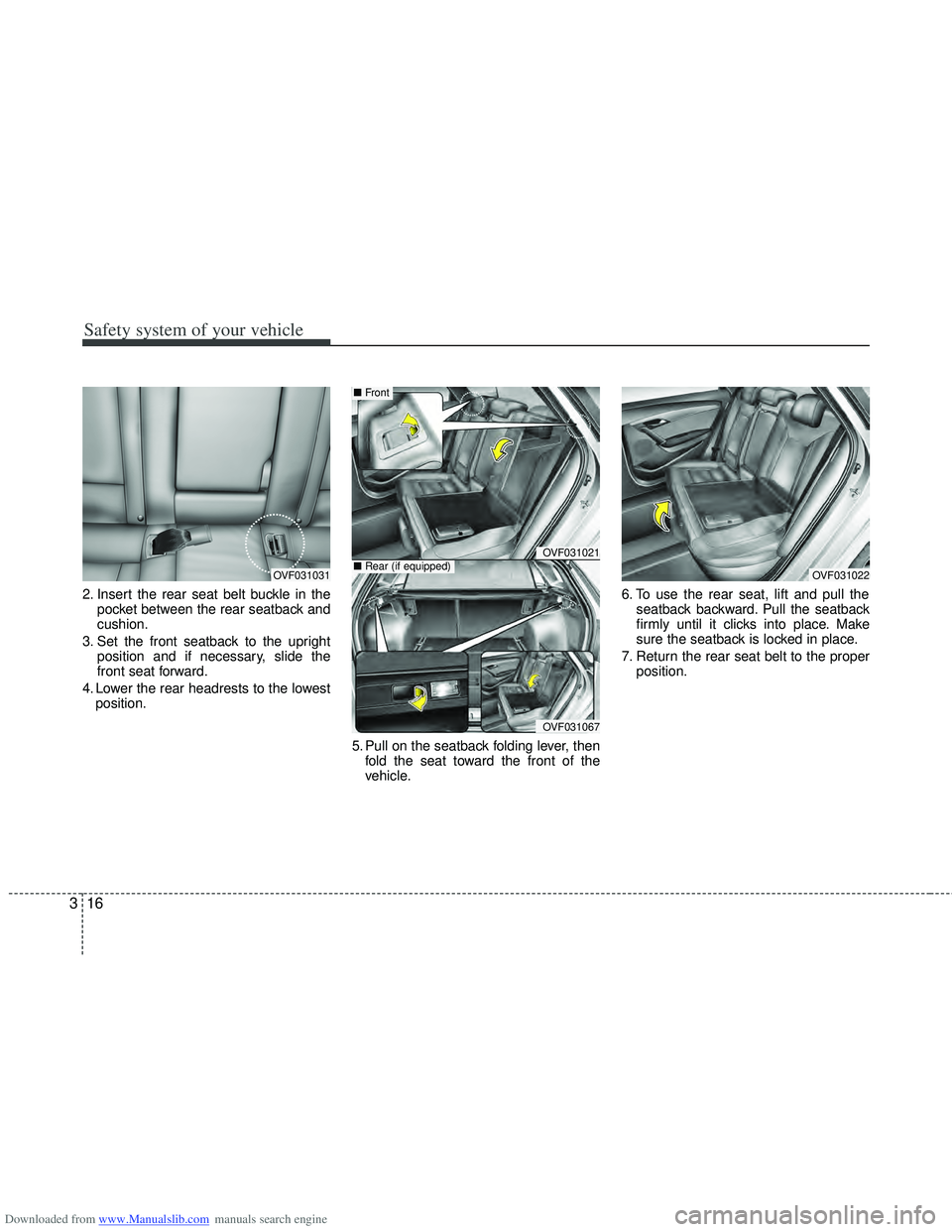
2. Insert the rear seat belt buckle in the
pocket between the rear seatback and
cushion.
3. Set the front seatback to the upright position and if necessary, slide the
front seat forward.
4. Lower the rear headrests to the lowest position.
5. Pull on the seatback folding lever, thenfold the seat toward the front of the
vehicle. 6. To use the rear seat, lift and pull the
seatback backward. Pull the seatback
firmly until it clicks into place. Make
sure the seatback is locked in place.
7. Return the rear seat belt to the proper position.
OVF031022OVF031031
OVF031021
OVF031067
■Front
■Rear (if equipped)
Page 41 of 534
Downloaded from www.Manualslib.com manuals search engine 317
Safety system of your vehicle
WARNING- Cargo
Cargo should always be secured to
prevent it from being thrown about
the vehicle in a collision and caus-
ing injury to the vehicle occupants.
Special care of objects should be
taken when placing them in the rear
seats, since those may hit the front
seat occupants in a frontal colli-
sion.
CAUTION- Rear seat belts
When returning the rear seatbacksto the upright position, remember to return the rear shoulder belts totheir proper position. Routing theseat belt webbing through the rear seat belt guides will help keep thebelts from being trapped behind or under the seats.
CAUTION - Damaging rear
seat belt buckles
When you fold the rear seatback or
put luggage on the rear seat cush-ion, insert the buckle in the pocketbetween the rear seatback andcushion. Doing so can prevent the buckle from being damaged by therear seatback or luggage.
WARNING - Cargo loading
Make sure the engine is off, the
automatic transaxle is in P (Park)
or the manual transaxle is in R
(Reverse) or 1st, and the parking
brake is securely applied whenever
loading or unloading cargo. Failure
to take these steps may allow the
vehicle to move if the shift lever is
inadvertently moved to another
position.
WARNING
When you return the rear seatback
to its upright position after being
folded down:
Be careful not to damage the seat
belt webbing or buckle. Do not
allow the seat belt webbing or
buckle to get caught or pinched in
the rear seat. Ensure that the seat-
back is completely locked into its
upright position by pushing on the
top of the seatback. Otherwise, in
an accident or sudden stop, the
seat could fold down and allow
cargo to enter the passenger com-
partment, which could result in
serious injury or death.
WARNING - Uprighting
seat
When you return the seatback to its
upright position, hold the seatback
and return it slowly. If the seatback
is returned without holding it, the
back of the seat could spring for-
ward resulting in injury caused by
being struck by the seatback.
Page 42 of 534
Downloaded from www.Manualslib.com manuals search engine Safety system of your vehicle
18
3
Seat belt restraint system
SEAT BELTS
(Continued)
Avoid wearing twisted seat belts.
A twisted belt can't do its job as
well. In a collision, it could even
cut into you. Be sure the belt
webbing is straight and not twist-
ed.
Be careful not to damage the belt webbing or hardware. If the belt
webbing or hardware is dam-
aged, replace it.
WARNING
Seat belts are designed to bear
upon the bony structure of the
body, and should be worn low
across the front of the pelvis or the
pelvis, chest and shoulders, as
applicable; wearing the lap section
of the belt across the abdominal
area must be avoided.
Seat belts should be adjusted as
firmly as possible, consistent with
comfort, to provide the protection
for which they have been designed.
A slack belt will greatly reduce the
protection afforded to the wearer.
(Continued)
WARNING
For maximum restraint systemprotection, the seat belts must
always be used whenever the car
is moving.
Seat belts are most effective when seatbacks are in the
upright position.
Children age 12 and younger must always be properly
restrained in the rear seat. Never
allow children to ride in the front
passenger seat. If a child over 12
must be seated in the front seat,
he/she must be properly belted
and the seat should be moved as
far back as possible.
Never wear the shoulder belt under your arm or behind your
back. An improperly positioned
shoulder belt can cause serious
injuries in a crash. The shoulder
belt should be positioned midway
over your shoulder across your
collarbone.
(Continued)
(Continued)
Care should be taken to avoid con-
tamination of the webbing with pol-
ishes, oils and chemicals, and par-
ticularly battery acid.
Cleaning may safely be carried out
using mild soap and water. The belt
should be replaced if webbing
becomes frayed, contaminated or
damaged. It is essential to replace
the entire assembly after it has
been worn in a severe impact even
if damage to the assembly is not
obvious. Belts should not be worn
with straps twisted. Each belt
assembly must only be used by one
occupant; it is dangerous to put a
belt around a child being carried on
the occupant's lap.
Page 51 of 534
Downloaded from www.Manualslib.com manuals search engine 327
Safety system of your vehicle
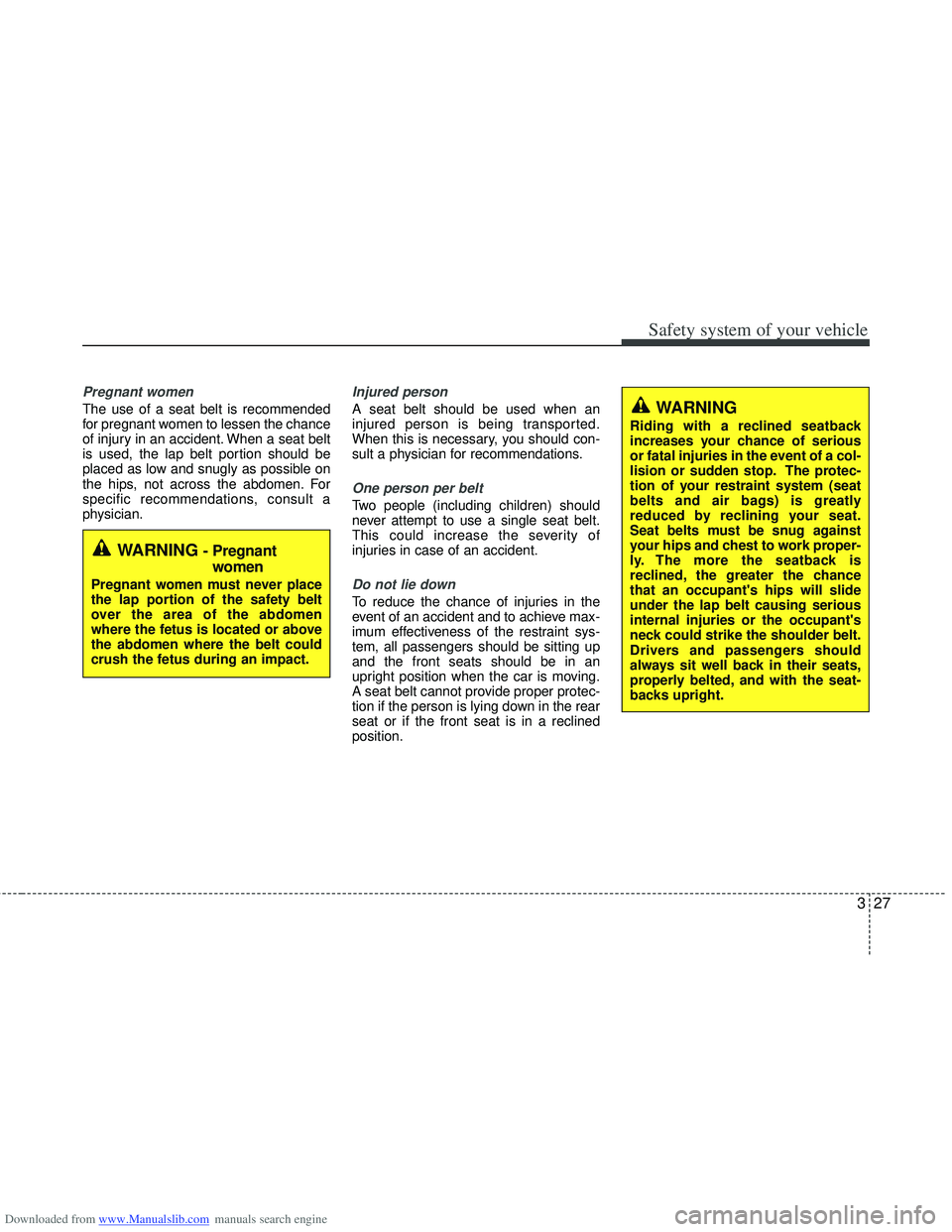
Pregnant women
The use of a seat belt is recommended
for pregnant women to lessen the chance
of injury in an accident. When a seat belt
is used, the lap belt portion should be
placed as low and snugly as possible on
the hips, not across the abdomen. For
specific recommendations, consult a
physician.
Injured person
A seat belt should be used when an
injured person is being transported.
When this is necessary, you should con-
sult a physician for recommendations.
One person per belt
Two people (including children) should
never attempt to use a single seat belt.
This could increase the severity of
injuries in case of an accident.
Do not lie down
To reduce the chance of injuries in the
event of an accident and to achieve max-
imum effectiveness of the restraint sys-
tem, all passengers should be sitting up
and the front seats should be in an
upright position when the car is moving.
A seat belt cannot provide proper protec-
tion if the person is lying down in the rear
seat or if the front seat is in a reclined
position.
WARNING
Riding with a reclined seatback
increases your chance of serious
or fatal injuries in the event of a col-
lision or sudden stop. The protec-
tion of your restraint system (seat
belts and air bags) is greatly
reduced by reclining your seat.
Seat belts must be snug against
your hips and chest to work proper-
ly. The more the seatback is
reclined, the greater the chance
that an occupant's hips will slide
under the lap belt causing serious
internal injuries or the occupant's
neck could strike the shoulder belt.
Drivers and passengers should
always sit well back in their seats,
properly belted, and with the seat-
backs upright.
WARNING - Pregnantwomen
Pregnant women must never place
the lap portion of the safety belt
over the area of the abdomen
where the fetus is located or above
the abdomen where the belt could
crush the fetus during an impact.
Page 62 of 534
Downloaded from www.Manualslib.com manuals search engine Safety system of your vehicle
38
3
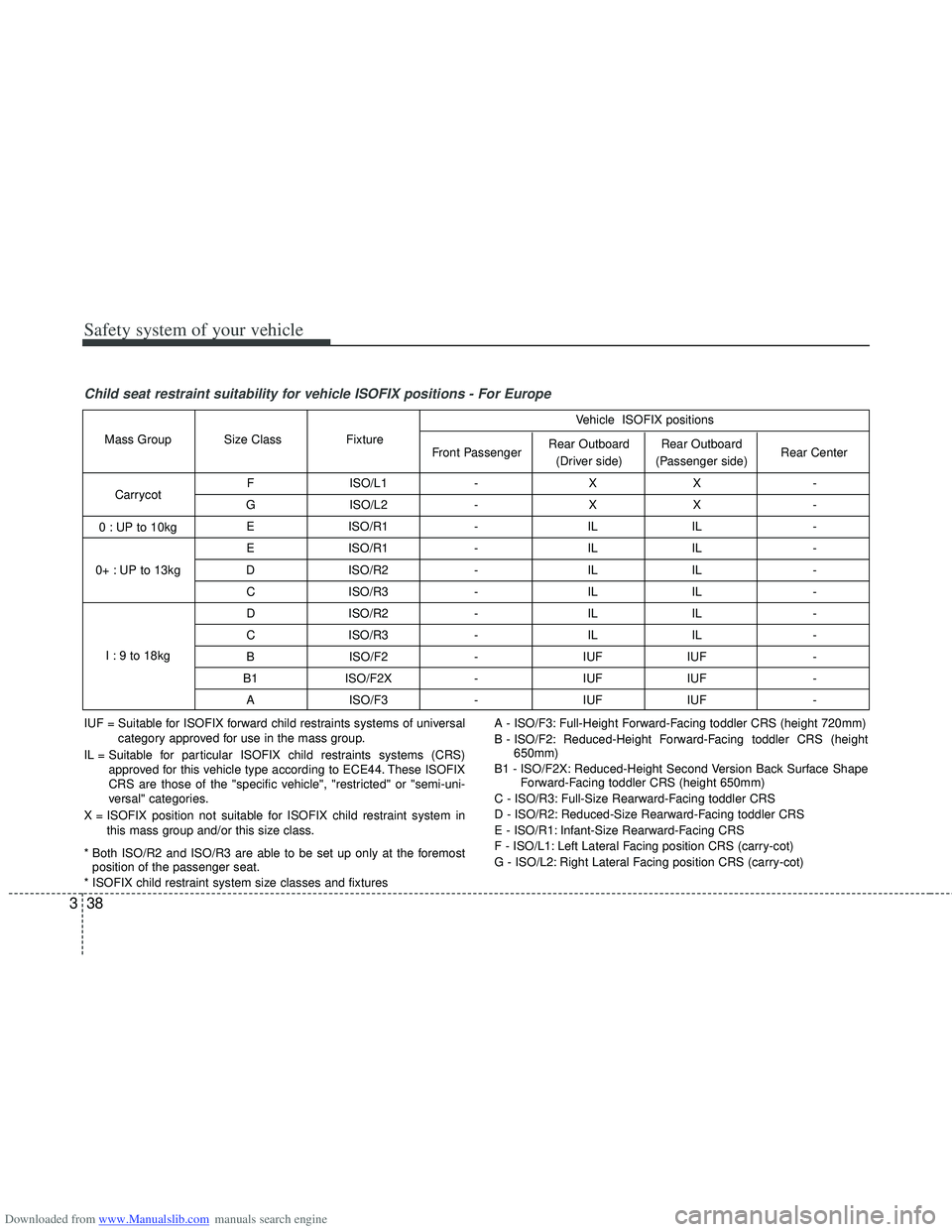
Child seat restraint suitability for vehicle ISOFIX positions - For Europe
F ISO/L1 - X X-
G ISO/L2 - X X-
E ISO/R1 - IL IL-
E ISO/R1 - IL IL-
D ISO/R2 - IL IL-
C ISO/R3 - IL IL-
D ISO/R2 - IL IL-
C ISO/R3 - IL IL-
B ISO/F2 - IUF IUF-
B1 ISO/F2X - IUF IUF-
A ISO/F3 - IUF IUF-
Rear Outboard
(Passenger side)
Rear Outboard
(Driver side)
Front Passenger
Fixture
Size Class
Mass Group
Carrycot
0 : UP to 10kg
0+ : UP to 13kg
I : 9 to 18kg Rear Center
Vehicle ISOFIX positions
IUF = Suitable for ISOFIX forward child restraints systems of universal
category approved for use in the mass group.
IL = Suitable for particular ISOFIX child restraints systems (CRS) approved for this vehicle type according to ECE44. These ISOFIX
CRS are those of the "specific vehicle", "restricted" or "semi-uni-
versal" categories.
X = ISOFIX position not suitable for ISOFIX child restraint system in this mass group and/or this size class.
* Both ISO/R2 and ISO/R3 are able to be set up only at the foremost position of the passenger seat.
* ISOFIX child restraint system size classes and fixtures A - ISO/F3: Full-Height Forward-Facing toddler CRS (height 720mm)
B - ISO/F2: Reduced-Height Forward-Facing toddler CRS (height
650mm)
B1 - ISO/F2X: Reduced-Height Second Version Back Surface Shape Forward-Facing toddler CRS (height 650mm)
C - ISO/R3: Full-Size Rearward-Facing toddler CRS
D - ISO/R2: Reduced-Size Rearward-Facing toddler CRS
E - ISO/R1: Infant-Size Rearward-Facing CRS
F - ISO/L1: Left Lateral Facing position CRS (carry-cot)
G - ISO/L2: Right Lateral Facing position CRS (carry-cot)
Page 73 of 534
Downloaded from www.Manualslib.com manuals search engine 349
Safety system of your vehicle
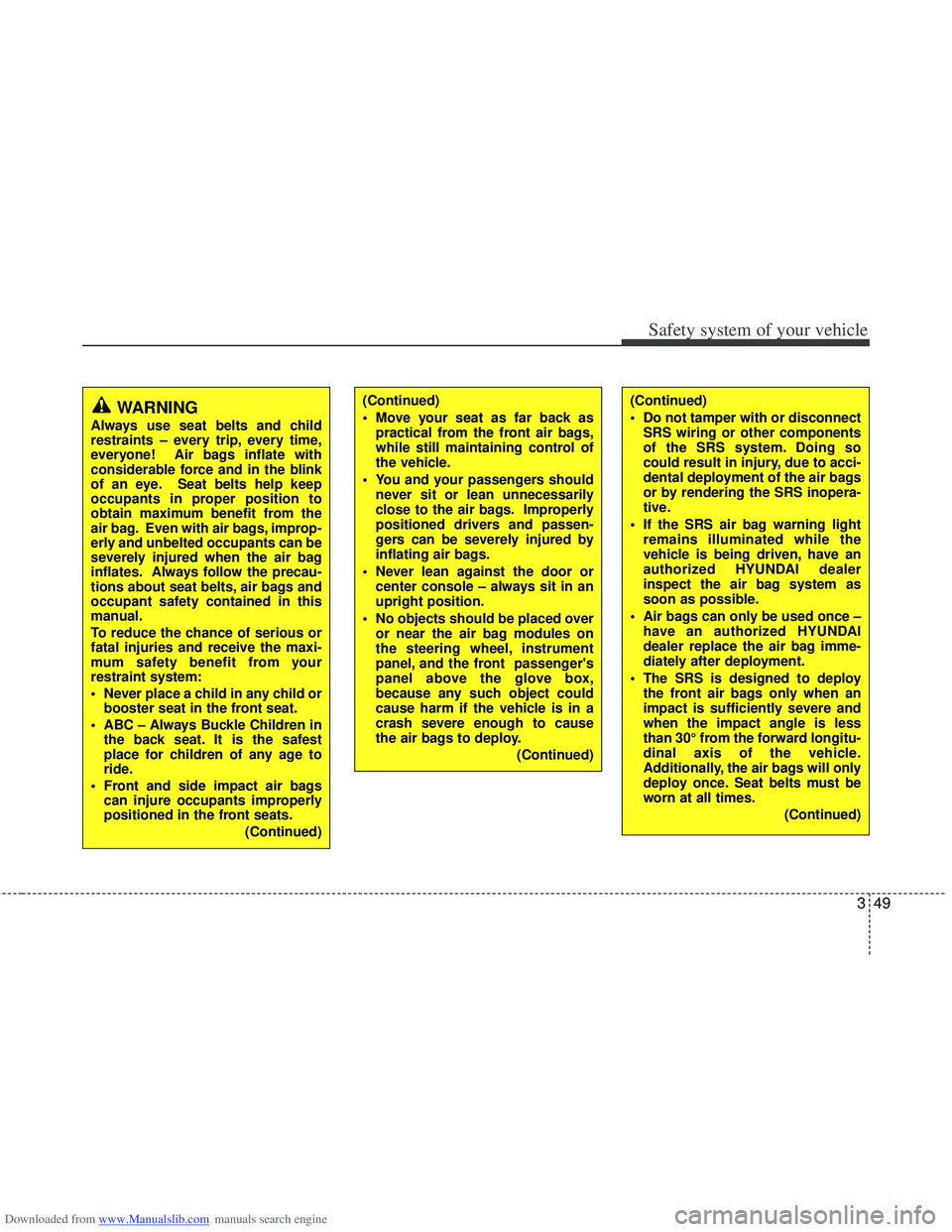
(Continued)
Do not tamper with or disconnectSRS wiring or other components
of the SRS system. Doing so
could result in injury, due to acci-
dental deployment of the air bags
or by rendering the SRS inopera-
tive.
If the SRS air bag warning light remains illuminated while the
vehicle is being driven, have an
authorized HYUNDAI dealer
inspect the air bag system as
soon as possible.
Air bags can only be used once – have an authorized HYUNDAI
dealer replace the air bag imme-
diately after deployment.
The SRS is designed to deploy the front air bags only when an
impact is sufficiently severe and
when the impact angle is less
than 30° from the forward longitu-
dinal axis of the vehicle.
Additionally, the air bags will only
deploy once. Seat belts must be
worn at all times.
(Continued)WARNING
Always use seat belts and child
restraints – every trip, every time,
everyone! Air bags inflate with
considerable force and in the blink
of an eye. Seat belts help keep
occupants in proper position to
obtain maximum benefit from the
air bag. Even with air bags, improp-
erly and unbelted occupants can be
severely injured when the air bag
inflates. Always follow the precau-
tions about seat belts, air bags and
occupant safety contained in this
manual.
To reduce the chance of serious or
fatal injuries and receive the maxi-
mum safety benefit from your
restraint system:
Never place a child in any child orbooster seat in the front seat.
ABC – Always Buckle Children in the back seat. It is the safest
place for children of any age to
ride.
Front and side impact air bags can injure occupants improperly
positioned in the front seats.
(Continued)
(Continued)
Move your seat as far back aspractical from the front air bags,
while still maintaining control of
the vehicle.
You and your passengers should never sit or lean unnecessarily
close to the air bags. Improperly
positioned drivers and passen-
gers can be severely injured by
inflating air bags.
Never lean against the door or center console – always sit in an
upright position.
No objects should be placed over or near the air bag modules on
the steering wheel, instrument
panel, and the front passenger's
panel above the glove box,
because any such object could
cause harm if the vehicle is in a
crash severe enough to cause
the air bags to deploy.
(Continued)
Page 74 of 534
Downloaded from www.Manualslib.com manuals search engine Safety system of your vehicle
50
3
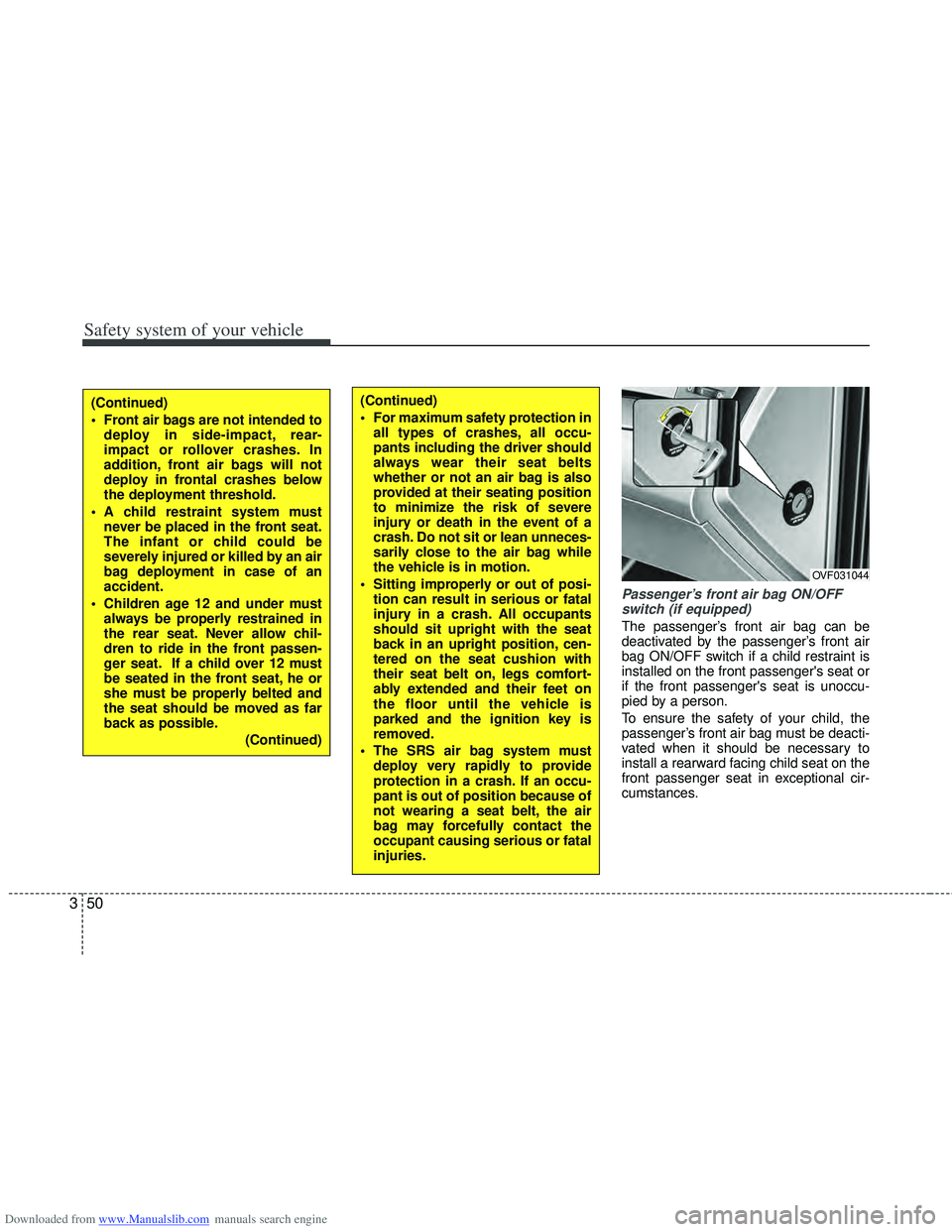
Passenger’s front air bag ON/OFF
switch (if equipped)
The passenger’s front air bag can be
deactivated by the passenger’s front air
bag ON/OFF switch if a child restraint is
installed on the front passenger's seat or
if the front passenger's seat is unoccu-
pied by a person.
To ensure the safety of your child, the
passenger’s front air bag must be deacti-
vated when it should be necessary to
install a rearward facing child seat on the
front passenger seat in exceptional cir-
cumstances.
OVF031044
(Continued)
For maximum safety protection in all types of crashes, all occu-
pants including the driver should
always wear their seat belts
whether or not an air bag is also
provided at their seating position
to minimize the risk of severe
injury or death in the event of a
crash. Do not sit or lean unneces-
sarily close to the air bag while
the vehicle is in motion.
Sitting improperly or out of posi- tion can result in serious or fatal
injury in a crash. All occupants
should sit upright with the seat
back in an upright position, cen-
tered on the seat cushion with
their seat belt on, legs comfort-
ably extended and their feet on
the floor until the vehicle is
parked and the ignition key is
removed.
The SRS air bag system must deploy very rapidly to provide
protection in a crash. If an occu-
pant is out of position because of
not wearing a seat belt, the air
bag may forcefully contact the
occupant causing serious or fatal
injuries.(Continued)
Front air bags are not intended todeploy in side-impact, rear-
impact or rollover crashes. In
addition, front air bags will not
deploy in frontal crashes below
the deployment threshold.
A child restraint system must never be placed in the front seat.
The infant or child could be
severely injured or killed by an air
bag deployment in case of an
accident.
Children age 12 and under must always be properly restrained in
the rear seat. Never allow chil-
dren to ride in the front passen-
ger seat. If a child over 12 must
be seated in the front seat, he or
she must be properly belted and
the seat should be moved as far
back as possible.
(Continued)
Page 77 of 534
Downloaded from www.Manualslib.com manuals search engine 353
Safety system of your vehicle
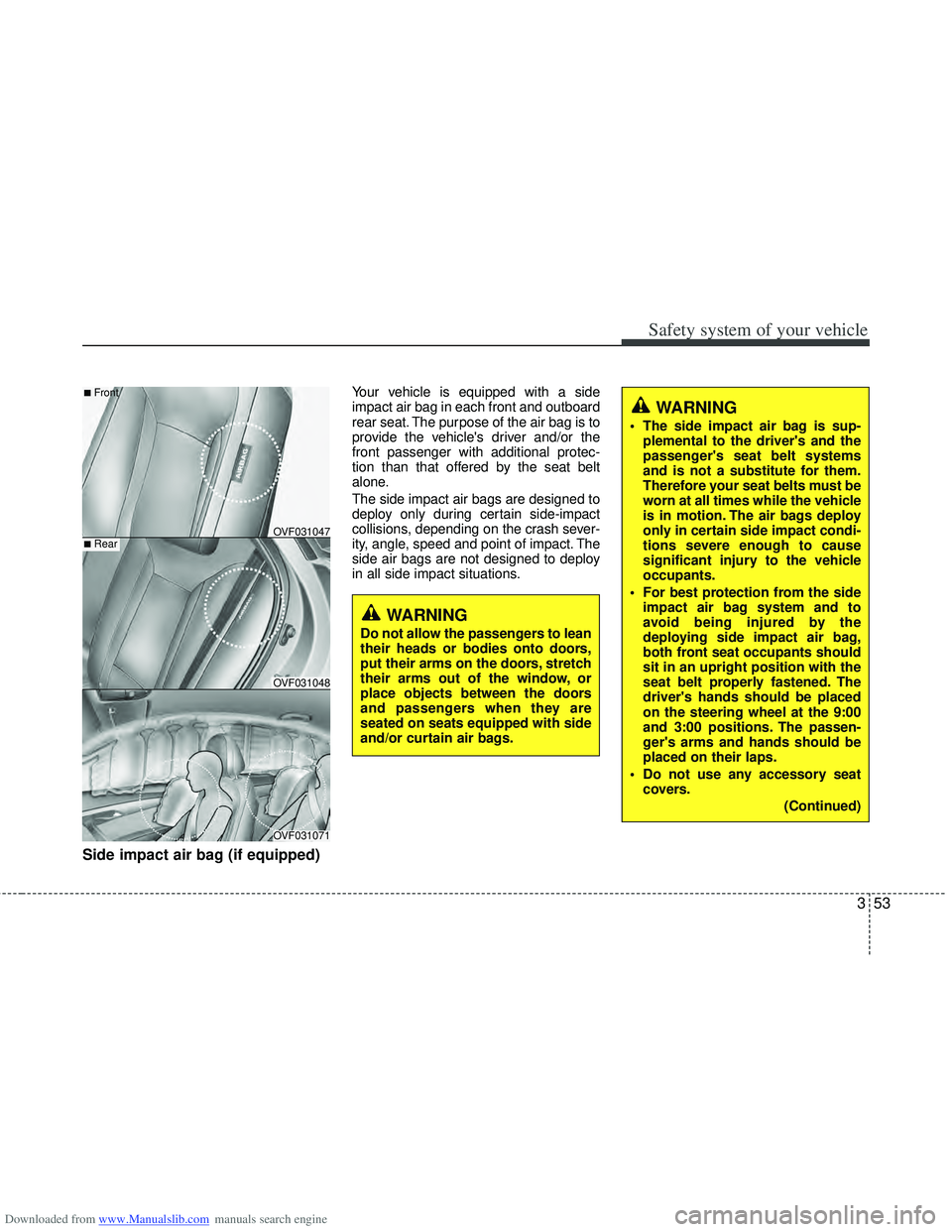
Side impact air bag (if equipped)
Your vehicle is equipped with a side
impact air bag in each front and outboard
rear seat. The purpose of the air bag is to
provide the vehicle's driver and/or the
front passenger with additional protec-
tion than that offered by the seat belt
alone.
The side impact air bags are designed to
deploy only during certain side-impact
collisions, depending on the crash sever-
ity, angle, speed and point of impact. The
side air bags are not designed to deploy
in all side impact situations.
WARNING
The side impact air bag is sup-plemental to the driver's and the
passenger's seat belt systems
and is not a substitute for them.
Therefore your seat belts must be
worn at all times while the vehicle
is in motion. The air bags deploy
only in certain side impact condi-
tions severe enough to cause
significant injury to the vehicle
occupants.
For best protection from the side impact air bag system and to
avoid being injured by the
deploying side impact air bag,
both front seat occupants should
sit in an upright position with the
seat belt properly fastened. The
driver's hands should be placed
on the steering wheel at the 9:00
and 3:00 positions. The passen-
ger's arms and hands should be
placed on their laps.
Do not use any accessory seat covers.
(Continued)
WARNING
Do not allow the passengers to lean
their heads or bodies onto doors,
put their arms on the doors, stretch
their arms out of the window, or
place objects between the doors
and passengers when they are
seated on seats equipped with side
and/or curtain air bags.
■Front
■Rear
OVF031071 OVF031047
OVF031048
Page 79 of 534
Downloaded from www.Manualslib.com manuals search engine 355
Safety system of your vehicle
(Continued)
Do not allow the passengers tolean their heads or bodies onto
doors, put their arms on the
doors, stretch their arms out of
the window, or place objects
between the doors and passen-
gers when they are seated on
seats equipped with side and/or
curtain air bags.
Never try to open or repair any components of the side curtain
air bag system. This should only
be done by an authorized
HYUNDAI dealer.
Failure to follow the above men-
tioned instructions can result in
injury or death to the vehicle occu-
pants in an accident.WARNING
In order for side impact and cur- tain air bags to provide the best
protection, both front seat occu-
pants and both outboard rear
occupants should sit in an
upright position with the seat
belts properly fastened.
Importantly, children should sit in
a proper child restraint system in
the rear seat.
When children are seated in the rear outboard seats, they must be
seated in the proper child
restraint system.
Make sure to put the child
restraint system as far away from
the door side as possible, and
secure the child restraint system
in a locked position.
(Continued)