maintenance schedule HYUNDAI I800 2015 User Guide
[x] Cancel search | Manufacturer: HYUNDAI, Model Year: 2015, Model line: I800, Model: HYUNDAI I800 2015Pages: 339, PDF Size: 7.25 MB
Page 280 of 339
Maintenance
18 7
AUTOMATIC TRANSMISSION FLUID (IF EQUIPPED)
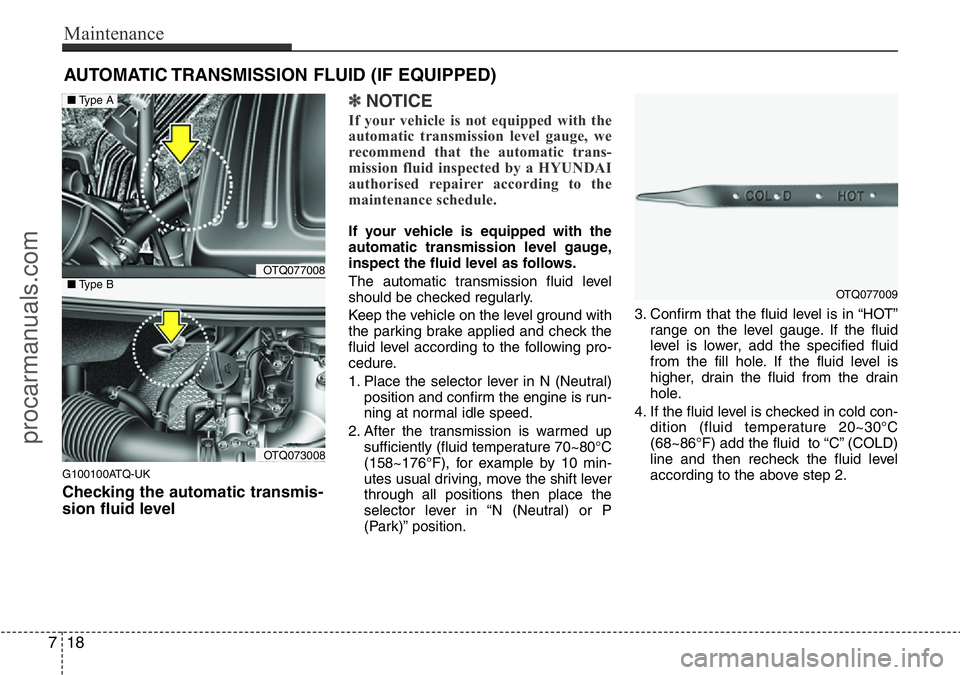
G100100ATQ-UK
Checking the automatic transmis-
sion fluid level
✽NOTICE
If your vehicle is not equipped with the
automatic transmission level gauge, we
recommend that the automatic trans-
mission fluid inspected by a HYUNDAI
authorised repairer according to the
maintenance schedule.
If your vehicle is equipped with the
automatic transmission level gauge,
inspect the fluid level as follows.
The automatic transmission fluid level
should be checked regularly.
Keep the vehicle on the level ground with
the parking brake applied and check the
fluid level according to the following pro-
cedure.
1. Place the selector lever in N (Neutral)
position and confirm the engine is run-
ning at normal idle speed.
2. After the transmission is warmed up
sufficiently (fluid temperature 70~80°C
(158~176°F), for example by 10 min-
utes usual driving, move the shift lever
through all positions then place the
selector lever in “N (Neutral) or P
(Park)” position.3. Confirm that the fluid level is in “HOT”
range on the level gauge. If the fluid
level is lower, add the specified fluid
from the fill hole. If the fluid level is
higher, drain the fluid from the drain
hole.
4. If the fluid level is checked in cold con-
dition (fluid temperature 20~30°C
(68~86°F) add the fluid to “C” (COLD)
line and then recheck the fluid level
according to the above step 2.
OTQ077009
OTQ077008
OTQ073008
■Type A
■Type B
procarmanuals.com
Page 281 of 339
719
Maintenance
✽NOTICE
“C” (COLD) range is for reference only
and should NOT be used to determine
transmission fluid level.
✽NOTICE
New automatic transmission fluid
should be red. The red dye is added so
the assembly plant can identify it as
automatic transmission fluid and distin-
guish it from engine oil or antifreeze.
The red dye, which is not an indicator of
fluid quality, is not permanent. As the
vehicle is driven, the automatic trans-
mission fluid will begin to look darker.
The colour may eventually appear light
brown. Therefore, we recommend that
the system be replaced by a HYUNDAI
authorised repairer according to the
Scheduled Maintenance at the begin-
ning of this section.
Use only the specified automatic trans-
mission fluid. (Refer to “Recommended
lubricants and capacities” in section 9.)
G100200AFD-UK
Changing the automatic transmis-
sion fluid
We recommend that the automatic trans-
mission fluid changed by a HYUNDAI
authorised repairer according to the
maintenance schedule.
WARNING - Transmission
fluid
The transmission fluid level should
be checked when the engine is at
normal operating temperature. This
means that the engine, radiator,
radiator hose and exhaust system
etc., are very hot. Exercise great
care not to burn yourself during
this procedure.
WARNING- Parking brake
To avoid sudden movement of the
vehicle, apply parking brake and
depress the brake pedal before
moving the shift lever.
CAUTION
• Low fluid level causes transmis-
sion slippage. Overfilling can
cause foaming, loss of fluid and
transmission malfunction.
• The use of a non-specified fluid
could result in transmission mal-
function and failure.
procarmanuals.com
Page 285 of 339
723
Maintenance
Replace the filter according to the
Maintenance Schedule.
If the vehicle is operated in extremely
dusty or sandy areas, replace the ele-
ment more often than the usual recom-
mended intervals.
G170100BEN
Filter inspection
The climate control air filter should be
replaced according to the maintenance
schedule. If the vehicle is operated in
severely air-polluted cities or on dusty
rough roads for a long period, it should
be inspected more frequently and
replaced earlier. When you replace the
climate control air filter, replace it per-
forming the following procedure, and be
careful to avoid damaging other compo-
nents.
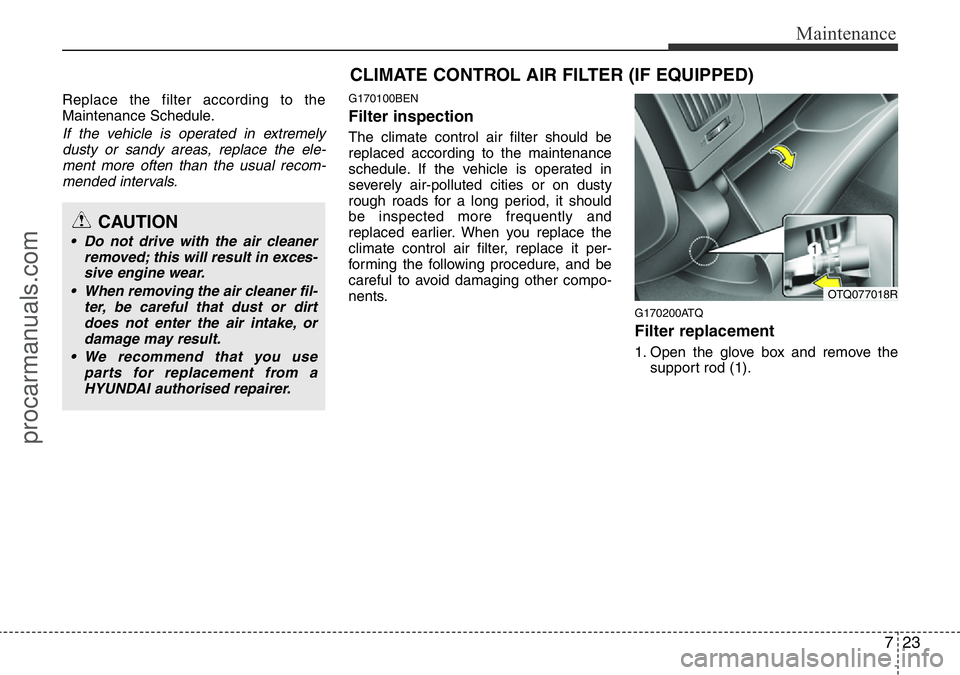
G170200ATQ
Filter replacement
1. Open the glove box and remove the
support rod (1).
CAUTION
• Do not drive with the air cleaner
removed; this will result in exces-
sive engine wear.
• When removing the air cleaner fil-
ter, be careful that dust or dirt
does not enter the air intake, or
damage may result.
• We recommend that you use
parts for replacement from a
HYUNDAI authorised repairer.
CLIMATE CONTROL AIR FILTER (IF EQUIPPED)
OTQ077018R
procarmanuals.com
Page 327 of 339
765
Maintenance
EMISSION CONTROL SYSTEM (IF EQUIPPED)
G270000AEN-UK
The emission control system of your
vehicle is covered by a written limited
warranty. Please see the warranty infor-
mation contained in the Service Passport
in your vehicle.
Your vehicle is equipped with an emis-
sion control system to meet all applicable
emission regulations.
There are three emission control sys-
tems, as follows.
(1) Crankcase emission control system
(2) Evaporative emission control system
(3) Exhaust emission control system
In order to assure the proper function of
the emission control systems, it is rec-
ommended that you have your car
inspected and maintained by a
HYUNDAI authorised repairer in accor-
dance with the maintenance schedule in
this manual.Caution for the Inspection and
Maintenance Test (With Electronic
Stability Program (ESP) system)
• To prevent the vehicle from misfir-
ing during dynamometer testing,
turn the Electronic Stability
Program (ESP) system off by press-
ing the ESP switch.
• After dynamometer testing is com-
pleted, turn the ESP system back on
by pressing the ESP switch again.
G270100AUN
1. Crankcase emission control
system
The positive crankcase ventilation sys-
tem is employed to prevent air pollution
caused by blow-by gases being emitted
from the crankcase. This system supplies
fresh filtered air to the crankcase through
the air intake hose. Inside the crankcase,
the fresh air mixes with blow-by gases,
which then pass through the PCV valve
into the induction system.
G270200AEN-UK
2. Evaporative emission control
system
The Evaporative Emission Control
System is designed to prevent fuel
vapours from escaping into the atmos-
phere.
G270201AUN-UK
Canister
Fuel vapours generated inside the fuel
tank are absorbed and stored in the
onboard canister. When the engine is
running, the fuel vapours absorbed in the
canister are drawn into the surge tank
through the purge control solenoid valve.
G270202AUN
Purge Control Solenoid Valve (PCSV)
The purge control solenoid valve is con-
trolled by the Engine Control Module
(ECM); when the engine coolant temper-
ature is low during idling, the PCSV clos-
es so that evaporated fuel is not taken
into the engine. After the engine warms-
up during ordinary driving, the PCSV
opens to introduce evaporated fuel to the
engine.
procarmanuals.com