brake HYUNDAI I800 2015 Workshop Manual
[x] Cancel search | Manufacturer: HYUNDAI, Model Year: 2015, Model line: I800, Model: HYUNDAI I800 2015Pages: 339, PDF Size: 7.25 MB
Page 235 of 339
545
Driving your vehicle
5. Start the vehicle, hold the brakes, shift
to neutral, release the parking brake
and slowly release the brakes until the
trailer chocks absorb the load.
6. Reapply the brakes, reapply the park-
ing brake and shift the vehicle to R
(Reverse) for manual transmission or
P (Park) automatic transmission.
7. Shut off the vehicle and release the
vehicle brakes but leave the parking
brake set.
When you are ready to leave after park-
ing on a hill
1. With the manual transmission in
Neutral or automatic transmission in P
(Park), apply your brakes and hold the
brake pedal down whilst you:
• Start your engine;
• Shift into gear; and
• Release the parking brake.2. Slowly remove your foot from the
brake pedal.
3. Drive slowly until the trailer is clear of
the chocks.
4. Stop and have someone pick up and
store the chocks.
E140500AUN-UK
Maintenance when trailer towing
Your vehicle will need service more often
when you regularly pull a trailer.
Important items to pay particular atten-
tion to include engine oil, automatic
transmission fluid, axle lubricant and
cooling system fluid. Brake condition is
another important item to frequently
check. Each item is covered in this man-
ual, and the Index will help you find them
quickly. If you’re trailering, it’s a good idea
to review these sections before you start
your trip.
Don’t forget to also maintain your trailer
and towbar. Follow the maintenance
schedule that accompanied your trailer
and check it periodically. Preferably, con-
duct the check at the start of each day’s
driving. Most importantly, all towbar nuts
and bolts should be tight.
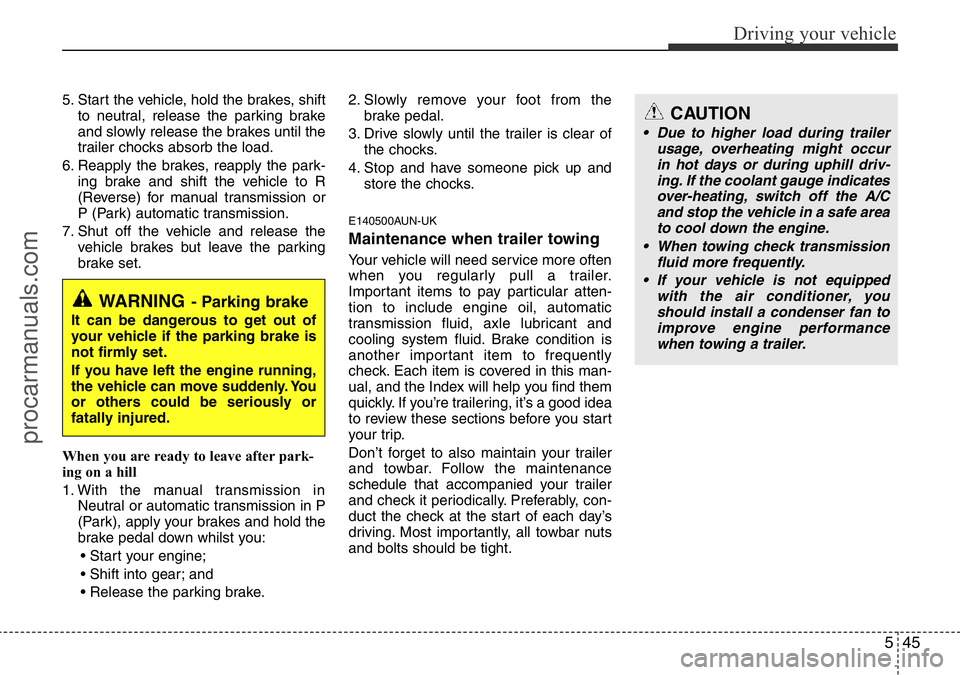
WARNING- Parking brake
It can be dangerous to get out of
your vehicle if the parking brake is
not firmly set.
If you have left the engine running,
the vehicle can move suddenly. You
or others could be seriously or
fatally injured.
CAUTION
• Due to higher load during trailer
usage, overheating might occur
in hot days or during uphill driv-
ing. If the coolant gauge indicates
over-heating, switch off the A/C
and stop the vehicle in a safe area
to cool down the engine.
• When towing check transmission
fluid more frequently.
• If your vehicle is not equipped
with the air conditioner, you
should install a condenser fan to
improve engine performance
when towing a trailer.
procarmanuals.com
Page 236 of 339
Driving your vehicle
46 5
E140600ATQ-UK
If you do decide to pull a trailer
Here are some important points if you
decide to pull a trailer:
• Consider using a sway control. You can
ask a towbar dealer about sway con-
trol.
• Do not do any towing with your car dur-
ing its first 1,000 miles in order to allow
the engine to properly run-in. Failure to
heed this caution may result in serious
engine or transmission damage.
• When towing a trailer, we recommend
that you consult a HYUNDAI autho-
rised repairer on additional require-
ments such as a towing kit, etc.
• Always drive your vehicle at a moder-
ate speed (less than 60 mph (100
km/h)).
• On a long uphill grade, do not exceed
45 mph (70 km/h) or the posted towing
speed limit, whichever is lower.
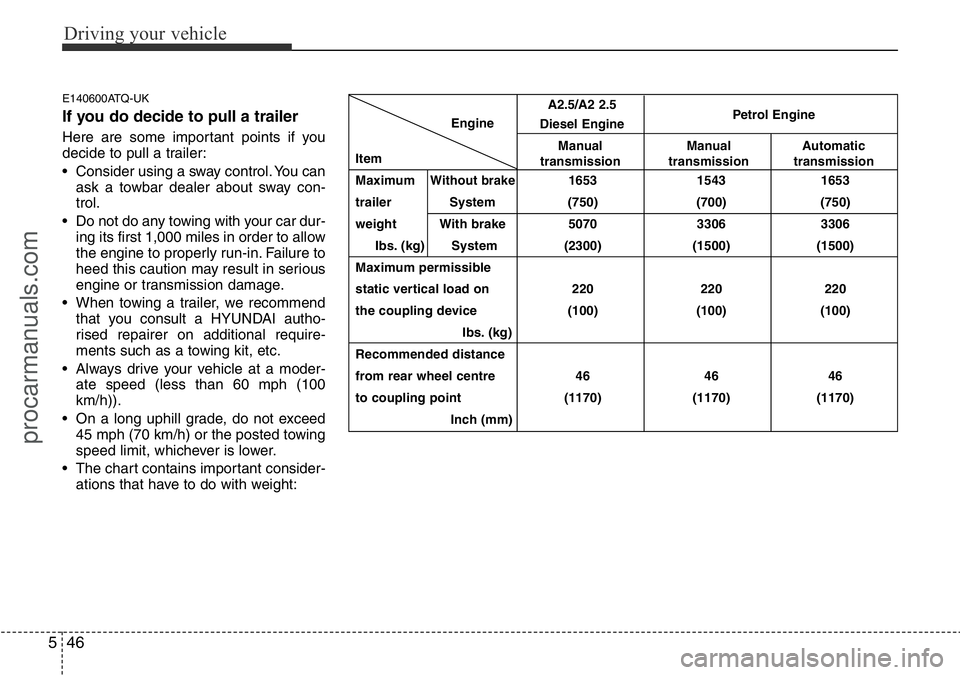
• The chart contains important consider-
ations that have to do with weight:Engine
Item
Maximum
Without brake1653 1543 1653
trailer System (750) (700) (750)
weight With brake 5070 3306 3306
Ibs. (kg) System (2300) (1500) (1500)
Maximum permissible
static vertical load on 220 220 220
the coupling device (100) (100) (100)
Ibs. (kg)
Recommended distance
from rear wheel centre 46 46 46
to coupling point (1170) (1170) (1170)
Inch (mm)
A2.5/A2 2.5
Diesel EnginePetrol Engine
Manual
transmissionManual
transmissionAutomatic
transmission
procarmanuals.com
Page 237 of 339
547
Driving your vehicle
E140601AUN-UK
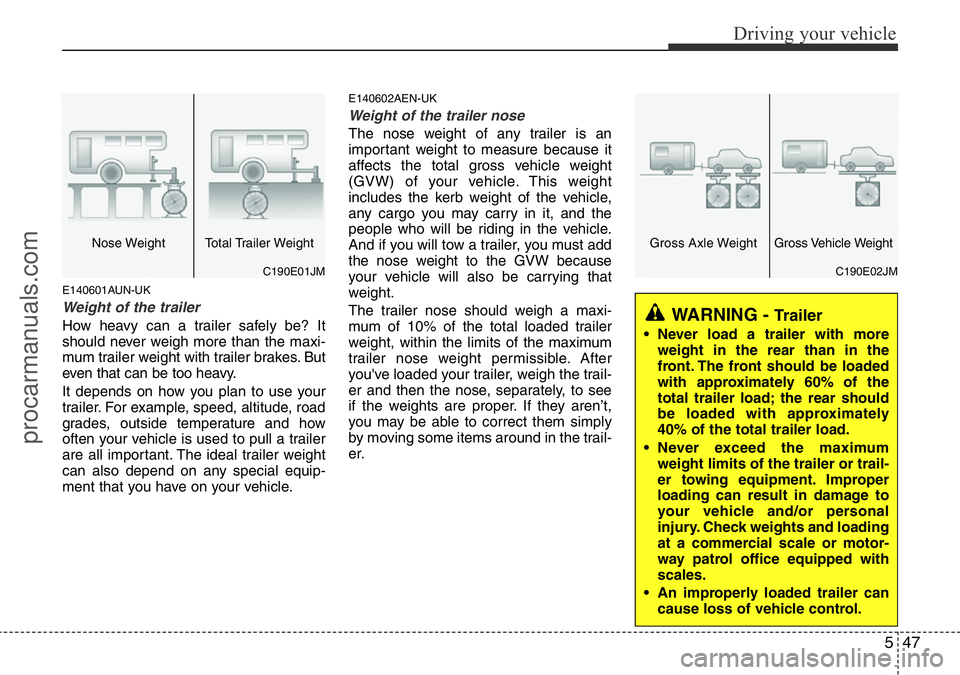
Weight of the trailer
How heavy can a trailer safely be? It
should never weigh more than the maxi-
mum trailer weight with trailer brakes. But
even that can be too heavy.
It depends on how you plan to use your
trailer. For example, speed, altitude, road
grades, outside temperature and how
often your vehicle is used to pull a trailer
are all important. The ideal trailer weight
can also depend on any special equip-
ment that you have on your vehicle.
E140602AEN-UK
Weight of the trailer nose
The nose weight of any trailer is an
important weight to measure because it
affects the total gross vehicle weight
(GVW) of your vehicle. This weight
includes the kerb weight of the vehicle,
any cargo you may carry in it, and the
people who will be riding in the vehicle.
And if you will tow a trailer, you must add
the nose weight to the GVW because
your vehicle will also be carrying that
weight.
The trailer nose should weigh a maxi-
mum of 10% of the total loaded trailer
weight, within the limits of the maximum
trailer nose weight permissible. After
you've loaded your trailer, weigh the trail-
er and then the nose, separately, to see
if the weights are proper. If they aren’t,
you may be able to correct them simply
by moving some items around in the trail-
er.
WARNING - Trailer
• Never load a trailer with more
weight in the rear than in the
front. The front should be loaded
with approximately 60% of the
total trailer load; the rear should
be loaded with approximately
40% of the total trailer load.
• Never exceed the maximum
weight limits of the trailer or trail-
er towing equipment. Improper
loading can result in damage to
your vehicle and/or personal
injury. Check weights and loading
at a commercial scale or motor-
way patrol office equipped with
scales.
• An improperly loaded trailer can
cause loss of vehicle control.
C190E02JM
Gross Axle WeightGross Vehicle Weight
C190E01JM
Nose Weight Total Trailer Weight
procarmanuals.com
Page 241 of 339
63
What to do in an emergency
3. Passengers must not be allowed to
remain inside the vehicle during wheel
changing. If a puncture occurs whilst
the vehicle is on a motorway, the pas-
sengers should take refuge on the
motorway embankment to avoid the
possibility of injury occurring should
the vehicle be struck by other motor-
way traffic.
4. Wheel changing should be performed
according to the following instructions.
F020300AEN-UK
If engine stalls whilst driving
1. Reduce your speed gradually, keeping
a straight line. Move cautiously off the
road to a safe place.
2. Turn on your emergency flashers.
3. Try to start the engine again. If your
vehicle will not start, we recommend
that you consult a HYUNDAI autho-
rised repairer.
F030100AUN-UK
If engine cannot be cranked
1. If your car has an automatic transmis-
sion, be sure the gear selector lever is
in N (Neutral) or P (Park) and the
emergency brake is set.
2. Check the battery terminals and con-
nections to ensure that these are clean
and also tight.
3. If the ignition warning lights dim when
the engine is cranked and the battery
terminals have been checked, a dis-
charged battery is indicated.
4. Do not attempt to push or tow start the
vehicle, refer to "Jump Starting" for
information regarding engine starting
when the battery is discharged.
F030200AEN-UK
If engine turns over normally but
does not start
1. Check fuel level.
2. With the ignition switch in the LOCK
position, check all connectors at the
ignition coils and spark plugs.
Reconnect any that may be discon-
nected or loose.
3. Check the fuel line in the engine com-
partment.
4. If the engine still does not start, we
recommend that you call a HYUNDAI
authorised repairer.
IF THE ENGINE WILL NOT START
WARNING
If the engine refuses to start, no
attempt should be made to push or
tow start the vehicle. Vehicles with
automatic transmission or fuel
injection will not be able to be start-
ed in this manner since no drive is
transmitted through the automatic
transmission whilst the engine is
not running, and in the case of fuel
injected derivatives, the fuel pump
will not operate under tow start
conditions. In addition, if the vehi-
cle is equipped with an exhaust cat-
alyst, damage to the catalyst may
result if the vehicle is tow started.
procarmanuals.com
Page 244 of 339
What to do in an emergency
6 6
IF THE ENGINE OVERHEATS
F050000AFD-UK
If your temperature gauge indicates over-
heating, you experience a loss of power,
or hear loud pinging or knocking, the
engine is probably too hot. If this hap-
pens, you should:
1. Pull off the road and stop as soon as it
is safe to do so.
2. Place the gear selector lever in P
(automatic transmission) or neutral
(manual transmission) and set the
parking brake. If the air conditioning is
on, turn it off.
3. If engine coolant is running out under
the car or steam is coming out from
the bonnet, stop the engine. Do not
open the bonnet until the coolant has
stopped running or the steaming has
stopped. If there is no visible loss of
engine coolant and no steam, leave
the engine running and check to be
sure the engine cooling fan is operat-
ing. If the fan is not running, turn the
engine off.4. Check to see if the water pump drive
belt is missing. If it is not missing,
check to see that it is tight. If the drive
belt seems to be satisfactory, check
for coolant leaking from the radiator,
hoses or under the car. (If the air con-
ditioning had been in use, it is normal
for cold water to be draining from it
when you stop).
5. If the water pump drive belt is broken
or engine coolant is leaking out, stop
the engine immediately and we recom-
mend that you call a HYUNDAI autho-
rised repairer.6. If the cause of the overheating cannot
be found, wait until the engine temper-
ature has returned to normal. Then, if
coolant has been lost, carefully add
coolant to the reservoir to bring the
fluid level in the reservoir up to the
base of the radiator fill opening. Fill the
coolant expansion tank to the halfway
mark. To ensure the correct water to
coolant mix is obtained after top up,
testing by an authorised repairer is
required.
7. Proceed with caution until it is estab-
lished that the engine is operating nor-
mally. If overheating happens again,
we recommend that you call a
HYUNDAI authorised repairer.
CAUTION
• Serious loss of coolant indicates
there is a leak in the cooling sys-
tem and we recommend that the
system be checked by a HYUNDAI
authorised repairer.
• When the engine overheats from
low engine coolant, suddenly
adding engine coolant may cause
cracks in the engine. To prevent
damage, add engine coolant
slowly in small quantities.
WARNING
Whilst the engine is running, keep
hair, hands and clothing away from
moving parts such as the fan and
drive belts to prevent injury.
WARNING
Do not remove the radiator cap
when the engine is hot since steam
and boiling water may be ejected
from the radiator resulting in burns
or scalding.
procarmanuals.com
Page 248 of 339
What to do in an emergency
10 6
Changing a Tyre with TPMS
If you have a flat tyre, the Low Tyre
Pressure Telltale will illuminate. If you
believe you have a flat tyre or feel
any vehicle instability, take your foot
off the accelerator pedal and let the
vehicle slow down whilst driving
straight ahead. Do not apply the
brakes immediately or attempt to pull
off the road as this may cause a loss
of control resulting in an accident.
When the vehicle has slowed to such
a speed that it is safe to do so, brake
carefully and pull off the road. Drive
off the road as far as possible and
park on firm, level ground. If you are
on a divided highway, do not park in
the median area between the two
traffic lanes. Replace the flat tyre
with the compact spare tyre.The spare tyre is not equipped with a
tyre pressure monitoring sensor.
When the low pressure tyre or the flat
tyre is replaced with the spare tyre,
the Low Tyre Pressure Telltale will
remain on. Also, the TPMS
Malfunction Indicator will illuminate
after blinking for one minute if the
vehicle is driven at speed above 25
km/h (15.5 mph) for approximately 10
minutes.
Once the original tyre equipped with
a tyre pressure monitoring sensor is
reinflated to the recommended pres-
sure and reinstalled on the vehicle,
the Low Tyre Pressure Telltale and
TPMS Malfunction Indicator will go
off within a few minutes.
If the indicator is not extinguished
after a few minutes of driving, We rec-
ommend that the system be checked
by a HYUNDAI authorised repairer.
Each wheel is equipped with a tyre
pressure sensor mounted inside the
tyre behind the valve stem (except for
the spare tyre). You must use TPMS
specific wheels. It is recommended
that you always have your tyres serv-
iced by a HYUNDAI authorised
repairer as soon as possible.
CAUTION
To prevent damaging your tyre
pressure sensor, never use a
puncture-repairing agents or
tyre sealants to repair and/or
inflate a low pressure tyre. If
used, you will have to replace
the tyre pressure sensor.
WARNING - For EUROPE
• Do not modify the vehicle, it
may interfere with the TPMS
function.
• The wheels on the market do
not have a TPMS sensor.
For your safety, we recom-
mend that you use parts for
replacement from a HYUNDAI
authorised repairer.
• If you use the wheels on the
market, use a TPMS sensor
approved by a HYUNDAI dealer.
If your vehicle is not equipped
with a TPMS sensor or TPMS
does not work properly, you
may fail the periodic vehicle
inspection conducted in your
country.
❈All vehicles sold in the
EUROPE market during below
period must be equipped with
TPMS.
- New model vehicle :
Nov. 1, 2012 ~
- Current model vehicle :
Nov. 1, 2014~ (Based on vehi-
cle registrations)
procarmanuals.com
Page 251 of 339
613
What to do in an emergency
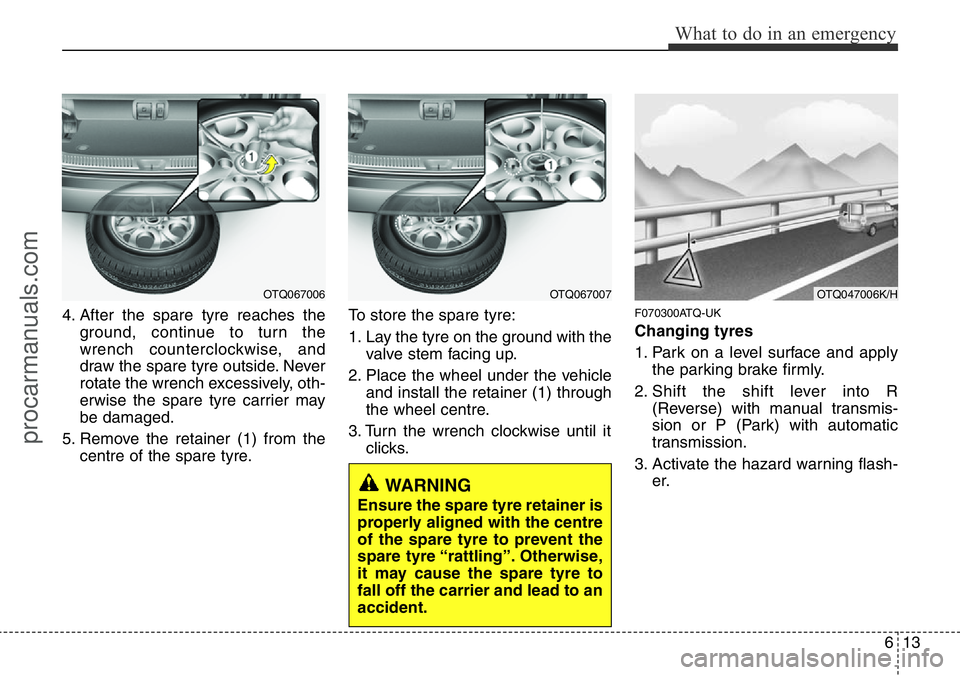
4. After the spare tyre reaches the
ground, continue to turn the
wrench counterclockwise, and
draw the spare tyre outside. Never
rotate the wrench excessively, oth-
erwise the spare tyre carrier may
be damaged.
5. Remove the retainer (1) from the
centre of the spare tyre.To store the spare tyre:
1. Lay the tyre on the ground with the
valve stem facing up.
2. Place the wheel under the vehicle
and install the retainer (1) through
the wheel centre.
3. Turn the wrench clockwise until it
clicks.F070300ATQ-UK
Changing tyres
1. Park on a level surface and apply
the parking brake firmly.
2. Shift the shift lever into R
(Reverse) with manual transmis-
sion or P (Park) with automatic
transmission.
3. Activate the hazard warning flash-
er.
OTQ067006OTQ067007
WARNING
Ensure the spare tyre retainer is
properly aligned with the centre
of the spare tyre to prevent the
spare tyre “rattling”. Otherwise,
it may cause the spare tyre to
fall off the carrier and lead to an
accident.
OTQ047006K/H
procarmanuals.com
Page 252 of 339
What to do in an emergency
14 6
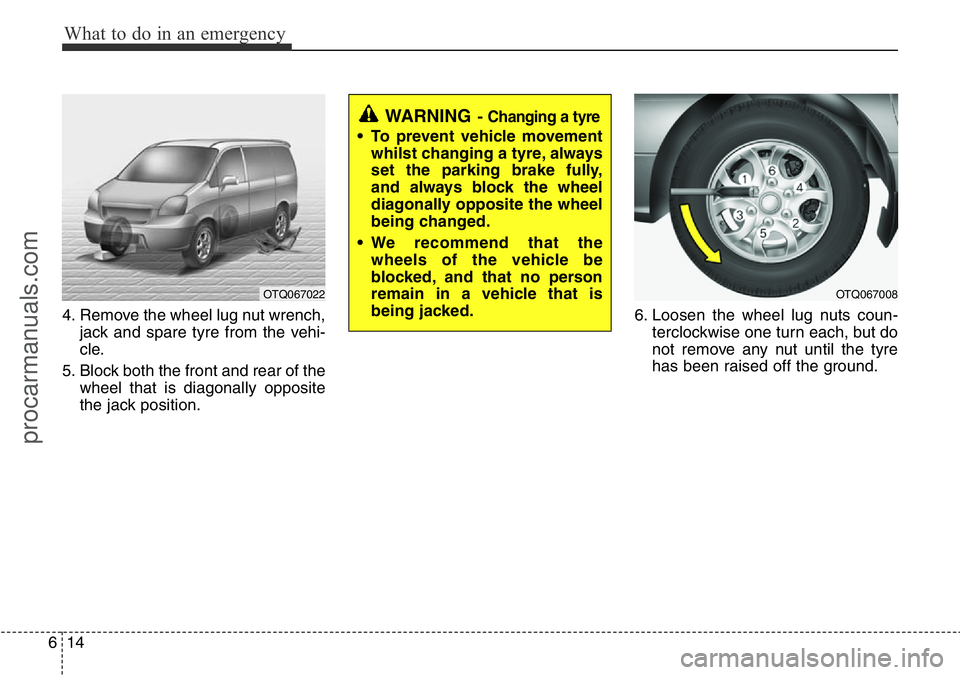
4. Remove the wheel lug nut wrench,
jack and spare tyre from the vehi-
cle.
5. Block both the front and rear of the
wheel that is diagonally opposite
the jack position.6. Loosen the wheel lug nuts coun-
terclockwise one turn each, but do
not remove any nut until the tyre
has been raised off the ground.
OTQ067022OTQ067008
WARNING- Changing a tyre
• To prevent vehicle movement
whilst changing a tyre, always
set the parking brake fully,
and always block the wheel
diagonally opposite the wheel
being changed.
• We recommend that the
wheels of the vehicle be
blocked, and that no person
remain in a vehicle that is
being jacked.
procarmanuals.com
Page 256 of 339
What to do in an emergency
18 6
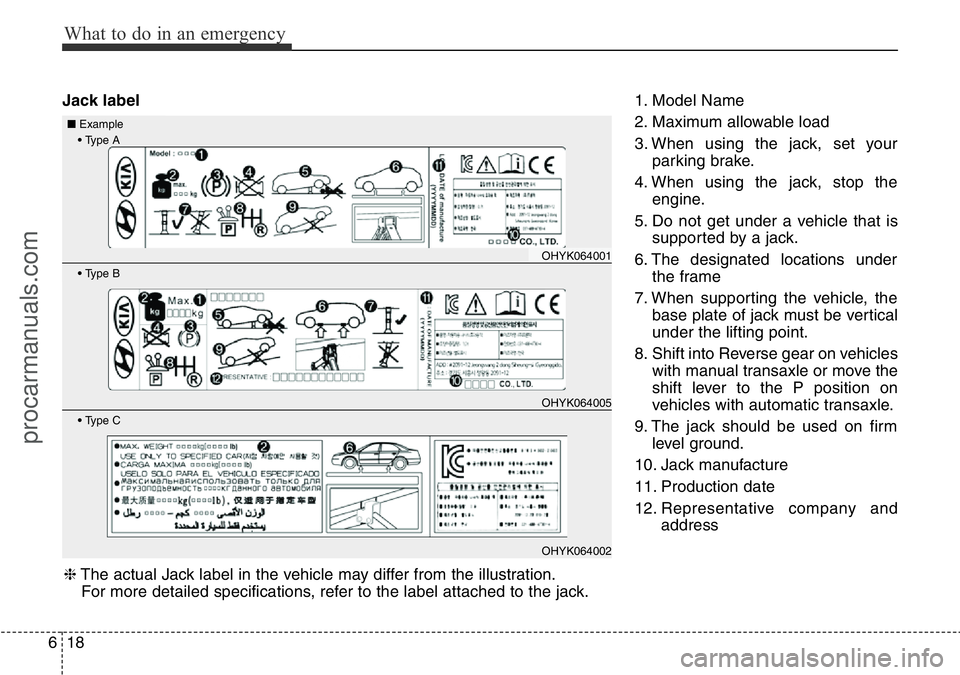
Jack label1. Model Name
2. Maximum allowable load
3. When using the jack, set your
parking brake.
4. When using the jack, stop the
engine.
5. Do not get under a vehicle that is
supported by a jack.
6. The designated locations under
the frame
7. When supporting the vehicle, the
base plate of jack must be vertical
under the lifting point.
8. Shift into Reverse gear on vehicles
with manual transaxle or move the
shift lever to the P position on
vehicles with automatic transaxle.
9. The jack should be used on firm
level ground.
10. Jack manufacture
11. Production date
12. Representative company and
address
❈The actual Jack label in the vehicle may differ from the illustration.
For more detailed specifications, refer to the label attached to the jack.
• Type A ■Example
• Type B
• Type C
OHYK064001
OHYK064005
OHYK064002
procarmanuals.com
Page 259 of 339
621
What to do in an emergency
When towing your vehicle in an emer-
gency without wheel dollies :
1. Set the ignition switch in the ACC posi-
tion.
2. Place the transmission shift lever in N
(Neutral).
3. Release the parking brake.
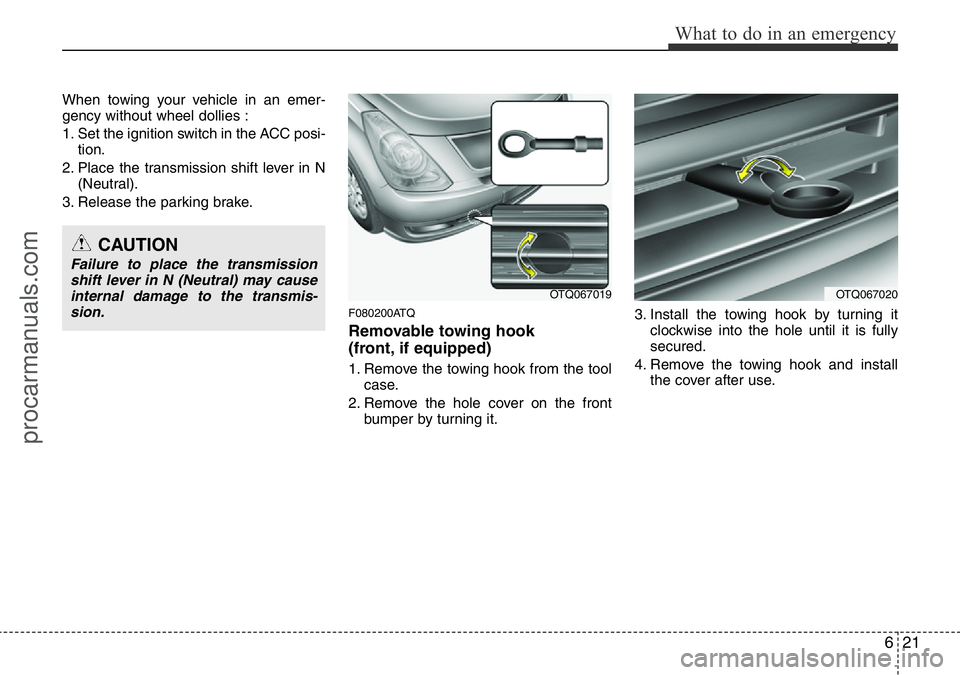
F080200ATQ
Removable towing hook
(front, if equipped)
1. Remove the towing hook from the tool
case.
2. Remove the hole cover on the front
bumper by turning it.3. Install the towing hook by turning it
clockwise into the hole until it is fully
secured.
4. Remove the towing hook and install
the cover after use.
CAUTION
Failure to place the transmission
shift lever in N (Neutral) may cause
internal damage to the transmis-
sion.
OTQ067019OTQ067020
procarmanuals.com