warning light HYUNDAI I800 2015 Repair Manual
[x] Cancel search | Manufacturer: HYUNDAI, Model Year: 2015, Model line: I800, Model: HYUNDAI I800 2015Pages: 339, PDF Size: 7.25 MB
Page 268 of 339
Maintenance
6 7
OWNER MAINTENANCE
G030000AEN-UK
The following lists are vehicle checks and
inspections that should be performed at
the frequencies indicated to help ensure
safe, dependable operation of your vehi-
cle.
If you have any question, we recommend
that you consult a HYUNDAI authorised
repairer.
These Owner Maintenance Checks are
generally not covered by warranties and
you may be charged for labour, parts and
lubricants used.Owner maintenance schedule
G030101AUN-UK
When you stop for fuel:
• Check the engine oil level.
• Check coolant level in coolant reser-
voir.
• Check the windscreen washer fluid
level.
• Look for low or under-inflated tyres.
G030102AUN-UK
Whilst operating your vehicle:
• Note any changes in the sound of the
exhaust or any smell of exhaust fumes
in the vehicle.
• Check for vibrations in the steering
wheel. Notice any increased steering
effort or looseness in the steering
wheel, or change in its straight-ahead
position.
• Notice if your vehicle constantly turns
slightly or “pulls” to one side when trav-
elling on smooth, level road.
• When stopping, listen and check for
unusual sounds, pulling to one side,
increased brake pedal travel or “hard-
to-push” brake pedal.
• If any slipping or changes in the oper-
ation of your transmission occurs,
check the transmission fluid level.
• Check automatic transmission P (Park)
function.
• Check parking brake.
• Check for fluid leaks under your vehicle
(water dripping from the air condition-
ing system during or after use is nor-
mal).
WARNING
Be careful when checking your
engine coolant level when the
engine is hot. Scalding hot coolant
and steam may blow out under
pressure. This could cause burns
or other serious injury.
procarmanuals.com
Page 269 of 339
77
Maintenance
G030103AUN-UK
At least monthly:
• Check coolant level in the engine
coolant reservoir.
• Check the operation of all exterior
lights, including the stoplights, turn sig-
nals and hazard warning flashers.
• Check the inflation pressures of all
tyres including the spare.
G030104AUN-UK
At least twice a year
(i.e., every Spring and Fall) :
• Check radiator, heater and air condi-
tioning hoses for leaks or damage.
• Check windscreen washer spray and
wiper operation. Clean wiper blades
with clean cloth dampened with wash-
er fluid.
• Check headlight alignment.
• Check muffler, exhaust pipes, shields
and clamps.
• Check the lap/shoulder belts for wear
and function.
• Check for worn tyres and loose wheel
lug nuts.
G030105AUN-UK
At least once a year:
• Clean body and door drain holes.
• Lubricate door hinges and checks, and
bonnet hinges.
• Lubricate door and bonnet locks and
latches.
• Lubricate door rubber weatherstrips.
• Check the air conditioning system.
• Check the power steering fluid level.
• Inspect and lubricate automatic trans-
mission linkage and controls.
• Clean battery and terminals.
• Check the brake fluid level.
procarmanuals.com
Page 281 of 339
719
Maintenance
✽NOTICE
“C” (COLD) range is for reference only
and should NOT be used to determine
transmission fluid level.
✽NOTICE
New automatic transmission fluid
should be red. The red dye is added so
the assembly plant can identify it as
automatic transmission fluid and distin-
guish it from engine oil or antifreeze.
The red dye, which is not an indicator of
fluid quality, is not permanent. As the
vehicle is driven, the automatic trans-
mission fluid will begin to look darker.
The colour may eventually appear light
brown. Therefore, we recommend that
the system be replaced by a HYUNDAI
authorised repairer according to the
Scheduled Maintenance at the begin-
ning of this section.
Use only the specified automatic trans-
mission fluid. (Refer to “Recommended
lubricants and capacities” in section 9.)
G100200AFD-UK
Changing the automatic transmis-
sion fluid
We recommend that the automatic trans-
mission fluid changed by a HYUNDAI
authorised repairer according to the
maintenance schedule.
WARNING - Transmission
fluid
The transmission fluid level should
be checked when the engine is at
normal operating temperature. This
means that the engine, radiator,
radiator hose and exhaust system
etc., are very hot. Exercise great
care not to burn yourself during
this procedure.
WARNING- Parking brake
To avoid sudden movement of the
vehicle, apply parking brake and
depress the brake pedal before
moving the shift lever.
CAUTION
• Low fluid level causes transmis-
sion slippage. Overfilling can
cause foaming, loss of fluid and
transmission malfunction.
• The use of a non-specified fluid
could result in transmission mal-
function and failure.
procarmanuals.com
Page 283 of 339
721
Maintenance
FUEL FILTER (FOR DIESEL)
G150100AFD-UK
Draining water from fuel filter
The fuel filter for diesel engine plays an
important role of separating water from
fuel and accumulating the water in its
bottom.
If water accumulates in the
fuel filter, the warning light
comes on when the ignition
switch is in the ON position.
If the stroke is more or less
than specified, we recom-
mend that the system be
serviced by a HYUNDAI
authorised repairer.
G150200AEN
Fuel filter cartridge replacement
✽NOTICE
When replacing the fuel filter cartridge,
we recommend that you use parts for
replacement from a HYUNDAI autho-
rised repairer.
OTQ077012R
CAUTION
If the water accumulated in the fuel
filter is not drained at proper times,
damages to the major parts such as
the fuel system can be caused by
water permeation in the fuel filter.
procarmanuals.com
Page 290 of 339
Maintenance
28 7
BATTERY
G190100DUN
For best battery service
• Keep the battery securely mounted.
• Keep the battery top clean and dry.
• Keep the terminals and connections
clean, tight, and coated with petroleum
jelly or terminal grease.
• Rinse any spilled electrolyte from the
battery immediately with a solution of
water and baking soda.
• If the vehicle is not going to be used for
an extended time, disconnect the bat-
tery cables.
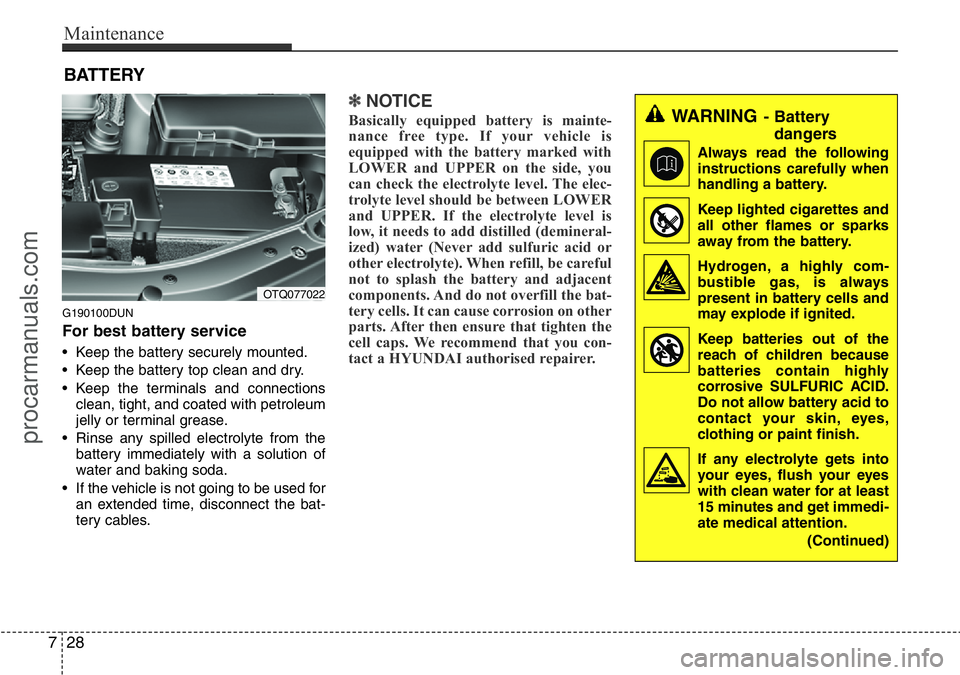
✽NOTICE
Basically equipped battery is mainte-
nance free type. If your vehicle is
equipped with the battery marked with
LOWER and UPPER on the side, you
can check the electrolyte level. The elec-
trolyte level should be between LOWER
and UPPER. If the electrolyte level is
low, it needs to add distilled (demineral-
ized) water (Never add sulfuric acid or
other electrolyte). When refill, be careful
not to splash the battery and adjacent
components. And do not overfill the bat-
tery cells. It can cause corrosion on other
parts. After then ensure that tighten the
cell caps. We recommend that you con-
tact a HYUNDAI authorised repairer.
OTQ077022
WARNING- Battery
dangers
Always read the following
instructions carefully when
handling a battery.
Keep lighted cigarettes and
all other flames or sparks
away from the battery.
Hydrogen, a highly com-
bustible gas, is always
present in battery cells and
may explode if ignited.
Keep batteries out of the
reach of children because
batteries contain highly
corrosive SULFURIC ACID.
Do not allow battery acid to
contact your skin, eyes,
clothing or paint finish.
If any electrolyte gets into
your eyes, flush your eyes
with clean water for at least
15 minutes and get immedi-
ate medical attention.
(Continued)
procarmanuals.com
Page 292 of 339
Maintenance
30 7
G190200AUN-UK
Battery recharging
Your vehicle has a maintenance-free,
calcium-based battery.
• If the battery becomes discharged in a
short time (because, for example, the
headlights or interior lights were left on
whilst the vehicle was not in use),
recharge it by slow charging (trickle)
for 10 hours.
• If the battery gradually discharges
because of high electric load whilst the
vehicle is being used, recharge it at 20-
30A for two hours.
G190300BTQ
Reset items
Items should be reset after the battery
has been discharged or the battery has
been disconnected.
• Climate control system
(See section 4)
• Clock (See section 4)
• Audio (See section 4)
• Auto up/down window (See section 4)
• Trip computer (See section 4)
(Continued)
• Before performing maintenance
or recharging the battery, turn off
all accessories and stop the
engine.
• The negative battery cable must
be removed first and installed
last when the battery is discon-
nected.WARNING- Recharging
battery
When recharging the battery,
observe the following precautions:
• The battery must be removed
from the vehicle and placed in an
area with good ventilation.
• Do not allow cigarettes, sparks,
or flame near the battery.
• Watch the battery during charg-
ing, and stop or reduce the charg-
ing rate if the battery cells begin
gassing (boiling) violently or if
the temperature of the electrolyte
of any cell exceeds 49°C (120°F).
• Wear eye protection when check-
ing the battery during charging.
• Disconnect the battery charger in
the following order.
1. Turn off the battery charger main
switch.
2. Unhook the negative clamp from
the negative battery terminal.
3. Unhook the positive clamp from
the positive battery terminal.
(Continued)
procarmanuals.com
Page 298 of 339
Maintenance
36 7
G200700BUN-UK
Wheel replacement
When replacing the metal wheels for
any reason, make sure the new
wheels are equivalent to the original
factory units in diameter, rim width
and offset.
G200800AUN-UK
Tyre traction
Tyre traction can be reduced if you
drive on worn tyres, tyres that are
improperly inflated or on slippery
road surfaces. Tyres should be
replaced when tread wear indicators
appear. To reduce the possibility of
losing control, slow down whenever
there is rain, snow or ice on the road.
G200900AUN-UK
Tyre maintenance
In addition to proper inflation, correct
wheel alignment helps to decrease
tyre wear. If you find a tyre is worn
unevenly, we recommend that the
wheel alignment be checked by a
HYUNDAI authorised repairer.
When you have new tyres installed,
make sure they are balanced. This
will increase vehicle ride comfort and
tyre life. Additionally, a tyre should
always be rebalanced if it is removed
from the wheel.
(Continued)
• Using tyres and wheel other
than the recommended sizes
could cause unusual handling
characteristics and poor vehi-
cle control, resulting in a seri-
ous accident.
• Wheels that do not meet
HYUNDAI’s specifications
may fit poorly and result in
damage to the vehicle or
unusual handling and poor
vehicle control.
• The ABS works by comparing
the speed of the wheels. Tyre
size can affect wheel speed.
When replacing tyres, all 4
tyres must use the same size
originally supplied with the
vehicle. Using tyres of a dif-
ferent size can cause the ABS
(Anti-lock Brake System) and
ESP (Electronic Stability
Program) (if equipped) to
work irregularly.
WARNING
A wheel that is not the correct
size may adversely affect wheel
and bearing life, braking and
stopping abilities, handling
characteristics, ground clear-
ance, body-to-tyre clearance,
snow chain clearance,
speedometer and odometer cal-
ibration, headlight aim and
bumper height.
procarmanuals.com
Page 304 of 339
Maintenance
42 7
FUSES
G210000BEN-UK
A vehicle’s electrical system is protected
from electrical overload damage by
fuses.This vehicle has 3 fuse panels, one locat-
ed in the driver’s side panel bolster, the
other in the engine compartment.
If any of your vehicle’s lights, acces-
sories, or controls do not work, check the
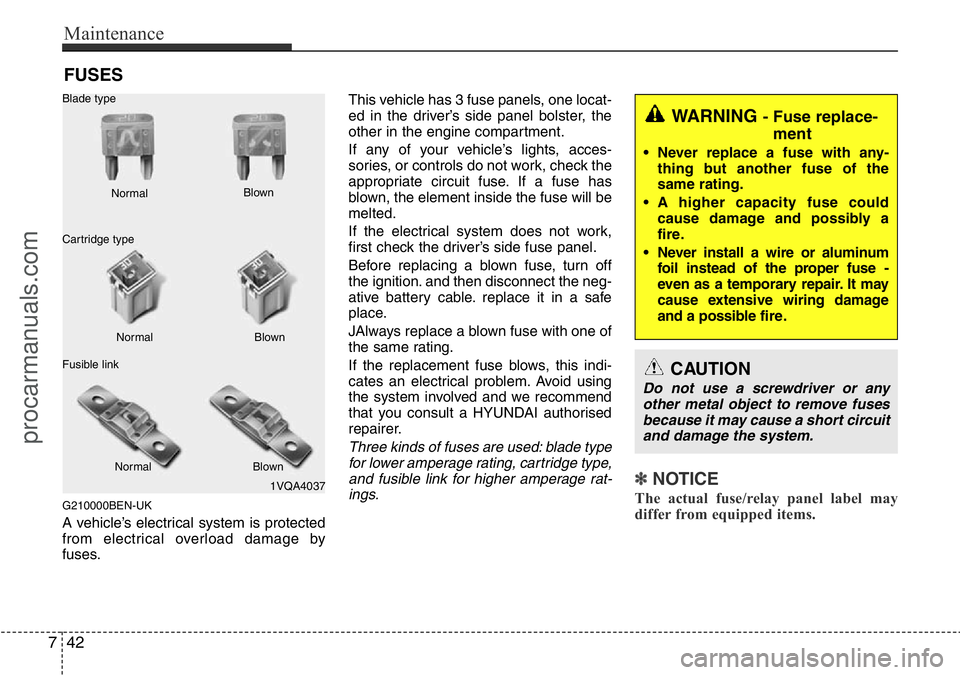
appropriate circuit fuse. If a fuse has
blown, the element inside the fuse will be
melted.
If the electrical system does not work,
first check the driver’s side fuse panel.
Before replacing a blown fuse, turn off
the ignition. and then disconnect the neg-
ative battery cable. replace it in a safe
place.
JAlways replace a blown fuse with one of
the same rating.
If the replacement fuse blows, this indi-
cates an electrical problem. Avoid using
the system involved and we recommend
that you consult a HYUNDAI authorised
repairer.
Three kinds of fuses are used: blade type
for lower amperage rating, cartridge type,
and fusible link for higher amperage rat-
ings.
✽NOTICE
The actual fuse/relay panel label may
differ from equipped items.1VQA4037 Normal Normal Blade type
Cartridge type
Fusible linkBlown
Blown
Normal Blown
WARNING - Fuse replace-
ment
• Never replace a fuse with any-
thing but another fuse of the
same rating.
• A higher capacity fuse could
cause damage and possibly a
fire.
• Never install a wire or aluminum
foil instead of the proper fuse -
even as a temporary repair. It may
cause extensive wiring damage
and a possible fire.
CAUTION
Do not use a screwdriver or any
other metal object to remove fuses
because it may cause a short circuit
and damage the system.
procarmanuals.com
Page 306 of 339
Maintenance
44 7
If the headlights or other electrical com-
ponents do not work and the fuses are
OK, check the fuse panel in the engine
compartment. If a fuse is blown, it must
be replaced.
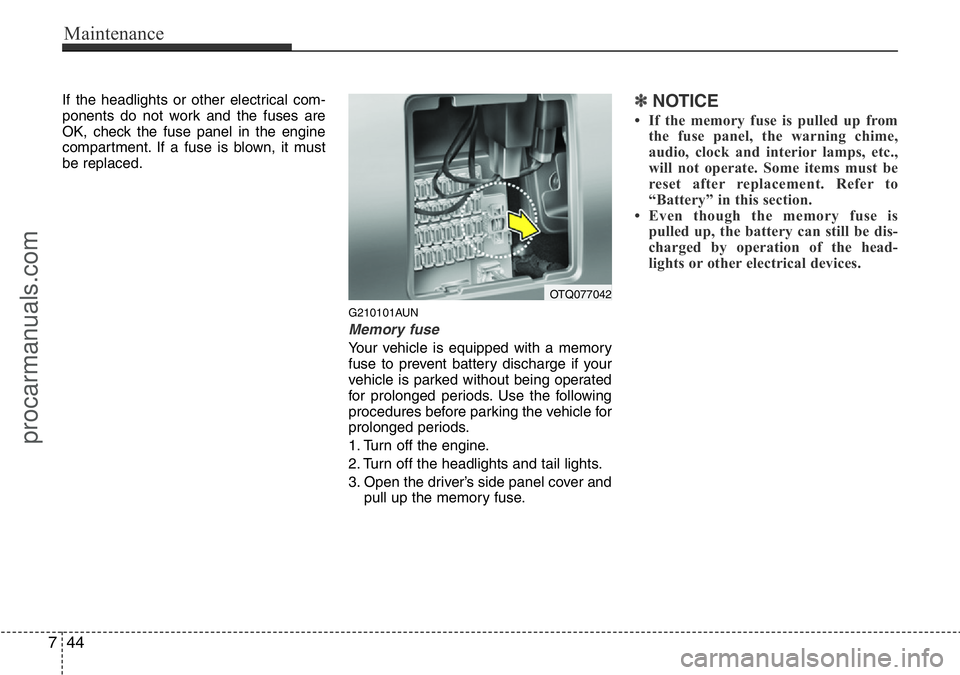
G210101AUN
Memory fuse
Your vehicle is equipped with a memory
fuse to prevent battery discharge if your
vehicle is parked without being operated
for prolonged periods. Use the following
procedures before parking the vehicle for
prolonged periods.
1. Turn off the engine.
2. Turn off the headlights and tail lights.
3. Open the driver’s side panel cover and
pull up the memory fuse.
✽NOTICE
• If the memory fuse is pulled up from
the fuse panel, the warning chime,
audio, clock and interior lamps, etc.,
will not operate. Some items must be
reset after replacement. Refer to
“Battery” in this section.
• Even though the memory fuse is
pulled up, the battery can still be dis-
charged by operation of the head-
lights or other electrical devices.
OTQ077042
procarmanuals.com
Page 309 of 339
747
Maintenance
Instrument panel fuse panel
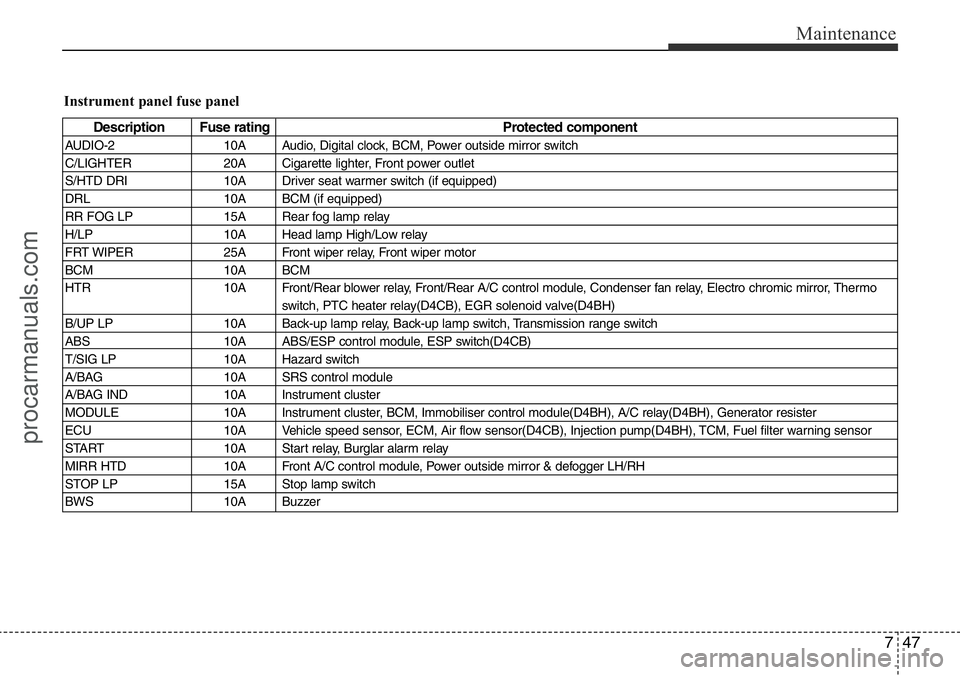
Description Fuse rating Protected component
AUDIO-2 10A Audio, Digital clock, BCM, Power outside mirror switch
C/LIGHTER 20A Cigarette lighter, Front power outlet
S/HTD DRI 10A Driver seat warmer switch (if equipped)
DRL 10A BCM (if equipped)
RR FOG LP 15A Rear fog lamp relay
H/LP 10A Head lamp High/Low relay
FRT WIPER 25A Front wiper relay, Front wiper motor
BCM 10A BCM
HTR 10A Front/Rear blower relay, Front/Rear A/C control module, Condenser fan relay, Electro chromic mirror, Thermo
switch, PTC heater relay(D4CB), EGR solenoid valve(D4BH)
B/UP LP 10A Back-up lamp relay, Back-up lamp switch, Transmission range switch
ABS 10A ABS/ESP control module, ESP switch(D4CB)
T/SIG LP 10A Hazard switch
A/BAG 10A SRS control module
A/BAG IND 10A Instrument cluster
MODULE 10A Instrument cluster, BCM, Immobiliser control module(D4BH), A/C relay(D4BH), Generator resister
ECU 10A Vehicle speed sensor, ECM, Air flow sensor(D4CB), Injection pump(D4BH), TCM, Fuel filter warning sensor
START 10A Start relay, Burglar alarm relay
MIRR HTD 10A Front A/C control module, Power outside mirror & defogger LH/RH
STOP LP 15A Stop lamp switch
BWS 10A Buzzer
procarmanuals.com