steering wheel HYUNDAI I800 2016 Owner's Guide
[x] Cancel search | Manufacturer: HYUNDAI, Model Year: 2016, Model line: I800, Model: HYUNDAI I800 2016Pages: 419, PDF Size: 9.23 MB
Page 328 of 419
What to do in an emergency
24 6
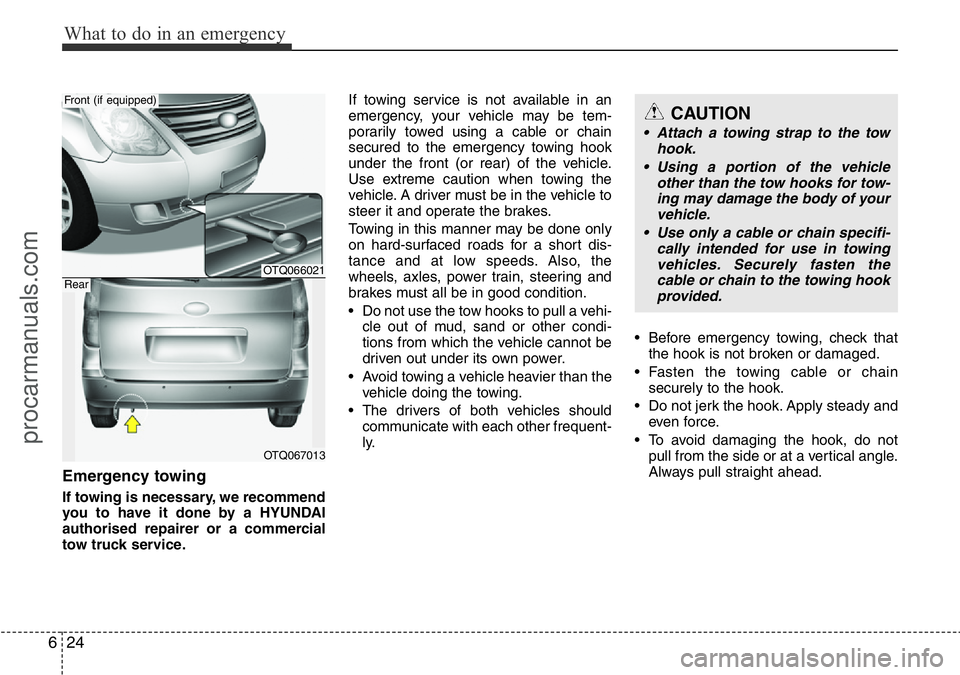
Emergency towing
If towing is necessary, we recommend
you to have it done by a HYUNDAI
authorised repairer or a commercial
tow truck service.If towing service is not available in an
emergency, your vehicle may be tem-
porarily towed using a cable or chain
secured to the emergency towing hook
under the front (or rear) of the vehicle.
Use extreme caution when towing the
vehicle. A driver must be in the vehicle to
steer it and operate the brakes.
Towing in this manner may be done only
on hard-surfaced roads for a short dis-
tance and at low speeds. Also, the
wheels, axles, power train, steering and
brakes must all be in good condition.
• Do not use the tow hooks to pull a vehi-
cle out of mud, sand or other condi-
tions from which the vehicle cannot be
driven out under its own power.
• Avoid towing a vehicle heavier than the
vehicle doing the towing.
• The drivers of both vehicles should
communicate with each other frequent-
ly.• Before emergency towing, check that
the hook is not broken or damaged.
• Fasten the towing cable or chain
securely to the hook.
• Do not jerk the hook. Apply steady and
even force.
• To avoid damaging the hook, do not
pull from the side or at a vertical angle.
Always pull straight ahead.
CAUTION
• Attach a towing strap to the tow
hook.
• Using a portion of the vehicle
other than the tow hooks for tow-
ing may damage the body of your
vehicle.
• Use only a cable or chain specifi-
cally intended for use in towing
vehicles. Securely fasten the
cable or chain to the towing hook
provided.
OTQ066021
OTQ067013
Front (if equipped)
Rear
procarmanuals.com
Page 329 of 419
625
What to do in an emergency
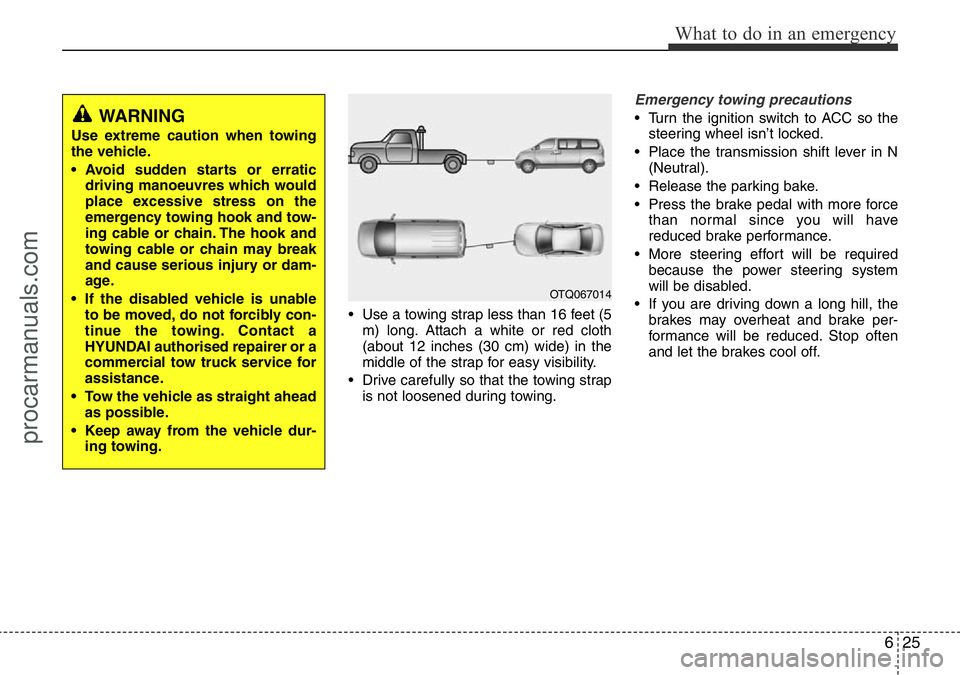
• Use a towing strap less than 16 feet (5
m) long. Attach a white or red cloth
(about 12 inches (30 cm) wide) in the
middle of the strap for easy visibility.
• Drive carefully so that the towing strap
is not loosened during towing.
Emergency towing precautions
• Turn the ignition switch to ACC so the
steering wheel isn’t locked.
• Place the transmission shift lever in N
(Neutral).
• Release the parking bake.
• Press the brake pedal with more force
than normal since you will have
reduced brake performance.
• More steering effort will be required
because the power steering system
will be disabled.
• If you are driving down a long hill, the
brakes may overheat and brake per-
formance will be reduced. Stop often
and let the brakes cool off.WARNING
Use extreme caution when towing
the vehicle.
• Avoid sudden starts or erratic
driving manoeuvres which would
place excessive stress on the
emergency towing hook and tow-
ing cable or chain. The hook and
towing cable or chain may break
and cause serious injury or dam-
age.
• If the disabled vehicle is unable
to be moved, do not forcibly con-
tinue the towing. Contact a
HYUNDAI authorised repairer or a
commercial tow truck service for
assistance.
• Tow the vehicle as straight ahead
as possible.
• Keep away from the vehicle dur-
ing towing.
OTQ067014
procarmanuals.com
Page 330 of 419
Tie-down hook
(for flatbed towing)
WARNING
Do not use the hooks under the
front (or rear) of the vehicle for tow-
ing purposes. These hooks are
designed ONLY for transport tie-
down. If the tie-down hooks are
used for towing, the tie-down hooks
or front bumper will be damaged
and this could lead to serious
injury.
CAUTION - Automatic
transmission
• If the car is being towed with all
four wheels on the ground, it can
be towed only from the front. Be
sure that the transmission is in
neutral. Be sure the steering is
unlocked by placing the ignition
switch in the ACC position. A
driver must be in the towed vehi-
cle to operate the steering and
brakes.
• To avoid serious damage to the
automatic transmission, limit the
vehicle speed to 10 mph (15 km/h)
and drive less than 1 mile (1.5
km) when towing.
• Before towing, check the auto-
matic transmission fluid leak
under your vehicle. If the auto-
matic transmission fluid is leak-
ing, a flatbed equipment or tow-
ing dolly must be used.
626
What to do in an emergency
procarmanuals.com
Page 331 of 419
7
Engine compartment / 7-2
Maintenance services / 7-4
Owner maintenance / 7-6
Scheduled maintenance service / 7-8
Explanation of scheduled maintenance items / 7-9
Engine oil / 7-13
Engine coolant / 7-15
Brake and clutch fluid / 7-18
Power steering fluid / 7-19
Automatic transmission fluid / 7-20
Washer fluid / 7-22
Parking brake / 7-22
Fuel filter (for diesel) / 7-23
Air cleaner / 7-24
Climate control air filter / 7-25
Wiper blades / 7-27
Battery / 7-30
Tyres and wheels / 7-33
Fuses / 7-45
Light bulbs / 7-54
Appearance care / 7-62
Emission control system / 7-69
• Selective catalytic reduction / 7-72
• Urea gauge / 7-72
• Low urea warning message / 7-73
• Malfunction with the scr system / 7-74
• Clearing the vehicle-restarting restriction / 7-75
• Adding the urea solution / 7-76
• Storing the urea solution / 7-78
• Urea solution purity / 7-79
Maintenance
procarmanuals.com
Page 336 of 419
Maintenance
6 7
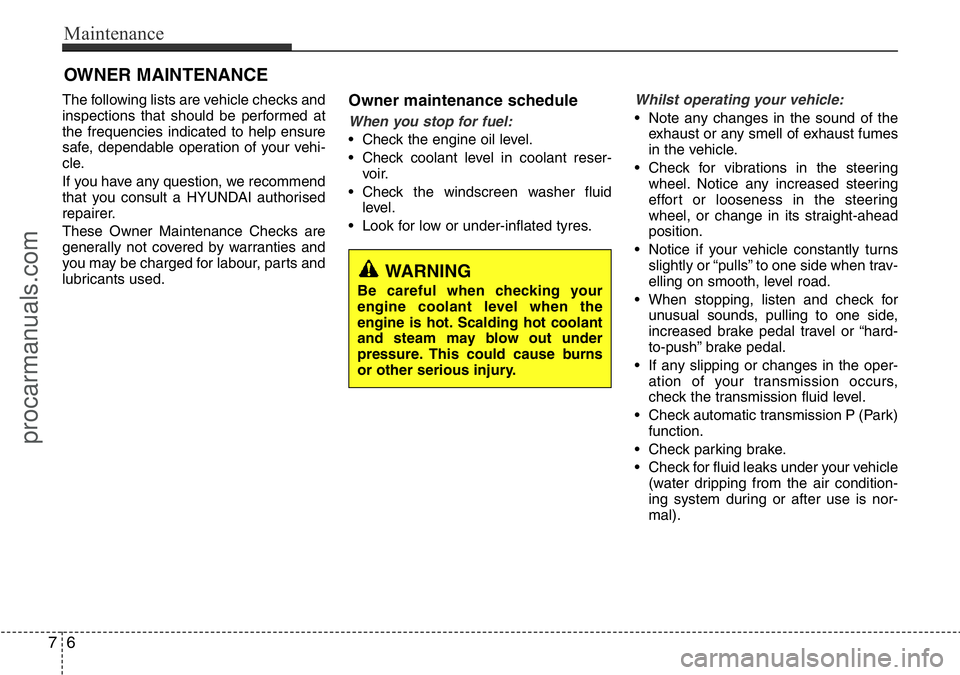
OWNER MAINTENANCE
The following lists are vehicle checks and
inspections that should be performed at
the frequencies indicated to help ensure
safe, dependable operation of your vehi-
cle.
If you have any question, we recommend
that you consult a HYUNDAI authorised
repairer.
These Owner Maintenance Checks are
generally not covered by warranties and
you may be charged for labour, parts and
lubricants used.Owner maintenance schedule
When you stop for fuel:
• Check the engine oil level.
• Check coolant level in coolant reser-
voir.
• Check the windscreen washer fluid
level.
• Look for low or under-inflated tyres.
Whilst operating your vehicle:
• Note any changes in the sound of the
exhaust or any smell of exhaust fumes
in the vehicle.
• Check for vibrations in the steering
wheel. Notice any increased steering
effort or looseness in the steering
wheel, or change in its straight-ahead
position.
• Notice if your vehicle constantly turns
slightly or “pulls” to one side when trav-
elling on smooth, level road.
• When stopping, listen and check for
unusual sounds, pulling to one side,
increased brake pedal travel or “hard-
to-push” brake pedal.
• If any slipping or changes in the oper-
ation of your transmission occurs,
check the transmission fluid level.
• Check automatic transmission P (Park)
function.
• Check parking brake.
• Check for fluid leaks under your vehicle
(water dripping from the air condition-
ing system during or after use is nor-
mal).
WARNING
Be careful when checking your
engine coolant level when the
engine is hot. Scalding hot coolant
and steam may blow out under
pressure. This could cause burns
or other serious injury.
procarmanuals.com
Page 337 of 419
77
Maintenance
At least monthly:
• Check coolant level in the engine
coolant reservoir.
• Check the operation of all exterior
lights, including the stoplights, turn sig-
nals and hazard warning flashers.
• Check the inflation pressures of all
tyres including the spare.
At least twice a year
(i.e., every Spring and Fall) :
• Check radiator, heater and air condi-
tioning hoses for leaks or damage.
• Check windscreen washer spray and
wiper operation. Clean wiper blades
with clean cloth dampened with wash-
er fluid.
• Check headlight alignment.
• Check muffler, exhaust pipes, shields
and clamps.
• Check the lap/shoulder belts for wear
and function.
• Check for worn tyres and loose wheel
lug nuts.
At least once a year:
• Clean body and door drain holes.
• Lubricate door hinges and checks, and
bonnet hinges.
• Lubricate door and bonnet locks and
latches.
• Lubricate door rubber weatherstrips.
• Check the air conditioning system.
• Check the power steering fluid level.
• Inspect and lubricate automatic trans-
mission linkage and controls.
• Clean battery and terminals.
• Check the brake fluid level.
procarmanuals.com
Page 342 of 419
Maintenance
12 7
Steering gear box, linkage &
boots/lower arm ball joint
With the vehicle stopped and engine off,
check for excessive free-play in the
steering wheel.
Check the linkage for bends or damage.
Check the dust boots and ball joints for
deterioration, cracks, or damage.
Replace any damaged parts.
Power steering pump, belt and
hoses
Check the power steering pump and
hoses for leakage and damage. Replace
any damaged or leaking parts immedi-
ately. Inspect the power steering belt (or
drive belt) for evidence of cuts, cracks,
excessive wear, oiliness and proper ten-
sion. Replace or adjust it if necessary.
Air conditioning refrigerant
(if equipped)
Check the air conditioning lines and con-
nections for leakage and damage.
procarmanuals.com
Page 367 of 419
737
Maintenance
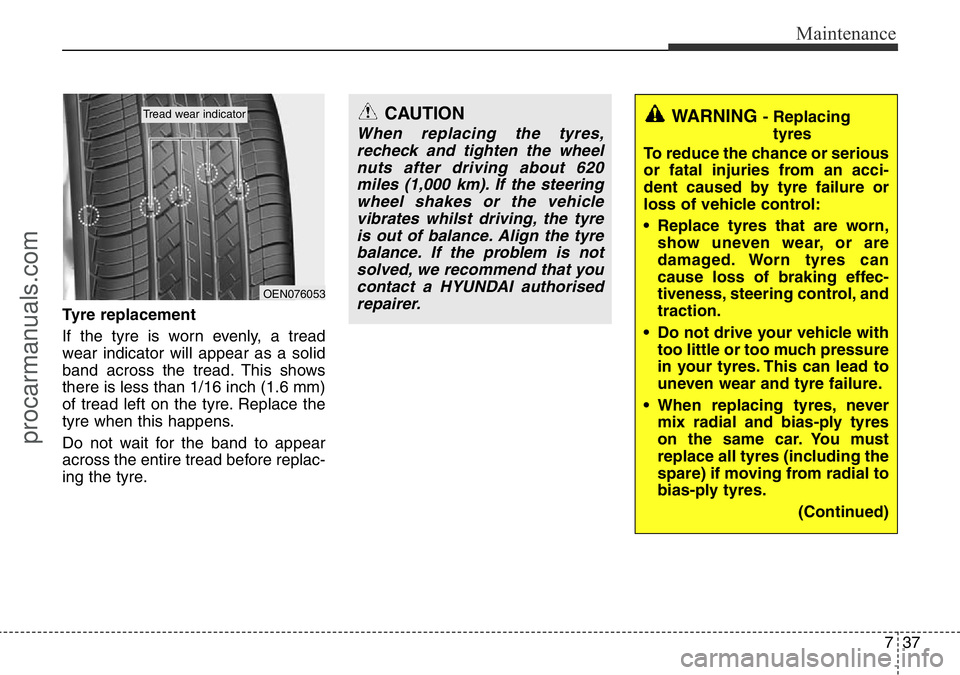
Tyre replacement
If the tyre is worn evenly, a tread
wear indicator will appear as a solid
band across the tread. This shows
there is less than 1/16 inch (1.6 mm)
of tread left on the tyre. Replace the
tyre when this happens.
Do not wait for the band to appear
across the entire tread before replac-
ing the tyre.
OEN076053
Tread wear indicatorWARNING - Replacing
tyres
To reduce the chance or serious
or fatal injuries from an acci-
dent caused by tyre failure or
loss of vehicle control:
• Replace tyres that are worn,
show uneven wear, or are
damaged. Worn tyres can
cause loss of braking effec-
tiveness, steering control, and
traction.
• Do not drive your vehicle with
too little or too much pressure
in your tyres. This can lead to
uneven wear and tyre failure.
• When replacing tyres, never
mix radial and bias-ply tyres
on the same car. You must
replace all tyres (including the
spare) if moving from radial to
bias-ply tyres.
(Continued)CAUTION
When replacing the tyres,
recheck and tighten the wheel
nuts after driving about 620
miles (1,000 km). If the steering
wheel shakes or the vehicle
vibrates whilst driving, the tyre
is out of balance. Align the tyre
balance. If the problem is not
solved, we recommend that you
contact a HYUNDAI authorised
repairer.
procarmanuals.com
Page 381 of 419
751
Maintenance
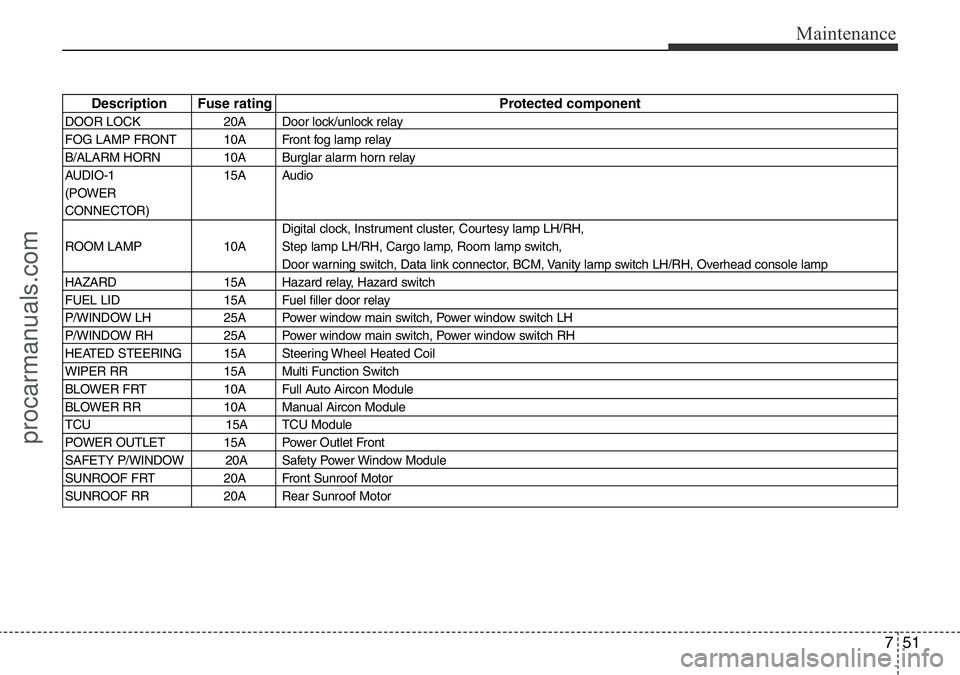
Description Fuse rating Protected component
DOOR LOCK 20A Door lock/unlock relay
FOG LAMP FRONT 10A Front fog lamp relay
B/ALARM HORN 10A Burglar alarm horn relay
AUDIO-1 15A Audio
(POWER
CONNECTOR)
Digital clock, Instrument cluster, Courtesy lamp LH/RH,
ROOM LAMP 10A Step lamp LH/RH, Cargo lamp, Room lamp switch,
Door warning switch, Data link connector, BCM, Vanity lamp switch LH/RH, Overhead console lamp
HAZARD 15A Hazard relay, Hazard switch
FUEL LID 15A Fuel filler door relay
P/WINDOW LH 25A Power window main switch, Power window switch LH
P/WINDOW RH 25A Power window main switch, Power window switch RH
HEATED STEERING 15A Steering Wheel Heated Coil
WIPER RR 15A Multi Function Switch
BLOWER FRT 10A Full Auto Aircon Module
BLOWER RR 10A Manual Aircon Module
TCU 15A TCU Module
POWER OUTLET 15A Power Outlet Front
SAFETY P/WINDOW 20A Safety Power Window Module
SUNROOF FRT 20A Front Sunroof Motor
SUNROOF RR 20A Rear Sunroof Motor
procarmanuals.com
Page 397 of 419
767
Maintenance
Keep paint and trim in good condition
Scratches or chips in the finish should be
covered with "touch-up" paint as soon as
possible to reduce the possibility of cor-
rosion. If bare metal is showing through,
the attention of a qualified body and paint
shop is recommended.
Bird droppings : Bird droppings are high-
ly corrosive and may damage painted
surfaces in just a few hours. Always
remove bird droppings as soon as possi-
ble.
Don't neglect the interior
Moisture can collect under the floor mats
and carpeting to cause corrosion. Check
under the mats periodically to be sure
the carpeting is dry. Use particular care if
you carry fertilisers, cleaning materials or
chemicals in the car.
These should be carried only in proper
containers and any spills or leaks should
be cleaned up, flushed with clean water
and thoroughly dried.Interior care
Interior general precautions
Prevent chemicals such as perfume, cos-
metic oil, sun cream, hand cleaner and
air freshener from contacting the interior
parts because they may cause damage
or discoloration. If they do contact the
interior parts, wipe them off immediately.
See the instructions that follow for the
proper way to clean vinyl.
Cleaning the upholstery and interior
trim
Vinyl
Remove dust and loose dirt from vinyl
with a whisk broom or vacuum cleaner.
Clean vinyl surfaces with a vinyl cleaner.
Fabric
Remove dust and loose dirt from fabric
with a whisk broom or vacuum cleaner.
Clean with a mild soap solution recom-
mended for upholstery or carpets.
Remove fresh spots immediately with a
fabric spot cleaner. If fresh spots do not
receive immediate attention, the fabric
can be stained and its colour can be
affected. Also, its fire-resistant properties
can be reduced if the material is not
properly maintained.
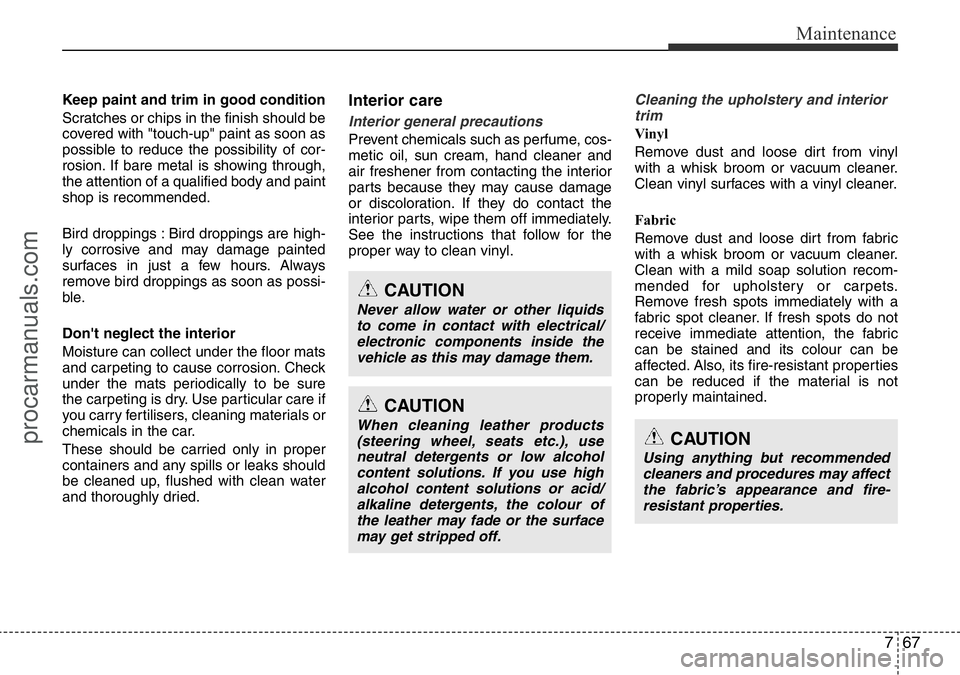
CAUTION
Never allow water or other liquids
to come in contact with electrical/
electronic components inside the
vehicle as this may damage them.
CAUTION
When cleaning leather products
(steering wheel, seats etc.), use
neutral detergents or low alcohol
content solutions. If you use high
alcohol content solutions or acid/
alkaline detergents, the colour of
the leather may fade or the surface
may get stripped off.CAUTION
Using anything but recommended
cleaners and procedures may affect
the fabric’s appearance and fire-
resistant properties.
procarmanuals.com