air lock HYUNDAI I800 2016 Owners Manual
[x] Cancel search | Manufacturer: HYUNDAI, Model Year: 2016, Model line: I800, Model: HYUNDAI I800 2016Pages: 419, PDF Size: 9.23 MB
Page 9 of 419
Introduction
4 1
Other fuels
Using fuels such as;
- Silicone (Si) contained fuel,
- MMT (Manganese, Mn) contained fuel,
- Ferrocene (Fe) contained fuel, and
- Other metallic additives contained fuels,
may cause vehicle and engine damage
or cause plugging, misfiring, poor accel-
eration, engine stalling, catalyst melting,
abnormal corrosion, life cycle reduction,
etc.
Also, the Malfunction Indicator Lamp
(MIL) may illuminate.
✽ NOTICE
Damage to the fuel system or perform-
ance problem caused by the use of these
fuels may not be covered by your New
Vehicle Limited Warranty.
Use of MTBE
HYUNDAI recommends that fuels con-
taining MTBE (Methyl Tertiary Butyl
Ether) over 15.0% vol. (Oxygen Content
2.7% weight) should not be used in your
vehicle.
Fuel containing MTBE over 15.0% vol.
(Oxygen Content 2.7% weight) may
reduce vehicle performance and produce
vapour lock or hard starting.
Do not use methanol
Fuels containing methanol (wood alco-
hol) should not be used. This type of fuel
can reduce vehicle performance and
damage components of the fuel system.
Fuel Additives
HYUNDAI recommends that you use
unleaded petrol which has an Octane
Rating of RON (Research Octane
Number) 91 / AKI (Anti-Knock Index) 87
or higher.
For customers who do not use good
quality petrols including fuel additives
regularly, and have problems starting or
the engine does not run smoothly, one
bottle of additives added to the fuel tank
at every 10,000 miles (15,000 km).
Additives are available from your
HYUNDAI authorised repairer along with
information on how to use them. Do not
mix other additives.
CAUTION
The New Vehicle Warranty does not
cover damage to the fuel system or
any performance problems caused
by the use of fuels containing
methanol or fuels containing MTBE
(Methyl Tertiary Butyl Ether) over
15.0% vol. (Oxygen Content 2.7%
weight).
procarmanuals.com
Page 13 of 419
Your vehicle at a glance
2 2
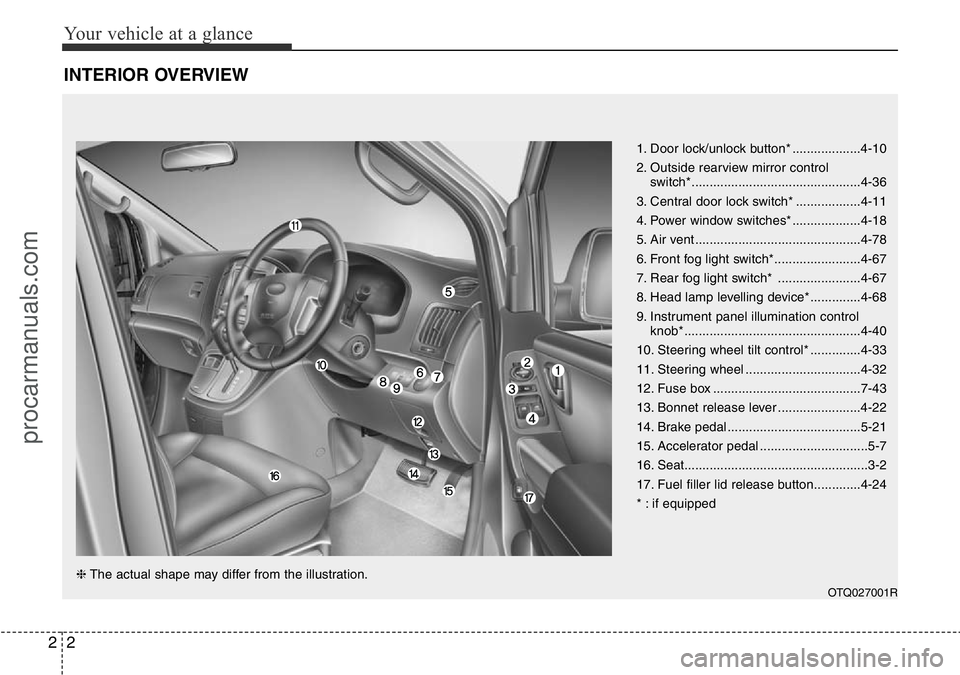
INTERIOR OVERVIEW
1. Door lock/unlock button* ...................4-10
2. Outside rearview mirror control
switch*...............................................4-36
3. Central door lock switch* ..................4-11
4. Power window switches* ...................4-18
5. Air vent ..............................................4-78
6. Front fog light switch*........................4-67
7. Rear fog light switch* .......................4-67
8. Head lamp levelling device* ..............4-68
9. Instrument panel illumination control
knob* .................................................4-40
10. Steering wheel tilt control* ..............4-33
11. Steering wheel ................................4-32
12. Fuse box .........................................7-43
13. Bonnet release lever .......................4-22
14. Brake pedal .....................................5-21
15. Accelerator pedal ..............................5-7
16. Seat...................................................3-2
17. Fuel filler lid release button.............4-24
* : if equipped
OTQ027001R
❈The actual shape may differ from the illustration.
procarmanuals.com
Page 18 of 419
33
Safety features of your vehicle
WARNING- Driver’s seat
• Never attempt to adjust the seat
whilst the vehicle is moving. This
could result in loss of control,
and an accident causing death,
serious injury, or property dam-
age.
• Do not allow anything to interfere
with the normal position of the
seatback. Storing items against a
seatback or in any other way
interfering with proper locking of
a seatback could result in serious
or fatal injury in a sudden stop or
collision.
• Always drive and ride with your
seatback upright and the lap por-
tion of the seat belt snug and low
across the hips. This is the best
position to protect you in case of
an accident.
• In order to avoid unnecessary
and perhaps severe air bag
injuries, always sit as far back as
possible from the steering wheel
whilst maintaining comfortable
control of the vehicle. We recom-
mend that your chest be at least
10 inches (250 mm) away from
the steering wheel.
WARNING - Uprighting
seat
When you return the seatback to its
upright position, hold the seatback
and return it slowly and be sure
there are no other occupants
around the seat. If the seatback is
returned without being held and
controlled, the back of the seat
could spring forward resulting in
accidental injury to a person struck
by the seatback.
WARNING- Loose objects
Loose objects in the driver’s foot
area could interfere with the opera-
tion of the foot pedals, possibly
causing an accident. Do not place
anything under the front seats.
WARNING- Driver respon-
sibility for passengers
Riding in a vehicle with the seat-
back reclined could lead to serious
or fatal injury in an accident. If a
seat is reclined during an accident,
the occupant’s hips may slide
under the lap portion of the seat
belt applying great force to the
unprotected abdomen. Serious or
fatal internal injuries could result.
The driver must advise the front
passenger to keep the seatback in
an upright position whenever the
vehicle is in motion.
WARNING
Do not use a sitting cushion that
reduces friction between the seat
and passenger. The passenger's
hips may slide under the lap por-
tion of the seat belt during an acci-
dent or a sudden stop. Serious or
fatal internal injuries could result
because the seat belt can't operate
normally.
procarmanuals.com
Page 37 of 419
Safety features of your vehicle
22 3
• The rear seat belt buckles can be
stowed in the pocket between the rear
seatback and cushion when not in use.
• The centre seat belt can be stowed
with the plate and webbing rolled in the
pocket between the rear seatback and
cushion.
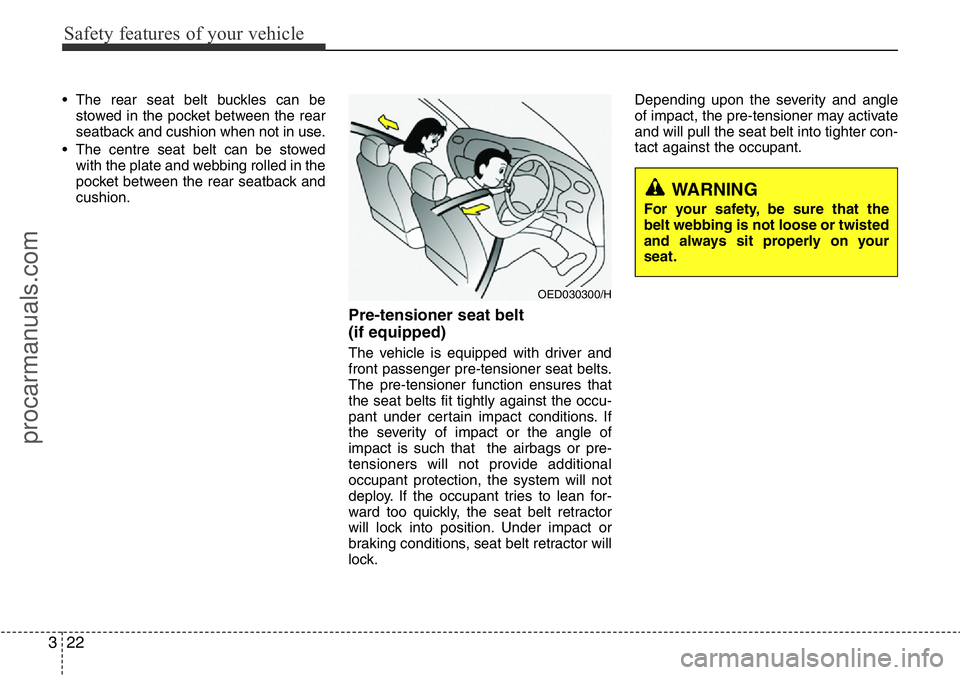
Pre-tensioner seat belt
(if equipped)
The vehicle is equipped with driver and
front passenger pre-tensioner seat belts.
The pre-tensioner function ensures that
the seat belts fit tightly against the occu-
pant under certain impact conditions. If
the severity of impact or the angle of
impact is such that the airbags or pre-
tensioners will not provide additional
occupant protection, the system will not
deploy. If the occupant tries to lean for-
ward too quickly, the seat belt retractor
will lock into position. Under impact or
braking conditions, seat belt retractor will
lock.Depending upon the severity and angle
of impact, the pre-tensioner may activate
and will pull the seat belt into tighter con-
tact against the occupant.
OED030300/H
WARNING
For your safety, be sure that the
belt webbing is not loose or twisted
and always sit properly on your
seat.
procarmanuals.com
Page 45 of 419
Safety features of your vehicle
30 3
WARNING
To reduce the chance or serious or
fatal injuries:
• Children of all ages are safer
when restrained in the rear seat.
A child riding in the front passen-
ger seat can be forcefully struck
by an inflating air bag resulting in
serious or fatal injuries.
• Always follow the child restraint
system manufacturer’s instruc-
tions for installation and use of
the child restraint.
• Always make sure the child seat
is secured properly in the car and
your child is securely restrained
in the child seat.
• Never hold a child in your arms or
lap when riding in a vehicle. The
violent forces created during a
crash will tear the child from your
arms and throw the child against
the car’s interior.
• Never put a seat belt over your-
self and a child. During a crash,
the belt could press deep into the
child causing serious internal
injuries.
(Continued)
(Continued)
• Never leave children unattended
in a vehicle – not even for a short
time. The car can heat up very
quickly, resulting in serious
injuries to children inside. Even
very young children may inadver-
tently cause the vehicle to move,
entangle themselves in the win-
dows, or lock themselves or oth-
ers inside the vehicle.
• Never allow two children, or any
two persons, to use the same
seat belt.
• Children often squirm and repo-
sition themselves improperly.
Never let a child ride with the
shoulder belt under their arm or
behind their back. Always prop-
erly position and secure children
in rear seat.
• Never allow a child to stand-up or
kneel on the seat or floor of a
moving vehicle. During a colli-
sion or sudden stop, the child
can be violently thrown against
the vehicles interior, resulting in
serious injury.
(Continued)(Continued)
• Never use an infant carrier or a
child safety seat that "hooks"
over a seatback, it may not pro-
vide adequate security in an acci-
dent.
• Seat belts can become very hot,
especially when the car is parked
in direct sunlight. Always check
seat belt buckles before fasten-
ing them over a child.
• After an accident, we recommend
that the system be checked by a
HYUNDAI authorised repairer.
procarmanuals.com
Page 62 of 419
347
Safety features of your vehicle
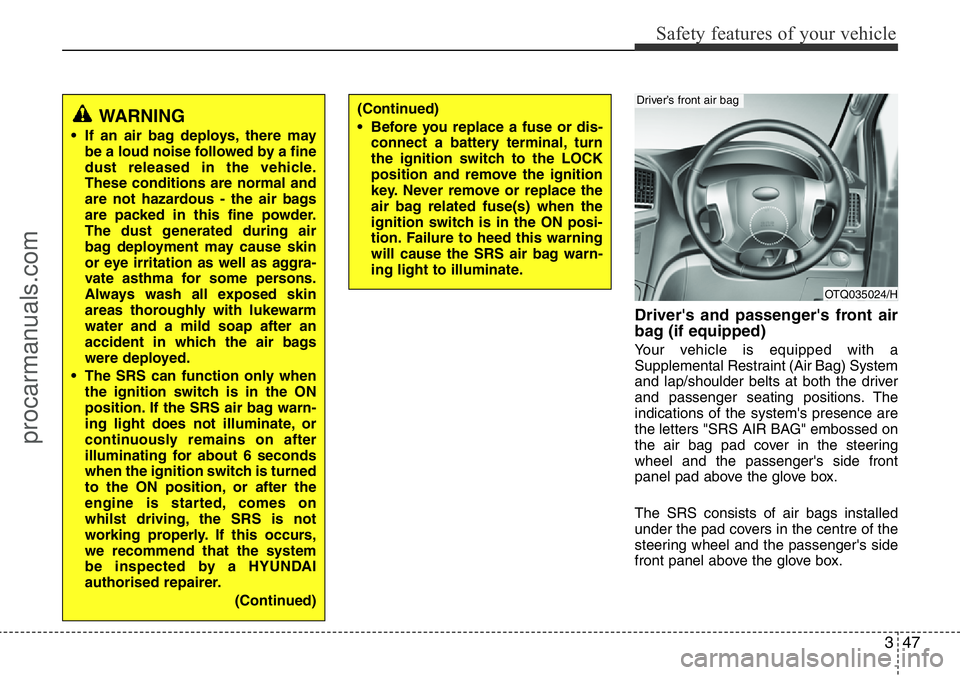
Driver's and passenger's front air
bag (if equipped)
Your vehicle is equipped with a
Supplemental Restraint (Air Bag) System
and lap/shoulder belts at both the driver
and passenger seating positions. The
indications of the system's presence are
the letters "SRS AIR BAG" embossed on
the air bag pad cover in the steering
wheel and the passenger's side front
panel pad above the glove box.
The SRS consists of air bags installed
under the pad covers in the centre of the
steering wheel and the passenger's side
front panel above the glove box.
WARNING
• If an air bag deploys, there may
be a loud noise followed by a fine
dust released in the vehicle.
These conditions are normal and
are not hazardous - the air bags
are packed in this fine powder.
The dust generated during air
bag deployment may cause skin
or eye irritation as well as aggra-
vate asthma for some persons.
Always wash all exposed skin
areas thoroughly with lukewarm
water and a mild soap after an
accident in which the air bags
were deployed.
• The SRS can function only when
the ignition switch is in the ON
position. If the SRS air bag warn-
ing light does not illuminate, or
continuously remains on after
illuminating for about 6 seconds
when the ignition switch is turned
to the ON position, or after the
engine is started, comes on
whilst driving, the SRS is not
working properly. If this occurs,
we recommend that the system
be inspected by a HYUNDAI
authorised repairer.
(Continued)
(Continued)
• Before you replace a fuse or dis-
connect a battery terminal, turn
the ignition switch to the LOCK
position and remove the ignition
key. Never remove or replace the
air bag related fuse(s) when the
ignition switch is in the ON posi-
tion. Failure to heed this warning
will cause the SRS air bag warn-
ing light to illuminate.
OTQ035024/H
Driver’s front air bag
procarmanuals.com
Page 76 of 419

Features of your vehicle
2 4
Record your key number
The key code number is
stamped or printed on
the bar code tag
attached to the key set.
Should you lose your
keys, we recommend that you contact a
HYUNDAI authorised repairer.
Remove the key code tag and store it in
a safe place. Also, record the code num-
ber and keep it in a safe and handy
place, but not in the vehicle.
Key operations
Used to start the engine, lock and unlock
the doors.
KEYS
WARNING
We recommend that you use parts
for replacement from a HYUNDAI
authorised repairer.
If an aftermarket key is used, the
ignition switch may not return to
ON after START. If this happens,
the starter will continue to operate
causing damage to the starter
motor and possible fire due to
excessive current in the wiring.
WARNING - Ignition key
Leaving children unattended in a
vehicle with the ignition key is dan-
gerous even if the key is not in the
ignition switch is ACC or ON posi-
tion. Children copy adults and they
could place the key in the ignition
switch.
The ignition key would enable chil-
dren to operate power windows or
other controls, or even make the
vehicle move, which could result in
serious bodily injury or even death.
Never leave the keys in your vehicle
with unsupervised children, when
the engine is running.
procarmanuals.com
Page 79 of 419
45
Features of your vehicle
Transmitter precautions
✽NOTICE
The transmitter will not work if any of
following occur:
• The ignition key is in ignition switch.
• You exceed the operating distance
limit (about 30 feet [10 m]).
• The battery in the transmitter is
weak.
• Other vehicles or objects may be
blocking the signal.
• The weather is extremely cold.
• The transmitter is close to a radio
transmitter such as a radio station or
an airport which can interfere with
normal operation of the transmitter.
When the transmitter does not work
correctly, open and close the door with
the ignition key. If you have a problem
with the transmitter, we recommend
that you contact a HYUNDAI autho-
rised repairer.
(Continued)(Continued)
• If the transmitter is in close proximity
to your cell phone or smart phone, the
signal from the transmitter could be
blocked by normal operation of your
cell phone or smart phone. This is
especially important when the phone
is active such as making call, receiving
calls, text messaging, and/or sending/
receiving emails. Avoid placing the
transmitter and your cell phone or
smart phone in the same pants or
jacket pocket and maintain adequate
distance between the two devices.
CAUTION
Keep the transmitter away from
water or any liquid. If the keyless
entry system is inoperative due to
exposure to water or liquids, it will
not be covered by your manufactur-
er vehicle warranty.
CAUTION
Changes or modifications not
expressly approved by the party
responsible for compliance could
void the user’s authority to operate
the equipment. If the keyless entry
system is inoperative due to
changes or modifications not
expressly approved by the party
responsible for compliance, it will
not be covered by your manufactur-
er’s vehicle warranty.
CAUTION
Keep the transmitter away from
electromagnetic materials that
blocks electromagnetic waves to
the key surface.
procarmanuals.com
Page 81 of 419
47
Features of your vehicle
THEFT-ALARM SYSTEM (IF EQUIPPED)
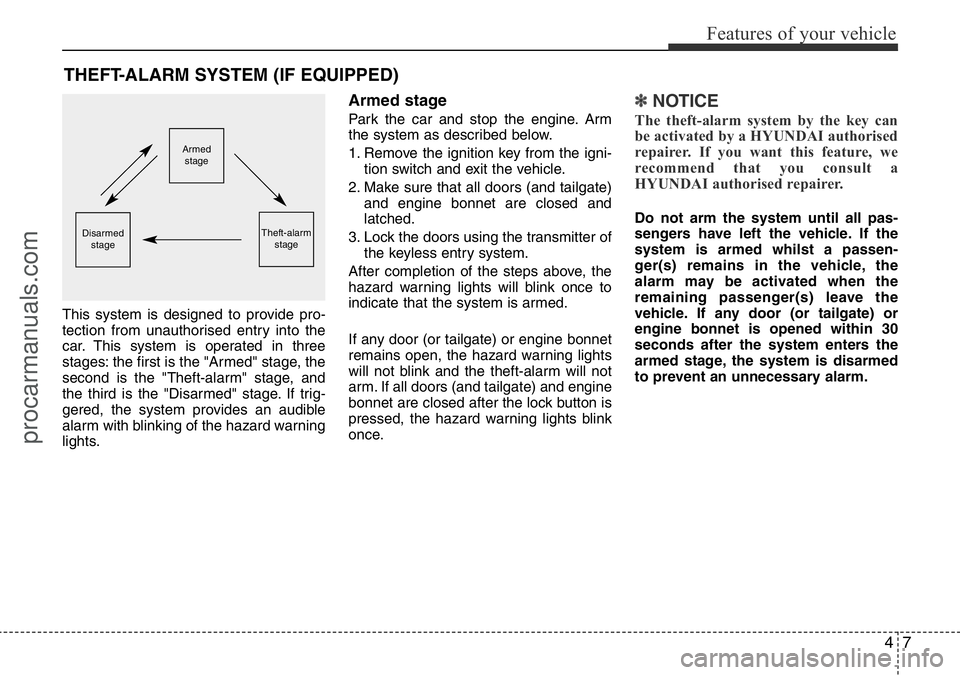
This system is designed to provide pro-
tection from unauthorised entry into the
car. This system is operated in three
stages: the first is the "Armed" stage, the
second is the "Theft-alarm" stage, and
the third is the "Disarmed" stage. If trig-
gered, the system provides an audible
alarm with blinking of the hazard warning
lights.
Armed stage
Park the car and stop the engine. Arm
the system as described below.
1. Remove the ignition key from the igni-
tion switch and exit the vehicle.
2. Make sure that all doors (and tailgate)
and engine bonnet are closed and
latched.
3. Lock the doors using the transmitter of
the keyless entry system.
After completion of the steps above, the
hazard warning lights will blink once to
indicate that the system is armed.
If any door (or tailgate) or engine bonnet
remains open, the hazard warning lights
will not blink and the theft-alarm will not
arm. If all doors (and tailgate) and engine
bonnet are closed after the lock button is
pressed, the hazard warning lights blink
once.
✽NOTICE
The theft-alarm system by the key can
be activated by a HYUNDAI authorised
repairer. If you want this feature, we
recommend that you consult a
HYUNDAI authorised repairer.
Do not arm the system until all pas-
sengers have left the vehicle. If the
system is armed whilst a passen-
ger(s) remains in the vehicle, the
alarm may be activated when the
remaining passenger(s) leave the
vehicle. If any door (or tailgate) or
engine bonnet is opened within 30
seconds after the system enters the
armed stage, the system is disarmed
to prevent an unnecessary alarm.
Armed
stage
Theft-alarm
stageDisarmed
stage
procarmanuals.com
Page 82 of 419
Features of your vehicle
8 4
Theft-alarm stage
The alarm will be activated if any of the
following occurs whilst the system is
armed.
• A front or rear door is opened without
using the transmitter.
• The tailgate is opened without using
the transmitter.
• The engine bonnet is opened.
The horn will sound and the hazard
warning lights will blink continuously for
approximately 30 seconds. To turn off the
system, unlock the doors with the trans-
mitter.
Disarmed stage
The system will be disarmed when the
doors (and tailgate) are unlocked with the
transmitter.
After depressing the unlock button, the
hazard warning lights will blink twice to
indicate that the system is disarmed.
After depressing the unlock button, if any
door (or tailgate) is not opened within 30
seconds, the system will be rearmed.
✽NOTICE
• If the system is not disarmed with the
transmitter, insert the key into the
ignition switch and start the engine.
Then the system will be disarmed.
• If you lose your keys, we recommend
that you consult a HYUNDAI autho-
rised repairer.
CAUTION
Do not change, alter or adjust the
theft-alarm system because it could
cause the theft-alarm system to
malfunction. We recommend that
the system be serviced by a
HYUNDAI authorised repairer.
Malfunctions caused by improper
alterations, adjustments or modifi-
cations to the theft-alarm system
are not covered by your vehicle
manufacturer warranty.
procarmanuals.com