height HYUNDAI I800 2016 Owners Manual
[x] Cancel search | Manufacturer: HYUNDAI, Model Year: 2016, Model line: I800, Model: HYUNDAI I800 2016Pages: 419, PDF Size: 9.23 MB
Page 17 of 419
Safety features of your vehicle
2 3
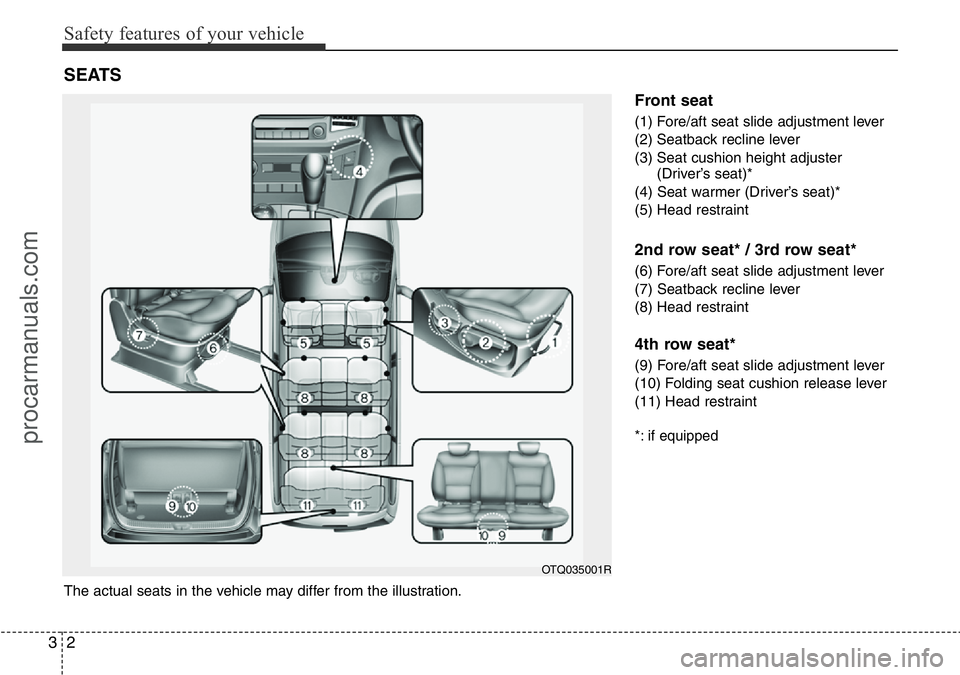
Front seat
(1) Fore/aft seat slide adjustment lever
(2) Seatback recline lever
(3) Seat cushion height adjuster
(Driver’s seat)*
(4) Seat warmer (Driver’s seat)*
(5) Head restraint
2nd row seat* / 3rd row seat*
(6) Fore/aft seat slide adjustment lever
(7) Seatback recline lever
(8) Head restraint
4th row seat*
(9) Fore/aft seat slide adjustment lever
(10) Folding seat cushion release lever
(11) Head restraint
*: if equipped
SEATS
OTQ035001R
The actual seats in the vehicle may differ from the illustration.
procarmanuals.com
Page 20 of 419
35
Safety features of your vehicle
Front seat adjustment
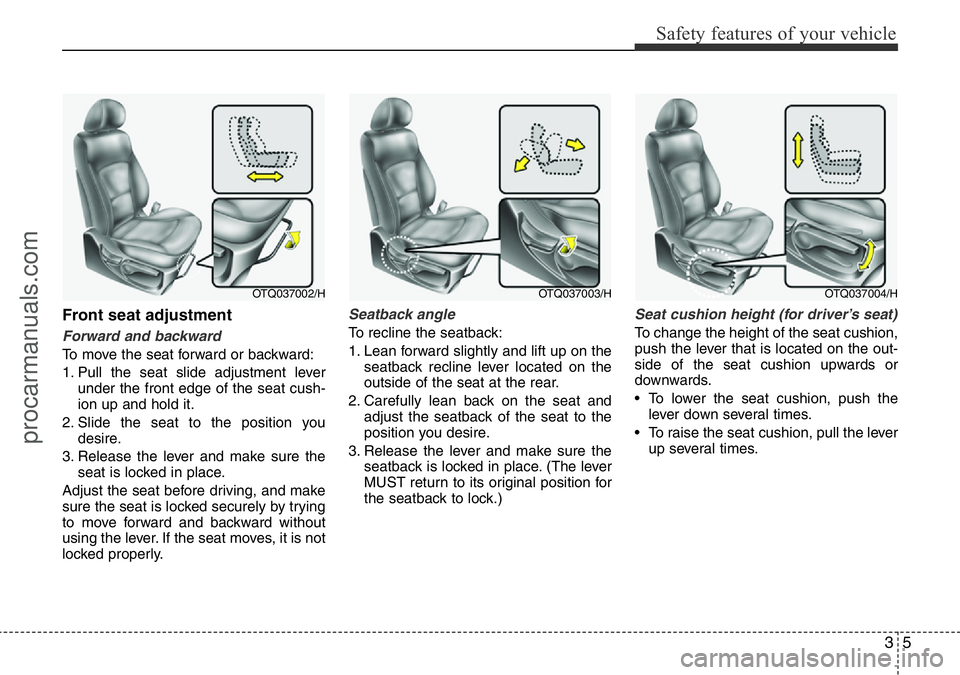
Forward and backward
To move the seat forward or backward:
1. Pull the seat slide adjustment lever
under the front edge of the seat cush-
ion up and hold it.
2. Slide the seat to the position you
desire.
3. Release the lever and make sure the
seat is locked in place.
Adjust the seat before driving, and make
sure the seat is locked securely by trying
to move forward and backward without
using the lever. If the seat moves, it is not
locked properly.
Seatback angle
To recline the seatback:
1. Lean forward slightly and lift up on the
seatback recline lever located on the
outside of the seat at the rear.
2. Carefully lean back on the seat and
adjust the seatback of the seat to the
position you desire.
3. Release the lever and make sure the
seatback is locked in place. (The lever
MUST return to its original position for
the seatback to lock.)
Seat cushion height (for driver’s seat)
To change the height of the seat cushion,
push the lever that is located on the out-
side of the seat cushion upwards or
downwards.
• To lower the seat cushion, push the
lever down several times.
• To raise the seat cushion, pull the lever
up several times.
OTQ037002/HOTQ037004/HOTQ037003/H
procarmanuals.com
Page 22 of 419
37
Safety features of your vehicle
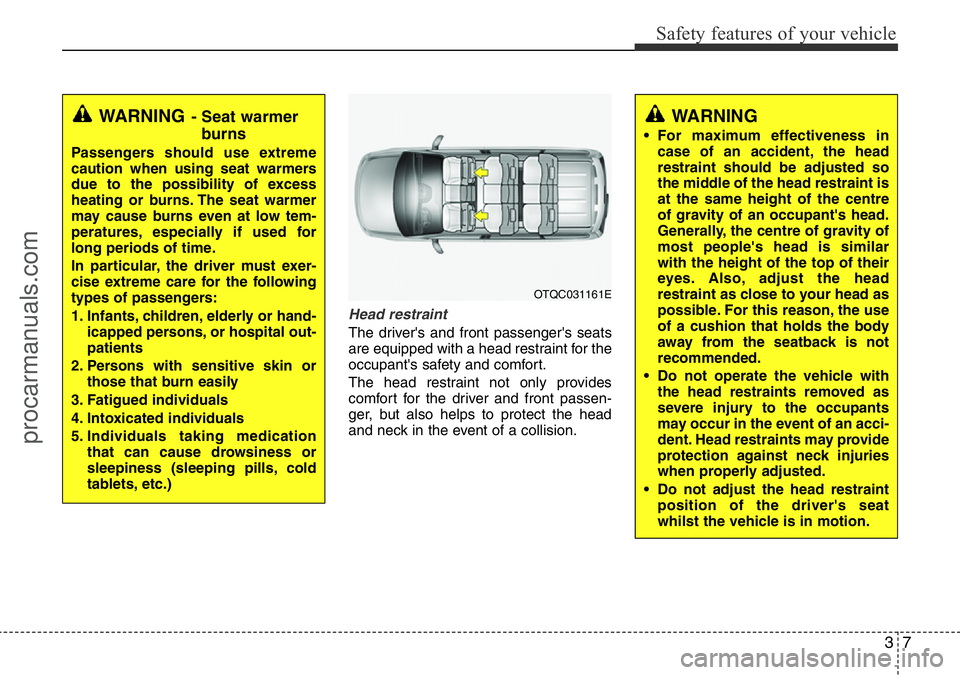
Head restraint
The driver's and front passenger's seats
are equipped with a head restraint for the
occupant's safety and comfort.
The head restraint not only provides
comfort for the driver and front passen-
ger, but also helps to protect the head
and neck in the event of a collision.
WARNING- Seat warmer
burns
Passengers should use extreme
caution when using seat warmers
due to the possibility of excess
heating or burns. The seat warmer
may cause burns even at low tem-
peratures, especially if used for
long periods of time.
In particular, the driver must exer-
cise extreme care for the following
types of passengers:
1. Infants, children, elderly or hand-
icapped persons, or hospital out-
patients
2. Persons with sensitive skin or
those that burn easily
3. Fatigued individuals
4. Intoxicated individuals
5. Individuals taking medication
that can cause drowsiness or
sleepiness (sleeping pills, cold
tablets, etc.)
OTQC031161E
WARNING
• For maximum effectiveness in
case of an accident, the head
restraint should be adjusted so
the middle of the head restraint is
at the same height of the centre
of gravity of an occupant's head.
Generally, the centre of gravity of
most people's head is similar
with the height of the top of their
eyes. Also, adjust the head
restraint as close to your head as
possible. For this reason, the use
of a cushion that holds the body
away from the seatback is not
recommended.
• Do not operate the vehicle with
the head restraints removed as
severe injury to the occupants
may occur in the event of an acci-
dent. Head restraints may provide
protection against neck injuries
when properly adjusted.
• Do not adjust the head restraint
position of the driver's seat
whilst the vehicle is in motion.
procarmanuals.com
Page 23 of 419
Safety features of your vehicle
8 3
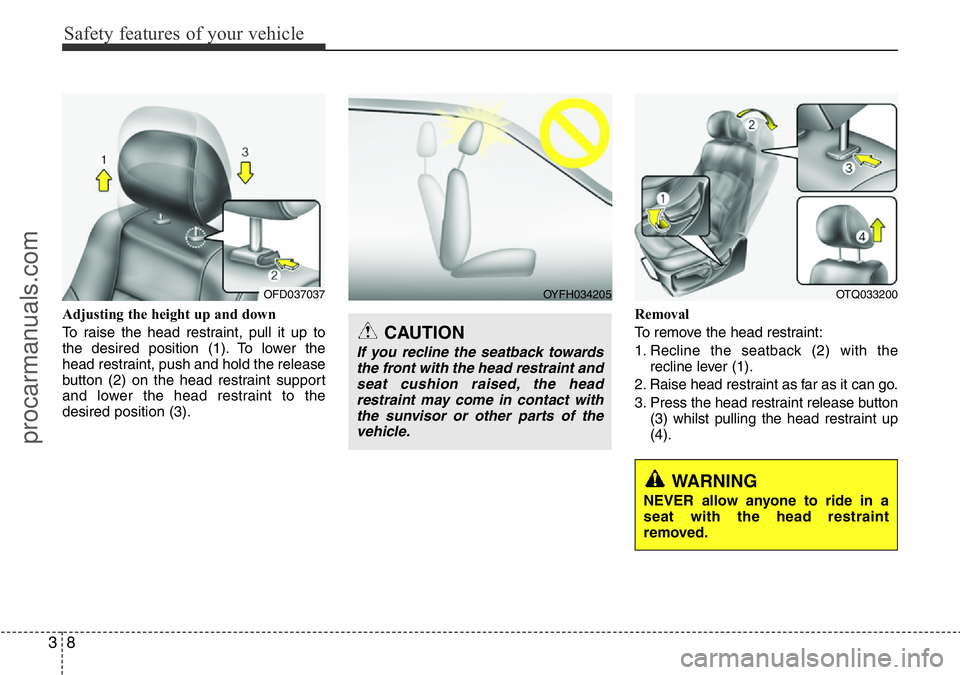
Adjusting the height up and down
To raise the head restraint, pull it up to
the desired position (1). To lower the
head restraint, push and hold the release
button (2) on the head restraint support
and lower the head restraint to the
desired position (3).Removal
To remove the head restraint:
1. Recline the seatback (2) with the
recline lever (1).
2. Raise head restraint as far as it can go.
3. Press the head restraint release button
(3) whilst pulling the head restraint up
(4).
OFD037037OTQ033200
WARNING
NEVER allow anyone to ride in a
seat with the head restraint
removed.
OYFH034205
CAUTION
If you recline the seatback towards
the front with the head restraint and
seat cushion raised, the head
restraint may come in contact with
the sunvisor or other parts of the
vehicle.
procarmanuals.com
Page 24 of 419
39
Safety features of your vehicle
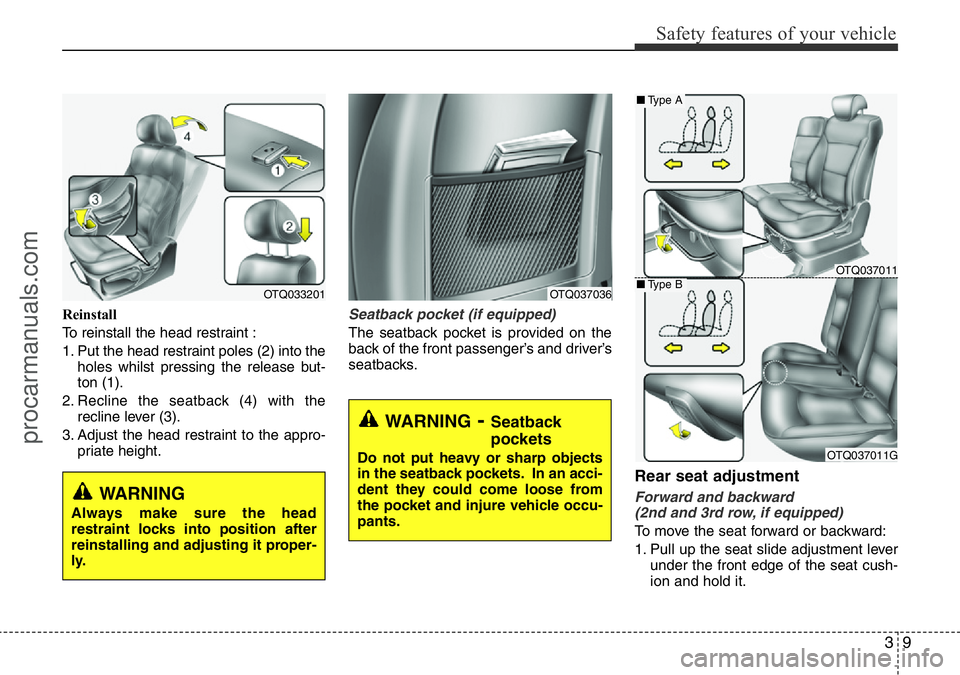
Reinstall
To reinstall the head restraint :
1. Put the head restraint poles (2) into the
holes whilst pressing the release but-
ton (1).
2. Recline the seatback (4) with the
recline lever (3).
3. Adjust the head restraint to the appro-
priate height.Seatback pocket (if equipped)
The seatback pocket is provided on the
back of the front passenger’s and driver’s
seatbacks.
Rear seat adjustment
Forward and backward
(2nd and 3rd row, if equipped)
To move the seat forward or backward:
1. Pull up the seat slide adjustment lever
under the front edge of the seat cush-
ion and hold it.
OTQ033201
WARNING
Always make sure the head
restraint locks into position after
reinstalling and adjusting it proper-
ly.
WARNING- Seatback
pockets
Do not put heavy or sharp objects
in the seatback pockets. In an acci-
dent they could come loose from
the pocket and injure vehicle occu-
pants.
OTQ037036
OTQ037011
OTQ037011G
■Type A
■Type B
procarmanuals.com
Page 26 of 419
311
Safety features of your vehicle
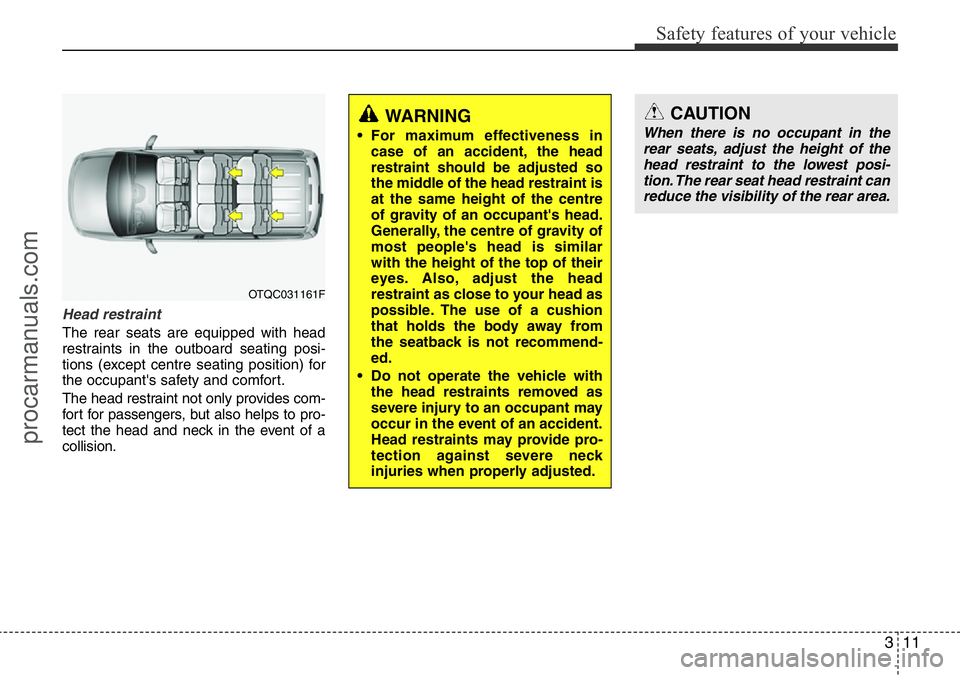
Head restraint
The rear seats are equipped with head
restraints in the outboard seating posi-
tions (except centre seating position) for
the occupant's safety and comfort.
The head restraint not only provides com-
fort for passengers, but also helps to pro-
tect the head and neck in the event of a
collision.
OTQC031161F
WARNING
• For maximum effectiveness in
case of an accident, the head
restraint should be adjusted so
the middle of the head restraint is
at the same height of the centre
of gravity of an occupant's head.
Generally, the centre of gravity of
most people's head is similar
with the height of the top of their
eyes. Also, adjust the head
restraint as close to your head as
possible. The use of a cushion
that holds the body away from
the seatback is not recommend-
ed.
• Do not operate the vehicle with
the head restraints removed as
severe injury to an occupant may
occur in the event of an accident.
Head restraints may provide pro-
tection against severe neck
injuries when properly adjusted.
CAUTION
When there is no occupant in the
rear seats, adjust the height of the
head restraint to the lowest posi-
tion. The rear seat head restraint can
reduce the visibility of the rear area.
procarmanuals.com
Page 27 of 419
Safety features of your vehicle
12 3
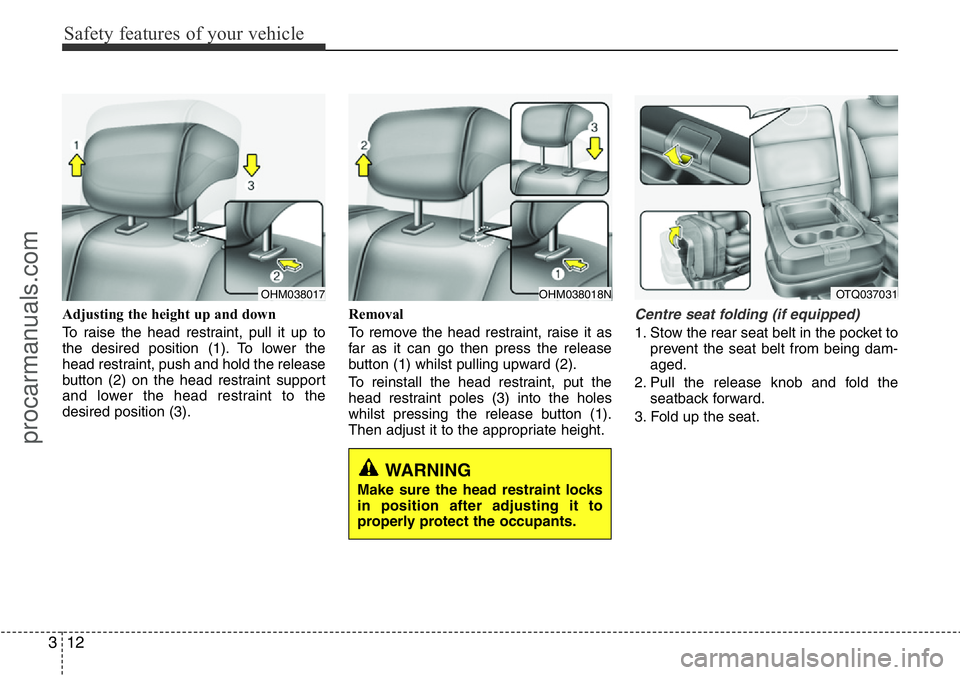
Adjusting the height up and down
To raise the head restraint, pull it up to
the desired position (1). To lower the
head restraint, push and hold the release
button (2) on the head restraint support
and lower the head restraint to the
desired position (3).Removal
To remove the head restraint, raise it as
far as it can go then press the release
button (1) whilst pulling upward (2).
To reinstall the head restraint, put the
head restraint poles (3) into the holes
whilst pressing the release button (1).
Then adjust it to the appropriate height.Centre seat folding (if equipped)
1. Stow the rear seat belt in the pocket to
prevent the seat belt from being dam-
aged.
2. Pull the release knob and fold the
seatback forward.
3. Fold up the seat.
OHM038017OHM038018N
WARNING
Make sure the head restraint locks
in position after adjusting it to
properly protect the occupants.
OTQ037031
procarmanuals.com
Page 30 of 419
315
Safety features of your vehicle
WARNING- Cargo
Cargo should always be secured to
prevent it from being thrown about
the vehicle in a collision and caus-
ing injury to the vehicle occupants.
Do not place objects in the rear
seats, since they cannot be proper-
ly secured and may hit the front
seat occupants in a collision.
WARNING - Cargo loading
Make sure the engine is off, the
automatic transmission is in P
(Park) or the manual transmission
is in R (Reverse) or 1st, and the
parking brake is securely applied
whenever loading or unloading
cargo. Failure to take these steps
may allow the vehicle to move if the
shift lever is inadvertently moved to
another position.
OUN026140
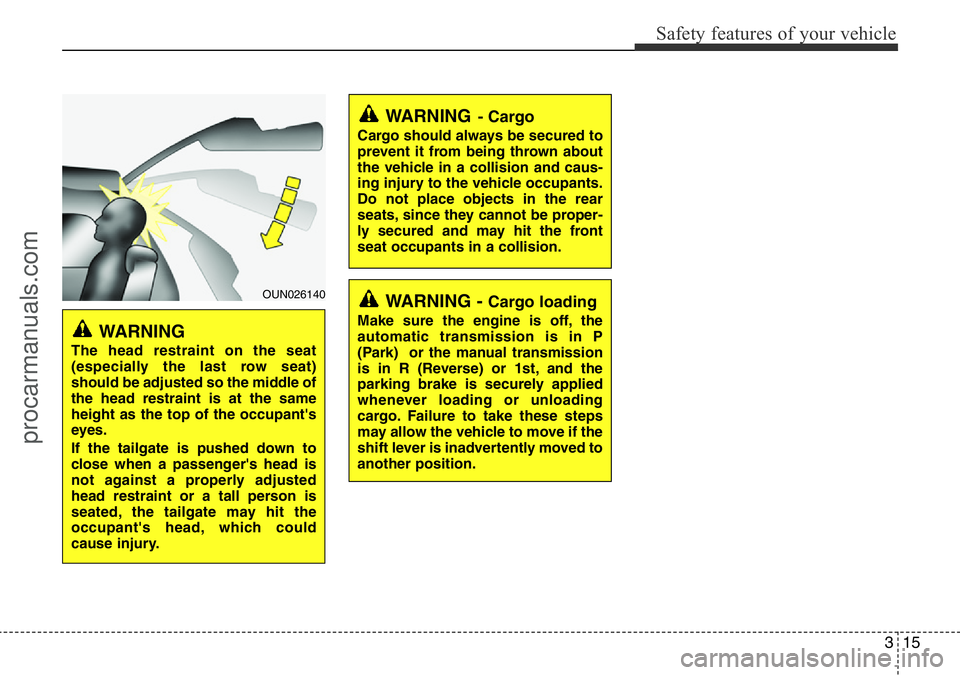
WARNING
The head restraint on the seat
(especially the last row seat)
should be adjusted so the middle of
the head restraint is at the same
height as the top of the occupant's
eyes.
If the tailgate is pushed down to
close when a passenger's head is
not against a properly adjusted
head restraint or a tall person is
seated, the tailgate may hit the
occupant's head, which could
cause injury.
procarmanuals.com
Page 34 of 419
319
Safety features of your vehicle
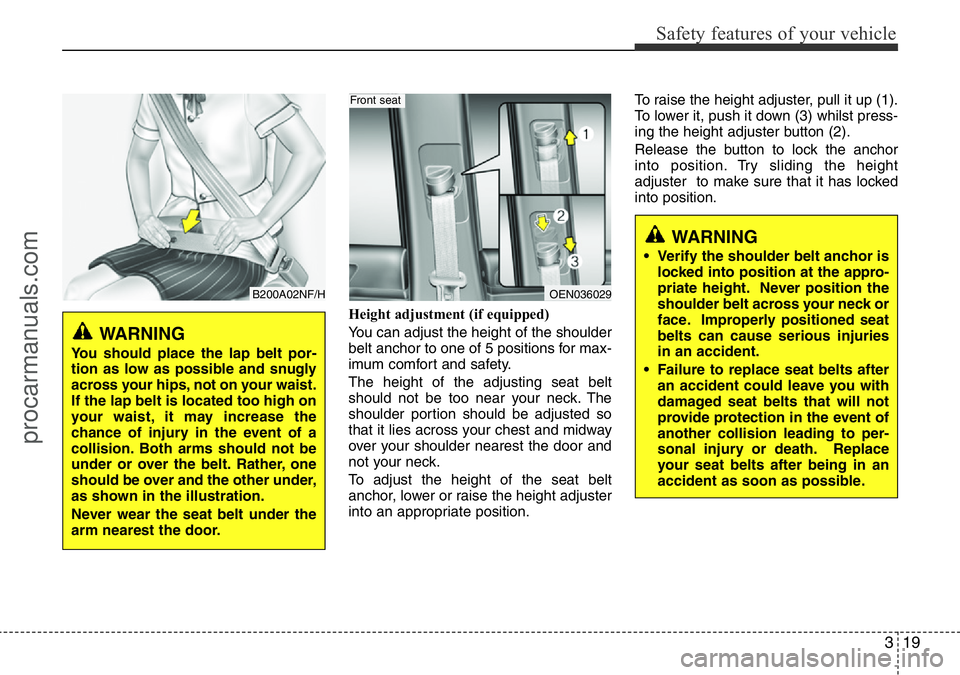
Height adjustment (if equipped)
You can adjust the height of the shoulder
belt anchor to one of 5 positions for max-
imum comfort and safety.
The height of the adjusting seat belt
should not be too near your neck. The
shoulder portion should be adjusted so
that it lies across your chest and midway
over your shoulder nearest the door and
not your neck.
To adjust the height of the seat belt
anchor, lower or raise the height adjuster
into an appropriate position.To raise the height adjuster, pull it up (1).
To lower it, push it down (3) whilst press-
ing the height adjuster button (2).
Release the button to lock the anchor
into position. Try sliding the height
adjuster to make sure that it has locked
into position.
B200A02NF/H
WARNING
You should place the lap belt por-
tion as low as possible and snugly
across your hips, not on your waist.
If the lap belt is located too high on
your waist, it may increase the
chance of injury in the event of a
collision. Both arms should not be
under or over the belt. Rather, one
should be over and the other under,
as shown in the illustration.
Never wear the seat belt under the
arm nearest the door.
WARNING
• Verify the shoulder belt anchor is
locked into position at the appro-
priate height. Never position the
shoulder belt across your neck or
face. Improperly positioned seat
belts can cause serious injuries
in an accident.
• Failure to replace seat belts after
an accident could leave you with
damaged seat belts that will not
provide protection in the event of
another collision leading to per-
sonal injury or death. Replace
your seat belts after being in an
accident as soon as possible.
OEN036029
Front seat
procarmanuals.com
Page 40 of 419
325
Safety features of your vehicle
Seat belt precautionsInfant or small child
You should be aware of the specific
requirements in your country. Child
and/or infant seats must be properly
placed and installed in the rear seat. For
more information about the use of these
restraints, refer to “Child restraint sys-
tem” in this section.
WARNING
All occupants of the vehicle must
wear their seat belts at all times.
Seat belts and child restraints
reduce the risk of serious or fatal
injuries for all occupants in the
event of a collision or sudden stop.
Without a seat belt, occupants
could be shifted too close to a
deploying air bag, strike the interior
structure or be thrown from the
vehicle. Properly worn seat belts
greatly reduce these hazards.
Always follow the precautions
about seat belts, air bags and occu-
pant seating contained in this man-
ual.
WARNING
Every person in your vehicle needs
to be properly restrained at all
times, including infants and chil-
dren. Never hold a child in your
arms or lap when riding in a vehi-
cle. The violent forces created dur-
ing a crash will tear the child from
your arms and throw the child
against the interior. Always use a
child restraint appropriate for your
child's height and weight.
CAUTION
Body work on the front area of the
vehicle may damage the pre-ten-
sioner seat belt system. Therefore,
we recommend that the system be
serviced by a HYUNDAI authorised
repairer.
procarmanuals.com